










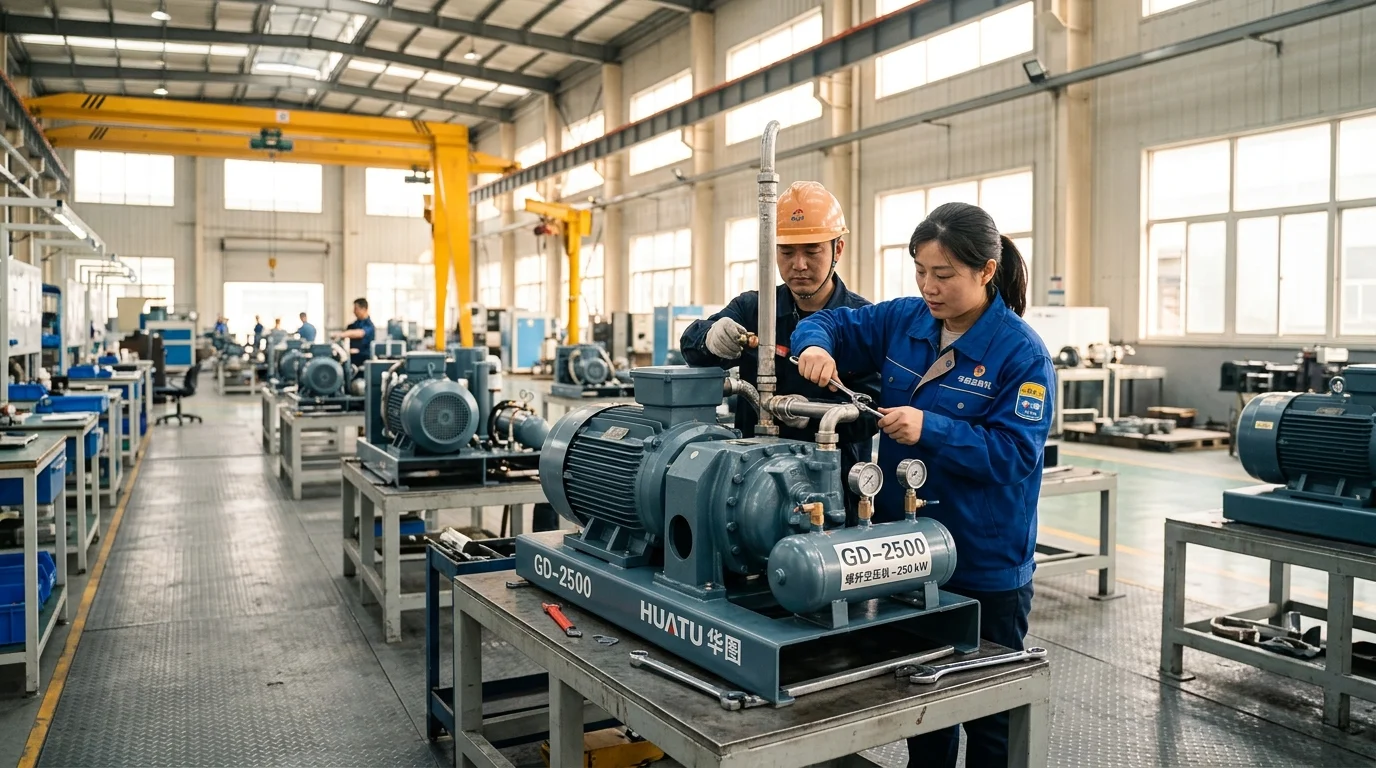
Industrial distributors are under growing pressure to deliver compressed air systems that are not only reliable, but measurably efficient over years of operation. As energy prices rise and regulations tighten, procurement decisions are shifting from lowest purchase price to lowest lifecycle cost. This is where capable Chinese compressor manufacturers are gaining global attention: many now combine advanced PM VSD technology, high-efficiency motors, intelligent controls, and scalable system integration at competitive cost levels. This article examines what distributors should look for when evaluating manufacturers, from SEC benchmarks and airend design to compliance, after-treatment, monitoring, and long-term support.
Why Source from a Chinese Compressor Manufacturer
Global industrial distributors are increasingly turning to a Chinese compressor manufacturer to fulfill the rising demand for reliable, high-performance compressed air systems. Over the past decade, the industrial sector has witnessed a profound paradigm shift. Chinese facilities have transitioned from merely assembling low-cost, entry-level units to engineering technologically advanced systems equipped with proprietary airends, intelligent controllers, and IoT-enabled monitoring. This evolution is driven by massive investments in R&D and the adoption of Industry 4.0 manufacturing standards. For global distributors, establishing a strategic partnership with a capable Chinese manufacturer offers a distinct competitive advantage. It allows them to combine competitive pricing structures with rigorous engineering standards, effectively disrupting established market hierarchies dominated by legacy Western brands.
Market Demand for Energy-Efficient Compressors
The transition toward sustainable manufacturing and stringent environmental regulations has fundamentally altered procurement priorities across the globe. Industrial end-users now prioritize operational expenditure (OPEX) over initial capital expenditure (CAPEX). This shift is driven by the fact that electricity consumption typically accounts for approximately 75% to 80% of a compressor's total lifecycle cost over a standard 10-year operational period. Consequently, the global market has seen exponential demand for energy-efficient solutions, specifically Permanent Magnet Variable Speed Drive (PM VSD) screw compressors. Leading Chinese manufacturers have responded to this trend by integrating IE4 and even IE5 ultra-premium efficiency motors into their flagship models. Distributors aiming to capture this lucrative market segment must source from manufacturers capable of delivering verifiable energy savings that comply with international mandates, such as the European Ecodesign Directive and the US Department of Energy (DOE) compressor efficiency standards.
Key Definitions for Compressor Efficiency
Evaluating a Chinese compressor manufacturer requires a firm grasp of standardized efficiency metrics to cut through marketing rhetoric. The primary benchmark utilized by industry experts is Specific Energy Consumption (SEC), which measures the exact electrical power required to deliver a specific volume of compressed air. This is typically expressed in kW/(m³/min) or kW/(100 cfm). For example, a highly efficient 37kW (50 HP) PM VSD compressor should demonstrate an SEC between 5.8 and 6.2 kW/(m³/min) when operating at a discharge pressure of 8 bar. Additionally, distributors must critically evaluate the isentropic efficiency of the airend itself. This metric compares the actual thermodynamic compression process against an idealized, perfectly insulated process. Procuring equipment featuring optimized asymmetric rotor profiles, precision-ground clearances, and reduced internal blow-by leakage ensures that the SEC remains consistently low throughout the unit's entire operational lifespan.
Technical Specifications to Compare

To effectively benchmark a Chinese compressor manufacturer against established European or North American brands, distributors must conduct a rigorous, data-driven technical analysis. Superficial comparisons of motor horsepower, physical footprint, or basic marketing brochures are insufficient for expert procurement. Instead, a granular examination of thermodynamic performance metrics, operational limits, mechanical design tolerances, and certified testing methodologies is required to validate the manufacturer's true engineering capabilities.
Performance Metrics for Screw Compressors
When sourcing rotary screw compressors, Free Air Delivery (FAD) is the definitive measure of output capacity and volumetric efficiency. FAD must be measured precisely at the compressor discharge valve under specific ambient conditions, ensuring the volume cited represents actual, usable air delivered to the plant network. A verified Chinese compressor manufacturer will provide comprehensive FAD performance curves across the entire operational RPM range of their VSD units, rather than just a single data point at maximum speed. Furthermore, acoustic performance is a critical metric for modern factory environments; standard 55kW (75 HP) enclosed screw compressors should operate within a noise threshold of 68 to 72 dB(A). Evaluating the thermal management system is equally essential for assessing long-term reliability. The approach temperature of the air/oil cooler—which measures the difference between the compressed air discharge temperature and the ambient cooling air—should ideally be less than 8°C. This ensures the unit will not suffer from high-temperature shutdowns during peak summer operations.
Pressure Range and Flow Rate Comparison
Distributors must meticulously map the manufacturer's technological portfolio against their target market requirements, particularly regarding operating pressure profiles and volumetric flow demands. Standard single-stage screw compressors typically operate efficiently between 7 and 13 bar, delivering sufficient flow for general pneumatic applications, CNC machining, and automated assembly lines. However, for high-demand industrial environments requiring elevated flow rates coupled with drastically reduced energy consumption, two-stage compression technology is vastly superior. Two-stage units utilize interstage cooling to reduce the compression ratio per stage, minimizing thermal losses and improving volumetric efficiency.
| Compressor Architecture | Typical Pressure Range | Efficiency Gain vs Standard | Optimal Flow Rate Range | Primary Application Suitability |
|---|---|---|---|---|
| Single-Stage Screw | 7 to 13 bar | Baseline (Standard) | 1.2 to 40 m³/min | General manufacturing, automotive, light industrial |
| Two-Stage Screw | 8 to 10 bar | +12% to +15% | 10.0 to 65 m³/min | Heavy industry, steel processing, continuous high-demand |
| Low-Pressure Screw | 3 to 5 bar | Application specific | 5.0 to 30 m³/min | Textiles, glass blowing, pneumatic conveying |
How to Assess Efficiency Claims
Claims of superior SEC and maximum FAD must be validated through standardized, internationally recognized testing protocols. Distributors should explicitly require performance data that is certified under ISO 1217 Annex C (for fixed-speed compressors) and Annex E (for variable-speed compressors). Reputable Chinese manufacturers utilize climate-controlled testing laboratories equipped with high-precision mass flow meters and digital power analyzers to generate these reports. ISO 1217 dictates strict tolerances, typically allowing a maximum specific power deviation of +/- 5% for standard industrial units. If a supplier provides theoretical efficiency calculations rather than empirical data derived from ISO 1217 compliant testing, it serves as a significant red flag. Expert buyers often stipulate Factory Acceptance Testing (FAT) for initial pilot units, physically verifying power draw, vibration levels, and flow rates prior to authorizing mass production.
How to Qualify a Manufacturer
Identifying a technologically capable Chinese compressor manufacturer on paper is only the preliminary phase of the strategic sourcing process. Distributors must implement rigorous, on-the-ground qualification frameworks to ensure the selected supplier possesses the operational maturity to consistently deliver high-quality units at a global scale. A comprehensive due diligence audit encompassing facility capabilities, strict regulatory compliance, and deep supply chain transparency is essential.
Factory Audit Criteria
A physical or highly detailed third-party virtual factory audit is the only reliable method to separate genuine, vertically integrated manufacturers from mere trading companies or low-tier assemblers. The audit must critically evaluate the machining precision of the core components. For instance, the in-house manufacturing of rotary screw airends requires advanced multi-axis CNC grinding centers capable of consistently achieving rotor profile tolerances of 5 to 10 microns. Furthermore, the audit should assess the assembly line's integration of systematic quality control checkpoints. This includes the dynamic balancing of male and female rotors, high-pressure helium leak testing of fluid and air circuits, and automated 4-hour run-in testing protocols for every completed unit. A robust, export-ready manufacturer will demonstrate a First-Pass Yield (FPY) exceeding 98% and an overall field defect rate maintained below 0.5%.
Certifications and Compliance Requirements
Global distributors operate within highly regulated technical environments, making compliance a critical qualification criterion. At a minimum baseline, the manufacturing facility must hold active, verifiable ISO 9001 (Quality Management) and ISO 14001 (Environmental Management) certifications. Depending on the ultimate destination market, the compressors themselves must bear specific, legally mandated regulatory markings. For the European market, CE marking fully compliant with the Machinery Directive (2006/42/EC), the Electromagnetic Compatibility Directive (2014/30/EU), and the Pressure Equipment Directive (2014/68/EU) is mandatory. For North American distribution, UL and CSA certifications for electrical control panels, alongside ASME Section VIII Division 1 certification for pressure vessels, are strict legal requirements. Because certificate fraud and "paper compliance" can occur in overseas manufacturing, due diligence requires more than just contacting the issuing body. Distributors must cross-reference the manufacturer's registered legal name against official notified body databases and request the original, full-length laboratory test reports to prevent customs rejections.
OEM Manufacturing Verification
A world-class Chinese compressor manufacturer operates with complete transparency regarding its Bill of Materials (BOM). The long-term reliability of an industrial compressor relies on the provenance and quality of its sub-components. Distributors must verify the OEM supply chain for all critical parts. Premium manufacturers will utilize globally recognized bearings engineered for 50,000 to 100,000 hours of L10 design life, heavy-duty electrical contactors, and advanced VFD controllers from leading international or domestic brands. While component substitution is often contractually permitted under standard "equivalent part" clauses, distributors should negotiate strict BOM lock provisions. This ensures the factory cannot substitute premium components with unverified alternatives during subsequent mass production runs without explicit written approval.
Cost, Logistics, and Support
Achieving financial viability in global sourcing extends far beyond negotiating the lowest EXW (Ex Works) or FOB (Free On Board) unit price. Experienced distributors must calculate the total landed cost while successfully navigating complex international logistics, supply chain fragility, and geopolitical risks. Furthermore, they must guarantee that the manufacturer possesses the infrastructure to support the equipment throughout its operational lifecycle.
Landed Cost Factors
The true landed cost of industrial compressors encompasses ocean freight, marine insurance, complex customs duties, and localized port handling fees. Recent years have highlighted the impact of port congestion patterns and global disruptions, prompting many distributors to weigh "China plus one" strategies alongside their primary sourcing to mitigate geographic risk. Because air compressors are heavy, high-density cargo, freight optimization within shipping containers is crucial for maintaining margins. A standard 40-foot High Cube (40HQ) container can typically accommodate 18 to 24 units of 37kW (50 HP) compressors, depending on the manufacturer's packaging dimensions and the use of stackable export pallets. Distributors importing into the United States must acutely account for Section 301 tariffs, which currently impose an additional 25% duty on Chinese-manufactured compressors classified under specific Harmonized System (HS) codes (e.g., 8414.80). Factoring these duties, alongside fluctuating ocean freight rates, is essential for maintaining accurate domestic pricing models.
Lead Times, MOQs, and Incoterms
Negotiating favorable commercial terms requires a delicate balance between the distributor's inventory management needs and the manufacturer's production constraints. Capable Chinese manufacturers typically quote production lead times of 25 to 45 days for standard catalog models. This timeline frequently extends to 60 or even 75 days for customized OEM configurations, specialized voltage requirements (e.g., 460V/60Hz for North America), or specialized offshore paint coatings. Minimum Order Quantities (MOQs) also vary significantly; while standard units may have an MOQ of just 1 to 3 units for initial testing, requiring private labeling or custom canopy colors usually necessitates a firm commitment of at least one Full Container Load (FCL). Utilizing FCA (Free Carrier) or FOB Incoterms is the standard best practice, granting the distributor total control over the primary freight forwarder, routing choices, and ocean transit costs.
After-Sales Service Capabilities
The ultimate test of a Chinese compressor manufacturer is the depth and responsiveness of its after-sales support infrastructure. Industrial end-users expect immediate resolution of costly downtime events. Distributors must ensure the manufacturer provides comprehensive, native-level English technical documentation, including interactive digital parts catalogs, electrical schematics, and detailed troubleshooting matrices. Warranty terms are a critical negotiation point; a standard, globally competitive baseline offers a 12-month warranty on the complete package and an extended 24-month or 5-year warranty on the airend itself. Furthermore, the supplier must legally guarantee the availability of proprietary spare parts—such as specialized air intake filters, spin-on oil separators, thermostatic valves, and minimum pressure valve service kits—for a minimum of 10 years post-production. This guarantees the distributor can establish lucrative, recurring revenue streams through preventative maintenance contracts.
Decision Framework for Distributors
Successfully integrating a Chinese compressor manufacturer into a global supply chain requires a highly structured, analytical approach. Distributors must move beyond anecdotal industry recommendations and employ rigorous, data-driven frameworks to mitigate supply chain risk, ensure technical and regulatory compliance, and secure sustainable profitability in a competitive market.
Step-by-Step Sourcing Process
The optimal sourcing process follows a phased escalation strategy designed to systematically eliminate unqualified suppliers. It begins with a detailed Request for Information (RFI) to filter candidates based on overall production capacity, financial stability, and baseline regulatory compliance. This is immediately followed by a Request for Quotation (RFQ) utilizing highly standardized technical specifications to ensure accurate, apples-to-apples pricing comparisons. Once a primary candidate is identified, the distributor must procure a pilot unit for exhaustive, localized field testing. This critical testing phase—often spanning 500 to 1,000 operational hours—evaluates thermal stability under peak loads, verifies the actual SEC, and tests the controller's reliability under real-world grid fluctuations. Only upon the successful, documented completion of this pilot phase should the distributor proceed to negotiate a formal Master Supply Agreement (MSA), execute Non-Disclosure and Non-Compete (NNN) agreements, and place initial container-volume orders.
Decision Matrix for Supplier Selection
To objectively compare multiple shortlisted suppliers, procurement teams should utilize a weighted decision matrix. This analytical tool quantifies qualitative observations from factory audits and pilot tests, effectively removing emotional bias and purely price-driven decision-making from the selection process. By assigning specific weights to different operational categories, distributors can identify the manufacturer that offers the best holistic value proposition.
| Evaluation Criteria | Weighting (%) | Key Indicators for Maximum Score | Warning Signs (Red Flags) |
|---|---|---|---|
| Technical Performance | 25% | ISO 1217 certified data, exceptional SEC, premium airend design | Theoretical data, high approach temperatures |
| Quality Assurance & QA | 20% | ISO 9001/14001, < 0.5% defect rate, automated testing labs | Failure to track first-pass yield, poor machining tolerances |
| Total Landed Cost | 20% | Competitive FOB pricing, optimized container loading | Hidden packaging fees, inflexible payment terms |
| Regulatory Compliance | 15% | Verified CE/UL/ASME certifications, correct HS code usage | Forged certificates, ignorance of local directives |
| Geographic/Logistics Risk | 10% | Proximity to major export ports, diversified routing options | Over-reliance on single shipping lanes, high tariff exposure |
| After-Sales Support | 10% | 24+ month airend warranty, rapid spare parts dispatch | No English manuals, slow technical response times |
Balancing Price, Quality, and Risk
Ultimately, selecting a Chinese compressor manufacturer is a complex exercise in balancing price competitiveness against long-term operational risk. While excessively low pricing can artificially inflate short-term profit margins, excessive cost-cutting at the factory level inevitably manifests as premature component failure, elevated warranty claim rates, and severe reputational damage to the distributor's brand. Distributors must prioritize manufacturers that view the relationship through actionable collaboration rather than purely transactional export operations. By emphasizing engineering transparency, demanding verifiable efficiency metrics, and establishing joint inventory planning and quarterly engineering reviews, distributors can secure a highly resilient supply chain. This approach guarantees not only immediate profitability but also sustainable, long-term market growth and customer loyalty.
Key Takeaways
- Compare compressors by lifecycle energy cost because electricity typically accounts for 75% to 80% of total ownership cost over 10 years.
- Prioritize PM VSD screw compressors with IE4 or IE5 motors when targeting industrial customers focused on verifiable energy savings.
- Use Specific Energy Consumption, not horsepower alone, to benchmark compressor efficiency across Chinese, European, and North American brands.
- For a 37kW PM VSD compressor at 8 bar, look for SEC performance around 5.8 to 6.2 kW/(m³/min).
- Evaluate airend quality by reviewing rotor profile, machining precision, internal leakage control, and isentropic efficiency data.
- Choose manufacturers that can support complete compressed air systems, including dryers, piping, heat recovery, and remote monitoring.
Frequently Asked Questions
Why are distributors sourcing compressors from China?
Chinese manufacturers now offer competitive pricing, advanced engineering, proprietary airends, intelligent controls, and IoT-enabled monitoring, helping distributors meet global demand for efficient compressed air systems.
What makes PM VSD screw compressors attractive to industrial buyers?
PM VSD screw compressors reduce energy waste by matching output to demand. Since electricity can represent 75% to 80% of lifecycle cost, efficiency directly improves long-term ROI.
Which efficiency metrics should distributors compare?
Distributors should review Specific Energy Consumption, isentropic efficiency, airend design, operating pressure, and certified test data rather than relying only on motor power or brochure claims.
What SEC range indicates strong efficiency for a 37kW compressor?
A highly efficient 37kW or 50 HP PM VSD compressor should typically show about 5.8 to 6.2 kW/(m³/min) at 8 bar discharge pressure.
How does Deman support global compressed air projects?
Deman, founded in China in 1998, provides one-stop compressed air solutions including PM VSD compressors, oil-free blowers, dryers, vacuum pumps, piping, heat recovery, and remote monitoring.