- Precision manufacturing in 2026 is more sensitive to oil, moisture, and particle contamination than ever before.
- The best oil-free compressed air system is not a single machine; it is a matched system of generation, treatment, control, and distribution.
- Stable pressure and verified air quality can reduce scrap, protect tooling, and support repeatable process capability.
- System design should follow the application, not the compressor catalog.
- Real value comes from lower rework risk, better uptime, and measurable energy efficiency.
For precision manufacturing, an oil-free compressed air system is increasingly tied to product quality, not just plant hygiene. ISO 8573-1 classifies compressed air by particles, water, and oil, and even Class 1 oil limits total oil to 0.01 mg/m3, a level that illustrates how small contamination thresholds can become in high-value production. In a factory where pneumatic clamps, blow-off stations, coating lines, and instrument air all share the same network, a single unstable zone can create defects downstream. That is why a modern system must be designed around air quality, stable pressure, and verified performance, with support from solutions such as screw air compressors, oil-free blower systems, and after-treatment equipment.
Why an oil-free compressed air system matters more in precision manufacturing in 2026
The core reason is simple: precision manufacturing now loses more money from invisible contamination than from obvious machine downtime.
Electronics, automotive components, medical devices, high-end textiles, and engineered plastics all depend on repeatability. A tiny oil mist can alter adhesion, affect coating uniformity, or leave residues on parts that later fail inspection. A small dew point deviation can cause condensation in lines and fixtures. A pressure fluctuation can change the force applied by pneumatic actuators, shifting part positioning just enough to create dimensional scatter.
In 2026, this matters more because production lines are more automated, more distributed, and more data-driven. Machines run faster, alarms travel farther, and quality expectations are stricter. When the compressed air system drifts, the problem is not isolated. It propagates across clamp force, blowing performance, instrument stability, and inspection consistency.
The practical answer is not simply “buy oil-free.” It is to engineer the compressed air system so that pressure, flow, and air quality stay inside the real process window. That is where system thinking becomes essential.
What precision manufacturing actually needs from compressed air
Precision manufacturing needs compressed air that is stable, clean, and predictable under changing load conditions.
The three operating variables are pressure, flow, and air quality. Pressure affects actuator force and tooling consistency. Flow determines whether multiple stations can run simultaneously without sag. Air quality determines whether contamination reaches the product, the tooling, or the control system.
ISO 8573-1 is the most practical reference point for air quality class selection. It separates contaminants into particles, water, and oil. For high-sensitivity processes, the relevant question is not whether the compressor is “efficient,” but whether the entire air train can maintain the required class at the point of use.
That is also why site planning matters. A correctly sized compressor with poor piping, excess pressure drop, or inadequate drying can still fail the application. A system approach is required.
| Requirement | Why it matters | Typical risk if uncontrolled |
|---|---|---|
| Pressure stability | Supports repeatable actuator force and blow-off performance | Dimensional drift, clamp inconsistency, cycle instability |
| Flow capacity | Keeps multiple stations supplied during peak demand | Pressure sag, slow cycle times, downtime |
| Oil content | Protects product surfaces and downstream equipment | Residue, coating defects, valve fouling |
| Dew point | Reduces condensation in lines and fixtures | Corrosion, water marks, sensor failures |
How ISO and NIST guidance shape oil-free compressed air design
Standards give manufacturers a common language for air quality and measurement.
ISO 8573-1 defines purity classes, while ISO 7183 covers desiccant dryers and their performance testing framework. In practical terms, these standards help engineers specify what “clean air” actually means instead of relying on vague vendor claims. For contamination control, that matters more than brand language.
NIST also plays an important role through metrology and measurement traceability. When a plant verifies pressure, flow, and dew point instruments, calibration traceability is what turns a maintenance reading into a defensible quality record. Without that, compressed air data may look precise but not be reliable enough for process decisions.
For readers who want to cross-check the standard itself, see ISO 8573-1 compressed air purity classes, ISO 7183 air dryers, and NIST measurement and standards resources.
A useful rule in precision plants is this: if the product spec is tight, the air spec should be explicit. If the line uses pneumatic motion, the air quality class should be written into the process document, not left to maintenance preference.
Where oil-free compressed air systems reduce risk the most
The highest value appears where contamination can become scrap, warranty claims, or hidden downtime.
In textile production, oil, water, and dust can create fabric defects, staining, or surface inconsistency. In plastics and automotive components, oil contamination can affect molding vents, assemblies, and finishing. In electronics and precision assembly, residue can interfere with bonding, cleaning, and inspection. In instrument air systems, contamination can compromise valve response and process stability.
That is why the most successful projects do not start with a compressor spec sheet. They start with the end-use risk map: what fails, how it fails, and what the failure costs. From there, the correct solution may be an oil-free compressor, a dryer upgrade, better distribution piping, or a control strategy that stabilizes the entire station.
| Industry | Main air quality concern | Operational impact | Common system response |
|---|---|---|---|
| Textiles | Oil and moisture | Fabric defects and cleaning burden | Oil-free generation plus drying and filtration |
| Automotive parts | Pressure fluctuation | Clamp variation and tooling inconsistency | Stable pressure control and load balancing |
| Plastics | Residue and condensation | Surface defects and process interruptions | High-quality after-treatment and monitoring |
| Electronics | Particles and oil aerosol | Bonding and inspection failures | Cleaner air network and point-of-use protection |
Oil-free compressed air system versus conventional systems
The difference is not only in the compressor chamber; it is in lifecycle risk.
An oil-lubricated system can be appropriate for many industrial uses, but in contamination-sensitive manufacturing, the internal oil path creates an added purification burden. That burden is not free. It shows up as filter change frequency, condensate handling, audit complexity, and the possibility of oil carryover if maintenance slips.
An oil-free compressed air system removes that specific contamination pathway at the source. However, it does not eliminate the need for drying, filtration, or maintenance. Oil-free air still contains water and particles if the system is poorly designed. In other words, oil-free is necessary in many precision environments, but not sufficient by itself.
| Aspect | Oil-lubricated system | Oil-free compressed air system |
|---|---|---|
| Oil carryover risk | Higher by design | Much lower at generation stage |
| Downstream treatment need | More intensive | Still required, but easier to control |
| Best-fit applications | General industry, non-sensitive pneumatic use | Precision, clean, and contamination-sensitive processes |
| Quality assurance burden | Higher | Lower when properly engineered |
For many plants, the decision is less about ideology and more about risk transfer. If product contamination is costly, the system should shift risk away from the process and into predictable utilities management.
Why pressure stability is becoming as important as air purity
Pressure stability now affects quality as much as contamination control in many precision applications.
Modern automated lines often use pneumatic grippers, clamps, ejectors, air knives, and actuators that depend on consistent supply. If pressure swings, actuation force changes. If force changes, cycle consistency changes. That can lead to part misplacement, incomplete sealing, unstable blow-off, or uneven finishing.
This is where intelligent control becomes valuable. A multi-compressor control platform can distribute load more evenly, cut unnecessary idling, and keep the whole station closer to the target range. In Deman’s solution set, this role is handled by intelligent control systems and Air Commander-style multi-machine coordination, which are designed to improve plant-wide efficiency rather than just individual machine output.
The most important idea is that pressure should match demand, not guesswork. Constant overpressure wastes energy, while underpressure creates quality risk. Stable, demand-based control is often the most practical path to both efficiency and process consistency.
Quantitative factors that matter when selecting an oil-free compressed air system
Selection should be based on measurable process parameters, not brochure language.
For precision manufacturing, three numbers usually drive the decision: required pressure, peak and average flow, and target air quality class. A common industrial pressure range is 0.6 to 0.8 MPa, but the real target should be the minimum pressure that reliably supports the process. Running higher than necessary raises energy use and can magnify leakage losses.
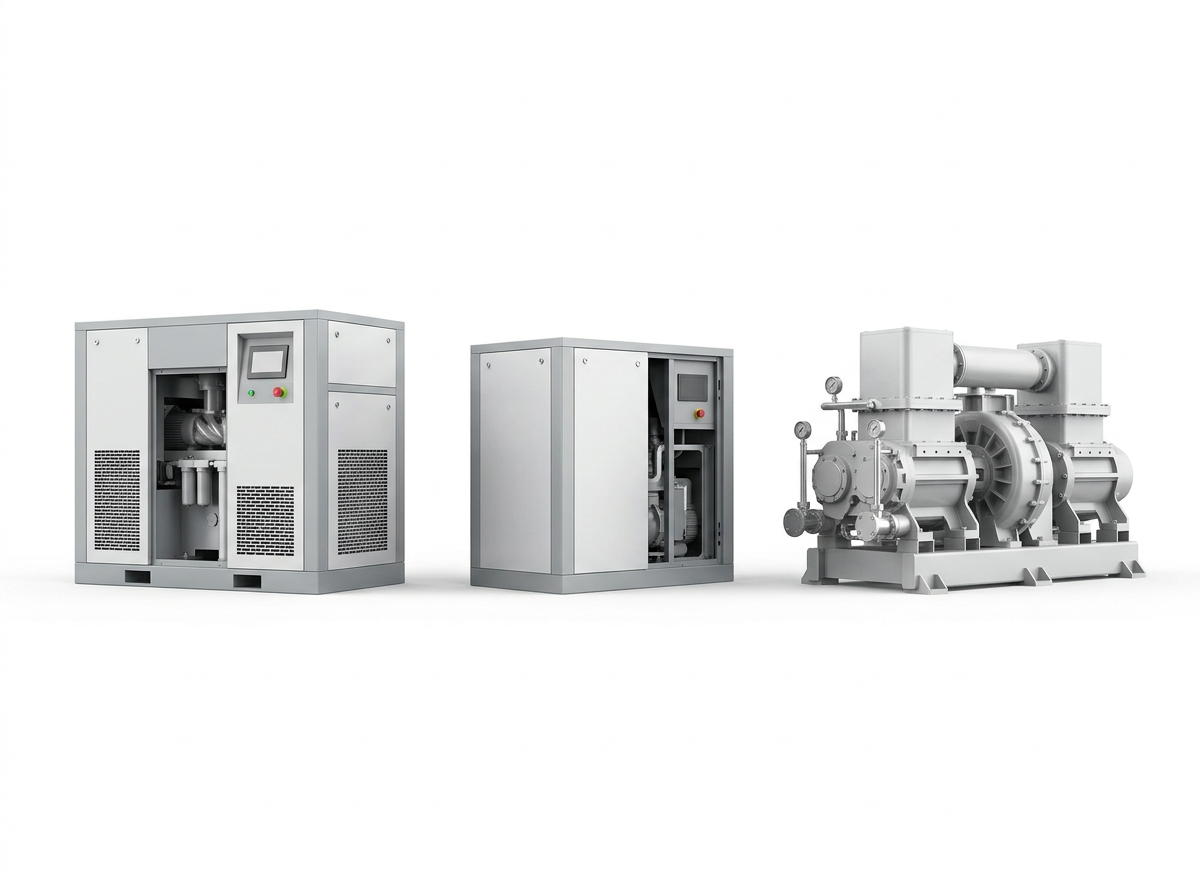

In practical terms, the best system is often one that avoids oversizing. Oversizing may look safe at purchase time, but it usually causes poor load factor, more cycling, and higher lifetime cost.
| Selection variable | Why it matters | Typical design target |
|---|---|---|
| Operating pressure | Affects energy use and actuator force | Only as high as required by the process |
| Peak flow | Prevents pressure sag during simultaneous use | Matched to peak demand with margin |
| Air quality class | Controls contamination risk | Defined by process spec and ISO 8573-1 |
| Pressure drop | Indicates system losses | Kept as low as practical through layout and piping |
System architecture: why the compressor alone is not the answer
The compressor is only one part of the compressed air chain.
A complete oil-free compressed air system usually includes generation, drying, filtration, storage, monitoring, and distribution. If any one of those is undersized, the whole system suffers. A high-quality compressor feeding poor piping can still create unstable pressure at the point of use. A good dryer with bad condensate management can still allow moisture-related problems. A smart controller without leak management can still waste energy.
This is why site planning comes first. The plant should identify which tools, lines, and quality-critical points use air; what pressure each one needs; and how much demand changes across shifts. Only then should the equipment be configured.
For many customers, this systems-first approach is more valuable than single-machine optimization because it reduces hidden losses across the whole compressed air network.
How oil-free compressed air supports energy efficiency in 2026
Oil-free does not automatically mean low energy, but modern oil-free systems can support more efficient plants when paired with the right controls.
Variable speed control, demand matching, and multi-machine scheduling reduce wasted unloaded running. Intelligent sequencing also helps avoid one machine carrying a disproportionate share of the load. In large or distributed plants, that can matter as much as the compressor technology itself.
Heat recovery adds another layer of value. Much of the electrical energy used by a compressor becomes heat, and recovering that heat can support hot water or space heating applications. According to the U.S. Department of Energy, waste heat recovery is one of the established ways to improve compressed air system economics. In the right plant, it can improve total energy utilization without affecting process air quality.
That is why a 2026 purchasing decision should ask a broader question: can the air system lower utility cost while protecting product quality? If the answer is yes, the system is doing real industrial work.
Common mistakes manufacturers make when specifying oil-free air
The biggest mistake is treating oil-free as a product feature rather than a process requirement.
- Choosing a compressor before defining the air quality class at point of use.
- Ignoring pressure drop in piping and filters.
- Underestimating peak flow and simultaneous demand.
- Assuming oil-free generation removes the need for drying and filtration.
- Skipping monitoring, calibration, and maintenance documentation.
A second common mistake is focusing only on purchase price. In precision manufacturing, a lower-capex system can be more expensive if it increases scrap, rework, or unplanned downtime. The better metric is lifecycle cost, including energy, maintenance, and quality losses.
A third mistake is forgetting that compressed air is an infrastructure system. It should be engineered like one.
How to evaluate an oil-free compressed air system before buying
The best buying process starts with the process itself.
- Map every air-using station and classify it by quality sensitivity.
- Define minimum pressure, peak flow, and allowable pressure fluctuation.
- Specify contamination limits using ISO 8573-1 where applicable.
- Review dryer type, filtration grade, and condensate handling.
- Check monitoring capability for pressure, dew point, and fault alerts.
- Estimate lifecycle cost, not only equipment price.
If the plant runs multiple compressors, centralized control can improve load sharing and reduce inefficiency. For example, a system built around smart sequencing and remote diagnostics can reduce unnecessary interventions and help maintenance teams respond before a small issue becomes a quality event. In Deman’s ecosystem, that is the role of remote monitoring and energy recovery systems.
What a future-ready oil-free compressed air system looks like
The future-ready system is measurable, connected, and application-specific.
It uses oil-free generation where contamination risk justifies it. It verifies air quality at the right point. It holds pressure within a narrow band. It reduces pressure losses through better piping design. It uses monitoring to catch abnormal behavior early. And it treats energy recovery and load control as part of the original design, not as afterthoughts.
That is also why more industrial buyers now expect solution partners, not just hardware suppliers. They want someone who can connect the dots between production demand, maintenance workload, energy cost, and quality risk. In this context, a system provider such as Demanac is evaluated less by single-product claims and more by whether the final installation supports the plant’s total operating goals.
For precision manufacturing in 2026, the winning air strategy is not simply “oil-free.” It is “oil-free, stable, verified, and designed around the process.”
FAQ about oil-free compressed air system in precision manufacturing
1. What is an oil-free compressed air system?
An oil-free compressed air system is a compressed air setup designed to eliminate oil contamination at the generation stage, reducing the risk of oil carryover into sensitive processes.
2. Why is oil-free air important for precision manufacturing?
It reduces contamination risk that can affect coating, bonding, cleaning, inspection, pneumatic actuation, and surface quality.
3. Is oil-free air enough for clean production?
No. Oil-free generation still needs drying, filtration, pressure control, and distribution design to protect process quality.
4. What standard should I use to specify air quality?
ISO 8573-1 is the most common reference for compressed air purity classes, covering particles, water, and oil.
5. How does pressure stability affect product quality?
Unstable pressure changes actuator force and process consistency, which can lead to defect variation and scrap.
6. Does oil-free air always cost more?
Initial cost can be higher, but total cost may be lower when scrap reduction, uptime, and maintenance savings are included.
7. What should I check before upgrading to oil-free air?
Check process sensitivity, point-of-use pressure, peak flow, allowable pressure drop, air quality class, and monitoring needs.