
When Does a Variable Frequency Air Compressor Help Packaging Lines?
A variable frequency air compressor helps a packaging line when compressed air demand changes materially during shifts, between products, or across operating stages. By adjusting motor speed within its approved range, a variable speed drive can reduce unnecessary unloaded running while supporting steadier pressure. It is most valuable when the system is correctly sized, monitored, and matched with storage, drying, filtration, and controls.
- A variable frequency compressor for packaging is usually worth evaluating when demand fluctuates rather than remaining constant.
- Motor-speed control can reduce inefficient unloaded operation, but a VFD is not a substitute for leak repair, correct sizing, or proper controls.
- Packaging air quality depends on the complete system, including the compressor, dryer, filters, receiver, piping, and point-of-use equipment.
- Operating below the compressor's approved speed range can create reliability risks; one industry source advises avoiding consistent operation below 20% on applicable VSD systems.
Packaging lines often combine intermittent actuators, pneumatic valves, filling equipment, pick-and-place systems, blow-off devices, and product-specific operating cycles. This makes packaging line air demand fluctuations an important selection factor. A VFD changes motor speed to follow demand, while a fixed-speed machine generally uses load and unload control. Industry guidance warns that a VSD rotary screw compressor should not be operated consistently below 20% because low-load operation may contribute to condensation, corrosion, and premature failure; see the discussion from Kaishan USA. The right decision therefore depends on the demand profile, minimum stable output, air quality, controls, and lifecycle cost rather than the drive label alone.
When a Variable Frequency Air Compressor Is a Strong Fit
A variable frequency compressor is a strong fit when the line's compressed air consumption rises and falls often enough that a fixed-speed machine would spend substantial time unloading or cycling.
Frequent product changeovers are a common reason to evaluate variable speed technology. Different package sizes, filling rates, sealing formats, and pneumatic recipes can require different air volumes. A motor that slows during lower-demand periods can follow those changes more closely than a motor operating at one speed.
Multiple production shifts can also strengthen the business case. A line may run at full rate during one shift, reduced rate during another, and remain idle during sanitation, changeover, or material replenishment. A variable speed compressor can respond to these transitions, although the control system must be configured so that low-demand operation remains within the manufacturer's approved range.
Several packaging applications already use variable speed equipment because pressure requirements can fluctuate with the product and process. This application context is described by Giant Air Compressor in its discussion of VFD compressors for food and beverage packaging.
When a Fixed-Speed Compressor May Be More Appropriate
A fixed-speed compressor may be more economical when the packaging line has a stable, continuous demand close to the machine's efficient operating point.
Constant production at a predictable rate reduces the advantage of continuously modulating motor speed. In that situation, a properly sized fixed-speed rotary screw compressor, receiver, and sequencing controller may deliver a simpler installation and predictable maintenance plan.
Very low or highly sporadic demand can also require a different solution. If a variable speed machine operates near its minimum stable output for long periods, the expected energy benefit may be weakened and moisture-management risks may increase. A smaller trim compressor, a fixed-speed base-load machine paired with a variable speed trim unit, or a multi-compressor control strategy may be more suitable.
The correct choice is therefore a system decision. A compressor should be evaluated together with storage volume, dryer pressure drop, filter condition, pipe losses, leaks, point-of-use regulators, and the actual production schedule.
How the Drive Responds to Packaging Line Air Demand
A VFD regulates output by changing motor speed in response to system pressure or a related control signal. When demand increases, the motor accelerates within its approved operating range; when demand falls, it slows. This operating principle is also summarized by Midwest Compressor Systems.
Pressure control is only as good as the measurement and control architecture. A sensor located too close to the compressor may not represent pressure at a distant filler or sealer. Conversely, a poorly selected setpoint can cause the compressor to chase short air pulses instead of allowing the receiver to absorb them.
Air storage improves the response to short peaks. A receiver can buffer intermittent demand, reduce rapid control changes, and help separate brief actuator events from the underlying production load. The receiver does not create free air, however; it must be sized and integrated with the compressor and control strategy.
| Factor | 0 points | 1 point | 2 points | 3 points |
|---|---|---|---|---|
| Demand variation | Nearly constant | Occasional change | Frequent change | Large repeated swings |
| Production schedule | One stable cycle | Minor shift variation | Several recipes | Frequent changeovers or idle periods |
| Air-intensive equipment | Few steady users | Some intermittent users | Several cyclic users | Many simultaneous cyclic users |
| Existing unloaded operation | Rare | Noticeable | Frequent | Persistent and unmeasured |
This table is a screening tool, not a guaranteed savings calculation. A high score supports a detailed load study; it does not prove that a VFD will be the lowest-cost option.
Packaging Air Quality Must Be Considered Alongside Energy
Compressed air quality can affect both product protection and equipment reliability, so energy selection should never be separated from contamination control.
Packaging systems commonly need control of particles, oil aerosol, water, and pressure stability. Moisture can damage pneumatic valves and cylinders, while unsuitable filtration can allow contaminants to reach product-contact or sensitive process areas. Dryer and filter selection should follow the required air quality class, ambient conditions, pressure, flow, and maintenance plan.
Oil-free compression may be appropriate for contamination-sensitive processes, but the term does not remove the need for downstream treatment. Intake conditions, piping, receiver hygiene, filters, and the dryer still influence delivered air quality.
A refrigerated dryer is suitable for many general industrial applications, while more demanding processes may require a higher level of drying or filtration. The correct choice should be confirmed against the packaging process and the required quality specification rather than selected solely by compressor type.
System Checks Before Buying a Variable Speed Unit
A reliable selection begins with measured operating data rather than a nameplate estimate.
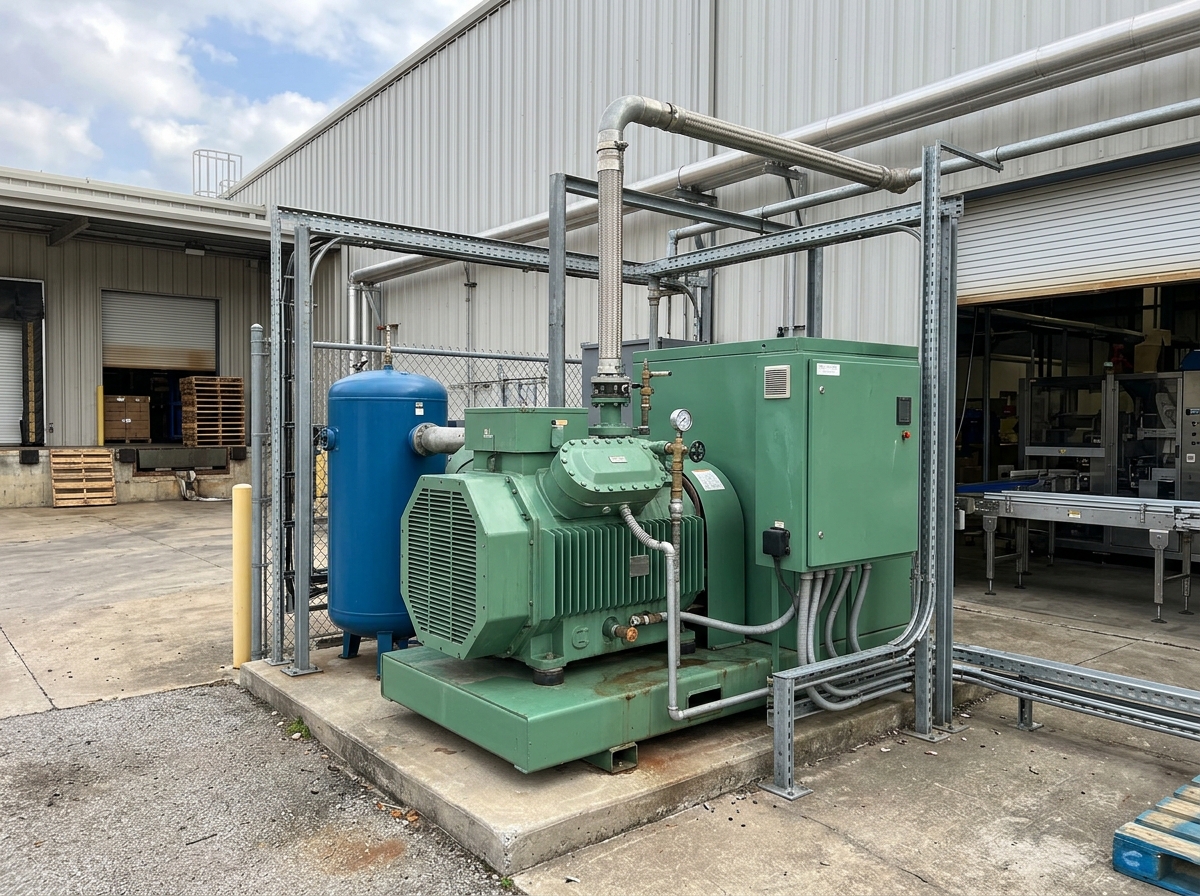
- Record pressure, flow, motor status, load and unload behavior, and production status over representative operating periods.
- Separate base demand from short peaks created by blow-off, cylinders, valves, or other intermittent devices.
- Inspect leaks, inappropriate open blowing, clogged filters, undersized piping, and excessive pressure setpoints.
- Confirm the minimum and maximum flow range approved by the compressor manufacturer.
- Compare a variable speed option with fixed-speed sequencing, a trim compressor, receiver capacity, and a multi-machine control system.
- Include electricity, maintenance, dryer energy, filter replacement, downtime exposure, and commissioning support in the lifecycle review.
Leak reduction should come before oversizing. A compressor that appears too small may actually be compensating for distribution losses or uncontrolled end uses. A compressor that appears too large may be reacting to short peaks that should be managed with storage or local controls.
Control Strategies for Multiple Packaging Lines
Multi-machine control is often more important than selecting one premium compressor. If several machines operate together, a master controller can assign base and trim duties according to real-time demand instead of allowing every compressor to run inefficiently.
A practical arrangement may use one machine for stable base demand and another machine for changing trim demand. The appropriate sequence depends on compressor capacity, minimum turn-down, operating hours, pressure requirements, and redundancy expectations.
Remote monitoring can improve maintenance decisions by identifying pressure drift, abnormal run time, temperature changes, filter loading, and repeated alarms. It cannot replace physical inspection, but it can reduce blind spots between service visits.
| Review item | Required record | Review frequency | Acceptance question |
|---|---|---|---|
| System pressure | Setpoint and measured range | During each production mode | Is pressure stable at the critical user? |
| Compressor loading | Loaded, unloaded, and stopped status | Across a representative cycle | Does operation match the demand profile? |
| Air quality | Dryer and filter condition | Per maintenance plan | Does delivered air meet the process requirement? |
| Leak condition | Leak list and repair status | At scheduled surveys | Are avoidable losses being controlled? |
| Production impact | Stops, alarms, and quality events | Per shift or batch | Has reliability improved without process compromise? |
Practical Packaging Scenarios
A high-speed filling line with several recipes is a typical variable speed candidate because its pneumatic demand can change with product format and line rate. The engineering team should still verify the minimum stable flow and determine whether a receiver can absorb short peaks.
A carton line that runs continuously at one rate may not need a variable speed compressor. A fixed-speed base unit with appropriate storage and sequencing may be simpler, especially if measured demand stays close to a stable operating point.
A plant with several packaging lines may benefit from a combination of technologies. One variable speed compressor can provide trim capacity while fixed-speed units provide base load, provided that the master controller prevents low-load operation and maintains redundancy for critical production.
A retrofit requires special care because the compressor package, air end, motor, drive, cooling system, and controller must be compatible. The retrofit guidance from Compressed Air Best Practices emphasizes that the air end must have a known speed range before a VFD retrofit is considered.
Seven Frequently Asked Questions
1. What is a variable frequency air compressor?
It is an air compressor equipped with a variable frequency drive that changes motor speed to adjust compressor output. The drive operates within the approved speed and control range of the compressor package.
2. Is a variable frequency compressor always more efficient?
No. It can be advantageous under changing demand, but a correctly sized fixed-speed system may be competitive under stable demand. Efficiency depends on the entire system, including pressure, storage, leaks, controls, and maintenance.
3. Why is fluctuating demand important on a packaging line?
Fluctuating demand can cause a fixed-speed compressor to spend more time unloaded or to cycle frequently. Variable speed control can follow changing demand more closely when the operating range is suitable.
4. Can a VFD eliminate pressure fluctuations?
No. It can improve control response, but pressure stability also depends on receiver capacity, sensor location, piping losses, valve behavior, and the timing of short air events.
5. Should packaging plants use oil-free air?
Oil-free air may be appropriate for processes with strict contamination sensitivity. The decision should follow the product, process, air quality specification, and validation requirements, with suitable drying and filtration included.
6. Is a VFD retrofit suitable for every compressor?
No. The motor, air end, cooling system, controller, and approved speed range must be checked. A retrofit should be engineered and commissioned rather than treated as a simple drive replacement.
7. What information should a buyer provide to a compressor supplier?
Provide flow and pressure requirements, production modes, shift patterns, peak events, air quality needs, ambient conditions, existing equipment, maintenance records, and the consequences of production downtime. Measured data is more useful than a single estimated flow number.
About Deman
Deman develops compressed-air solutions around the complete operating system rather than treating the compressor as an isolated machine. Its approach can include equipment selection, air treatment, storage, piping considerations, controls, monitoring, and service planning. For packaging projects, buyers should request a demand review that connects production behavior with pressure stability, air quality, lifecycle cost, and maintenance requirements.
To discuss a packaging-line application, prepare your operating data and request an engineering review through the company website.
Conclusion
A variable frequency air compressor helps packaging lines when demand changes often enough to make fixed-speed operation inefficient, but the decision should be based on measured load behavior and system design. Evaluate the compressor, receiver, dryer, filters, piping, controls, and point-of-use equipment together. When the demand profile and approved operating range support it, variable speed technology can improve matching between compressed-air production and real production demand.