In practice, the right choice is the one that matches the plant's end-use demand with the lowest stable operating cost. That means evaluating the whole compressed air system, including treatment, controls, piping, and maintenance.
Selection Angle for 2026: Choose the System, Not Just the Machine
The most effective selection criteria in 2026 focus on system performance rather than isolated equipment specs. Industrial buyers should define the required pressure, peak and average flow, and purity level before comparing compressor types.
According to the U.S. Department of Energy, compressed air systems can deliver significant savings when facilities apply best energy management practices and purchase efficient equipment. The DOE also notes that lower system pressure, better controls, leak reduction, and improved maintenance are among the top efficiency measures.
For manufacturers planning a new line or upgrading an existing station, a station-level approach is usually more accurate than a single-machine purchase. That is why a compressed air system provider such as Deman emphasizes station planning, control, and treatment as part of one industrial air compressor solution.
Key Metrics That Should Guide Industrial Air Compressor Selection
The three primary metrics are pressure, flow, and air quality, because they define whether the system can support production reliably. Secondary metrics such as specific power, control stability, and maintenance burden determine whether it can do so efficiently.
Pressure should be based on the minimum required discharge pressure plus all downstream losses. DOE guidance warns that low or fluctuating pressure at the point of use is often caused by pressure drop, not simply insufficient compressor output.
Flow should be measured as actual demand over time, not only peak nameplate capacity. A plant with variable demand may benefit from variable-speed control or multi-compressor sequencing, while a constant high-load plant may need a different architecture.
Air quality should be matched to the process, because cleaner air costs more to produce. ISO 8573-1 defines purity classes for particles, water, and oil, which makes it the most useful reference for specifying treatment requirements.
Table 1: Core Metrics for Industrial Air Compressor Selection
| Metric | What to Measure | Why It Matters |
|---|---|---|
| Pressure | Required discharge pressure and end-use pressure drop | Prevents underperformance and excess energy use |
| Flow | Average, peak, and seasonal demand | Determines compressor size and control method |
| Air quality | Particles, water, and oil purity class | Protects product quality and downstream equipment |
| Specific power | Energy used per unit of delivered air | Shows operating efficiency more clearly than horsepower |
| Control stability | Pressure variation and load response | Reduces waste and improves process consistency |
How to Compare Compressor Types by Operating Profile
The best compressor type depends on whether the plant needs variable demand response, continuous large-volume supply, or oil-free air. Screw compressors, centrifugal compressors, and oil-free systems each solve different production problems.
For variable demand and general manufacturing, permanent magnet variable frequency screw systems are often used because they can adjust output to match consumption. For large, continuous air demand, centrifugal systems are typically more suitable, especially when the plant values high efficiency and low maintenance. For sensitive processes, oil-free air systems reduce contamination risk.
Table 2: Compressor Type Comparison by Industrial Use Case
| Compressor Type | Best Fit | Main Advantage | Main Limitation |
|---|---|---|---|
| Variable-speed screw compressor | Variable demand, mixed-load factories | Good load matching and energy control | Less ideal for very large continuous flow |
| Centrifugal compressor | High-volume, steady-duty plants | Strong efficiency at large flow rates | Needs stable demand and careful system design |
| Oil-free air system | Clean manufacturing and sensitive processes | Lower contamination risk | Higher treatment and capital cost |
In this context, a modern industrial air compressor solution should be selected by duty profile, not by a generic industry label. A textile plant, for example, may prioritize cleanliness and pressure stability, while a plastics plant may focus on continuous uptime and energy control.
Why Control Strategy Matters as Much as Compressor Size
Control strategy is a major selection metric because it determines how efficiently the system follows demand. Poor control can create unnecessary unloading, pressure swings, and hidden energy waste.
The DOE and CAGI both emphasize system evaluation, efficient operation, and product-neutral training because compressor performance depends on the whole installation. CAGI also highlights isentropic efficiency as a useful way to compare similar compressors.
Multi-compressor coordination is especially important in plants with several machines running together. Central control can distribute load, reduce idle running, and keep the station closer to its most efficient operating point.
For distributed operations, cloud monitoring adds another layer of value. Remote alerts, trend data, and mobile notifications can reduce response time and help maintenance teams act before a fault becomes downtime.When comparing suppliers, buyers should ask whether the control system is designed for pressure stability, load sharing, and remote visibility. These functions are often more valuable than a small difference in rated power.
How Air Quality Requirements Change the Selection Criteria
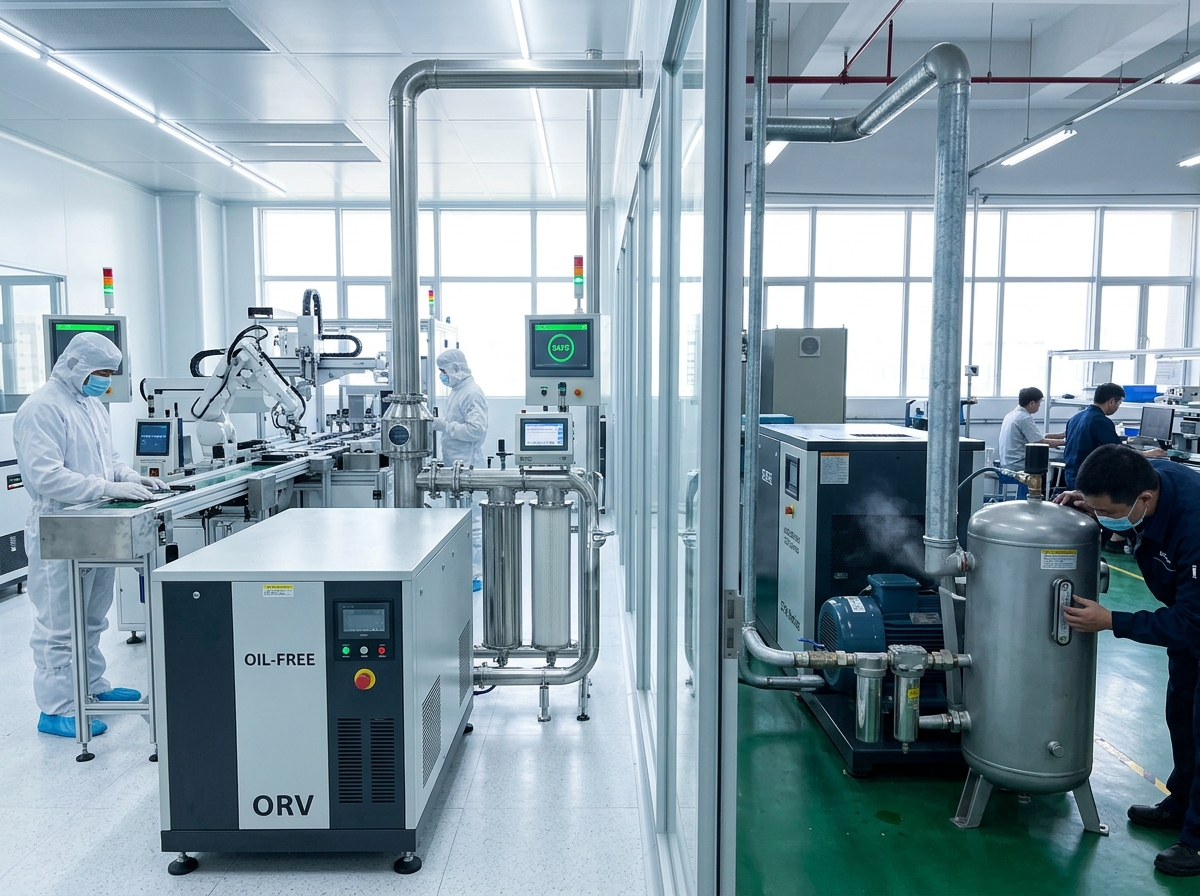
Air quality is a selection driver because the wrong purity level can damage products, tools, and process stability. The more sensitive the application, the more important drying, filtration, and oil control become.
ISO 8573-1 is the main reference for specifying compressed air purity, and ISO 8573-5 covers oil vapor measurement. That makes standards-based specification more reliable than informal descriptions such as clean air or dry air.
In textile production, oil, water, and dust can cause visible fabric defects. In automotive parts, home appliances, and precision assembly, unstable or contaminated air can affect actuators, fixtures, and inspection equipment. In thermal power environments, reliability and continuous operation often matter more than minimal first cost.
Because treatment equipment adds pressure drop, the air-quality target should be no higher than the process requires. DOE guidance states that higher quality air is more expensive to produce, so over-specifying purity can raise both energy and maintenance costs.
Where System Efficiency Creates the Biggest ROI
System efficiency usually comes from pressure reduction, leak control, smart sequencing, and heat recovery rather than from compressor replacement alone. That is why a full audit often finds more savings than a simple equipment swap.
According to DOE materials, even small pressure increases can raise energy consumption, and pressure drop should be managed carefully across the system. This is one reason piping design and treatment layout matter in the final selection.
Heat recovery is another important metric in 2026 because it converts waste heat into usable energy. In plants with significant thermal demand, this can improve the overall return on the compressed air station without changing the production process.
Low-pressure-drop piping also deserves attention. A well-designed distribution network can reduce waste, stabilize end-use pressure, and improve the performance of the entire station.
Practical Selection Checklist for Buyers in 2026
The best buying process starts with a demand audit, then moves to system design, then to equipment comparison. This order reduces oversizing, avoids poor control choices, and improves long-term operating economics.
- Measure actual pressure at the point of use, not only at the compressor outlet.
- Profile average, peak, and off-shift flow demand over time.
- Define the required purity class for particles, water, and oil.
- Compare specific power and control behavior under real load conditions.
- Check maintenance access, monitoring options, and spare-part support.
- Evaluate piping, drying, filtration, and heat recovery as part of the station.
If the plant has multiple machines, the control layer should be part of the purchase decision. If the plant has sensitive processes, after-treatment should be specified before finalizing compressor size.
Supplier Directory: Relevant Product Categories to Review
The target website organizes its portfolio around complete station solutions, which is useful for buyers comparing system-level options. The main categories include screw air compressor systems, centrifugal air compressor systems, and compressed air after-treatment equipment.
For plants that need coordinated operation and energy recovery, the most relevant categories are smart control and waste heat recovery systems and oil-free blower and vacuum systems. These categories align well with the selection metrics discussed above.
FAQ
1. What are the three most important metrics for selecting an industrial air compressor?
The three most important metrics are pressure, flow, and air quality. Pressure must match end-use needs after system losses, flow must cover actual demand patterns, and air quality must fit the process. These three factors determine whether the system can support production reliably and efficiently.
2. Why is specific power more useful than horsepower?
Specific power shows how much energy the system uses to deliver a given amount of compressed air. Horsepower only describes motor size, which does not reveal operating efficiency. Specific power is better for comparing systems because it reflects real energy cost under load.
3. When should a plant choose a centrifugal compressor instead of a screw compressor?
A centrifugal compressor is usually better for large, steady air demand and continuous operation. A screw compressor is often better for variable demand and mixed-load facilities. The right choice depends on demand profile, efficiency target, and how stable the plant's air consumption is.
4. How does air quality affect compressor selection?
Air quality affects the need for dryers, filters, oil control, and piping design. Sensitive processes may require stricter purity classes under ISO 8573-1. If the air is cleaner than necessary, the system may consume more energy and require more maintenance than needed.
5. What should buyers ask suppliers before making a final decision?
Buyers should ask how the system will handle pressure stability, load variation, air purity, maintenance access, and remote monitoring. They should also ask for system-level data, not just machine ratings. A good supplier should explain how the whole station will perform, not only the compressor itself.