










Introduction
In manufacturing, compressed air often powers more than tools—it supports production speed, product quality, and overall uptime. A screw air compressor is designed for this kind of demand, delivering a steady flow of air for continuous-duty applications where interruptions can slow an entire line. This article explains where screw air compressors are used in manufacturing, why they are preferred over other compressor types in many facilities, and how their performance characteristics fit medium- to large-scale operations. From pneumatic equipment and automation to packaging and process support, the sections ahead show how these systems function as a core utility in modern plants.
Why Screw Air Compressors Matter in Manufacturing
Rotary screw air compressors represent the backbone of modern industrial pneumatic systems. Unlike piston-driven alternatives, these machines utilize twin helical rotors to compress air in a continuous, smooth motion. This fundamental mechanical difference makes them indispensable for manufacturing facilities that treat compressed air as a primary utility, alongside electricity and water.
Impact on uptime and throughput
The primary advantage of a screw air compressor lies in its ability to support continuous operations. Because the rotors do not touch and are continuously cooled (typically by oil or water), these units achieve a 100% duty cycle. This means they can run 24 hours a day, 7 days a week, accumulating up to 8,000 operating hours annually without requiring cool-down periods. In contrast, standard reciprocating compressors typically max out at a 50% to 60% duty cycle, making them prone to overheating and causing expensive production downtime if pushed beyond their mechanical limits.
Best-fit manufacturing environments
These compressors are the optimal choice for medium to large-scale manufacturing environments that demand steady, high-volume airflow. Facilities requiring anywhere from 50 cubic feet per minute (CFM) to over 1,500 CFM rely on rotary screw technology to maintain stable line pressure. They are particularly critical in environments governed by strict quality management protocols, where stable pressure and predictable air purity align with ISO standards for industrial manufacturing processes.
Common Uses of Screw Air Compressors
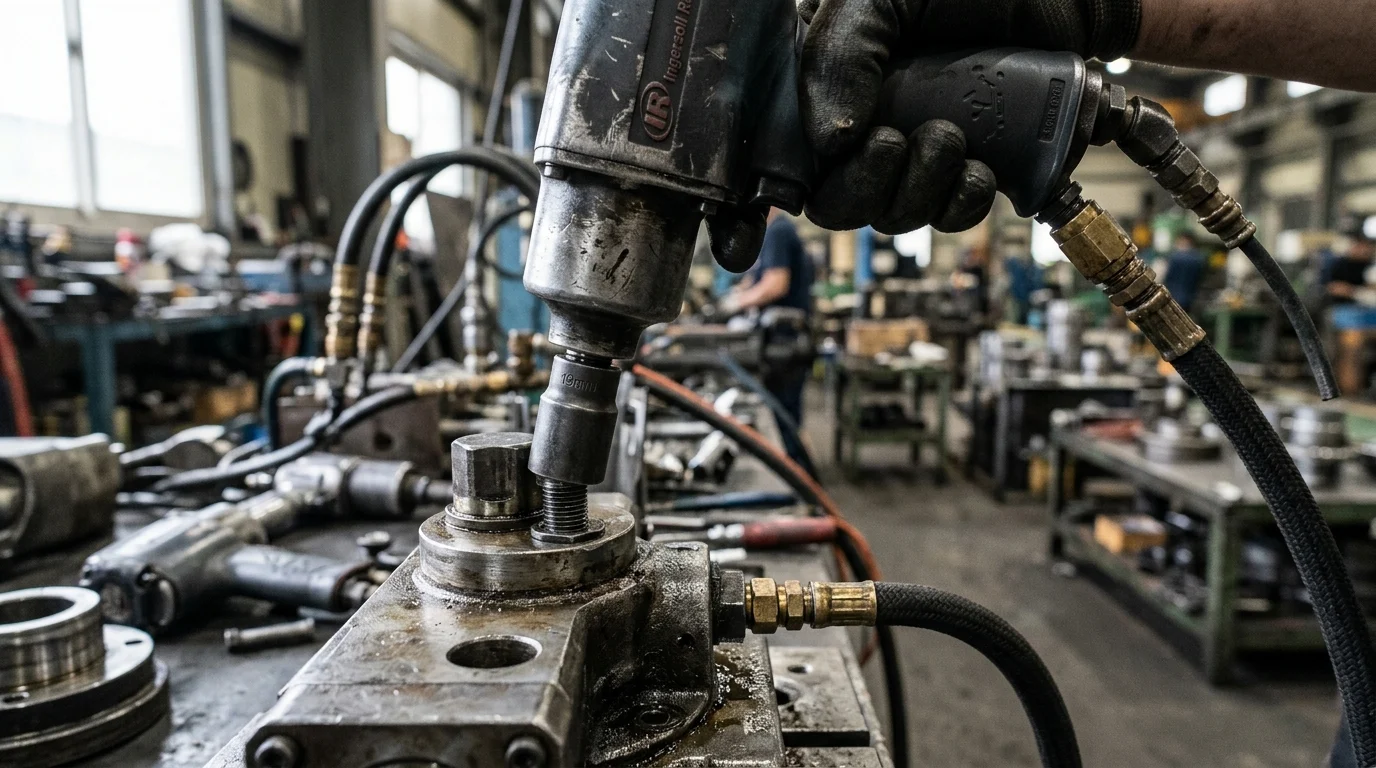
Compressed air generated by rotary screw systems powers a vast array of processes across the factory floor. The continuous flow characteristics of these compressors ensure that downstream equipment receives a stable supply of power without the pressure pulsations common to other compressor types.
Production applications
Within general production, screw compressors drive automated material handling systems, robotic arms, and heavy-duty pneumatic tools. A typical assembly line requires a constant operating pressure of 90 to 125 pounds per square inch (PSI) to ensure torque tools function accurately and pneumatic cylinders actuate at precise speeds. Any drop in pressure could lead to defective product assembly or stalled conveyor systems, making the continuous output of a rotary screw unit essential.
Industry-specific use cases
Different industries require highly specialized air quality profiles from their screw compressors. For instance, the automotive sector relies on heavily filtered, moisture-free air to prevent fisheyes and defects in robotic paint booths. Conversely, the food, beverage, and pharmaceutical industries mandate strict adherence to air purity standards to prevent product contamination.
| Industry Sector | Primary Application | Air Quality Requirement |
|---|---|---|
| Automotive Assembly | Paint booths, pneumatic robotics | Filtered, low dew point |
| Food & Beverage | Product packaging, sorting | ISO 8573-1 Class 0 (Oil-Free) |
| Heavy Fabrication | Sandblasting, grinding, lifting | Standard particulate filtration |
| Electronics | PCB cleaning, component placement | Ultra-dry, Class 0 particulate |
Plant support functions
Beyond direct production, screw compressors sustain critical plant support functions. These include powering pneumatic HVAC control valves, industrial dust collection baghouses, and air curtains. Dust collection systems, for example, rely on reverse-pulse jet cleaning mechanisms that demand sudden, high-volume bursts of air, often drawing 20 to 50 CFM per pulse. A rotary screw compressor paired with an adequately sized receiver tank ensures these support systems operate without starving the primary production lines of air.
Screw Air Compressor Types and Comparisons
Understanding how rotary screw compressors compare to alternative technologies and configurations is vital for specifying the correct equipment for a facility's unique operational demands.
How screw compressors differ from other compressor types
The industrial compressor market is generally divided into reciprocating (piston), rotary screw, and centrifugal technologies. Reciprocating units are cost-effective for intermittent demands under 20 horsepower (HP). Centrifugal compressors are dynamic machines suited for massive base-load operations exceeding 500 HP and 2,000 CFM. Rotary screw compressors occupy the crucial middle ground, servicing the 20 HP to 300 HP range with unmatched reliability.
| Compressor Type | Typical HP Range | Duty Cycle | Best Fit Application |
|---|---|---|---|
| Reciprocating | 1 - 20 HP | 50% - 60% | Small shops, intermittent use |
| Rotary Screw | 20 - 300 HP | 100% | Continuous manufacturing |
| Centrifugal | 500+ HP | 100% | Heavy industrial base load |
Pressure, duty cycle, and efficiency differences
Efficiency in a rotary screw compressor is heavily tied to its operating pressure and duty cycle. Generating higher pressure requires exponentially more energy; a common engineering rule states that every 2 PSI increase in discharge pressure increases energy consumption by approximately 1%. Because screw compressors thrive in 100% duty cycle applications, running them at partial loads can be inefficient unless they are equipped with advanced modulation or motor control systems.
Oil-injected vs oil-free and fixed-speed vs variable-speed
Manufacturers must choose between oil-injected and oil-free models, as well as fixed-speed and variable-speed drive (VSD) configurations. Oil-injected models use lubricant to seal the rotors and absorb heat, making them highly durable and cost-effective, though they require downstream filtration. Oil-free models utilize special rotor coatings and timing gears to prevent metal contact without oil, which is essential for strict cleanroom standards. Meanwhile, a VSD compressor adjusts its motor speed to match fluctuating plant air demand, yielding energy savings of up to 35% compared to a fixed-speed unit that constantly loads and unloads.
Selection Factors for Manufacturers
Selecting the right screw air compressor requires a rigorous analysis of technical specifications, lifecycle costs, and regulatory compliance to ensure the investment yields a positive return.
Sizing by CFM, PSI, air quality, and duty cycle
Proper sizing is the most critical selection factor. Oversizing leads to wasted capital and inefficient partial-load operation, while undersizing causes pressure drops and production bottlenecks. Sizing must account for total CFM demand, required PSI, and the specific duty cycle of the plant. A standard industrial benchmark is that a screw compressor generates roughly 4 to 5 CFM per 1 HP at 100 PSI. Engineers must conduct a comprehensive air audit, measuring peak and average consumption, to specify a machine that operates near its maximum efficiency point.
Cost drivers and total cost of ownership
When evaluating the total cost of ownership (TCO) over a standard 10-year lifecycle, the initial purchase price represents only about 10% to 15% of the total expense. Maintenance accounts for another 10%, while electrical power consumption dominates at roughly 75% to 80%. For example, a 100 HP fixed-speed compressor operating 8,000 hours annually at an electricity rate of $0.10 per kWh will cost approximately $60,000 per year just to power. Consequently, investing upfront in premium efficiency models or VSD technology often pays for itself within 12 to 24 months.
Safety, compliance, and regulatory requirements
Industrial air systems must adhere strictly to safety and regulatory standards. Pressure vessels and receiver tanks must comply with local boiler and pressure vessel codes to prevent catastrophic failures. Additionally, workplace safety regulations mandate strict noise controls. Modern rotary screw compressors are typically housed in sound-attenuating enclosures, reducing operational noise to a manageable 65 to 75 dB(A). This is a significant occupational safety improvement over reciprocating units, which frequently exceed 85 dB(A) and require dedicated hearing protection zones.
How to Decide if a Screw Air Compressor Is Right
Finalizing the decision to transition to or upgrade a rotary screw air compressor involves assessing current operational pain points and aligning with competent supply chain partners.
Sizing and integration steps
The integration of a new screw compressor begins with optimizing the plant's pneumatic infrastructure. Upgrading the compressor without addressing downstream piping often negates efficiency gains. Engineers must size the distribution piping to keep air velocity below 20 feet per second, minimizing friction and pressure drop. Additionally, integrating the compressor requires proper sizing of auxiliary components, including refrigerated or desiccant air dryers, inline coalescing filters, and adequately sized wet and dry receiver tanks to buffer demand spikes.
Supplier and service considerations
The reliability of a screw compressor is highly dependent on the supplier's service network and parts availability. Standard maintenance intervals demand oil and filter changes every 4,000 to 8,000 hours, alongside periodic replacement of the air-oil separator. Procurement teams must evaluate the supplier's local service response time and the typical 4 to 12-week lead time for major replacement components. Establishing a comprehensive preventative maintenance contract is heavily advised to protect the capital investment and ensure maximum uptime.
How to assess fit for your operation
To assess if a rotary screw compressor is the right fit, operations managers should evaluate their current compressor's running behavior. If an existing reciprocating compressor is running more than 60% of the time, overheating frequently, or causing noticeable pressure fluctuations at the point of use, a rotary screw unit is financially and operationally justified. By matching the continuous output capabilities of a screw compressor to the actual production schedule, manufacturers can stabilize their pneumatic utility, reduce long-term energy expenditures, and eliminate air-related production downtime.
Key Takeaways
- The most important conclusions and rationale for Screw Air Compressor
- Specs, compliance, and risk checks worth validating before you commit
- Practical next steps and caveats readers can apply immediately
Frequently Asked Questions
What is a screw air compressor mainly used for in manufacturing?
It supplies continuous compressed air for assembly lines, pneumatic tools, robotics, conveyors, paint booths, and packaging systems that need stable pressure all day.
When should a factory choose a rotary screw compressor over a piston model?
Choose rotary screw when air demand is continuous, typically above light intermittent use, and uptime matters. It handles 24/7 operation better than piston compressors.
What pressure range do manufacturing tools usually need from a screw compressor?
Most production tools and cylinders run around 90 to 125 PSI. Matching compressor output to this range helps maintain tool accuracy and line speed.
Which industries benefit most from screw air compressors?
Automotive, food and beverage, electronics, pharmaceuticals, and heavy fabrication benefit most because they need reliable airflow, stable pressure, and application-specific air quality.
How can I choose the right screw air compressor for my plant?
Size it by required CFM, operating PSI, duty cycle, and air quality needs. Demanac can help compare rotary screw and centrifugal options for your application.