










Usage and Maintenance of Air Compressor Lubricating Oil
Lubricating oil performs multiple core functions in air compressors including lubrication, sealing, cooling and rust prevention, serving as a key factor for long-term stable unit operation. Operators and maintenance staff should master basic knowledge of the lubrication system's composition, working principle, structure and application requirements. Meanwhile, continuous on-site experience accumulation and routine maintenance are required to keep the compressor and its lubrication system in optimal operating condition.
I. Keep Lubricating Oil Clean
Dirty or deteriorated lubricating oil directly causes bearing abrasion, shortens the service life of the main airend, and may trigger high-temperature shutdown faults.
Maintenance Key Points
- Inspect oil appearance and viscosity regularly; replace oil immediately if it turns black, emulsifies or develops strange odors.
- Replace Deman special lubricating oil and oil-air separator element on schedule to block impurities and moisture from entering the oil circuit.
- Fully drain all waste oil during oil replacement to avoid mixing new and old oil.
II. Maintain Proper Oil Level
Neither excessive nor insufficient oil volume is acceptable. Low oil level leads to inadequate lubrication and high-temperature abrasion; overfilling increases residual oil content in discharged air and overburdens the oil-air separation system.
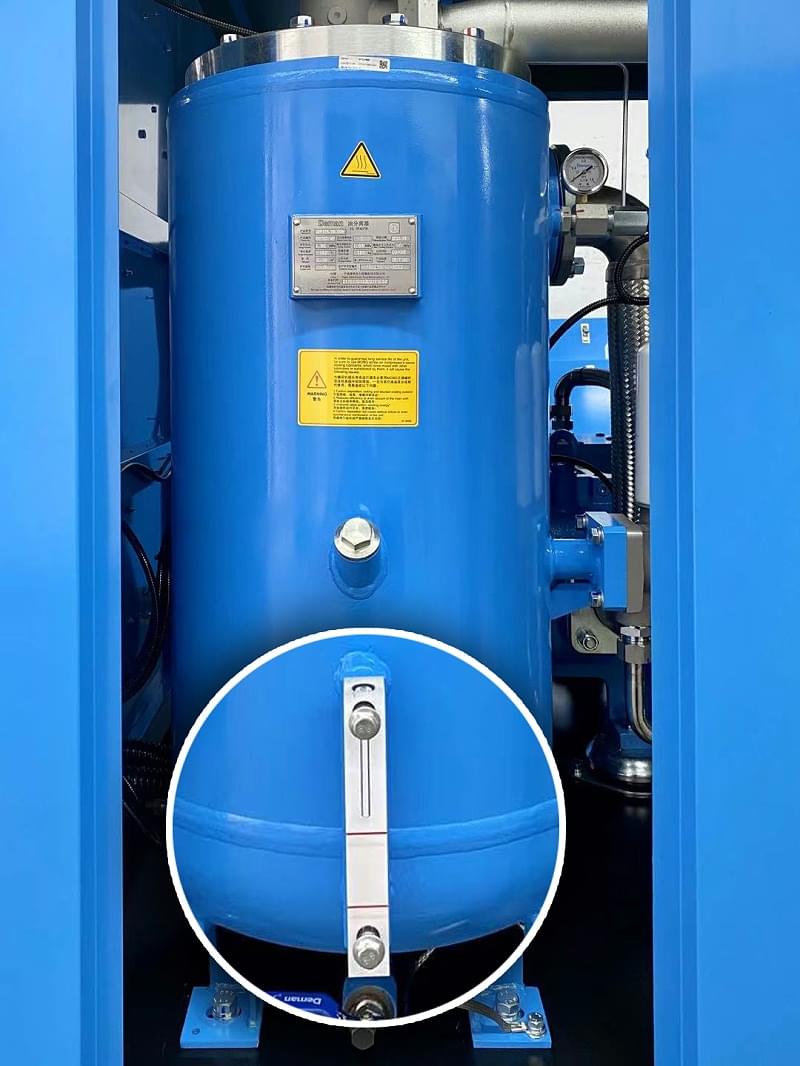
Identification Method
- Observe the oil sight glass mounted on the oil-air separator tank.
- Compressors below 15kW: Oil level must be visible on the sight glass when the unit is shut down.
- Compressors above 18kW: Oil level must be visible on the sight glass during running operation.
💡 Practical Tip: Keep the oil level between the two red marking lines on the sight glass. A slight drop in oil level during operation is normal, but the oil level must never fall below the lower limit line.
III. Inspect Carbon Deposits and Sludge
Long-term high-temperature operation causes lubricating oil to oxidize and form carbon deposits and sludge, which adhere to exhaust assemblies, pipelines and air valves. These deposits hinder heat dissipation and airflow, and may even lead to spontaneous combustion in severe cases.
Maintenance Key Points
- Regularly check exhaust components and pipelines for carbon and sludge accumulation.
- Clean or replace relevant parts promptly once heavy carbon buildup is found.
- Adopt high-quality Deman special lubricating oil to effectively slow carbon formation.
IV. Control Oil Temperature
Excessively high oil temperature reduces oil viscosity and accelerates oxidation and deterioration; excessively low oil temperature raises viscosity, impairs fluidity and weakens lubrication and startup performance.
Maintenance Key Points
- Maintain normal operating oil temperature within the recommended range of 75~95°C.
- Oil temperature is measured in real time by an oil temperature sensor and transmitted to the controller.
- Inspect the cooling system, thermal control valve and oil circuit for blockages if abnormal oil temperature occurs.
V. Safety Valve Maintenance
Mounted on the oil-air separator tank, the safety valve is a critical protective device that automatically opens to release pressure once system pressure exceeds the preset threshold.
Maintenance Key Points
- Inspect the safety valve at least once a year or follow local labor supervision department regulations.
- The opening pressure of the safety valve shall be set in accordance with national standards or manufacturer specifications.
Important Reminder: End users are prohibited from adjusting the safety valve opening pressure on their own!
VI. Cooler Maintenance
The cooler dissipates heat generated during compressor operation. Clogged coolers reduce heat dissipation efficiency and raise discharge temperature, which disrupt unit operation and accelerate lubricant aging.
Maintenance Key Points
- Clean or blow the cooler regularly based on ambient conditions:
- Air-cooled type: Blow dust off cooling fins from inside out with low-pressure compressed air.
- Water-cooled type: Periodically remove limescale and impurities inside the cooler.
- A clean cooler ensures the compressor runs at normal temperature and extends the service life of both the unit and lubricating oil.
Lubricating Oil Maintenance Schedule Table
|
Maintenance Item |
Recommended Cycle |
Remarks |
|
Oil Level Inspection |
Daily |
Check sight glass during shutdown or running |
|
Oil Quality Inspection |
Monthly |
Observe color, viscosity and emulsification status |
|
Lubricating Oil Replacement |
4,000 hours / 1 year |
Use only Deman special oil; mixing different oils forbidden |
|
Oil Filter Replacement |
4,000 hours / 1 year |
Conduct simultaneously with oil change |
|
Carbon Deposit Inspection |
Annually |
Focus on exhaust assemblies and pipelines |
|
Cooler Cleaning |
As required (depends on environment) |
Blow air-cooled radiators; descale water-cooled coolers |
|
Safety Valve Inspection |
Annually |
Performed by professional technicians; no self-adjustment |
Conclusion
Standardized usage and maintenance of compressor lubricating oil can effectively extend unit service life, cut maintenance costs and generate substantial operational savings for enterprises.
All Deman air compressors are equipped with the Deman Cloud intelligent remote O&M system, which monitors real-time critical parameters including oil temperature and oil level, and automatically pushes maintenance reminders to help users manage lubricant status scientifically.
Please contact us for professional maintenance service or lubricating oil procurement.
About the Author
Mr. Ryan — Air Compressor Solutions Expert, Deman
Mr. Ryan works with Deman, a national High-tech Enterprise and "Little Giant" firm founded in 1998, combining German quality standards with Chinese manufacturing expertise. Specialized in VSD oil-injected compressors, two-stage PM VSD systems, and intelligent compressed air solutions. With 29+ years of experience, 127 patents, and a ten-year warranty commitment — helping global manufacturers and industrial buyers source energy-efficient, reliable air compressor systems with confidence.
LinkedIn: Deman Compressor LinkedIn | Facebook: Deman Facebook