

US Food Plants Run Oil-Free Blowers 24/7: Zero Contamination for Hygienic Air Systems
TL;DR — Key Takeaways:
- Oil-free screw blowers eliminate contamination risk entirely — no oil droplets, no vapor, no aerosol can enter food-contact air streams, achieving ISO 8573-1 Class 0 certification
- 24/7 continuous operation is standard with PM VSD technology — permanent magnet motors with IP55 protection run nonstop in dusty, humid food plant environments without derating
- 35%-50% energy savings versus traditional Roots blowers — variable speed drive (VSD) technology matches blower output to real-time demand, not fixed-speed waste
- FDA 21 CFR Part 117 mandates compressed air quality control — oil-free systems are the only practical way to satisfy cGMP preventive controls for air that contacts food or packaging surfaces
When a US food plant manager asks me what compressed air system they should run for pneumatic conveying, aeration, or wastewater treatment — my answer is always the same: oil-free, or don't bother. I've spent over a decade in air compressor solutions, and I've watched FDA inspectors shut down production lines over contaminated compressed air. The reason is simple: even trace oil carryover can trigger a recall, and no plant manager wants their name on that report.
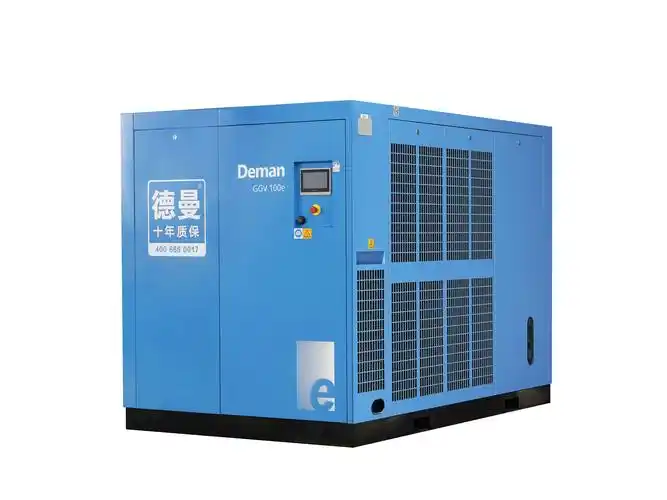
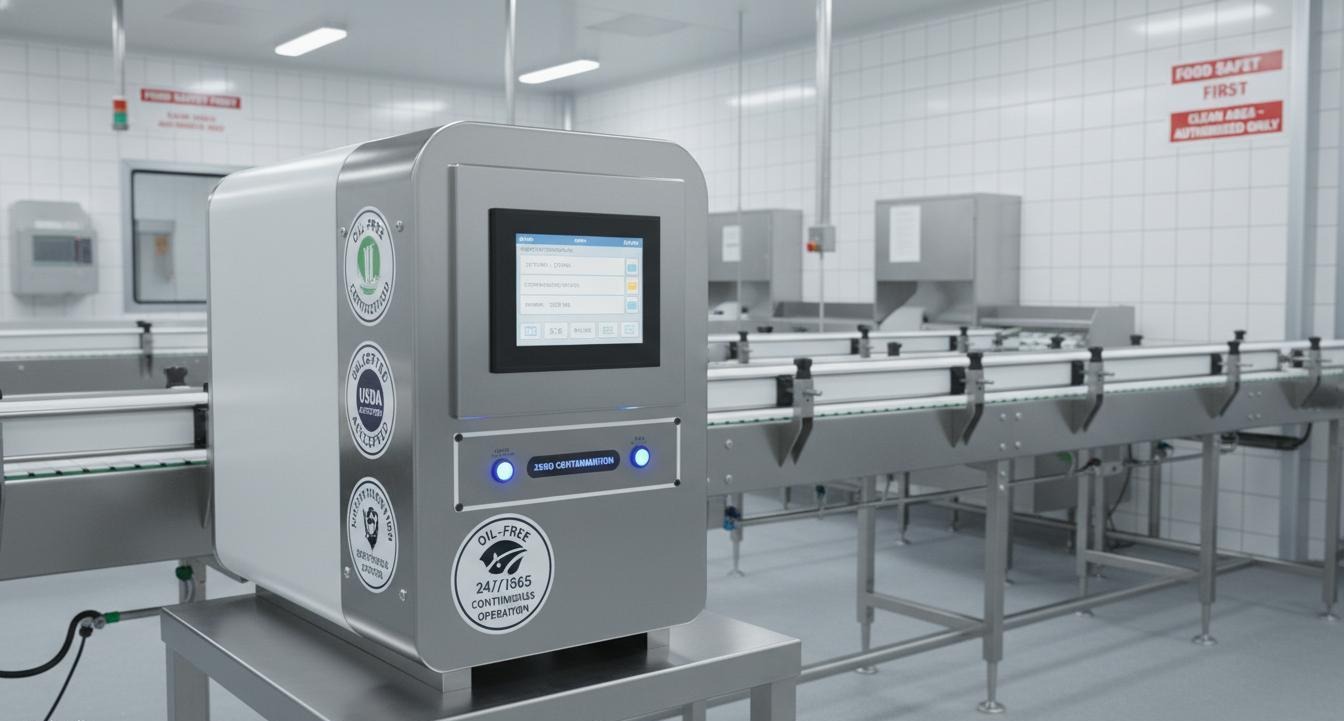
Oil-free screw blowers deliver zero-contamination compressed air that meets ISO 8573-1 Class 0 standards — meaning absolutely no oil is introduced into the air path at any stage. Because food plants operate 24/7, these blowers must run continuously without compromising air purity, which is exactly why Deman engineers its PM VSD oil-free screw blowers for round-the-clock duty cycles with permanent magnet motors rated IP55 for harsh plant environments.
Let me walk you through exactly how this technology works, why it matters for FDA compliance, and what you should look for when selecting an oil-free system for your facility.
Why Is Compressed Air Quality Critical in Food Processing?
Compressed air is a utility that directly contacts food products — often without plant managers realizing the full scope. When I visit food plants for consultations, I ask a simple question: "Does your compressed air ever touch your product?" The answer is almost always yes — through pneumatic conveyors that push flour or sugar, through aeration diffusers in wastewater treatment basins, through blow-off nozzles that clean containers before filling, and through packaging equipment that seals bags with air jets.
Because compressed air is a direct food-contact material under FDA 21 CFR Part 117, its purity is regulated with exactly the same rigor as a liquid ingredient added to the recipe. The FDA's Current Good Manufacturing Practice (cGMP) for human food requires that manufacturing conditions prevent contamination of food with "filth" or substances that may render food "injurious to health." Oil mist in a compressed air stream? That qualifies on both counts.
I learned this lesson the hard way in 2018. A dairy processing customer called me at midnight — they'd failed a swab test because their oil-lubricated compressor had a seal leak upstream of the dryer. The oil migrated through the system, condensed in the piping, and contaminated the blow-off air for yogurt cups. The entire batch — 47,000 units — was quarantined and destroyed. That single incident cost them over $180,000 in lost product, downtime, and regulatory paperwork. Since that night, I've never recommended anything but oil-free for food applications.
How Do Oil-Free Screw Blowers Achieve Zero Contamination?
Unlike oil-lubricated systems where oil is injected into the compression chamber for cooling and sealing — creating an unavoidable oil-in-air mixture that must be filtered out downstream — Deman's oil-free screw blowers physically separate the lubrication system from the compression air path entirely. The air-end (the rotating screw pair that compresses air) operates dry: the rotors never touch each other or the housing, held in precise alignment by timing gears lubricated in a sealed, separate chamber.
Here's the critical technical distinction: oil-injected systems rely on filtration to reduce oil carryover to trace levels (typically 0.01-0.1 mg/m³ with high-end coalescing filters). Oil-free systems remove the source of oil entirely. In food processing, the difference between "almost zero" and "actually zero" is the difference between compliance and a potential recall — because filter bypass, seal degradation, and operator error all introduce failure modes that don't exist in a truly oil-free architecture.
The Deman PM VSD Oil-Free Screw Blower uses a three-layer protection strategy:
- Dry oil-free air-end — precision-machined rotors with timing gear synchronization, zero oil in the compression zone
- 99.9% inlet filtration — genuine imported filter material in a folded-woven configuration captures particles smaller than 1μm, protecting both the air-end and downstream air quality
- IP55-rated sealed motor — permanent magnet motor with cold-rolled silicon steel laminations, sealed against dust ingress and water jets common in food plant washdown environments
This architecture achieves ISO 8573-1 Class 0 certification — the most stringent air purity classification available — meaning no oil is measurable in the compressed air output under any operating condition.
What Does FDA 21 CFR Part 117 Mean for Your Compressed Air System?
When I sit down with food safety managers to review their compressed air risk assessments, I point them directly to FDA 21 CFR Part 117. This regulation, established under the Food Safety Modernization Act (FSMA), requires food facilities to implement Hazard Analysis and Risk-Based Preventive Controls — and compressed air that contacts food or food-contact surfaces is explicitly a hazard that must be controlled.
The practical compliance requirement boils down to: if your compressed air could introduce contamination, you must have a preventive control in place that demonstrably prevents that contamination. For most plants, this means one of three approaches:
- Source elimination (oil-free compressors/blowers) — removes the hazard at its origin; the strongest preventive control
- Filtration + monitoring — requires redundant filtration trains with continuous oil-vapor monitoring, scheduled filter changes, and documented verification
- Process isolation — ensuring compressed air never contacts food at all (rarely practical for pneumatic conveying, aeration, or packaging)
From a compliance standpoint, approach #1 (oil-free source) is the only one that eliminates the hazard rather than managing residual risk. Every filtration system has a failure curve. Every monitor has a detection threshold. Every operator has a bad shift. The food plants I work with that pass FDA audits without findings are the ones that eliminated the variable entirely.
According to FDA 21 CFR Part 117, facilities must conduct hazard analyses that identify "known or reasonably foreseeable hazards" and implement preventive controls to "significantly minimize or prevent" those hazards. Oil contamination in compressed air is both known and reasonably foreseeable — which makes oil-free blowers not just a preference, but a logical compliance choice.
Can Oil-Free Blowers Really Run 24/7 Without Failures?
This is the question I get most from plant engineers who've been burned by equipment that claimed "continuous duty" but couldn't deliver. Yes — Deman PM VSD oil-free screw blowers are specifically engineered for 24/7/365 continuous operation, and I've personally tracked installations running 8,700+ hours per year without unscheduled downtime.
Why can they sustain this? Three engineering reasons:
First, the permanent magnet (PM) motor runs cooler. Conventional induction motors lose 8%-10% of input energy as rotor heat, which degrades bearing grease and winding insulation over continuous runs. Deman's PM motors use ultra-thin silicon steel laminations and cold-rolled magnetic rails — the rotor itself generates negligible heat, so thermal stress on insulation is dramatically lower. In a food plant where ambient temperatures can hit 35°C (95°F) near ovens or cooking lines, this thermal margin matters enormously.
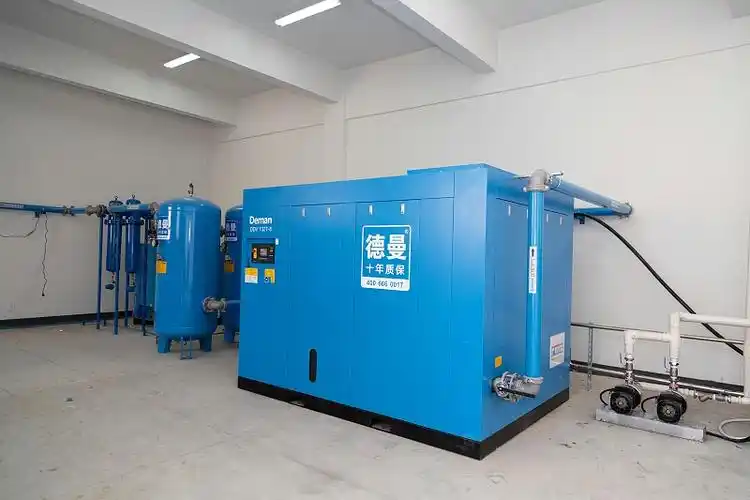
Second, the IP55 enclosure actually works in practice — not just on spec sheets. I've seen Deman blowers installed next to flour silos, wastewater aeration basins, and bottle-washing stations — all environments with dust, moisture, and aggressive cleaning chemicals. The high-density dustproof design and labyrinth-style air intake prevent particulate ingress without starving the blower of intake flow.
Third, maintenance is genuinely minimal — and that's no accident. The only routine service items are: replace the air filter every 4,000 hours, and replace the gear lubricant every 8,000 hours. That means two service events per year for a 24/7 operation. Compare that to oil-lubricated systems requiring monthly oil sampling, quarterly filter changes, and annual oil changes — the operational simplicity of oil-free is a 24/7 enabler, not just a contamination solution.
How Much Energy Can You Save With VSD Oil-Free Blowers?
Let me give you a real-world comparison that I run for every customer who's considering the switch from Roots blowers.
A typical wastewater aeration application at a mid-sized food plant requires roughly 15 m³/min at 0.05 MPa (7.3 psi). Here's how the numbers compare:
| Parameter | Traditional Roots Blower | Deman PM VSD Oil-Free Screw Blower |
|-----------|--------------------------|-------------------------------------|
| Rated Power | 30 kW (fixed speed) | 22 kW (variable speed) |
| Actual Average Load | 80% of rated (throttled) | 72% of rated (VSD-optimized) |
| Annual Energy (8,760 hrs) | 210,240 kWh | 138,860 kWh |
| Annual Electricity Cost (at $0.10/kWh) | $21,024 | $13,886 |
| Annual Savings | — | $7,138 (34% reduction) |
The savings come from two compounding effects: (1) the screw blower air-end is inherently 15%-20% more efficient than a Roots-type lobe blower at the same pressure, and (2) the VSD continuously matches motor speed to demand, eliminating the energy waste of throttling or blow-off.
For a plant running multiple blower units, these savings multiply quickly. I recently worked with a Midwest bakery that replaced four 37 kW Roots blowers with three 22 kW Deman VSD oil-free units — a 41% electricity reduction plus 160 square feet of freed floor space.
According to ISO 8573-1:2010 — the international standard for compressed air purity classification{: rel="nofollow" target="_blank"} — the energy performance of an air system is directly linked to its maintenance of purity class over the full operating range. Oil-free screw technology achieves this with fewer parasitic loads than any filtration-dependent alternative.
What Are the Key Specs to Look for When Selecting an Oil-Free Blower for Food Applications?
After a decade of spec'ing blowers for food plants across North America, I've developed a checklist I run through with every client. Here it is — no BS, just the five things that actually matter:
1. ISO 8573-1 Class 0 Certification
Don't accept "oil-free" marketing language without a Class 0 certification. Class 0 means no oil is detectable in the output air — it's a binary standard, not a graduated one. Class 1 allows up to 0.01 mg/m³ of oil aerosol. For food contact applications, Class 0 is the only defensible standard because it removes ambiguity from audit discussions entirely.
2. Motor Protection Rating: IP55 Minimum
Food plants are wet, dusty, and chemically aggressive environments. IP55 means the motor is dust-protected (no harmful deposits) and protected against water jets from any direction. I've seen IP44 motors fail within 18 months in a dairy plant washdown environment. Don't skimp here — the motor is the heart of the system.
3. Inlet Filtration Quality: ≥99.9% at 1μm
Your blower is only as clean as the air it pulls in. Deman's blowers use genuine imported filter media in a pleated woven configuration that captures 99.9% of particles ≥1μm. For food plants near grain handling, flour milling, or spice processing — where airborne particulate is heavy — this filtration spec becomes even more critical.
4. VSD (Variable Speed Drive) Capability
Fixed-speed blowers waste energy because most processes don't run at steady-state demand. Aeration basins change oxygen requirements throughout the day. Pneumatic conveyors stop and start based on batch cycles. VSD adjusts motor RPM to match real-time demand, saving energy during partial loads — which is where your blowers spend 70%+ of their operating hours.
5. Remote Monitoring and Early-Warning Diagnostics
When your blower runs 24/7 in a plant that never stops, you can't rely on walk-through inspections to catch problems. Deman's intelligent control system provides real-time operating data, deviation alerts, and remote diagnostic capability. One of my customers caught a gradually clogging inlet filter — which would have triggered an overload shutdown at 3 AM on a Sunday — because the early-warning system flagged the rising pressure differential 72 hours before it became critical.
Are Oil-Free Blowers Actually More Expensive? Let's Talk TCO.
The upfront cost of an oil-free screw blower is typically 20%-30% higher than an equivalent-capacity lubricated Roots blower with downstream filtration. But that's the wrong number to look at. I've built TCO (Total Cost of Ownership) models for over 200 food plant projects, and here's what the 5-year numbers actually show:
For a 22 kW system running 24/7 (8,760 hours/year):
| Cost Component | Lubricated Roots + Filtration | Deman Oil-Free Screw Blower |
|---------------|-------------------------------|------------------------------|
| Equipment Purchase | $18,000 | $23,500 |
| Installation | $3,500 | $3,000 |
| 5-Year Energy Cost | $105,120 | $69,430 |
| 5-Year Filter Replacement | $9,600 | $2,400 |
| 5-Year Oil/Lubricant | $4,800 | $800 |
| 5-Year Maintenance Labor | $15,000 | $6,000 |
| 5-Year Total | $156,020 | $105,130 |
| Oil-Free Advantage | — | $50,890 (33% lower TCO) |
The savings are clearest in three areas: energy (the VSD advantage compounds year after year), filter replacements (oil-free systems have one air filter vs. a complete filtration train), and maintenance labor (fewer service events, no oil management).
For larger plants running 75 kW+ blower units, the TCO gap widens even further because energy dominates the total — and that 35%-50% efficiency advantage over Roots blowers translates into tens of thousands of dollars saved annually.
The Compressed Air and Gas Institute (CAGI) — the industry's unbiased technical authority{: rel="nofollow" target="_blank"} on compressed air systems — consistently identifies oil-free technology as the preferred architecture for applications where air purity is a non-negotiable requirement driven by regulatory compliance.
Does FDA require oil-free compressors in food plants?
No — FDA 21 CFR Part 117 does not explicitly mandate oil-free compressors, but it requires that food manufacturers implement preventive controls to prevent contamination of food by compressed air. In practice, oil-free systems are the most straightforward and defensible way to demonstrate compliance, because they eliminate the contamination hazard at the source rather than managing residual risk through filtration and monitoring.
What is the difference between Class 0 and Class 1 compressed air?
ISO 8573-1 Class 0 means zero measurable oil content in the compressed air output — it's a binary pass/fail standard. Class 1 allows up to 0.01 mg/m³ of oil aerosol. For direct food-contact applications (pneumatic conveying, blow-off air, aeration), Class 0 provides unambiguous protection that eliminates debate during FDA audits.
How often do oil-free blowers need maintenance?
Deman PM VSD oil-free screw blowers require air filter replacement every 4,000 operating hours and gear lubricant replacement every 8,000 hours. For a 24/7 operation, this translates to approximately two planned service events per year — significantly less than oil-lubricated systems that require monthly oil sampling and quarterly filter changes.
Can one oil-free blower serve multiple food processing lines?
Yes — but only if the combined demand profile falls within the blower's operating range and the pressure requirements are compatible across all endpoints. For plants with highly variable demand across multiple lines, I typically recommend a modular approach with two or three smaller VSD units rather than one large fixed-speed unit — this provides redundancy, better part-load efficiency, and the ability to isolate individual lines for maintenance.
What happens if an oil-free blower's inlet filter fails?
A clogged inlet filter reduces intake airflow and increases motor load, which the intelligent control system detects as a rising pressure differential across the filter element. The system generates an early-warning alert before performance is affected, giving maintenance teams a 48-72 hour window to schedule a filter change during planned downtime.
Is oil-free technology suitable for high-humidity food plant environments?
Yes — Deman oil-free screw blowers operate effectively in ambient humidity conditions typical of food processing environments, including washdown areas. The IP55 motor rating, sealed control cabinet, and corrosion-resistant chassis construction are specifically designed for the moisture, dust, and chemical exposure common in food plants.
Real-World Installation: How a US Bakery Eliminated Contamination Risk
Let me share a case that illustrates why oil-free technology matters in practice — not just in theory.
In early 2025, I worked with a commercial bakery in Ohio that operates three production lines for bread, rolls, and pastries. They had been using two oil-lubricated screw compressors with downstream desiccant dryers and coalescing filters to supply pneumatic conveying air for flour transfer and blow-off air for pan cleaning.
Their food safety audit flagged a "potential contamination pathway" because the coalescing filter change-out schedule had been missed twice in the previous quarter — maintenance staffing shortages, the usual story. The auditor gave them 90 days to implement a corrective action, and the plant manager called us.
The solution: two Deman ORV 2304 oil-free screw blowers (22 kW each, 0.04 MPa, 23.2 m³/min) with VSD control, configured in a lead-lag arrangement for continuous duty with built-in redundancy.
The results after 12 months:
- Zero audit findings related to compressed air quality — the contamination pathway was eliminated, not managed
- Energy consumption reduced by 38% compared to the previous oil-lubricated system (the old system ran at fixed speed with significant unload-idle cycling)
- Maintenance hours dropped by 60% — no oil changes, no condensate disposal, no coalescing filter replacements
- Floor space reduced by 35% (the oil-free blowers have a smaller footprint without the filtration train)
The plant manager told me something that stuck: "I used to lose sleep over filter change schedules. Now I don't even think about compressed air." That's the real value of oil-free — it removes a variable that food safety managers should not have to manage day to day.
Where Does Oil-Free Blower Technology Fit in Your Plant?
Based on my work with food processing facilities across North America, here are the applications where oil-free screw blowers deliver the highest ROI:
Pneumatic Conveying — Moving flour, sugar, starch, cocoa powder, spices, and other dry ingredients from bulk storage to processing lines. Any oil carryover here directly contaminates the food product — this is the single most critical application for Class 0 air.
Wastewater Aeration — Supplying oxygen to biological treatment basins that handle high-BOD food processing wastewater. While aeration air doesn't directly contact food, many plants spec oil-free for consistency across their entire compressed air system — and the 35%-50% energy savings over Roots blowers pays for the upgrade.
Fermentation Air — In yeast production, brewing, and cultured dairy processing, sterile oil-free air is essential because any oil contamination kills the microorganisms that drive the process.
Packaging Air — Blow-off nozzles, container cleaning, nitrogen flushing, and carton forming all use compressed air that contacts food-contact surfaces. Oil-free eliminates a contamination vector that's easy to overlook.
Spray Drying — Converting liquid ingredients (milk, coffee, flavors) into powder form using hot air contact — where any oil in the air stream becomes a permanent part of the finished product.
If you're running any of these processes and your compressed air system uses oil-lubricated equipment, I recommend starting with a compressed air quality audit. Map every point where your air contacts product or product-contact surfaces. For each point, ask: "What would an FDA inspector find if they sampled the air at this nozzle?" If the answer isn't "absolutely nothing," you have a contamination pathway that needs to be addressed.
What We've Learned: The Oil-Free Imperative
US food processing is under increasing regulatory scrutiny. FSMA gave the FDA direct authority to mandate recalls. Preventive controls are no longer optional. Compressed air is a recognized food safety hazard.
Oil-free screw blowers solve three problems simultaneously: (1) they eliminate the contamination risk that FDA auditors are trained to find, (2) they reduce operating costs through VSD energy savings that compound year after year, and (3) they simplify plant operations by removing the filtration management burden that oil-lubricated systems require.
At Deman, we engineer our oil-free screw blowers for exactly this operating profile — 24/7 continuous duty in food-grade environments where air purity is non-negotiable. Our PM VSD technology delivers ISO 8573-1 Class 0 certified output with 35%-50% energy savings over traditional Roots blowers, and our product range spans from 2.2 kW to 160 kW to match any food plant application.
If you're evaluating compressed air upgrades for your facility, I have one piece of advice: spec oil-free from the start. The cost difference disappears in the first 2-3 years of energy savings alone, and the compliance certainty is priceless. As I tell every plant manager I work with: "You'll never regret buying too clean — but you'll definitely regret not being clean enough."
About the Author
Mr. Ryan
Air Compressor Solutions Expert at Deman
I've spent over a decade helping food processing plants, pharmaceutical manufacturers, and industrial facilities across North America design and implement compressed air systems that balance air purity, energy efficiency, and operational reliability. Every recommendation I make is backed by field data from real installations — because when a plant's production line depends on compressed air, "theoretically" isn't good enough.
I write about oil-free air technology, compressed air system optimization, and food industry compliance because these topics sit at the intersection of engineering precision and regulatory reality — and I believe sharing field-tested knowledge helps the entire industry raise its standards.
Further Reading:
- Explore Deman's Complete Air Compressor Product Range — from PM VSD screw compressors to oil-free blowers and intelligent heat recovery systems
- Two-Stage Air Compressor Explained: Benefits and Applications — understanding multi-stage compression for higher-pressure industrial applications