
Should Textile Mills Use Two-Stage Air Compressors for Air-Jet Looms?
Two-stage air compressors can be a strong choice for textile mills with continuous air-jet loom production, especially when the plant needs stable pressure, high flow, or a higher-pressure operating range. However, a two-stage compressor for air-jet looms is not automatically the best solution. The correct decision depends on loom demand, pressure stability, air quality, duty cycle, redundancy, lifecycle cost, and the complete compressed-air system.
- Two-stage compression may improve pressure stability and operating efficiency in demanding textile applications, but the benefit must be confirmed by a duty and flow study.
- Textile mill compressor selection should begin with measured loom demand, not with motor size or a catalog pressure rating.
- Air quality, dryers, filters, receivers, pipework, controls, and leak management are as important as the compressor package.
- Air-jet weaving can make compressed air a major energy expense; one industry source estimates it may represent 30% to 40% of mill energy cost.
Air-jet looms depend on precisely timed compressed-air pulses to carry weft yarn across the shed, so unstable pressure can affect production, fabric quality, and waste. A source focused on textile mills reports that air-jet weaving may account for 30% to 40% of mill energy cost, making compressor selection an operating-cost decision rather than a simple equipment purchase. This guide explains when a two-stage air compressor is justified, when a single-stage rotary screw may be sufficient, and how to evaluate the entire system.
Why Air-Jet Looms Place Special Demands on Compressed Air
Air-jet weaving requires a dependable combination of flow, pressure, timing, and cleanliness. Unlike a pneumatic tool that operates intermittently, an air-jet loom can impose repeated high-speed demand throughout the production shift. The compressor must therefore support the loom's instantaneous air requirement while maintaining acceptable pressure at the farthest user point.
Pressure stability is often more important than maximum nameplate pressure. A compressor that produces high pressure at the package outlet may still fail to support a loom if the dryer, filters, valves, receiver, or distribution network creates excessive pressure loss. For this reason, the evaluation should measure pressure at the loom header and at representative end-use points.
Compressed-air demand is also application-specific. Loom model, fabric width, pick rate, nozzle arrangement, yarn type, and manufacturer settings can all change air consumption. A useful textile mill compressor selection process therefore combines manufacturer data with field measurement instead of applying a broad rule of thumb.
What a Two-Stage Compressor Changes
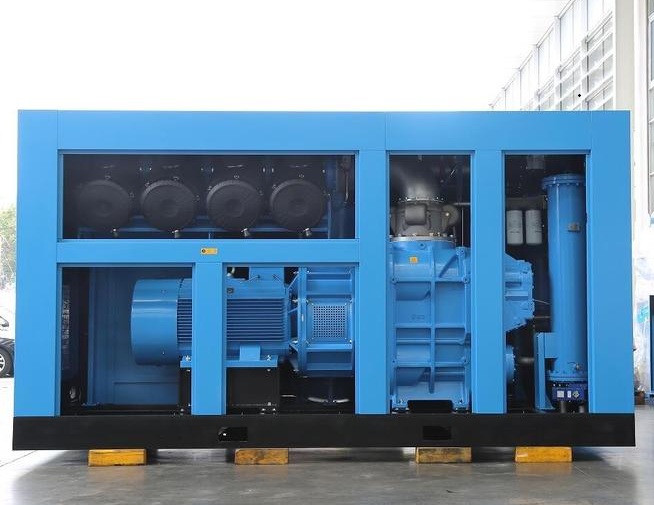
A two-stage compressor compresses air in two successive steps rather than completing the entire pressure increase in one step. An intercooler may be used between stages to reduce air temperature before the second compression step. The practical result can be improved compression conditions, particularly where the required pressure ratio and duty cycle are demanding.
Two-stage compression is most valuable when the plant operates continuously and the pressure requirement is sufficiently demanding to justify the additional equipment. It can also provide a useful operating margin when the mill has long pipe runs, elevation changes, multiple production halls, or a large number of air-jet looms.
Two-stage equipment is not a universal efficiency solution. A poorly sized two-stage unit can operate below its efficient range, while an oversized machine can spend excessive time unloaded. The total system must be assessed, including sequencing, receiver capacity, variable-speed control, cooling, filtration, and maintenance access.
| Stage number | Compression arrangement | Typical selection question | Primary evaluation focus |
|---|---|---|---|
| 1 | One compression step | Is the required pressure and flow moderate and stable? | Purchase cost, part-load behavior, and pressure loss |
| 2 | Two successive compression steps | Does continuous production justify additional compression capability? | Lifecycle energy, cooling, maintenance, and pressure stability |
The table describes the equipment architecture, not a guaranteed energy saving. Actual performance depends on the manufacturer's test conditions, operating pressure, inlet temperature, control mode, and plant load profile.
When Two-Stage Air Compressors Are a Good Fit
Two-stage equipment is most defensible when the mill has a high and sustained compressed-air load. Continuous air-jet weaving, multiple loom halls, and limited tolerance for pressure dips are practical indicators that a detailed two-stage evaluation is worthwhile.
- The looms operate for long production periods with limited demand variation.
- The plant has a high aggregate flow requirement and needs staged capacity control.
- Pressure at the compressor room is materially higher than pressure at the loom header.
- The distribution system is extensive or includes several production buildings.
- Unplanned pressure drops cause loom stops, fabric defects, or repeated operator intervention.
- The mill is planning expansion and wants additional capacity or redundancy.
Two-stage compression can also make sense when the mill's production losses are greater than the expected difference in equipment cost. The relevant comparison should include electricity, maintenance, downtime, rejected fabric, and future capacity—not only the initial quotation.
When a Single-Stage Rotary Screw May Be Sufficient
A single-stage rotary screw compressor may be the better choice when measured demand is moderate, pressure requirements are within the machine's efficient operating range, and the plant has a short, well-designed distribution network. Simpler equipment can reduce capital cost and make routine service easier.
Single-stage equipment is particularly reasonable when the mill has accurate demand data, adequate receiver volume, low leakage, and a control system that matches compressor output to loom demand. A variable-speed unit may help where demand changes significantly during shifts, provided it is selected for the actual operating envelope rather than maximum theoretical flow.
The deciding factor is not whether the compressor has one or two stages in isolation. It is whether the chosen package delivers the required flow and pressure at the loom with the lowest reliable lifecycle cost.
Textile Mill Compressor Selection Must Cover the Whole System
A compressed-air installation is a system rather than a standalone compressor. The system normally includes the compressor, air receiver, dryer, filters, pipe network, control system, and end-use equipment. Ignoring any of these elements can undermine a technically sound compressor choice.
| Review number | System element | Key question | Potential production impact |
|---|---|---|---|
| 1 | Compressor | Does capacity match measured demand? | Unloaded running, overload, or insufficient flow |
| 2 | Air receiver | Can it buffer demand changes? | Pressure cycling and unstable loom supply |
| 3 | Dryer | Is the drying level suitable for the process? | Moisture in valves, nozzles, and piping |
| 4 | Filters | Are particulate and oil-removal requirements defined? | Contamination and pressure drop |
| 5 | Pipe network | Are diameter, routing, and pressure loss acceptable? | Low end-use pressure and wasted energy |
| 6 | Controls | Can multiple machines share load efficiently? | Short cycling or inefficient part-load operation |
| 7 | End-use devices | Are nozzles and regulators correctly adjusted? | Excessive air consumption |
| 8 | Monitoring | Are flow, pressure, power, and alarms recorded? | Hidden losses and delayed fault detection |
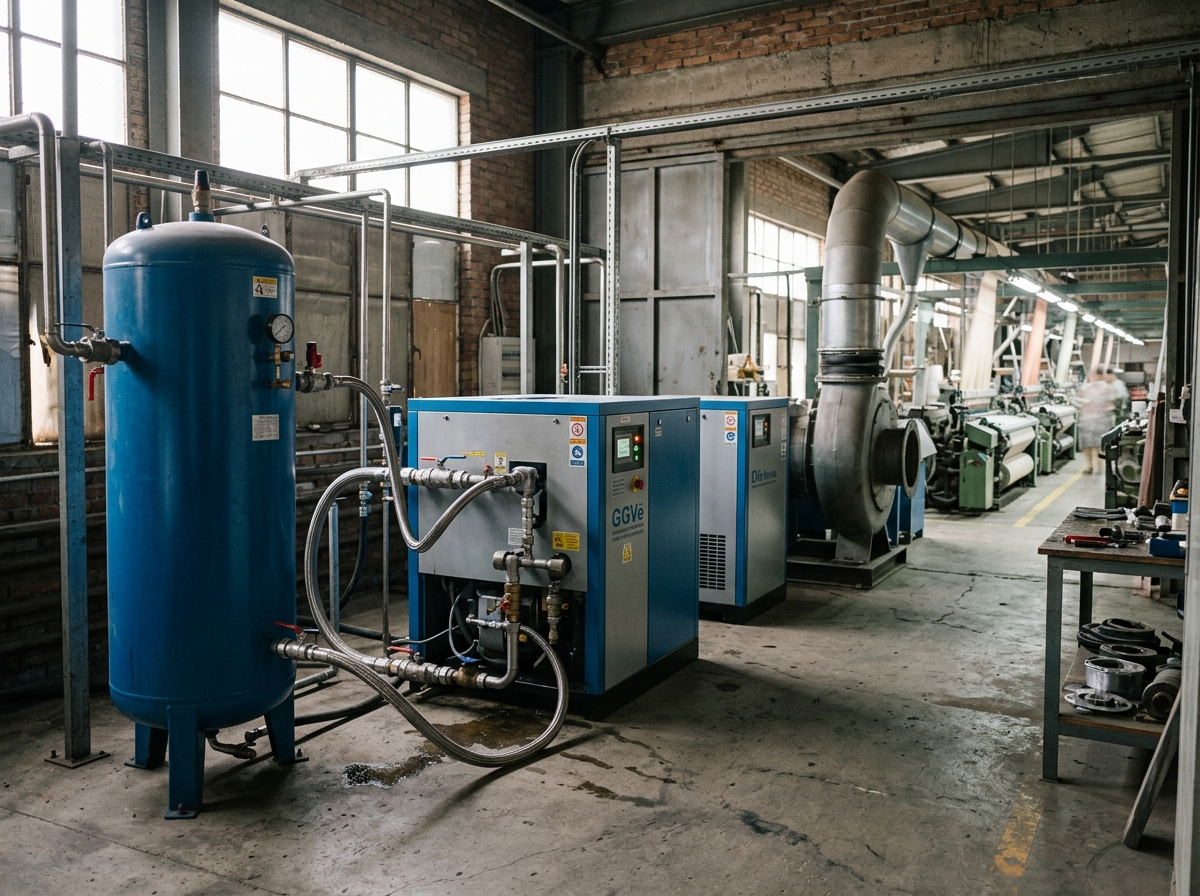
Air treatment deserves special attention in weaving. Textile applications generally need control of particles, oil aerosol, moisture, and pressure stability. The required treatment level depends on the loom manufacturer, plant environment, and product-quality risk. A source discussing textile compressor systems describes a treatment sequence that includes the compressor, receiver, refrigerated dryer, and precision filters; the final design should still be validated against the actual process requirement.
How to Compare Energy and Operating Cost
Lifecycle cost should guide the decision because electricity and production risk can outweigh the purchase price. Compare the expected operating profile of each option using measured flow, operating pressure, annual hours, electricity tariff, unloading behavior, maintenance requirements, and planned expansion.
Do not accept a generic efficiency claim without test conditions. Ask suppliers to state the flow basis, discharge pressure, inlet conditions, control mode, motor efficiency assumptions, and whether auxiliary equipment is included. A fair comparison should use the same boundary for both systems.
- Record compressor-room pressure, loom-header pressure, and end-use pressure during representative production.
- Measure or estimate flow during normal operation, peak production, shift changes, and idle periods.
- Identify leaks, open blowing, oversized regulators, and poorly adjusted nozzles.
- Model one-stage and two-stage options at the same delivered pressure and usable flow.
- Include dryers, filters, receivers, pipework, controls, service, and downtime exposure in the comparison.
- Review the result with production, maintenance, electrical, and quality teams before purchasing.
Energy optimization should continue after installation. Demand-based control, multi-machine sequencing, leak repair, nozzle optimization, remote monitoring, and heat recovery can improve the result regardless of whether the plant chooses one-stage or two-stage equipment.
Air Quality and Reliability Considerations
Clean and dry air protects both the compressed-air equipment and the weaving process. Moisture can promote corrosion and disturb pneumatic components, while particles or oil carryover may create maintenance and product-quality concerns.
Dryer selection should match the mill's ambient conditions and process sensitivity. Refrigerated drying is commonly suitable for general industrial applications, but a higher level of drying or filtration may be needed for a particular process. Pressure drop across treatment equipment must be included in the compressor calculation because excessive restriction can increase required discharge pressure.
Reliability planning should include redundancy and service access. A mill that cannot tolerate a single compressor failure may need multiple machines, independent treatment capacity, an adequately sized receiver, or a staged expansion plan. Remote monitoring can help identify abnormal temperature, pressure, vibration, loading, or filter conditions before they become production interruptions.
A Practical Decision Framework
The best answer is usually obtained through a measured, application-specific study rather than a general recommendation. Use the following sequence when reviewing a two-stage compressor for air-jet looms.
- Define the process: list loom types, operating schedules, fabric ranges, planned additions, and quality constraints.
- Measure demand: capture flow and pressure across representative production conditions.
- Check the network: inspect pipe sizing, pressure losses, storage, condensate handling, and leaks.
- Compare architectures: evaluate one-stage, two-stage, variable-speed, and multi-machine configurations on equal delivered-air terms.
- Validate treatment: specify filtration and drying according to the process and environmental conditions.
- Build the business case: include capital cost, electricity, maintenance, downtime, fabric loss, and expansion needs.
- Commission properly: verify pressure, flow, air quality, controls, alarms, and performance at the looms.
Independent research also supports treating air consumption as a central economic issue in air-jet weaving. The published study available through ResearchGate's investigation of air consumption in air-jet looms discusses the relationship between air use, production cost, and electricity demand.
Frequently Asked Questions
1. Is a two-stage air compressor always better for air-jet looms?
No. It may be advantageous for high-load, continuous, or pressure-sensitive production, but a correctly sized single-stage rotary screw can be more economical for moderate and stable demand.
2. What pressure should an air-jet loom compressor provide?
The required pressure must come from the loom manufacturer and be verified at the loom header. The compressor-room setting should also account for treatment equipment and pipe-network pressure loss.
3. How should a textile mill calculate compressor capacity?
Start with the combined measured demand of the looms, then evaluate peak demand, operating schedule, receiver storage, leakage, future expansion, and required redundancy. Avoid relying only on the sum of nameplate ratings.
4. Does variable-speed control replace the need for two stages?
No. Variable-speed control addresses capacity matching, while compression stages address the compression process and pressure ratio. The best configuration may combine staged compression with suitable load control.
5. Which air treatment equipment is needed?
Most installations require a receiver, dryer, and filters, but the exact specification depends on ambient conditions, loom requirements, contamination risk, and acceptable pressure drop.
6. Can pressure instability be caused by the pipe network?
Yes. Undersized pipes, long runs, excessive fittings, clogged filters, leaks, and poor receiver placement can reduce end-use pressure even when the compressor is correctly sized.
7. What information should a mill request from suppliers?
Request delivered flow, discharge pressure, power input, test conditions, control range, sound data, service requirements, treatment-equipment pressure drop, warranty terms, and references from comparable textile applications.
About Deman and the Next Step
Deman supports industrial compressed-air planning with a system-oriented approach that considers compressor selection, air treatment, storage, controls, pipework, monitoring, and lifecycle cost. For a textile project, the most useful next step is a documented demand review covering loom data, pressure measurements, air quality, production continuity, and future capacity. Use that evidence to compare one-stage and two-stage solutions before requesting a final quotation. For additional industry context, review this textile air-compressor sizing overview, this compressed-air guide for textile mills, and this discussion of two-stage compressors in textile manufacturing.