
Which Two-Stage Air Compressor Fits Continuous Metal Stamping Lines?
A two-stage air compressor for metal stamping is usually the stronger choice when the line requires stable pressure, frequent pneumatic actuation, or extended operating periods. The correct selection depends on measured flow demand, working pressure, air quality, duty profile, redundancy, and the complete air system—not compressor horsepower alone.
- Choose a two-stage compressor when stamping equipment has sustained or demanding compressed-air requirements.
- Size the metal stamping line air supply from measured demand, pressure at the point of use, leakage, and future expansion.
- A complete system includes the compressor, receiver, dryer, filters, piping, controls, and end-use equipment.
- Rotary screw technology generally suits continuous manufacturing better than a reciprocating piston unit when the duty profile is long and steady.
Continuous stamping lines need more than a high-pressure nameplate: they need an air system that maintains pressure while presses, feeders, clamps, blow-off devices, and automation operate together. Quincy Compressor explains that dual-stage compression produces higher air power and is better suited to large-scale and continuous applications. This guide compares the main options, identifies selection risks, and shows how to specify a reliable metal stamping line air supply.
Why Two-Stage Compression Can Suit Metal Stamping
Two-stage compression reduces the pressure increase performed by each cylinder or compression stage. Air is compressed initially in a low-pressure stage, cooled between stages, and then compressed again in a high-pressure stage. The staged process can support higher final pressure and more controlled compression than a basic single-stage arrangement.
The main benefit for stamping is pressure stability under demanding use, not simply a higher maximum-pressure rating. Pneumatic cylinders, valves, tooling, material feeders, and clamping systems can react poorly when pressure falls during simultaneous cycles. A correctly selected two-stage compressor provides a stronger foundation, but the receiver, piping, controls, and treatment equipment must also be sized correctly.
Two-stage equipment is not automatically the best answer for every line. A small, intermittent application may be served economically by another compressor type, while a large plant with a high and steady flow profile may need a rotary screw or centrifugal solution rather than a two-stage piston machine. The duty cycle and flow pattern should determine the architecture.
| Configuration | Compression stages | Typical operating pattern | Primary selection question |
|---|---|---|---|
| Single-stage piston | 1 | Intermittent or moderate demand | Is the required pressure and recovery adequate? |
| Two-stage piston | 2 | Higher pressure or demanding intermittent use | Can the duty cycle support the production schedule? |
| Two-stage rotary screw | 2 | Extended or continuous industrial demand | Can it maintain efficient flow at the measured load? |
| Centrifugal system | Multiple dynamic compression steps may be used | Large, steady centralized demand | Is plant flow large and stable enough to justify the system? |
The table describes equipment categories rather than a universal specification. Actual suitability depends on the manufacturer's rated flow, pressure, cooling method, control range, service conditions, and documented duty rating.
How to Size a Metal Stamping Line Air Supply
The correct compressor size starts with an air-demand study rather than a motor-size comparison. Record the air consumption of every pneumatic device, identify which devices operate at the same time, and distinguish peak demand from average demand.
- List presses, feeders, cylinders, valves, clamps, blow-off points, controls, and maintenance outlets.
- Record each device's required pressure and flow using its manufacturer documentation or field measurement.
- Map the production sequence to determine simultaneous demand and short-duration peaks.
- Measure pressure at the compressor room and at the most remote point of use.
- Account for dryer, filter, piping, leakage, expansion, and an appropriate engineering margin without using an arbitrary oversized factor.
Peak demand and average demand should be evaluated separately. A receiver can help absorb short peaks, but it cannot compensate indefinitely for an undersized compressor. Conversely, an oversized compressor may spend excessive time unloaded or cycling, which can increase energy waste and maintenance without improving production.
| Design item | Measured input | Numerical unit to record | Why it matters |
|---|---|---|---|
| Operating pressure | Required pressure at the tool | psi or bar | Determines compressor and control pressure |
| Air demand | Device and line consumption | CFM or cubic metres per minute | Determines capacity |
| Peak duration | Length of simultaneous demand | Seconds or minutes | Guides receiver and control selection |
| Operating schedule | Production hours and shifts | Hours per day | Separates intermittent from continuous duty |
| Pressure loss | Supply pressure minus point-of-use pressure | psi or bar | Reveals piping, filter, and dryer restrictions |
These are the numerical fields that should be collected during engineering; they are not default values. The final specification should use the same reference conditions and measurement method across all supplier quotations.
Choosing Between Piston, Rotary Screw, and Centrifugal Equipment
A two-stage piston compressor fits best when the line needs higher pressure but has an intermittent or moderate duty profile. Piston machines can be practical for smaller fabrication areas, backup service, or applications in which demand occurs in cycles. They require careful attention to duty rating, cooling, receiver capacity, vibration, and maintenance access.
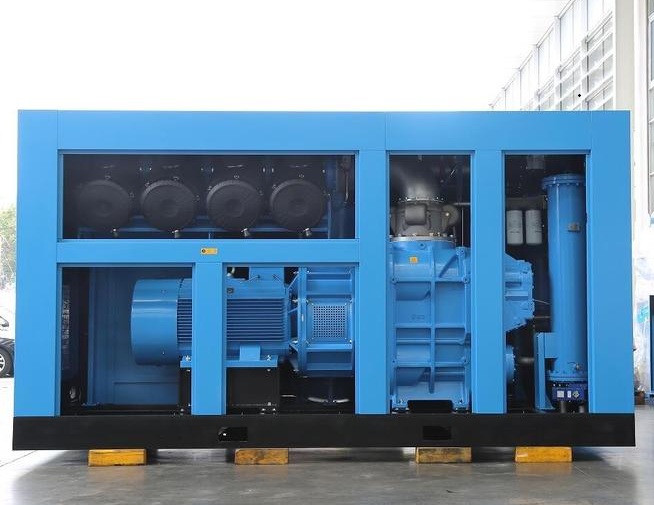
A two-stage rotary screw compressor is usually more appropriate when stamping demand remains high for long periods. Rotary screw systems are widely used in continuous manufacturing because they can provide steady flow, automatic control, and integration with dryers, filters, receivers, and plant monitoring. A variable-speed model can reduce unloaded operation when demand changes, provided its control range and operating envelope match the line.
A centrifugal compressor is normally considered for large centralized systems with substantial and relatively stable flow. It is not a default replacement for a piston or screw machine. The plant must have sufficient baseline demand, suitable cooling and water management where applicable, and an operating strategy that avoids inefficient low-load conditions.
The correct choice is a system decision. The two-stage rotary screw explanation from Kaishan describes the relationship between staged compression and continuous operation, while ABAC's single-stage and two-stage comparison provides useful background for evaluating pressure and application requirements.
Air Quality and System Components
Clean, dry, stable air protects pneumatic components and reduces production risk. Metal stamping environments can expose equipment to oil mist, water, dust, and temperature changes, while moisture or particles at the point of use may damage valves, contaminate tooling, or shorten actuator life.
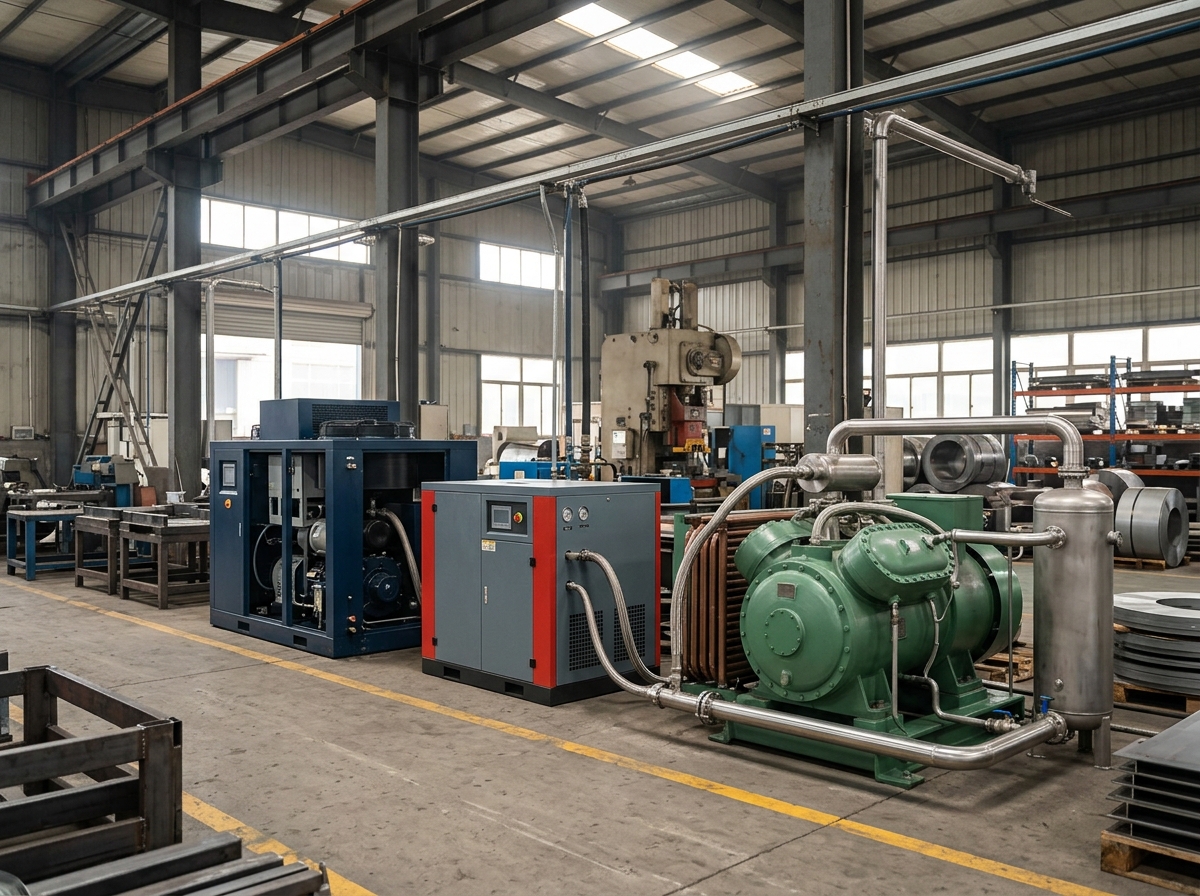
The compressor is only one part of the air system. A typical installation includes a compressor, aftercooler, receiver, dryer, particulate and coalescing filters, condensate management, distribution piping, control equipment, and point-of-use treatment. The required filtration and drying level should be based on the equipment and product sensitivity rather than a generic package.
- Use a refrigerated dryer for many general industrial applications when the required pressure dew point permits it.
- Consider a higher-grade drying and filtration arrangement when condensation, corrosion, or process contamination is unacceptable.
- Evaluate oil-free compression when the process is especially sensitive to oil contamination.
- Install drains and condensate controls that are suitable for the operating environment.
- Check pressure drop across filters and dryers at the actual peak flow.
Distribution design directly affects end-use pressure. Long runs, undersized pipe, sharp restrictions, blocked filters, and poorly positioned branches can create pressure loss that is incorrectly blamed on the compressor. A ring main, correctly sized headers, short drops, isolation valves, and leak management can improve stability without increasing compressor capacity.
Controls, Efficiency, and Reliability
Energy performance depends on how the compressors are controlled at changing demand. Variable-speed operation can match output more closely to demand, while multi-machine sequencing can prevent several units from operating inefficiently at partial load.
Remote monitoring improves maintenance visibility but does not replace a documented service plan. Track discharge pressure, temperature, running hours, load and unload behavior, filter differential pressure, dew point, condensate performance, and abnormal vibration or noise. Trending these values can identify deterioration before it interrupts a stamping shift.
Reliability should be designed with production consequences in mind. A single compressor may be adequate for a low-risk line, but a critical continuous line may need a lead-lag arrangement, standby capacity, isolation capability, or a temporary connection point. The right redundancy level depends on the cost of downtime, repair lead time, and the availability of alternative production capacity.
Waste-heat recovery can improve total energy utilization where the plant has a consistent demand for hot water or process heat. It should be evaluated as an integrated utility project, with attention to operating hours, temperature requirements, controls, and seasonal demand rather than treated as an automatic compressor benefit.
Practical Selection Checklist
A supplier quotation is complete only when it explains how the proposed package will perform at the line, not merely how large the motor is.
- Confirm required pressure at each critical point of use.
- Obtain measured or documented flow for all simultaneous pneumatic loads.
- Define average demand, peak demand, peak duration, and operating hours.
- Select piston, rotary screw, or centrifugal technology from the duty profile.
- Specify receiver, dryer, filters, drains, and piping as one coordinated package.
- Compare full-load, part-load, unloaded, and standby operating behavior.
- Require service access, replacement-part planning, alarms, and remote monitoring provisions.
- Validate the proposal with a commissioning test at the actual stamping line.
Common Selection Mistakes
The most common mistake is choosing by horsepower alone. Motor size does not prove delivered flow at the required pressure, and it does not show how the compressor behaves during peak demand or unloaded operation.
The second mistake is treating a receiver as a substitute for capacity. Storage can smooth short events, but repeated demand over a long production period still requires sufficient compressor output and appropriate controls.
The third mistake is ignoring the end-use pressure. If the press tools require stable pressure but the supplier rates the compressor at a different reference condition, the comparison may be misleading. Ask for consistent flow, pressure, air quality, and measurement conditions in every proposal.
The fourth mistake is overlooking maintenance and failure response. A technically efficient compressor that cannot be serviced quickly may create more production risk than a slightly less efficient system with strong local support and available parts.
Frequently Asked Questions
1. Is a two-stage air compressor always better for a stamping line?
No. It can be better for higher pressure or demanding operation, but the correct solution depends on measured flow, duty cycle, air quality, and required reliability. A continuous high-flow line may need a rotary screw or centrifugal system instead of a piston package.
2. What pressure should a metal stamping line use?
There is no universal pressure for every stamping line. Use the pressure specified by the pneumatic equipment and verify it at the point of use. Increasing compressor pressure to compensate for poor piping can raise energy use without solving the underlying restriction.
3. Can a piston two-stage compressor run continuously?
Only if the specific model is rated for the operating profile. Check the manufacturer's duty rating, cooling requirements, allowable run time, service intervals, and ambient conditions. Do not infer continuous suitability from the fact that the machine has two stages.
4. When is a rotary screw compressor preferable?
A rotary screw compressor is generally preferable when the line has sustained demand over long operating periods and needs steady flow with automatic control. Confirm that its turndown range and minimum stable load match the actual demand pattern.
5. Does the stamping line need a dryer?
Most industrial pneumatic systems benefit from appropriately dried air. The correct dryer type depends on the required pressure dew point, ambient conditions, process sensitivity, and downstream equipment. A refrigerated dryer may suit general use, while more demanding applications may require additional treatment.
6. How can pressure drops be reduced?
Measure pressure at the compressor and at the critical end uses, then inspect pipe sizing, branch layout, filters, dryers, valves, and leaks. Correcting restrictions and repairing leaks can improve performance before additional compressor capacity is purchased.
7. What information should be included in a quotation request?
Include operating pressure, measured or documented flow, peak duration, production hours, ambient conditions, air-quality requirements, available electrical service, installation constraints, redundancy expectations, monitoring needs, and the consequences of downtime.
About Deman
Deman develops industrial compressed-air solutions around the complete operating requirement rather than a standalone machine. Its approach considers compressor selection, air treatment, storage, piping, controls, energy use, monitoring, and maintenance planning. For a continuous metal stamping project, provide the measured demand profile and production constraints so the proposed two-stage system can be evaluated for capacity, efficiency, air quality, and long-term reliability before purchase.
For a project review, request a system assessment based on your actual stamping-line data, including peak flow, pressure at the tools, operating schedule, and required air quality.