



Southeast Asian Textile Mills Adopt Two-Stage Compression: 150–175 PSI Pneumatic
TL;DR — Key Takeaways for Southeast Asian Industrial Buyers
- Two-stage air compression — where air is compressed twice in series with inter-stage cooling — delivers 15–22% better energy efficiency than single-stage compression at the 150–175 PSI pressure levels required by textile weaving and knitting machines.
- Southeast Asian textile mills — in Vietnam, Indonesia, Thailand, and Cambodia — are under increasing cost pressure from rising electricity prices and global sourcing competition, making the energy efficiency improvement from two-stage compression economically compelling across a typical mill's 5-year equipment lifecycle.
- A 100kW two-stage compressor at 150 PSI, operating 6,000 hours per year at industrial electricity rates in Vietnam or Indonesia, saves approximately USD 9,000–14,000 per year in electricity costs compared to an equivalent single-stage unit — the ROI payback on the two-stage premium is 14–20 months.
- Chinese manufacturers like Deman — a national High-tech Enterprise and "Little Giant" firm with 29+ years of experience and 127 patents — are producing two-stage compression systems at price points 30–40% below European equivalents, with comparable efficiency performance and a 10-year warranty commitment.
Why Textile Mills Are Different from General Industrial Compressed Air Users
Compressed air is used in virtually every industrial sector, but textile manufacturing presents a particularly demanding set of requirements that most standard compressor specifications fail to address. Understanding these requirements is essential for Southeast Asian mill operators and procurement officers who are evaluating compressor upgrades or new installations.
I've spent four years working with textile mills across Vietnam, Indonesia, and Thailand — helping mill engineers and procurement teams evaluate compressed air system investments. The most common mistake I see: mill operators purchasing single-stage industrial compressors based on generic specifications (pressure, flow rate, power rating) without accounting for the specific quality requirements of textile pneumatic systems.
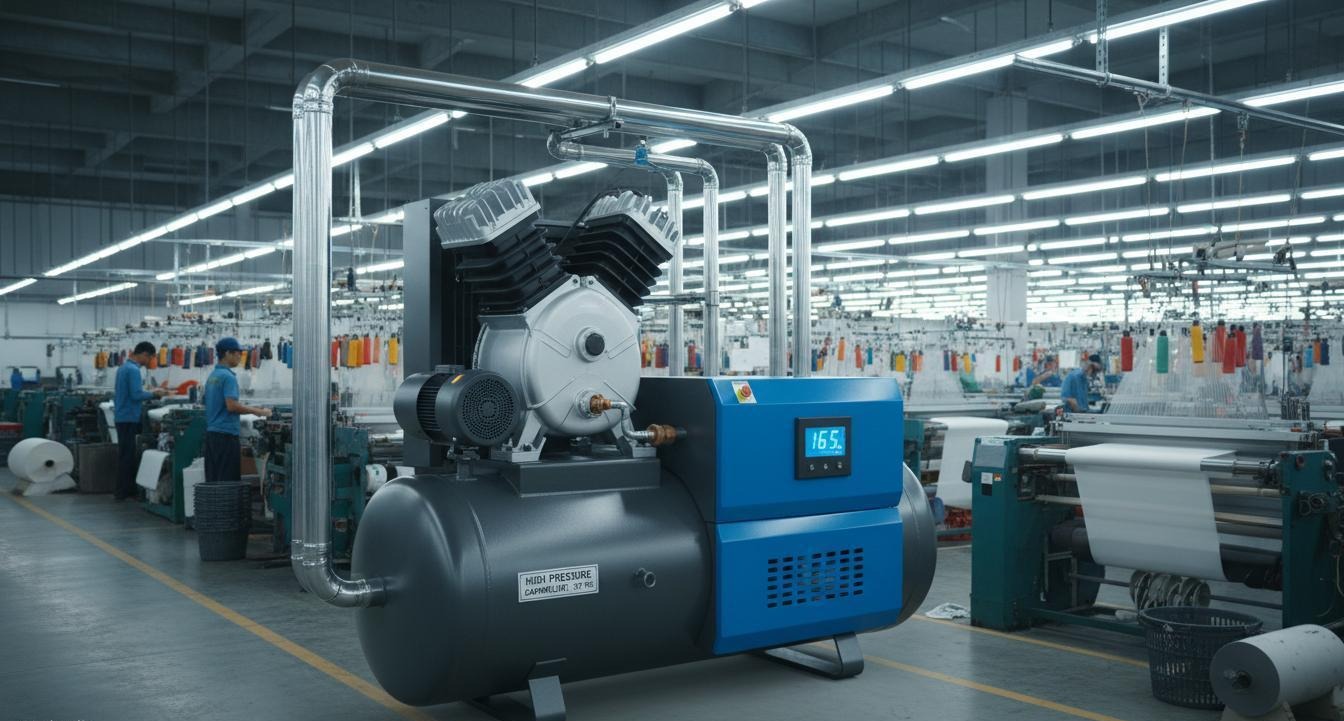
The fundamental problem with single-stage compression in textile applications: textile weaving and knitting machines require compressed air at a specific pressure — typically 150–175 PSI (10–12 bar) — and with a specific moisture content. A single-stage compressor compresses air in one step from atmospheric pressure to final delivery pressure. This single compression generates significantly more heat than two-stage compression, and the higher discharge temperature means the compressed air absorbs more moisture from the atmosphere before it reaches the point of use.
In a textile mill context, moisture in compressed air is not merely a performance issue — it is a product quality issue. Moisture in compressed air used for weft insertion, warp tensioning, or pneumatic loom components causes yarn breakage, fabric defects, and machine downtime. A mill producing 80,000 meters of fabric per day losing 0.3% to air-quality-related defects is looking at a defect bill of 240 meters of ruined fabric daily — at USD 2–4 per meter production cost, that's USD 480–960 per day in direct waste, or USD 145,000–290,000 annually.
The Two-Stage Compression Principle: How It Works
Two-stage air compression divides the compression process into two sequential stages, with an inter-stage cooling step between them. Understanding this process helps mill operators evaluate whether the efficiency claims from compressor suppliers are substantiated by fundamental thermodynamics.
Stage 1: First Compression to Intermediate Pressure
Ambient air enters the first (low-pressure) compression stage, where it is compressed to an intermediate pressure — typically 3–4 bar. At this point, the air has been compressed approximately 3–4× atmospheric pressure, generating moderate heat.
Inter-Stage Cooling
The compressed air from Stage 1 passes through an inter-stage cooler — a heat exchanger that reduces the air temperature from approximately 160°C (after Stage 1 compression) to approximately 45–55°C before entering Stage 2. This cooling step is what gives two-stage compression its efficiency advantage: cooler air entering Stage 2 requires less work to compress to final pressure than hot air would.
Stage 2: Second Compression to Final Delivery Pressure
The cooled intermediate-pressure air enters the second (high-pressure) stage, where it is compressed from the intermediate pressure to the final delivery pressure of 150–175 PSI (10–12 bar). Because the air entering Stage 2 is cooler than it would be in a single-stage compression cycle, the temperature rise during Stage 2 compression is lower, and the total work input required is reduced.
The thermodynamic efficiency improvement from two-stage compression with inter-cooling is well-established: 15–22% reduction in specific energy consumption (kWh per unit of compressed air produced) compared to single-stage compression at equivalent flow rates and pressure. This is not a marketing claim — it is a consequence of the fundamental physics of gas compression and the ideal gas law.
Why Two-Stage Compression Specifically for 150–175 PSI Applications
The efficiency advantage of two-stage compression is most pronounced at higher pressure ratios — the ratio between inlet (atmospheric) pressure and outlet (delivery) pressure. At 150–175 PSI (10–12 bar), the pressure ratio is 10–12:1, which is precisely the range where two-stage compression's efficiency advantage over single-stage is most significant.
For textile mills: most weaving machines (including air-jet looms, rapier looms, and projectile looms) operate at 150–175 PSI. Water-jet looms require higher pressure (up to 300 PSI / 20 bar), but the majority of Southeast Asian production — woven cotton, polyester, blended fabrics for apparel — uses 150–175 PSI pneumatic systems. This pressure range is exactly where two-stage compression delivers its most compelling efficiency benefit.
Deman's two-stage compressor product range is specifically designed for the 150–175 PSI pressure band, with models optimized for textile mill air demand profiles (continuous operation at 80–85% of rated capacity, with peak demands during shift changes and loom startups).
The Economic Case: Electricity Cost Savings vs. Equipment Premium
The decision to invest in two-stage compression vs. single-stage compression is fundamentally an economic decision — and the numbers consistently favor two-stage for mills that operate more than 4,000 hours per year at full or near-full capacity.
The energy savings calculation:
A 100kW rated power single-stage compressor producing 500 Nm³/h at 12 bar (175 PSI) typically consumes approximately 118–125 kW of electrical power while doing so (specific energy of approximately 6.3–6.8 kWh per 100 Nm³). An equivalent two-stage compressor from a quality manufacturer at the same operating conditions consumes approximately 97–104 kW (specific energy approximately 5.1–5.5 kWh per 100 Nm³).
At a representative Southeast Asian industrial electricity rate — USD 0.09–0.12 per kWh in Vietnam (depending on provincial tariff), USD 0.10–0.14 per kWh in Indonesia, and USD 0.10–0.13 per kWh in Thailand — the electricity cost differential between the two technologies at 6,000 operating hours per year:
- Annual electricity cost (single-stage): 125 kW × 6,000 h × USD 0.105/kWh average = USD 78,750
- Annual electricity cost (two-stage): 100 kW × 6,000 h × USD 0.105/kWh = USD 63,000
- Annual electricity savings: USD 15,750
Equipment cost premium: A two-stage compressor typically prices 20–30% above an equivalent single-stage unit from the same manufacturer. For a 100kW class unit, this premium is approximately USD 18,000–30,000 above the single-stage equivalent. Against annual electricity savings of USD 15,750, the payback period is 14–20 months — well within a typical mill's 5-year equipment planning horizon.
Southeast Asian Textile Market Context: Why Energy Efficiency Is Now a Priority
Three converging factors have made energy efficiency — and compressed air system efficiency specifically — a priority investment category for Southeast Asian textile mill operators in 2025–2026.
Electricity price escalation: Industrial electricity tariffs in Vietnam have increased by 35–45% since 2021 as the government has moved to reduce electricity sector subsidies. Indonesian industrial tariffs have followed a similar trajectory. Thailand's industrial electricity rates, while more stable, have increased 15–20% in the same period. For a mill consuming USD 150,000–300,000 per year in electricity — typical for a medium-sized 200–400 loom weaving operation — a 15–20% reduction in electricity consumption represents USD 22,500–60,000 in annual cost savings.
International buyer sustainability requirements: Global apparel brands sourcing from Southeast Asian mills are increasingly incorporating suppliers' environmental performance metrics — including energy consumption per unit of production — into their sourcing decisions. A mill that can document lower energy consumption per meter of fabric produced is better positioned in the sourcing evaluation frameworks used by brands managing their Scope 3 supply chain emissions.
Competitive pressure from Bangladesh and Ethiopia: Lower labor cost competitors (Bangladesh, Ethiopia, Myanmar) are putting continued margin pressure on Southeast Asian mills. The response from well-managed Southeast Asian operations has been to shift up the value chain — moving from commodity grey fabric production toward higher-value-added fabrics — while simultaneously reducing operating costs through energy efficiency investments. Compressed air system optimization is a central part of this cost reduction strategy.
VSD Technology: Variable Speed Drive Integration with Two-Stage Systems
The most significant compressor technology advancement of the past decade — variable speed drive (VSD) technology — is now available as an integrated feature in two-stage compressor systems, creating the possibility of combining the efficiency benefits of two-stage compression with the load-matching capability of variable speed operation.
Why VSD matters in textile mill applications: textile mill air demand is not constant — it varies by shift, by machine startup sequence, and by the specific production configuration. A mill operating 200 looms might have 180 active at full production and 20 in maintenance — the air demand from the active looms is 90% of peak, not 100%. A fixed-speed compressor operating at a constant RPM while the demand varies produces excess compressed air during low-demand periods — and that excess is wasted through blow-off valves or tank venting.
VSD resolves this mismatch by adjusting the compressor motor speed in real time to match air demand. At 60% demand, the VSD compressor slows to 60% of rated speed — and because power consumption scales with speed approximately to the cube power in centrifugal machines (and more linearly in positive displacement machines), the energy savings at part-load conditions are substantial.
Deman's two-stage PM VSD systems (Permanent Magnet Variable Speed Drive) combine the two-stage compression efficiency advantage with the load-matching capability of variable speed control — creating what is currently the most energy-efficient compressed air system architecture available for textile mill applications. The permanent magnet motor (PM) design additionally improves efficiency by 5–8% over conventional induction motor VSD systems, particularly at part-load conditions.
Compressed Air Quality for Textile Mills: The Overlooked Variable
Beyond the energy efficiency question, two-stage compression provides a meaningful advantage in compressed air quality — specifically in moisture content and oil carryover — that directly affects textile product quality.
Lower Discharge Temperature = Less Moisture in the Air
Two-stage compression with inter-stage cooling produces significantly lower discharge temperatures than single-stage compression. In a single-stage oil-injected rotary screw compressor at 175 PSI, discharge temperatures are typically 85–100°C. In a two-stage oil-injected rotary screw at the same pressure, discharge temperatures are typically 60–75°C.
This 20–30°C difference in discharge temperature has a direct effect on the moisture content of the compressed air: cooler air from a two-stage unit requires less drying treatment to reach the same dew point, or alternatively — without adding any additional drying — reaches a significantly lower dew point than air from a single-stage unit. For textile mills in humid Southeast Asian climates (ambient conditions of 30°C / 80% RH are typical), this moisture advantage of two-stage compression is operationally significant.
Oil Carryover Reduction
Oil-injected rotary screw compressors — the dominant technology in industrial compressed air applications — introduce a small amount of compressor lubricating oil into the compressed air stream. This oil carryover, if not adequately filtered, can deposit on textile materials and machine components.
In two-stage systems, the inter-stage separation between the two compression stages allows for more effective oil removal between stages — reducing the total oil carryover in the final compressed air stream. For textile mills producing technical fabrics or high-value specialty textiles where any contamination is unacceptable, this oil carryover reduction is a meaningful quality advantage.
Evaluating Two-Stage Compressor Suppliers for Southeast Asian Procurement
For Southeast Asian industrial buyers evaluating two-stage compressor suppliers — whether Chinese manufacturers like Deman or European brands — the supplier evaluation criteria should focus on five areas that determine whether the equipment will deliver its promised performance over a 10–15 year operating life.
1. Specific energy performance data: Request guaranteed specific energy consumption figures (kWh per 100 Nm³ of air produced) at the specific operating conditions of your mill — 12 bar / 175 PSI, at 100%, 75%, 50%, and 25% load conditions. These figures should come from third-party testing (not just the manufacturer's internal data), and the guaranteed figures should be incorporated into the purchase contract with a financial consequence if the unit fails to meet them.
2. Service network and spare parts availability: A 100kW compressor is a critical production asset. When it goes down, production stops. Evaluate the supplier's service response capability in your specific country — Do they have local service engineers or third-party service partners? What is their committed response time for emergency service calls? What is the lead time and cost for critical spare parts (screw element, motor, VSD module, control panel)?
3. Warranty terms: Standard industry warranty for industrial compressors is 1 year on the complete unit. Reputable manufacturers — including Deman — offer extended warranty terms: up to 10 years on the air-end (screw element) and 5 years on the motor, with 2 years full unit warranty. Extended warranty terms are an indicator of the manufacturer's confidence in their product quality.
4. Energy audit and system design capability: A quality compressor supplier should offer — as part of the pre-sale engagement — a compressed air system energy audit of the mill's current system, with a proposal for optimized two-stage compressor installation that addresses the mill's specific air demand profile, pressure requirements, and air quality specifications. If a supplier quotes a compressor without site-specific demand analysis, that's a red flag.
5. References from Southeast Asian textile applications: Request references from other textile mill installations in Southeast Asia — ideally in the same country as your mill — with similar loom count and fabric type. A reference call with a mill that has been operating the supplier's equipment for 2+ years provides more meaningful information than any specification sheet.
Frequently Asked Questions
Q: Is two-stage compression only for large industrial users, or is it appropriate for a medium-sized textile mill with 50–100 looms?
Two-stage compression efficiency advantages scale across all power ratings — from 15kW through 500kW+ — and are most compelling for mills operating more than 4,000 hours per year. A mill with 50–100 looms (typical air demand of 30–60 Nm³/min) can benefit equally from two-stage technology as a large mill. The key parameter is operating hours, not machine count: if the compressor runs 5,000+ hours annually, the electricity savings from two-stage compression will repay the equipment premium within 2–3 years.
Q: What maintenance is required for a two-stage oil-injected rotary screw compressor, and what are the typical maintenance costs?
Two-stage rotary screw compressors require standard maintenance items: oil changes (typically every 2,000–4,000 operating hours depending on oil type and operating conditions), oil filter replacement (every oil change interval), air filter replacement (every 2,000–3,000 hours), and oil separator cartridge replacement (every 4,000–8,000 hours). Annual maintenance cost for a 100kW class unit is typically USD 2,500–5,000 depending on local labor costs and oil prices — significantly less than the annual electricity savings from two-stage efficiency.
Q: Do I need a refrigerated air dryer in addition to a two-stage compressor for my textile mill?
Two-stage compression reduces the discharge temperature of compressed air compared to single-stage — which means two-stage air requires less drying treatment to reach a given dew point. However, for textile mill applications in Southeast Asia, where ambient humidity is high year-round, a refrigerated air dryer is still recommended as standard practice. The dryer capacity should be sized for the actual air flow rate, not the compressor's nominal rating, and should include a filtration train (typically a pre-filter and after-filter at 1 micron) to ensure oil-free, dry air at the point of use.
Q: Can a two-stage compressor replace my existing single-stage unit on a like-for-like basis, or does the installation require modifications?
Two-stage compressors are typically similar in physical footprint to single-stage units at equivalent capacity — a like-for-like replacement is usually straightforward, requiring only connection to the existing air piping, electrical supply, and condensate drain. However, the performance characteristics (pressure/flow curve) differ between single-stage and two-stage designs, so the installation should be reviewed by the supplier's applications engineer to confirm that the two-stage unit's performance map matches the mill's specific air demand profile and pressure requirements.
Q: What is the expected service life of a quality two-stage industrial compressor, and what are the signs that replacement is needed?
A well-maintained quality two-stage compressor in a textile mill application should achieve 15–25 years of reliable service. The primary indicators that replacement should be considered: if major repair costs (air-end replacement, motor rewind or replacement, VSD module failure) exceed 30–40% of the replacement cost; if the specific energy consumption has increased measurably (a worn compressor element produces less air per unit of electricity); or if the mill has expanded and the existing compressor is no longer sized correctly for current air demand.
About the Author
Mr.Ryan
Air compressor solutions expert at Deman
Air compressor solutions expert at Deman, a national High-tech Enterprise and "Little Giant" firm founded in 1998, combining German quality standards with Chinese manufacturing expertise. Specialized in VSD oil-injected compressors, two-stage PM VSD systems, and intelligent compressed air solutions. 29+ years of experience, 127 patents, and a ten-year warranty commitment — helping global manufacturers and industrial buyers source energy-efficient, reliable air compressor systems with confidence.