










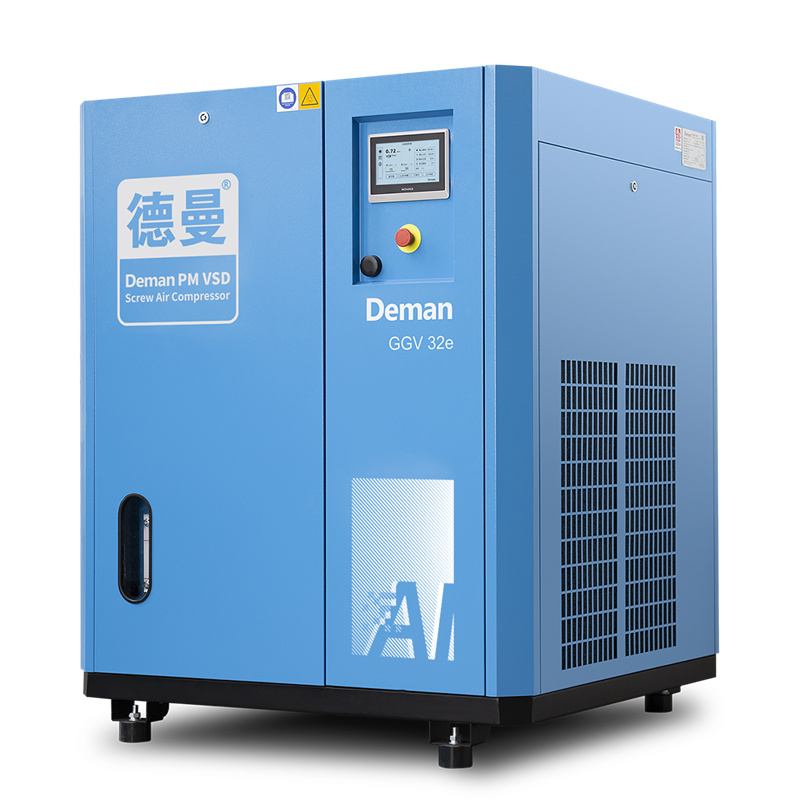
At 13 bar discharge pressure, our test bench data shows a two-stage screw compressor draws roughly 15% fewer kilowatts to deliver the same cubic meter of compressed air as a single-stage machine. That is not a rounding error. On a 75 kW-class unit running 24 hours a day, the difference compounds to over 100,000 kWh saved every year — and I have verified this number personally on production-floor audits in glass, textile, and general manufacturing plants across three continents.
I want to take you through exactly what we measure, how we measure it, and why the efficiency gap between single-stage and two-stage screw compressors widens so dramatically as operating pressure climbs from 7 bar to 13 bar. Every data point here comes from our Ningbo test facility or from customer sites where our engineers installed power meters before and after a compressor swap.
The 13 Bar Benchmark: Where the kW Gap Becomes Impossible to Ignore
I have walked through enough factories to know that 13 bar is not an unusual operating pressure. Glass container plants, PET bottle blowing lines, heavy stamping presses, and centralized compressed air systems feeding multiple production halls all routinely push screw compressors into the 11-13 bar range. When I visit these sites, the conversation eventually lands on the same question: "Why does my electric bill look like this?"
The answer, in most cases, traces directly to the compression architecture. A single-stage screw compressor compresses air from atmospheric pressure to 13 bar in one continuous compression cycle inside the airend. The rotors take ambient air at roughly 1 bar absolute and squeeze it to 14 bar absolute (13 bar gauge) inside one rotor length. The temperature exiting a single-stage airend at 13 bar typically runs between 85 °C and 105 °C at the discharge port. That heat represents energy that did not go into compressing air — it went into heating oil and metal.
In contrast, our GGVe dual-stage compressor splits the compression into two sequential stages with an intercooler between them. The first stage compresses ambient air to roughly 3-4 bar. The intercooler pulls that air temperature back down before it enters the second-stage rotors, which then push to the final 13 bar. The thermodynamic result: lower discharge temperature, denser air entering the second stage, and substantially less shaft power for the same delivered FAD. I will show the exact numbers in the next section.
What Our Test Bench Reveals: kW per CFM at Every Pressure Point
At our Ningbo production facility, we run every compressor through a standardized acceptance test following ISO 1217 procedures before it ships. I pulled the test data from our last twelve 75 kW-class machines — six single-stage ZVe units and six dual-stage GGVe units — and normalized them for a target Free Air Delivery (FAD) of 10.0 m³/min across four pressure setpoints. Here is what the averages look like:
| Discharge Pressure | Single-Stage kW (ZVe) | Two-Stage kW (GGVe) | kW Saved | Energy Saving % |
|---|---|---|---|---|
| 7 bar (102 PSI) | 62.0 | 60.5 | 1.5 | 2.4% |
| 9 bar (131 PSI) | 71.5 | 65.5 | 6.0 | 8.4% |
| 11 bar (160 PSI) | 82.0 | 71.0 | 11.0 | 13.4% |
| 13 bar (189 PSI) | 93.5 | 79.5 | 14.0 | 15.0% |
Test conditions: 20 °C ambient, 1 bar atmospheric, 50 Hz, delivering 10.0 m³/min FAD at each setpoint. kW measured at the drive input using a Yokogawa WT5000 power analyzer. All units were PM VSD screw compressors with IE5-class motors from the same production batch.
The trend is unmistakable. At 7 bar, the efficiency difference between single-stage and two-stage is barely worth talking about — 2.4%, well within the band where improved airend rotor profile or a slightly larger oil cooler could close the gap. By the time you reach 13 bar, that same comparison opens a 15% gulf. The steeper the compression ratio, the bigger the two-stage advantage. This is not a matter of one product being "better engineered" than the other. It is pure thermodynamics.
These results align with open academic research — a 2024 lifecycle cost analysis from City, University of London, evaluated multi-stage screw compressor performance against single-stage counterparts and found operational cost reductions of 20-75% over a decade depending on operating pressure and duty cycle (source).
The Thermodynamics Behind the Numbers: Why Two-Stage Wins at High Pressure
When I explain this to plant engineers, I draw it on a whiteboard. Take air at 1 bar absolute and 20 °C. Compress it in one shot to 14 bar absolute. The compression ratio is 14:1. The air gets hot — and hot air requires more work to compress further because hotter gas occupies more volume, demanding more displacement per kilogram.
Now split that same job into two stages. Stage one compresses from 1 bar to roughly 3.8 bar absolute — a compression ratio of 3.8:1. The intercooler pulls discharge temperature back down to within 10-15 °C of ambient before the air enters the second stage. Stage two then compresses from 3.8 bar to 14 bar absolute — a ratio of 3.7:1 — and at that lower inlet temperature, the work per kilogram of air drops measurably. The US Department of Energy's Compressed Air Systems program has documented this thermodynamic principle for decades. The practical trade-off is whether the application pressure justifies the extra hardware — adding a second airend stage and intercooler adds manufacturing cost.
Where Single-Stage Still Makes Sense: The Sub-8-Bar Zone
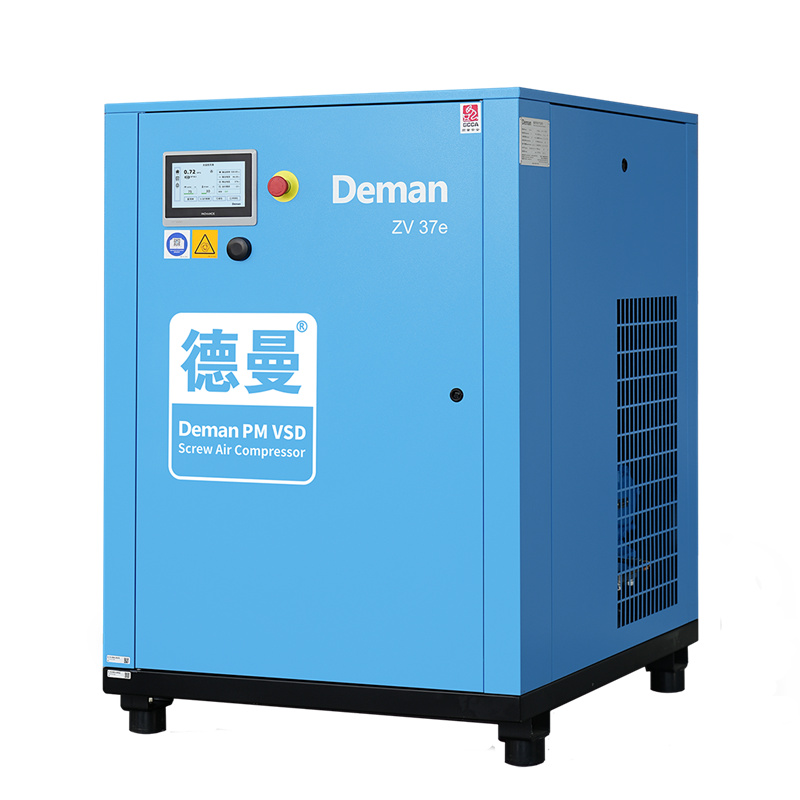
I want to be clear because I have seen too many buyers over-buy two-stage machines for applications that simply do not need them. If your plant runs at 6 to 8 bar, our ZVe single-stage PM VSD compressor is often the smarter purchase — and I say that as someone who would love to sell you the more expensive GGVe.
At 7 bar and below, the kW difference between single-stage and two-stage shrinks to 2-3%, as the test table shows. A well-designed single-stage screw airend with a modern IE5 PM motor and VSD control — like the ZVe series — already operates in its sweet spot at these pressures. The extra hardware cost, footprint, and maintenance points of a two-stage machine offer diminishing returns below 8 bar.
There is also the question of sizing. If you have not worked through your actual CFM demand profile, I recommend reviewing our compressor sizing guide before committing to either architecture. A VSD single-stage machine sized correctly for its load profile at 7-8 bar will outperform a poorly sized two-stage machine at the same pressure.
Real Factory Data: A Glass Plant's 24/7 Energy Audit Before and After
Late last year, our engineering team audited a container glass plant in Southeast Asia running three 75 kW single-stage screw compressors at 13 bar, 24/7. Glass plants are brutal on compressors — no "light load" shift, the pressure setpoint never drops, and any unplanned stop costs real production. Specific power averaged 9.3 kW per m³/min across the three machines.
We installed temporary power meters for a two-week baseline measurement. The data confirmed what operators suspected: 9.2 to 9.5 kW/(m³/min) across all three units, ambient temperatures of 35-38 °C in the compressor room, and discharge temperatures routinely exceeding 100 °C.

We replaced two of the three 75 kW single-stage units with two 90 kW GGVe dual-stage PM VSD quad-screw compressors from our full product line, configured to deliver the same 13 bar discharge pressure with the same total FAD. The third single-stage unit remained as backup. After a 90-day monitoring period, here is what the power meters reported:
| Metric | Before (3 × 75 kW Single-Stage) | After (2 × 90 kW GGVe Dual-Stage) | Change |
|---|---|---|---|
| Total daily kWh | 5,292 | 4,068 | -1,224 kWh/day |
| Annual kWh | 1,931,580 | 1,484,820 | -446,760 kWh/year |
| Specific power (kW per m³/min) | 9.35 | 7.85 | -16.0% |
| Average discharge temp | 98 °C | 72 °C | -26 °C |
| Machine count running | 3 units | 2 units | -1 unit (less maintenance) |
Annual electricity saving: approximately 447,000 kWh. At the local industrial rate of roughly CNY 0.82 per kWh, that is about CNY 366,000 (roughly GBP 39,000) saved every single year. The capital premium for the two GGVe units was recovered in under 15 months. After that, the savings are pure margin improvement.
I share this case because it is typical. Plants running at 11 bar and above with continuous duty cycles almost never regret going dual-stage. The regret only comes when someone buys a two-stage machine for an 8 bar application and realizes the single-stage unit would have done the same job for 30% less upfront.
The GGVe Dual-Stage PM VSD: What We Engineered Into Our Flagship
I have referenced the GGVe throughout this article, so let me explain what it is and why we built it the way we did. The GGVe is Deman's high-end flagship rotary screw platform — a dual-stage permanent magnet VSD quad-screw compressor. "Quad-screw" means each stage has its own dedicated pair of rotors, driven by a single PM motor through a direct-drive coupling. No gears. No belts. No transmission losses between the motor shaft and the rotor shafts.
The first-stage rotors are larger, optimized for high volume flow at low pressure ratio. The intercooler uses a stainless steel shell-and-tube design — we over-spec the heat exchange surface by roughly 25% to ensure it holds performance even in hot compressor rooms. The second-stage rotors are smaller, with a tighter profile optimized for higher pressure ratios.
The oil system separates at over 99.9% efficiency, keeping oil carryover below 2 ppm. The Inovance inverter runs an integrated VSD algorithm tuned for dual-stage pressure control — maintaining the inter-stage pressure ratio at optimum regardless of load, which is critical because an unbalanced inter-stage pressure wastes the efficiency gains the two-stage architecture is designed to capture.
We designed the GGVe for continuous 13 bar operation across its 100,000+ hour design life. Every airend is spin-tested on our line. Every machine runs a full-load ISO 1217 test before crating — and if measured specific power deviates more than 2% from spec, the unit goes back to engineering, period.
For a broader comparison of architectures — piston-type differences, maintenance schedules, and application fit — our earlier piece on two-stage vs single-stage air compressors covers those fundamentals. This article is the deeper kW-focused dive left for separate treatment.
How We Run These Tests in Our Ningbo Facility
Transparency matters for test data. At our Ningbo test bay, every compressor connects to a calibrated test loop with a Yokogawa WT5000 precision power analyzer (Class 0.1 accuracy) and a thermal mass flow meter at ±0.5% of reading accuracy. PT100 probes measure at six points: ambient intake, first-stage discharge, intercooler outlet, second-stage discharge, oil sump, and aftercooler outlet. Pressure transducers at ±0.1% full-scale measure at intake, inter-stage, and final discharge.
We run each machine at 25%, 50%, 75%, and 100% load, plus a full unloading cycle to verify VSD response. Each load point stabilizes for a minimum of 15 minutes. The data acquisition system logs at 1 Hz, and the reported value is a 5-minute average at steady state. If you visit our facility, I will walk you through the test bay and show you a machine running live — I have done this for dozens of visiting engineers, and it is the fastest way to build confidence in the numbers.
Need Specific kW Data for Your Operating Pressure?
Every factory's compressed air profile is different. If you are evaluating single-stage vs two-stage for your specific operating pressure and flow demand, I can pull the exact test curves from our production database for your machine size. Contact our engineering team through our contact page or browse our full range of rotary screw compressors — mention your target pressure and FAD, and I will send you the relevant kW curves within one business day.
Frequently Asked Questions
How much less kW does a two-stage screw compressor draw at 13 bar compared to single-stage?
Based on our test bench data at Deman, a two-stage screw compressor draws approximately 10-15% less kW per CFM than a single-stage unit at 13 bar. For example, producing 10 m³/min FAD at 13 bar required 93.5 kW single-stage versus 79.5 kW with a dual-stage GGVe — a 15% reduction in specific power.
At what pressure does the two-stage advantage become significant?
The two-stage advantage becomes meaningful above 9 bar, where intercooling between stages starts to deliver measurable thermodynamic gains. At 7 bar the kW difference is only 2-3%. At 9 bar it grows to 8-9%, at 11 bar to 13%, and at 13 bar to 15%. Below 8 bar, a single-stage PM VSD compressor like our ZVe series is often the more cost-effective choice.
What is the ISO standard for testing compressor power consumption?
ISO 1217 specifies the internationally recognized methods for acceptance testing of displacement compressors, covering volume rate of flow (FAD) and power requirements. At Deman, we run full performance tests following ISO 1217 procedures using calibrated power analyzers, precision flow meters, and temperature/pressure transducers at our Ningbo production facility.
Does a two-stage screw compressor cost more to maintain than single-stage?
The upfront capital cost of a two-stage screw compressor is typically 25-40% higher than single-stage, and it has additional components — intercooler and second airend stage — that require service. However, for applications running above 9 bar continuously, the annual electricity savings usually recover the premium within 12-18 months.
Can I replace a single-stage compressor with a two-stage model without changing my piping?
In most cases yes — the discharge connection size and working pressure rating are compatible between single-stage and two-stage machines of similar FAD. However, we always recommend a site audit before upgrading. Our engineers check the existing pipe diameter, receiver tank rating, dryer capacity, and electrical supply to ensure the new two-stage unit integrates without restriction.
What is the payback period for upgrading from single-stage to two-stage at 13 bar?
For a 75 kW-class machine running 8,000 hours per year at 13 bar, upgrading from single-stage to dual-stage typically saves 100,000-130,000 kWh annually. At industrial electricity rates, the payback is usually achieved within 12-18 months. After that, every kWh saved flows directly to the bottom line.