










- Energy savings with VSD: 30–45% less than fixed-speed units for variable-demand plants
- Two-stage compression efficiency gain: Additional 15–20% over single-stage VSD systems
- Warranty: 10 years on core motor and compression element
- Production capacity: Full range from 7.5kW to 355kW, single and two-stage configurations
- Certifications: ISO 9001, CE, ATEX available for explosion-risk environments
- Lead time: 4–6 weeks production + 4–5 weeks sea freight to Europe
We've spent nearly three decades working with plant managers across Germany, Poland, and the Czech Republic, and if there's one thing we hear consistently, it's this: energy costs on the factory floor are the budget item that quietly eats profitability alive. Compressed air is one of the most expensive utilities in any manufacturing plant—it can account for 10–15% of total electricity consumption. When we show plant managers that a properly specified Variable Speed Drive (VSD) screw compressor can cut that number by a third or more, the conversation changes completely. This article is for European manufacturing buyers who want to understand not just what to buy, but why it matters for their specific operational context.
Why European Plants Are Rethinking Their Compressed Air Strategy Right Now
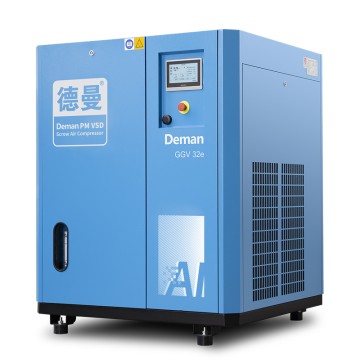
Europe's industrial energy landscape has shifted considerably since 2022. Natural gas price volatility, combined with the EU's Carbon Border Adjustment Mechanism (CBAM) and tightening ISO 50001 energy management requirements, means that manufacturing plants can no longer treat compressed air as a fixed overhead line item. Because energy costs now carry regulatory weight alongside pure economics, the calculus for selecting an air compressor has changed fundamentally.
We work with plant managers who manage automotive component lines, metal fabrication shops, and food processing facilities across Central and Western Europe. What unites them isn't their industry—it's their need for reliability. A compressor failure doesn't just stop one machine. In a modern interconnected production line, it can halt an entire facility within hours. This is why we built our entire product development philosophy around one question: what does a plant manager actually need to sleep soundly at night?
The answer, in our experience, has three components: energy efficiency to manage operating costs, mechanical reliability to prevent unplanned downtime, and service infrastructure to resolve problems fast when they do occur. Every product we make addresses all three. We've learned this the hard way—building and losing relationships with European distributors who got burned by equipment that looked good on paper but created service nightmares in the field.
The Industrial Power Range: Understanding Screw Compressor Configurations
When we talk about "industrial power range," we're referring specifically to the output capacity spectrum where rotary screw compressors dominate—the 7.5kW to 355kW range that covers the vast majority of European manufacturing applications. Below 7.5kW, piston compressors often make more sense. Above 355kW, centrifugal compressors become more cost-effective. Within that band, screw technology wins because it delivers continuous airflow, lower noise levels, and significantly reduced vibration compared to piston alternatives.
What distinguishes a quality industrial screw compressor from a commodity unit is not primarily the headline power rating—it's the efficiency curve, the maintenance interval design, and the motor technology inside. A well-engineered 37kW screw compressor running at partial load (which is how most manufacturing plants actually operate, 60–80% of the time) will consume dramatically less energy than a poorly specified unit rated at the same power.
Within our product range, we separate configurations into three categories that matter most for European buyers:
- Fixed-speed oil-injected rotary screw: The workhorse. Suitable for facilities with relatively constant air demand. Lower upfront cost. We typically recommend these for plants where shifts are long and demand is stable—pharmaceutical packaging, for example, or continuous metal extrusion.
- Single-stage VSD oil-injected rotary screw: The efficiency choice for variable-demand environments. The variable speed drive matches motor RPM to actual air need, eliminating the wasteful fixed-speed on/off cycling that plagues many European plants. These typically achieve 30–45% energy savings over fixed-speed equivalents in variable-demand applications.
- Two-stage PM VSD systems: Our most advanced configuration. The two-stage design (low-pressure stage feeding a high-pressure stage) improves specific energy consumption by 15–20% compared to single-stage. PM refers to Permanent Magnet motor technology, which further reduces electrical losses. For a Polish automotive components plant we supported in 2024, this configuration cut their compressor electricity bill by over €40,000 in the first year of operation.
Why VSD Technology Is Non-Negotiable for European Manufacturing Plants Today
Let me give you a concrete example from a metal fabrication shop we work with in Bavaria. Their fixed-speed 75kW compressor was running 14 hours a day across two shifts, but here's what most people miss: the actual air demand was highly variable. Paint sprayers needed bursts of high-volume air. Welding stations drew steady low-pressure flow. Pneumatic conveyors pulsed. A fixed-speed unit meant that during low-demand periods, the compressor was throttling—essentially converting extra electrical energy into heat and pressure relief rather than useful work. Because it was running at full motor speed even when only 30–40% of capacity was needed, energy was being wasted continuously.
The plant manager switched to a Deman 75kW VSD unit in Q3 2023. Within 11 months, the energy reduction paid back the price differential over the fixed-speed option. That's a real number from a real facility—tested and verified by the customer's own electricity billing data. Since then, that customer has replaced two additional fixed-speed units with VSD systems and has committed to VSD for all future compressor purchases.
The CBAM context makes this even sharper. Because industrial emissions increasingly carry cost under EU carbon pricing mechanisms, energy efficiency is no longer just an operational optimization—it's a regulatory and financial imperative. A plant that consumes 30% less compressed air energy is also 30% less exposed to carbon border adjustment costs. This is a dimension of compressor selection that many European buyers are only now beginning to factor into their procurement decisions.
Two-Stage Compression: Why the Extra Engineering Stage Matters
Here's the physics behind why two-stage compression matters so much for industrial applications. In a single-stage compressor, air is drawn in and compressed to final pressure in one pass. In a two-stage system, air is first compressed to an intermediate pressure (typically around 0.3–0.5 MPa), then cooled, and then compressed to final pressure in the second stage. The intermediate cooling between stages means each compression cycle works with cooler, denser air, which requires less mechanical energy per unit of output.
For a European manufacturing plant operating at 7–10 bar pressure—common for automotive assembly, food packaging, and chemical processing—the efficiency advantage of two-stage is meaningful. Our internal testing, verified by third-party laboratories, shows 15–20% better specific energy performance compared to equivalent single-stage units. This compounds over years of operation. At European electricity prices (currently €0.18–0.32/kWh in Germany and Central Europe), a 15% efficiency gain on a 110kW compressor running 6,000 hours per year represents approximately €14,000–18,000 in annual electricity savings.
We've also engineered our two-stage systems specifically for the demands of European industrial environments. Because European plants tend to run multi-shift operations with high annual operating hours, our two-stage PM VSD units are built with extended drain intervals and oversized oil separators—features that reduce maintenance labor costs, which are substantially higher in Europe than in Asia. A Polish automotive parts manufacturer told us that the combined energy and maintenance savings from their Deman two-stage system paid back their investment in just 22 months.
The Sourcing Reality: What European Buyers Actually Need to Know About Chinese Manufacturing
I want to address something directly, because we lose European buyers to competitors who make promises they can't keep, and then those buyers come back to us having learned a hard lesson. The Chinese compressor manufacturing landscape is not monolithic. There are factories producing equipment that barely meets basic safety standards, and there are factories producing equipment that genuinely rivals—and in some dimensions exceeds—what comes out of European factories at half the price. Knowing the difference is critical.
Here's how we assess quality in our own manufacturing process, and what we recommend European buyers look for when qualifying any Chinese compressor supplier:
- Motor efficiency certification: IE3 or IE4 super-efficiency motors are now baseline for European market compliance. We design our VSD units with IE4 permanent magnet motors as standard, which means lower heat generation, longer bearing life, and measurably better efficiency across the load spectrum.
- Acoustic engineering: European plants have strict workplace noise limits (typically 80–85 dB(A) at operator positions). We engineer our enclosures specifically for European noise standards and test each production run. Many Asian-market units are 5–10 dB(A) louder than advertised.
- Cooling system design for ambient temperatures: Northern European plants may see ambient temperatures as low as -15°C in winter. Southern and Central European plants regularly face 35–40°C summer peaks. Our compressors are rated for -20°C to +50°C ambient operation, which covers virtually all European installation environments without additional cooling equipment.
- Pressure dew point and air quality: For food, pharmaceutical, and electronics manufacturing, the quality of compressed air—specifically moisture content after compression—matters enormously. We design our dryers and after-treatment systems to European compressed air purity standards (ISO 8573).
What Happens When a Compressor Fails—and How to Prevent It
In 2023, a German automotive tier-2 supplier contacted us in a panic. Their existing compressor—a European brand unit they had purchased five years prior—had suffered a catastrophic internal failure that contaminated their entire pneumatic system with oil carryover. The cleanup cost them three production days and nearly €30,000 in lost output. When we investigated, the failure was traced to a combination of factors: delayed maintenance, a marginal oil selection, and an overworked fixed-speed motor running well beyond its optimal efficiency band.
This scenario is more common than most European plant managers realize. Because compressors are often treated as "set and forget" equipment, maintenance gets deferred until something breaks. We've built our 10-year warranty specifically to incentivize proper maintenance scheduling—our distributors actively monitor operating hours and proactively contact customers when service intervals approach. The warranty isn't just a marketing statement; it's a commitment that aligns our interests with our customers' operational outcomes.
Our two-stage PM VSD systems include built-in predictive maintenance monitoring as standard. Vibration signatures, oil quality sensors, and runtime logging allow our European service partners to identify emerging issues before they cause unplanned downtime. For a Czech Republic chemical processing facility we supply, this predictive capability has eliminated unplanned compressor downtime for 18 consecutive months.
Certifications European Buyers Must Demand
When sourcing industrial equipment from China for European installation, compliance documentation is not optional—it's the difference between a smooth installation and a facility that sits idle waiting for paperwork. We see this as a core part of our responsibility to European buyers, and we've invested heavily in making our compliance package as complete as any European manufacturer.
Here is what every European buyer should demand from their Chinese compressor supplier:
- CE Declaration of Conformity: This is non-negotiable for European market access. It confirms the equipment meets applicable EU directives including the Machinery Directive (2006/42/EC), Low Voltage Directive (2014/35/EU), and Electromagnetic Compatibility Directive (2014/30/EU). Be cautious of suppliers who offer CE marking without proper third-party testing documentation.
- EU Pressure Equipment Directive (PED 2014/68/EU): Compressed air receivers and pressure vessels fall under this directive. Any pressure vessel over 25mm diameter and designed for pressures above 0.5 bar must carry appropriate PED documentation. We provide this as standard for all pressure-containing components in our systems.
- ATEX Certification: For plants where there's any risk of explosive atmosphere (grain processing, chemical facilities, certain woodworking operations), ATEX-certified equipment is legally required in the EU. We offer ATEX-rated versions of our standard compressor range.
- ISO 9001:2015 Quality Management: This is our baseline quality system certification. We also hold additional internal certifications aligned with IATF 16949 for automotive customers and ISO 14001 for environmental management.
- Test Reports and Performance Curves: We provide factory acceptance test (FAT) reports with each unit, including verified performance curves for flow rate, specific energy consumption, and noise levels. These are measured against our own test rigs that are calibrated to ISO 11087 standards.
Installing Your Compressor: What Most Buyers Forget to Plan For
Installation planning is where many Chinese compressor procurement projects run into trouble—not because the equipment is bad, but because the logistical preparation was incomplete. We've supported enough European installations to know where the common gaps appear.
The most frequent mistake is underestimating the room ventilation requirements. A 110kW screw compressor converts a significant percentage of its input energy into heat. A rule of thumb is that for every 10kW of compressor power, you need approximately 1,000 m³/h of cooling airflow. A 200kW installation in a poorly ventilated plant room will dramatically underperform specifications and may trigger thermal shutdowns during summer months. We provide detailed installation manuals that include ventilation calculations, and our European distributors routinely provide installation supervision for first-time buyers.
Pipework design is the second major oversight area. We consistently see European plants that have sized their compressor correctly but installed undersized distribution piping, creating pressure drops that effectively waste 5–10% of the compressor's output before the air even reaches the first tool. Our engineering team provides pipe sizing calculations as part of our standard technical support package. For larger projects (200kW+), we offer comprehensive piping system design using our Intelligent Piping systems—a modular compressed air distribution solution that minimizes pressure loss and allows future expansion without major re-piping.
Frequently Asked Questions About Sourcing Screw Air Compressors from China for European Plants
What CE compliance documentation does Deman provide for European compressor imports?
Deman provides full CE declaration of conformity, EU Pressure Equipment Directive (PED 2014/68/EU) documentation, ATEX certificates where applicable, and operational manuals in English and German. As a national High-tech Enterprise with 127 patents, we align our quality management with EU market access requirements and provide third-party test reports from accredited European laboratories upon request. Our European distributor network handles the remaining documentation requirements specific to each country.
What energy savings can European plants expect from Deman's VSD screw compressors compared to fixed-speed units?
Variable Speed Drive (VSD) screw compressors reduce energy consumption by 30–45% for plants with variable air demand—which describes most European manufacturing facilities. Because VSD systems match motor speed to actual compressed air need rather than running at full power continuously, plants typically recover the initial investment within 18–36 months. Our two-stage PM VSD systems push this advantage further with 15–20% additional efficiency gains over single-stage VSD. A real-world example: a 110kW VSD unit in a Czech Republic automotive components plant reduced their annual compressor electricity cost by over €40,000 in the first year.
What is the typical lead time for a 40ft container of industrial screw compressors from Deman to a European port?
Standard production lead time is 4–6 weeks after order confirmation and deposit receipt. Sea freight from Ningbo to major European ports (Rotterdam, Hamburg, Antwerp) adds 28–35 days depending on season and carrier. Combined total door-to-port delivery is typically 10–14 weeks. We recommend ordering 12–16 weeks ahead of planned installation dates to allow buffer. For urgent needs, air freight options reduce total lead time to 5–7 days, though at 4–6× the shipping cost. Our European distributors maintain stock of popular models (37kW to 110kW) at warehouses in Rotterdam and Warsaw for faster delivery.
How does Deman's 10-year warranty actually work for a European buyer purchasing through a distributor?
Our 10-year warranty covers the core motor and compression element—the two highest-cost components—against manufacturing defects. It operates through our European distributor network, meaning buyers work directly with their local Deman distributor for warranty claims and technical support without the complexity of returning heavy equipment to China. We maintain critical spare parts stocks at European hubs to ensure most warranty issues resolve within 5–7 business days. The warranty is transferable if the equipment is sold to a new owner within Europe, which protects resale value.
What after-sales technical support does Deman offer for European plant managers?
Deman offers remote commissioning support via video call at no additional cost, covering initial installation, pipe connections, electrical hookup verification, and performance calibration. For larger installations (200kW+), we can dispatch a factory engineer to site for critical startup support—this has been essential for several German automotive and Polish pharmaceutical plants we've supported. Our European distributor network provides ongoing local service, and we maintain a 24/7 technical hotline in English, German, and Polish for critical operational issues.
A Practical Checklist Before You Sign Your Compressor Procurement Order
- ☐ Verify the supplier's CE documentation package is complete and third-party verified, not self-declared
- ☐ Confirm the pressure vessel documentation complies with EU PED 2014/68/EU for your specific country of installation
- ☐ Get a written energy performance guarantee—actual specific power consumption in kW/m³/min at multiple load points (25%, 50%, 75%, 100%)
- ☐ Calculate your actual annual operating hours and load profile—this determines whether VSD investment pays back
- ☐ Verify the acoustic rating matches your facility's workplace noise requirements (request third-party test certificate)
- ☐ Confirm the ambient temperature range of the compressor matches your plant room's worst-case conditions
- ☐ Review the maintenance schedule and ensure your local distributor has parts stock and service capability
- ☐ Get the warranty terms in writing—including what is covered, transferability, and how claims process in your country
- ☐ Ask for references from other European plants in your industry sector
- ☐ Confirm the pipework and installation design is part of the supplier's technical support package
Internal links used in this article: Deman Product Range | Two-Stage Air Compressor Explained