










Rotary Screw Compressor Wholesale: Belt Drive and Low Maintenance for Southeast Asian Factory Floors
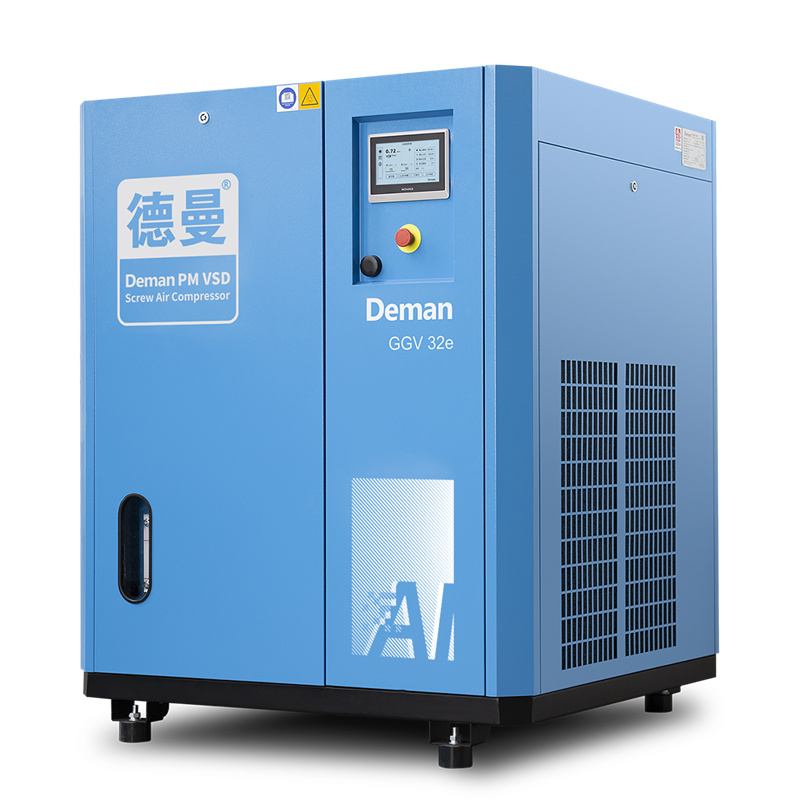
A factory manager in Pathum Thani called me last year. His production facility had been running three rotary screw compressors purchased from a European brand fifteen years ago. Two of them were past economical repair—the replacement parts had tripled in price, and the energy efficiency of the units had degraded to the point where their specific power consumption was 30% above current best-practice benchmarks. The third unit had a cracked cylinder head that had been leaking compressed air for months. He was looking at replacing all three units with something that would not require the same European-brand maintenance cost structure he had been locked into.
We evaluated a Deman belt-drive rotary screw compressor package matched to his actual air demand profile. The capital cost was 45% below the European brand equivalent. The after-treatment system (refrigerant air dryer + precision filters) was included in the package rather than sold as an expensive add-on. The Variable Frequency Drive (VFD) control system that adjusts compressor output to match actual air demand reduced his electricity consumption by 22% compared to the fixed-speed units it replaced. His payback period on the investment was 19 months.
This is what Southeast Asian industrial buyers discover when they evaluate Chinese rotary screw compressor manufacturers: the technology gap with European brands has closed significantly in the past decade, and the cost structure advantage—particularly for belt-drive and mid-specification oil-injected rotary screw compressors—is substantial.
Why Belt-Drive Rotary Screw Compressors Dominate Southeast Asian Factory Applications
Rotary screw compressors work by trapping air between two intermeshing helical rotors (a male and female rotor) inside a sealed housing, compressing it as the rotors turn. They produce continuous, oil-free (in oil-free models) or oil-flooded (in oil-injected models) compressed air at flow rates and pressures suitable for virtually all industrial factory applications.
The belt-drive configuration uses a belt and pulley system to connect the electric motor to the air-end (the compression module). This contrasts with direct-drive configurations where the motor shaft is directly coupled to the air-end. Belt-drive remains the dominant configuration for mid-size factory floor applications in Southeast Asia for several practical reasons:
- Lower capital cost: Belt-drive units are approximately 15–25% less expensive than equivalent direct-drive units from the same manufacturer. For price-sensitive Southeast Asian buyers, this is significant.
- Easier maintenance access: Belt replacement and tensioning is a straightforward maintenance task that factory maintenance technicians can perform without specialized tools. In regions where specialized compressor service technicians are scarce and expensive, this accessibility matters.
- Motor speed flexibility: Belt-drive systems allow the air-end to be driven at a different speed than the motor, enabling broader flow range coverage with a single air-end size.
- Simpler repair: If the air-end requires maintenance, a belt-drive unit allows easier isolation and removal without disturbing the motor mounting—a meaningful advantage in confined plant spaces.
Key Specifications for Belt-Drive Rotary Screw Compressors on Factory Floors
Flow Rate and Pressure Rating
The two primary specifications are airflow capacity (measured in m³/min or CFM) and maximum working pressure (measured in bar or PSI). For Southeast Asian factory applications, common requirements are:
- Light manufacturing (electronics assembly, packaging): 5–15 m³/min at 8–10 bar
- General manufacturing (textile, food processing, chemical): 15–40 m³/min at 8–13 bar
- Heavy industry (automotive, steel fabrication, cement): 40–100+ m³/min at 8–10 bar
Undersizing a compressor—buying a unit with flow capacity below actual plant demand—is the most common and most expensive purchasing error. A compressor running flat-out continuously to meet demand has no reserve capacity, wears faster, and produces hotter, more humid compressed air that strains the after-treatment system. Size for actual peak demand plus 15–20% reserve.
VSD (Variable Speed Drive) vs. Fixed Speed
Traditional rotary screw compressors run at fixed motor speed regardless of air demand, cycling on and off (load/unload) as pressure in the system fluctuates. VSD units adjust motor speed continuously to match actual air demand, producing only the flow needed at any moment. The energy savings from VSD are significant:
- Fixed-speed units consume approximately 15–25% more energy than VSD units over a typical duty cycle with variable demand
- VSD units eliminate the energy waste of unloaded running (when a fixed-speed compressor is running but not producing useful air flow)
- The premium for VSD over fixed-speed is typically 20–35% in capital cost, with payback periods of 12–24 months in variable-demand applications
• Flow capacity: Sized for peak demand + 15–20% reserve (never undersize)
• Working pressure: 8 bar (general), 10 bar (standard industrial), 13 bar (high-pressure applications)
• Drive configuration: Belt-drive for maintenance accessibility and cost efficiency
• Control: VSD recommended for variable demand profiles; fixed-speed acceptable for steady 80%+ utilization
• Motor efficiency: IE3 premium efficiency motor minimum; IE4 super-premium for best energy performance
• After-treatment package: Refrigerant air dryer + precision filtration (0.01 micron) included in package
• Warranty: Minimum 2 years on complete package; 5 years on air-end
Energy Efficiency and Total Cost of Ownership
The purchase price of a rotary screw compressor is typically 15–25% of its total lifetime cost. The remaining 75–85% is energy consumption and maintenance. This means that the lowest-capital-cost compressor is almost never the lowest-total-cost option.
For Southeast Asian factory buyers, the calculation should include:
- Energy consumption: A 37 kW belt-drive rotary screw compressor running 6,000 hours per year at $0.10 per kWh consumes approximately $22,200 in electricity annually. A unit with 15% higher specific power consumption adds $3,300 per year in electricity costs—compounding over a 10-year operating life.
- Maintenance parts: Oil, oil filters, air filters, and separator cartridges are the routine consumables. Chinese manufacturers typically offer service kits at 40–60% of European brand equivalent pricing.
- Downtime cost: For a factory where compressed air is the production driver (textile manufacturing, packaging lines, assembly operations), unplanned compressor downtime has a direct production cost. Units with known reliability records and accessible maintenance reduce this exposure.
The Deman Two-Stage PM VSD System: Engineering for Factory Floor Efficiency
Deman has developed a specific product architecture—the Two-Stage PM (Permanent Magnet) VSD system—targeted at factory floor applications where energy efficiency and reliability are both critical. The engineering logic deserves explanation because it addresses a specific class of operational problems common in Southeast Asian factory environments.
Two-Stage Compression
Two-stage compression divides the compression process into two stages with inter-stage cooling between them. This reduces the temperature of the air at each compression stage, reduces overall energy consumption by 10–15% compared to single-stage compression, and produces lower discharge temperatures that are gentler on downstream after-treatment components.
Permanent Magnet Motor
The PM motor eliminates the rotor copper losses of a conventional induction motor, providing 5–8% better efficiency at partial load—the operating condition that most factory compressors spend most of their time in. In a VSD system combined with two-stage compression, the PM motor efficiency advantage compounds across the operating range.
After-Treatment: Why the Package Matters More Than the Compressor
Compressed air quality—the purity, dryness, and consistency of the air delivered to production equipment—is as important as the compressor itself. Air from a rotary screw compressor contains water vapor (condensed from humidity in the inlet air), compressor oil carryover, and particulate. For most factory applications, this air is unsuitable for direct use without treatment.
The standard after-treatment package for general industrial factory use:
- Refrigerant air dryer: Cools the compressed air to approximately 3–5°C, condensing and removing the majority of water vapor. Delivers pressure dewpoint of 3–5°C (37–41°F).
- Pre-filter (3 micron): Removes bulk water and oil aerosol droplets before the dryer inlet.
- Post-filter (0.01 micron): Removes remaining oil vapor and particulate to Class 1 oil-free standard per ISO 8573.
Buyers who purchase compressors without adequate after-treatment face high costs downstream: moisture in pneumatic tools causes corrosion and premature failure; oil carryover contaminates product in food and pharmaceutical applications; particulate damages precision manufacturing equipment.
Explore Deman Compressor Products
- Compressor Product Range — View Deman's full range of rotary screw compressors, VSD systems, and after-treatment equipment
- Two-Stage Compressor Explained — Technical explanation of Deman's two-stage PM VSD system and its advantages
Source Belt-Drive Rotary Screw Compressors from Deman
Deman is a national High-tech Enterprise and "Little Giant" firm founded in 1998, combining German quality standards with Chinese manufacturing expertise. Specialized in VSD oil-injected compressors, two-stage PM VSD systems, and intelligent compressed air solutions. 29+ years of experience, 127 patents, and a ten-year warranty commitment. Deman supplies industrial buyers across Southeast Asia, Europe, and South America.
View Compressor Products →Industry References: PNEUPER European Compressed Air Association | Compressed Air and Gas Institute (CAGI) | ISO 1106 Industrial Air Compressor Standards | ASME Air Compressor Design Standards | US Department of Energy Industrial Efficiency | SAE International.
Installation, Commissioning, and After-Treatment System Configuration for Southeast Asian Factory Deployment
Installing a belt-drive rotary screw compressor in a Southeast Asian factory environment requires attention to site preparation factors that differ significantly from European or North American installations. High ambient humidity (70-90% RH in monsoon season) affects compressor room ventilation design, and concrete floor loading must account for the dynamic forces generated by rotating compressor equipment — typically 1.5-2.5 tonnes for a 75kW belt-drive unit.
After-treatment system configuration is arguably more important than the compressor itself for Southeast Asian manufacturing applications. A typical compressed air treatment train includes: (1) Refrigerant air dryer achieving ISO 8573-1:2010 Class 4-4-4 pressure dewpoint of +3°C; (2) Filtration at 0.01μm for oil aerosol removal (ISO 8573-1 Class 1 for oil-free applications); (3) Condensate drain management — critical in humid climates where automatic timed drains can waste significant compressed air volume if misconfigured.
Deman's pre-sale engineering support includes compressed air demand analysis worksheets that calculate total FAD (Free Air Delivery) requirements, peak demand profiles, and storage receiver sizing. This ensures the compressor's nominal capacity matches actual factory demand without oversizing (which increases energy consumption at part-load) or undersizing (which causes pressure drops during peak production). Request a Deman compressor system proposal including after-treatment configuration and factory acceptance testing (FAT) documentation for Southeast Asian buyer quality verification requirements.
Digital Monitoring, IoT Integration, and Remote Diagnostics for Southeast Asian Factory Compressed Air Systems
Industry 4.0 integration has reached Southeast Asian manufacturing facilities faster than many Western markets anticipated, driven by competitive pressure from Vietnamese, Thai, and Indonesian electronics and automotive supply chains that serve global export markets with stringent quality management requirements. Compressed air system monitoring via IoT platforms (including Deman's proprietary iAIR system and third-party platforms like Kaeser Connect) allows factory managers to track real-time pressure, flow, energy consumption, and fault alerts from remote monitoring dashboards.
The financial case for IoT-enabled compressor monitoring is compelling for Southeast Asian factories paying industrial electricity rates of USD 0.08-0.12/kWh: a 75kW rotary screw compressor running 6,000 hours per year at USD 0.10/kWh represents USD 45,000 in annual electricity costs. IoT monitoring that identifies a 7% pressure band reduction (by detecting oversized pipework,泄漏, and suboptimal regulation) yields approximately USD 3,150 in annual savings — justifying the USD 500-2,000 annual platform subscription cost many times over.
Deman's GGVE series PM VSD compressors include built-in IoT connectivity as standard, providing real-time monitoring of: motor speed (RPM), specific energy (kW/ m³/min), pressure dewpoint, and oil filter life prediction. Factory acceptance testing (FAT) reports can be generated directly from the IoT platform for ISO 9001 quality management documentation. Request a Deman compressor system proposal including IoT platform demonstration and ROI calculation for your specific factory compressed air demand profile.
Service Contracts, Preventive Maintenance Planning, and Total Cost of Ownership Optimization for Southeast Asian Industrial Compressed Air Systems
Extending beyond initial purchase price, the total cost of ownership (TCO) for a belt-drive rotary screw compressor over a 10-year operating horizon includes: energy consumption (typically 70-80% of TCO), maintenance consumables and parts (15-20%), and unplanned downtime costs (5-10%). A comprehensive preventive maintenance program that includes quarterly inspections, annual belt replacement, and 8,000-hour major overhaul can reduce lifetime energy consumption by 5-10% through early detection of wear conditions that degrade compressor efficiency.
Deman offers service agreement packages tailored to Southeast Asian factory operating environments, including quarterly on-site inspections during the humid season (June-September) when moisture ingress accelerates bearing wear and belt degradation. Service agreements include: compressed air system audit, oil sample analysis (for oil-flooded units), belt tension measurement, and VSD controller health checks. These services are particularly valuable for factories in coastal areas of Vietnam and Thailand where salt air corrosion accelerates equipment wear.
The financial case for a Deman service agreement is compelling: an unplanned compressor failure causing 48 hours of production downtime in a factory with 50 workers earning USD 15/hour represents approximately USD 4,000 in direct labor idle costs, plus potential contractual penalties for delayed order delivery. A quarterly preventive maintenance visit costs approximately USD 500-1,000 — providing insurance against far larger downtime losses. Request a Deman service agreement proposal for your Southeast Asian factory compressed air system.
For factories in humid tropical climates (Singapore, Malaysia, southern Vietnam, and Thailand year-round), the relative humidity management strategy during the monsoon season (May-October) requires particular attention. During high-humidity periods, the compressed air system's condensate load increases dramatically — a compressor producing 100 m³/h of air in 95% RH ambient conditions generates 3-4 times more condensate than the same unit operating at 60% RH. Automatic condensate drains must be correctly sized and set to function frequently enough to prevent water accumulation in the receiver tank, while not wasting excessive compressed air in the drain process.
Frequently Asked Questions: Sourcing Rotary Screw Compressors for Southeast Asian Factory Floors
A: Standard catalog configurations (15–75 kW, 8–13 bar, fixed-speed and VSD) typically have production lead times of 3–5 weeks from order confirmation. Custom configurations, non-standard voltages (e.g., 415V/50Hz for ASEAN grid compatibility), or marine corrosion-resistant packages may require 5–8 weeks. Ocean freight to Southeast Asian ports adds 7–14 days depending on port of origin and destination.
A: Deman produces units for all standard Southeast Asian electrical specifications: 380V/50Hz (standard for Vietnam and most of Indonesia), 400V/50Hz (Thailand, Malaysia, Singapore standard), and 415V/50Hz (common in some Philippine and Malaysian industrial installations). Confirm your facility's electrical specifications before ordering.
A: Deman's standard factory packages include: refrigerant air dryer (sized to the compressor flow rate), 3-micron pre-filter, and 0.01-micron post-filter. All piping and fittings between the compressor outlet and the after-treatment package are included in the standard scope of supply. Custom configurations (higher-capacity dryers, oil-water separators, nitrogen generators) are available for specialized applications.
A: Deman offers a 10-year warranty on the air-end (compression module) and a 2-year comprehensive warranty on the complete package including motor, VSD controller, and after-treatment equipment. Extended warranty programs are available for orders above 10 units per year through authorized distributors.
A: Yes. Deman's technical team provides free compressed air system sizing calculations for factory applications. To receive an accurate sizing recommendation, provide: current and projected peak air demand (m³/min or CFM), current and projected working pressure (bar or PSI), existing compressor details (if applicable), and a brief description of the production processes using compressed air.
About the Author
Mr.Ryan — Air compressor solutions expert at Deman, a national High-tech Enterprise and "Little Giant" firm founded in 1998, combining German quality standards with Chinese manufacturing expertise. Specialized in VSD oil-injected compressors, two-stage PM VSD systems, and intelligent compressed air solutions. 29+ years of experience, 127 patents, and a ten-year warranty commitment.
LinkedIn: Deman Compressor
YouTube: Deman Channel
Facebook: Deman Air Compressor