- Heavy-duty applications need continuous-duty air, not just high peak output.
- Pressure stability, flow matching, and air quality are the three variables that determine system cost.
- Multi-compressor control and low-pressure-drop piping can reduce wasted energy and idle running.
- Dryers and filtration should be selected by dew point and contamination risk, not guesswork.
- Lifecycle cost matters more than purchase price in any industrial air system with high runtime.
For heavy-duty manufacturing, the rotary screw air compressor is often the most practical core machine because modern compressed air systems must hold stable supply, avoid unnecessary load cycling, and deliver usable air quality at the point of use. Industrial tolerance and metrology matter here: ISO 230-1:2022 specifies test methods for machine tool positioning accuracy at the micrometer scale, which is one reason many automation lines require consistent air supply rather than fluctuating pressure. If your plant runs pneumatic clamps, textile machinery, packaging lines, or continuous process equipment, the compressor choice should be evaluated as a full system. That is also why a planning-first approach, supported by screw air compressors, variable speed air compressors, and air treatment equipment, often produces better long-term results than buying a single machine on horsepower alone.
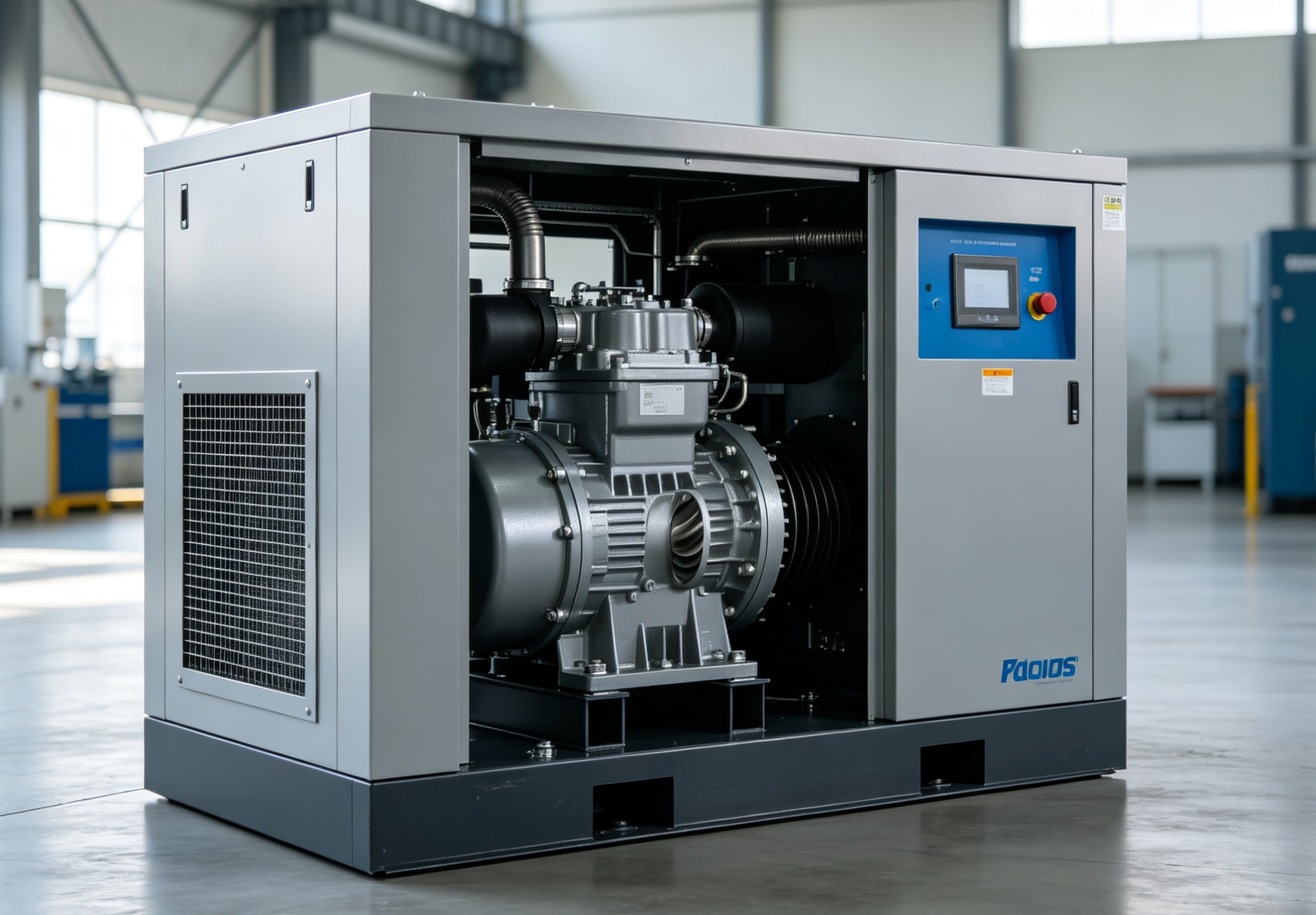
Rotary Screw Air Compressor Basics for Heavy Duty Industrial Use
The core advantage of a rotary screw air compressor is continuous output with fewer load shocks than a reciprocating compressor.
Inside the air end, two rotors compress air by reducing the trapped volume as they turn, which makes screw compressors well suited to steady industrial demand. In practice, this matters because most factories do not need only short bursts of air; they need a stable industrial air system that can hold production pressure during shift changes, tool peaks, and line acceleration. The U.S. Department of Energy notes that compressed air is often one of the most expensive utilities in manufacturing, and leakage or poor pressure management can significantly increase energy use. For that reason, system efficiency should be treated as a plant-wide issue, not a machine-only issue. A well-designed rotary screw air compressor is simply the starting point.
Heavy-duty use usually means longer runtime, higher ambient heat, and more frequent duty cycling than light commercial work. The compressor must therefore be selected for thermal margin, oil management, service access, and control logic. In plants where uptime is critical, a single oversized machine can waste energy, while an undersized unit can create pressure dips that interrupt automation. The more stable answer is often a matched package of compressor capacity, smart sequencing, and downstream treatment.
For plants exploring system-level planning, air compressor systems and energy recovery systems are important pages to review because the air end is only one part of the operating cost equation.
Why Pressure, Flow, and Air Quality Decide Performance
Pressure, flow, and air quality are the three metrics that determine whether a rotary screw air compressor is truly fit for heavy-duty industrial use.
Pressure is the force available to do work, but higher pressure is not automatically better. Many facilities increase pressure to compensate for poor piping design or leakage, and that decision usually increases power consumption. As a rule of thumb, the U.S. Department of Energy explains that every 2 psi increase in system pressure can raise energy consumption by about 1 percent. That is a small number on paper and a large number on an annual utility bill when a plant runs continuously. Stable pressure also protects the consistency of pneumatic actuators, spray systems, and downstream process control.
Flow is the real productivity metric because it tells you whether the compressor can meet demand during simultaneous use. A machine rated at high horsepower but unable to sustain required cfm at working pressure will still fail in production. Air quality is the third variable, and it is often overlooked until contamination causes rejected product or premature valve failure. In textile, electronics, food-adjacent packaging, and precision assembly, oil aerosol, water, and particulate matter can become direct quality risks. A heavy-duty industrial air system therefore needs the right combination of dryer, filtration, and condensate management.
| System Factor | What It Affects | Typical Quantitative Consideration | Operational Risk If Ignored |
|---|---|---|---|
| Pressure | Tool force, actuator performance | About 1 percent energy rise per 2 psi increase, per DOE guidance | Higher electricity cost, unstable output |
| Flow | Production continuity | Must match peak demand plus reserve margin | Pressure drop during simultaneous use |
| Air quality | Product quality, equipment life | Dew point, oil carryover, particulate class | Contamination, scrap, maintenance issues |
That is why many industrial teams move from machine buying to system engineering and consider air dryers and filtration separation as core parts of the purchase decision.
Rotary Screw Compressor vs Reciprocating Compressor in Industrial Plants
A rotary screw air compressor is usually better than a reciprocating compressor when the workload is continuous, while a piston machine can still make sense for intermittent service.
The simplest difference is duty profile. Reciprocating units are better suited to short, intermittent air use because their compression cycle is more cyclical and typically more vibration-prone. Rotary screw units are better for long runtimes because they deliver smoother output, lower pulsation, and easier integration with variable-speed control. In plants where line stoppages are expensive, a screw compressor often lowers hidden operating cost even when the initial purchase price is higher. The reason is not marketing; it is uptime economics.
| Feature | Rotary Screw Compressor | Reciprocating Compressor |
|---|---|---|
| Duty cycle | Continuous or near-continuous | Intermittent |
| Vibration | Lower | Higher |
| Maintenance pattern | More predictable service intervals | More frequent mechanical wear parts |
| Best fit | Factories, automation, process lines | Small shops, backup air, low duty use |
| Pressure stability | Better for steady supply | More fluctuation under load |
For a plant operating pneumatic fixtures, valves, and continuous tools, a rotary screw air compressor is usually the safer base platform. If the facility also needs redundancy, combining primary units with multi-compressor systems can protect production against single-point failure while improving part-load efficiency.
How to Size an Industrial Air System Correctly
Correct sizing starts with actual demand data, not nominal machine power.
The most common mistake is sizing the industrial air system from the compressor nameplate instead of the plant load profile. A better approach is to measure average demand, peak demand, leakage baseline, and future expansion margin. Because compressed air is often used across multiple departments, the total demand curve can be flatter or spikier than any single machine suggests. Plants should collect flow data over a full shift pattern before final selection.
- Measure average and peak air consumption during normal production.
- Identify pressure-sensitive tools and minimum acceptable pressure at the point of use.
- Estimate leakage during shutdown and low-load periods.
- Account for dryer and filter pressure drop.
- Add a realistic reserve margin for expansion or seasonal temperature changes.
Many engineering teams target reserve capacity rather than operating permanently at 100 percent load. That gives the rotary screw air compressor headroom for demand spikes and reduces the chance of pressure sag. It also makes a control strategy like sequencing or variable speed more effective. For planning around system architecture, portable air compressors and oil-free air compressors may be relevant depending on service area and contamination risk.
Variable Speed Control and Multi-Unit Sequencing
Variable speed control and multi-unit sequencing are the fastest ways to reduce wasted energy in a heavy-duty industrial air system.
A variable speed rotary screw air compressor adjusts motor speed to follow demand, which reduces unloaded running and excessive pressure swings. In plants with changing production schedules, this can create meaningful savings because air demand rarely stays constant across the full shift. Yet variable speed alone is not always enough. When multiple compressors operate together, a sequencer such as a centralized controller can assign base-load and trim-load roles, prevent conflict between machines, and avoid unnecessary starts and stops.
This is where digital control becomes an operational tool rather than a convenience feature. Smart load sharing can keep the most efficient machine in the lead role while rotating runtime across assets. That reduces uneven wear and helps maintenance teams plan service windows. For distributed facilities, remote monitoring can also matter. A control platform that flags alarms, pressure drift, or abnormal power consumption can prevent a small fault from becoming a line stoppage.
For readers comparing system control options, intelligent control systems and remote monitoring are useful internal resources because a compressor is only as good as the logic that runs it.
| Control Strategy | Main Benefit | Best Use Case | Operational Note |
|---|---|---|---|
| Fixed speed | Simplicity | Stable demand | Can waste energy at low load |
| Variable speed | Tracks demand more closely | Fluctuating production | Needs proper tuning and reserve planning |
| Multi-unit sequencing | Optimizes whole-station efficiency | Plants with several compressors | Reduces conflicting control actions |
Air Treatment, Dew Point, and Contamination Control
Air treatment is essential because compressed air leaves the compressor hot, wet, and potentially contaminated with oil and particulate matter.
When air is compressed, its temperature rises and water vapor condenses as the air cools. If a plant skips proper drying, water can damage valves, corrode piping, and disrupt product quality. This is why drying, filtration, and condensate separation are not optional accessories in a serious industrial air system. ISO 8573-1 is the widely used standard for compressed air purity classification, and its framework helps teams specify allowable particle, water, and oil content by application. In industries where even small contamination matters, the treatment train should be chosen around the actual process risk, not simply the compressor size.
For textile production, for example, oil and water can create visible defects on fabric surfaces. In automotive components or precision fixtures, contamination can interfere with seals and actuators. That is why a heavy-duty rotary screw air compressor should be evaluated together with dryers and filters. A lower pressure drop in treatment equipment also matters because every unnecessary loss adds load to the compressor.
Additional reference standards can help engineering teams validate compliance. ISO 8573-1 defines compressed air purity classes, while ISO 12500-1 addresses test methods for compressed air filter performance. For facilities designing new systems or upgrades, those documents provide a clearer basis for specification than vague vendor claims.
Energy Efficiency, Heat Recovery, and Piping Design
Energy efficiency in compressed air comes from system design, not from one component alone.
Compressed air is expensive because electric input is only partly converted into usable pneumatic work, and the rest becomes heat. That is why heat recovery can be valuable in heavy-duty industrial use. In many plants, recovered heat can support space heating, water preheating, or process support, improving total energy utilization. Exact savings depend on runtime, ambient conditions, and integration design, so conservative engineering review is necessary. Industry practice also shows that poor piping layout can erase a lot of the benefit of an efficient compressor. Narrow headers, excessive bends, and undersized drops increase pressure loss and force the machine to work harder.
Low-pressure-drop piping and proper ring-main design are therefore part of compressor selection. The compressor room should be planned with airflow, maintenance clearance, ventilation, and service routing in mind. In a heavy-duty environment, thermal management is especially important because sustained high temperature shortens component life and can destabilize oil performance.
For readers exploring whole-station optimization, energy recovery and green piping systems are directly relevant because they address the losses that happen after the compressor starts running.
| Optimization Area | Engineering Goal | Typical Impact | Why It Matters |
|---|---|---|---|
| Heat recovery | Reuse compressor waste heat | Improves total energy utilization | Reduces net utility burden |
| Low-pressure-drop piping | Minimize friction loss | Less pressure loss at point of use | Reduces unnecessary compressor loading |
| Ventilation | Control room temperature | Protects stable operation | Limits thermal stress on equipment |
Industry Applications Where a Rotary Screw Air Compressor Fits Best
The best applications are the ones with long runtime, moderate to high air demand, and a need for steady pressure.
In textiles, clean and stable air protects fabric quality and pneumatic automation. In hardware, plastics, automotive parts, and home appliance manufacturing, compressed air often powers tools, fixtures, actuators, and packaging systems. In power generation and related heavy industry, the key requirement is endurance under high-load conditions and reliable continuous operation. These are exactly the environments where a rotary screw air compressor can outperform more intermittent designs.
Oil-free compressed air becomes especially important when the process cannot tolerate hydrocarbon carryover. That does not mean every industrial site needs oil-free technology, but it does mean the application should be reviewed carefully. Plants can also segment air quality requirements by line: one area may need standard industrial air, while another may require cleaner supply with tighter filtration. That kind of segmentation often lowers total cost because it avoids over-specifying the entire plant.
Useful internal pages for application planning include textile solutions and automotive parts solutions, especially when the business case depends on air quality and uptime.
Procurement Checklist for Heavy Duty Industrial Use
The best purchase decision comes from a checklist that links process risk to compressor configuration.
- Confirm the required pressure at the point of use, not just at the compressor outlet.
- Calculate peak flow, average flow, and leakage load from real measurements.
- Define air quality needs using a purity standard such as ISO 8573-1.
- Decide whether fixed speed, variable speed, or multi-unit sequencing is the right control strategy.
- Review treatment pressure drop, piping layout, ventilation, and service access.
- Evaluate total lifecycle cost, including maintenance, downtime risk, and energy use.
A rigorous checklist avoids one of the most expensive mistakes in compressed air projects: buying capacity without solving system losses. In many factories, the compressor is blamed for problems that actually come from air leakage, poor controls, or undersized downstream equipment. When the full industrial air system is engineered correctly, the result is not just lower electricity use. It is also better product consistency and less unplanned shutdown risk.
What Buyers Should Expect From a Modern Industrial Air System
A modern industrial air system should be stable, measurable, and serviceable over its full lifecycle.
The right answer is rarely the biggest compressor. It is the one that matches demand with enough margin, keeps pressure within process limits, delivers the required air quality, and can be monitored and maintained without production disruption. That is why remote monitoring, load balancing, and air treatment are now part of the procurement conversation. In practice, the most successful plants treat compressed air as a utility network, not as an isolated machine purchase.
If a facility is planning a new line or upgrading an old station, the strongest route is usually to align compressor capacity, control logic, treatment equipment, and piping from the start. That approach improves efficiency, simplifies service, and makes future expansion easier. For many teams, the question is no longer whether to buy a rotary screw air compressor, but how to design the system around it so the compressor can operate at its best.
FAQ
What is the main advantage of a rotary screw air compressor?
Its main advantage is continuous-duty operation with stable output, which makes it well suited to heavy-duty industrial use.
How do I know if my plant needs a rotary screw compressor?
If your air demand is steady, your tools run throughout the shift, or pressure stability affects quality, a rotary screw compressor is usually the right starting point.
Is variable speed always better than fixed speed?
No. Variable speed is best when demand fluctuates, but fixed speed can still be cost-effective for stable loads.
Why is air quality so important in an industrial air system?
Water, oil, and particles can damage equipment, reduce product quality, and increase maintenance costs.
How much can pressure increases affect energy use?
According to U.S. Department of Energy guidance, every 2 psi increase in system pressure can raise energy consumption by about 1 percent.
What standards help define compressed air quality?
ISO 8573-1 is the main reference for purity classes, and ISO 12500-1 is used for filter performance testing.
Should I focus on the compressor or the whole system?
Focus on the whole system. Compressor efficiency matters, but piping, controls, treatment, and leakage often decide the final operating cost.