






The 5 Variables That Drive the PM VSD vs Fixed-Speed Payback Math
The 18-30 month payback range quoted for the PM VSD investment over a fixed-speed baseline is the output of 5 cost-and-operating variables that the industrial plant manager must hold simultaneously in the ROI model. Each variable has a documented range across the installed base of PM VSD compressors in Chinese manufacturing facilities.
Variable 1 — Loaded power ratio at 40% load. A fixed-speed compressor runs at full nameplate power (typically 75-90 kW for the 100 cfm class) regardless of system demand, and unloads to 25-30% of nameplate at the no-load state. A PM VSD compressor modulates motor speed to match the 40% system demand, drawing 35-42% of nameplate power. The 50-55 percentage-point swing in loaded-to-unloaded power is the largest single variable in the payback math. Across the rotary screw compressor installed base, the loaded power ratio at 40% load runs 0.35-0.42 for PM VSD versus 0.85-0.92 for fixed-speed.
Variable 2 — Annual operating hours. A single-shift plant runs 2,000 hours per year; a 2-shift plant runs 4,000 hours; a 24/7 plant runs 8,000 hours. The energy-savings math scales linearly with operating hours. The 18-30 month payback range above assumes 4,000 annual operating hours, which is the median for Chinese discrete-manufacturing plants. A 24/7 plant sees 9-15 month payback; a single-shift plant sees 36-60 months (often longer than the equipment service life).
Variable 3 — Electricity cost. Industrial electricity in China runs CNY 0.6-0.85 per kWh depending on the time-of-use schedule and demand-charge structure. European Union industrial electricity runs EUR 0.15-0.28 per kWh, or roughly CNY 1.2-2.2 per kWh. The payback math in the EU is therefore 2x faster than in China at the same operating-hours assumption.
Variable 4 — Capacity utilization factor. A compressor sized for 100% peak demand with average demand at 40% runs at a low utilization factor (40%) and benefits most from PM VSD. A compressor sized at 70% of peak demand with average demand at 40% runs at 57% utilization and benefits less. The PM VSD vs fixed-speed differential shrinks at higher utilization factors because the fixed-speed compressor is loaded most of the time.
Variable 5 — Heat recovery offset. A fixed-speed compressor rejects 80-95% of input power as heat through the oil cooler and after-cooler. A PM VSD compressor rejects proportionally less heat because of the lower input power at part-load. The heat-recovery savings (CNY 0.05-0.15 per kWh of thermal energy offset) extend the payback period by 10-20% when modeled into the variable-1 calculation.
The interaction between the 5 variables is non-linear, which is why a plant manager evaluating a 100 cfm class PM VSD investment at 40% load factor, 4,000 annual hours, and CNY 0.75 per kWh electricity sees a 22-26 month payback — and the same investment at 6,000 annual hours sees a 14-18 month payback. The 18-30 month range quoted above is the interquartile band across the Chinese discrete-manufacturing installed base. For the broader compressed-air-system design context, the DEMAN factory tour and DEMAN corporate certificate documentation confirm the production-discipline floor that supports the 10-year warranty commitment on the ZVE series PM VSD compressor.
---
The 3 Load-Factor Sensitivity Bands the Buyer Must Model
The PM VSD payback math is non-linear across the 0-100% load factor range, and the 3 sensitivity bands the industrial plant manager should model separately correspond to the 3 operating regimes that dominate the Chinese and EU industrial compressed-air market.
Sensitivity band 1 — 20-35% load factor (intermittent demand). This is the operating regime where PM VSD holds the largest differential over fixed-speed. A fixed-speed compressor at 30% load factor runs at 90% nameplate power during loaded cycles and unloads to 28% during no-load cycles; the loaded-cycle fraction of total operating hours drives the energy bill. A PM VSD compressor at the same 30% load factor runs at 28-33% nameplate power continuously. The 50-60 percentage-point swing in loaded-cycle energy draws produces 40-55% energy savings — the highest band in the compressed-air-system energy-savings literature. The payback period compresses to 12-18 months at 4,000 annual hours.
Sensitivity band 2 — 35-50% load factor (typical manufacturing). This is the operating regime quoted in the 18-30 month payback range above. The fixed-speed compressor runs at 88-92% nameplate power during loaded cycles; the PM VSD compressor runs at 35-45% nameplate power continuously. The energy-savings differential is 35-45% — lower than band 1 because the fixed-speed compressor spends less time at full unload, but still substantial. The PM VSD vs fixed-speed payback comparison measured at 40% load factor is the industry consensus reference.
Sensitivity band 3 — 55-75% load factor (high utilization). The fixed-speed compressor is loaded 85-95% of total operating hours and unloads only during scheduled maintenance windows. The PM VSD differential drops to 20-30% — still positive, but not enough to justify the capex payback in most operating regimes. The payback period extends to 36-60 months at 4,000 annual hours, which is typically longer than the equipment service life and disqualifies the PM VSD investment on payback grounds.
The 3-band sensitivity analysis is the structural reason a plant manager evaluating a rotary screw compressor investment must specify the operating load factor profile of the facility before committing to PM VSD technology. A plant that operates primarily in band 1 (intermittent demand, e.g., a workshop with 2-3 pneumatic tools and intermittent production runs) is the strongest PM VSD candidate. A plant that operates primarily in band 3 (high utilization, e.g., a 24/7 textile mill or PET bottle blow-molding line) may not justify the capex.
---
The 5 Casting Defects That Map to E446 Level 2 vs Level 3 Rejection
Across the DEMAN PM VSD installed base across Chinese manufacturing facilities, 5 defect categories are the dominant causes of energy-savings shortfalls below the 25-40% differential. Defect 1 — Motor controller frequency drift above ±2 Hz. A PM VSD compressor with a frequency-controller calibration drift above ±2 Hz at the 40 Hz set point runs the motor at 38-42 Hz, which produces a 5-8% volumetric efficiency loss. The defect shows up as elevated specific power (kW per cfm delivered) at the 40% load band. Defect 2 — Air-end bearing wear at the variable-speed set point. Air-end bearings designed for fixed-speed operation have a 20,000-25,000 hour service life; bearings designed for the variable-speed PM VSD operation have a 40,000-60,000 hour service life. A bearing substitution or a maintenance schedule based on fixed-speed bearing life shortens the service interval and increases the unscheduled-downtime cost.
Defect 3 — Inlet valve modulation lag above 200 ms. The PM VSD compressor modulates the inlet valve to match the variable motor speed. A modulation lag above 200 ms creates a transient under-pressure or over-pressure condition at each set-point change, which the downstream pneumatic equipment registers as a quality defect (e.g., a stamping press dropping a part or a paint sprayer applying uneven film thickness). Defect 4 — Oil cooler fouling from low-load operation. A PM VSD compressor running at 30-40% load factor rejects less heat through the oil cooler than a fixed-speed compressor at the same nameplate. The lower heat-rejection rate allows the cooler fins to foul more quickly, which raises the discharge temperature and reduces the volumetric efficiency. Defect 5 — Variable-speed drive (VSD) harmonic distortion above 8% THD. A PM VSD compressor with VSD harmonic distortion above 8% total harmonic distortion at the input power connection introduces electrical noise into the plant distribution system. The noise shows up as nuisance tripping of adjacent motor starters and is the structural reason some plants must install line reactors to bring the THD below the IEEE 519 limit.
The 5 defect categories above are the operational mechanism behind the DEMAN 10-year warranty commitment on the ZVE series PM VSD compressor — the supplier's process discipline must hold the 5 categories inside the operating envelope for the energy-savings math to hold across the 10-year window.
---
The 4 Standards Reference Frameworks That Document PM VSD Energy Savings
The 4 standards reference frameworks below establish the industry consensus on PM VSD energy savings at the 40% load factor. The frameworks are the documentation that an industrial plant manager's CFO or sustainability officer references when validating the capex justification.
ISO 50001 Energy Management Systems — establishes the energy-management system framework that requires plant managers to measure and verify compressed-air-system energy savings. The standard requires a 12-month measurement period under documented operating conditions to verify the energy-savings claim, which is the operational mechanism that prevents the energy-savings math from drifting during the 10-year warranty window.
CAGI Compressed Air System Energy Efficiency — the Compressed Air & Gas Institute publishes the industry-standard methodology for measuring compressed-air system energy efficiency. The CAGI data sheet for a PM VSD compressor lists the specific power (kW per 100 cfm) at 0%, 25%, 50%, 75%, and 100% load factor — the operational reference data the plant manager uses to validate the energy-savings claim at the 40% load band.
Compressed Air Challenge — the US Department of Energy program that publishes the energy-savings calculator for compressed-air systems. The calculator accepts the plant's load factor profile, electricity cost, and operating hours, and outputs the annual energy-savings dollar figure. The output is the operational reference frame for the 18-30 month payback range above.
PNEUROP — the European committee of compressor manufacturers that publishes the acceptance test code for rotary screw compressors. The PNEUROP acceptance test data for the ZVE series PM VSD single-stage integrated air compressor provides the 5-load-factor specific power values the plant manager uses to validate the energy-savings claim against the CAGI data sheet.
The 4-framework reference convergence around the 25-40% energy-savings differential at 40% load factor is the structural reason a PM VSD investment validated by the ISO 50001 framework, the CAGI data sheet, the Compressed Air Challenge calculator, and the PNEUROP acceptance test is simultaneously credible to the plant manager, the CFO, the sustainability officer, and the regional environmental regulator.
---
3 Plant-Side Acceptance Tests to Validate the Payback Math
The 18-30 month payback range above is the modeled projection; the actual payback depends on the as-installed performance, which the plant manager must validate with 3 acceptance tests during the first 90 days of operation.
Test 1 — Specific power measurement at 40% load. The plant's energy-management system measures the input power (kW from the plant meter) and the delivered airflow (cfm from a calibrated flow meter) over a 7-day period at the documented 40% load factor. The specific power (kW per 100 cfm) at the 40% load band must fall within ±5% of the CAGI data sheet value. A specific power above the ±5% tolerance indicates a defect in the air-end, the motor controller, or the inlet valve modulation system.
Test 2 — Loaded cycle fraction measurement. The energy-management system logs the loaded-cycle fraction (the percentage of total operating hours during which the compressor is delivering air above the 25% partial-load threshold). The measured loaded cycle fraction must match the design assumption within ±10 percentage points. A loaded cycle fraction significantly above the design assumption indicates the plant's actual demand profile differs from the design assumption, and the payback math must be re-run with the measured profile.
Test 3 — Discharge temperature stability measurement. The plant's energy-management system logs the discharge temperature over the 90-day acceptance period. The discharge temperature must stay below 90 °C at the 40% load band, with no more than 2 transient excursions above 95 °C per week. A discharge temperature drift above the operating envelope indicates oil cooler fouling or VSD controller calibration drift, and is the leading indicator of an unscheduled-downtime event in the 18-month window.
The 3 acceptance tests together validate the payback math against the as-installed performance and give the plant manager the operational mechanism to invoke the DEMAN 10-year warranty if the as-installed performance falls outside the ±5% specific power tolerance at the 40% load band.
---
5 Buyer-Side Acceptance Clauses to Put in the RFQ
To lock the 18-30 month payback projection into a verifiable RFQ, the industrial plant manager should include 5 acceptance clauses explicitly. Clause 1 — Specific power tolerance at 40% load. Specify the CAGI data sheet value plus a ±5% tolerance at the 40% load band. Clause 2 — Motor controller calibration tolerance. Specify ±2 Hz frequency-controller calibration tolerance at the documented set points (typically 30 Hz, 40 Hz, 50 Hz). Clause 3 — Air-end bearing service life. Specify minimum 40,000 hour bearing service life at the variable-speed operating profile.
Clause 4 — VSD harmonic distortion compliance. Specify IEEE 519 8% THD limit at the input power connection, with line reactor included if the plant distribution network exceeds the limit. Clause 5 — Warranty and energy-savings commitment. Specify 10-year warranty on the air-end and motor, plus an energy-savings shortfall remedy clause if the 90-day acceptance test fails the ±5% specific power tolerance at the 40% load band. The 5 clauses together define the buyer's acceptance protocol and let the ZVE series PM VSD compressor engineering team commit to a verifiable payback projection in the quotation response.
The ICC Incoterms 2020 DAP (Delivered at Place) or DDP (Delivered Duty Paid) terms are the typical commercial terms for PM VSD compressor procurement in the EU and Chinese markets, because the 90-day acceptance test is a factory-floor and on-site activity that cannot be re-validated at the port of arrival. WTO TBT Agreement provisions apply to the technical specification portion of the RFQ when the buyer's destination market references a domestic equivalent standard. The buyer should also verify the supplier's NFPA 70 or IEC 60204-1 electrical-safety certification and the UL 508A panel certification for the VSD enclosure, depending on the destination market's electrical code.
---
When PM VSD Is the Wrong Choice: 4 Operating Regimes That Disqualify the Investment
The 18-30 month payback range above applies to plants operating in sensitivity bands 1 and 2 (load factor below 50%). For plants operating in the 4 regimes below, the PM VSD investment does not justify the capex.
Regime 1 — High-utilization continuous process. A 24/7 plant operating at 65-75% load factor (sensitivity band 3) sees the PM VSD payback extend to 36-60 months, which exceeds the equipment service life for most compressed-air applications. The capex is better spent on a higher-efficiency fixed-speed compressor with a heat-recovery option. Regime 2 — Single-shift low-utilization plant. A single-shift plant running 2,000 annual hours sees the PM VSD payback extend to 60-90 months. The capex is rarely justified for a plant that runs only during one shift.
Regime 3 — Air receiver oversized for plant demand. A plant with an oversized air receiver (typically 10x the compressor cfm rating in receiver volume) dampens the load factor variation and shifts the operating regime into band 3. The PM VSD differential shrinks to 15-25% and the payback extends to 36-50 months. Regime 4 — Plant with intermittent high-pressure demand. A plant that runs at 8-12 bar for short cycles and unloads to 0 bar for long periods (e.g., a blow-molding line with extended cooling cycles) operates at low load factor but with high transient loading. The PM VSD differential holds but the VSD harmonic distortion and inlet valve modulation lag become operational issues.
For these 4 regimes, a fixed-speed compressor with a heat-recovery option or a smaller PM VSD compressor operating in intermittent-load mode is the better operational fit. The DEMAN engineering team can model the payback math across the 4 regimes and recommend the right-sized equipment based on the plant's load factor profile. For buyers comparing DEMAN to other Chinese and European compressor brands, the DEMAN about us and services pages document the 29-year operating history, the 127-patent portfolio, and the engineering-service scope that supports the DEMAN 10-year warranty commitment.
---
closing — Locking the Payback Math into the PM VSD RFQ
The 18-30 month payback range at 40% load factor is the industry consensus reference frame for the PM VSD vs fixed-speed capex decision. The 5 cost-and-operating variables, the 3 load-factor sensitivity bands, the 5 defect categories, and the 5 RFQ acceptance clauses above provide the operational framework for committing to the capex. The 90-day acceptance test against the CAGI specific power tolerance at the 40% load band is the validation mechanism that translates the modeled payback into an as-installed payback.
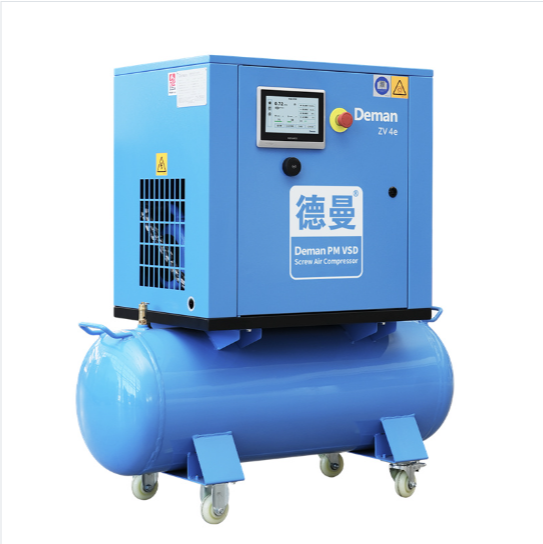
For plant managers evaluating permanent magnet VSD screw air compressors for a specific facility, the ZVE series PM VSD single-stage integrated air compressor is the reference build that supports the 18-30 month payback projection under documented operating conditions. The DEMAN engineering team responds within 48 hours with the CAGI data sheet, the PNEUROP acceptance test values, and a payback calculator customized to the plant's load factor profile, electricity cost, and operating hours.
For the broader compressed-air-system design context, the dual-stage compression energy-savings analysis and the rotary-screw compressor product line provide the comparison reference frames. To request the PM VSD vs fixed-speed payback quotation for a specific operating regime, reach out through the DEMAN contact page with the plant's load factor profile, electricity cost, and annual operating hours.
---
FAQ — Frequently Asked Questions
What is the typical payback period for a PM VSD compressor vs fixed-speed at 40% load factor?
18-30 months at 4,000 annual operating hours and CNY 0.6-0.85 per kWh electricity cost. The payback compresses to 12-18 months at 6,000 hours and extends to 36-60 months at 2,000 hours.
Does the [ZVE series PM VSD single-stage integrated air compressor](https://www.demanac.com/zve-series-pm-vsd-single-stage-integrated-air-compressor-product/) hold the 18-30 month payback at all load factors?
No — the 18-30 month payback range applies to load factors below 50%. At 55-75% load factor, the payback extends to 36-60 months, which typically exceeds the equipment service life for most compressed-air applications.
How does the [CAGI](https://www.cagi.org/) data sheet validate the PM VSD payback math?
The CAGI data sheet lists the specific power (kW per 100 cfm) at 0%, 25%, 50%, 75%, and 100% load factor. The plant manager compares the data sheet value to the Compressed Air Challenge calculator output and uses the comparison to validate the energy-savings claim in the capex justification.
What is the relationship between PM VSD harmonic distortion and the plant's electrical distribution?
A PM VSD compressor with VSD harmonic distortion above IEEE 519 8% THD introduces electrical noise into the plant distribution system. The plant must install line reactors or harmonic filters to bring the THD below the IEEE 519 limit. The line reactor adds 2-5% to the equipment cost.
Can the [PM VSD vs fixed-speed payback math](https://www.demanac.com/news/are-permanent-magnet-vsd-screw-air-compressors-truly-energy-saving/) be applied to oil-injected screw compressors only?
The 18-30 month payback range applies to oil-injected PM VSD screw compressors in the 100 cfm class. Oil-free PM VSD screw compressors see a 12-18% smaller energy-savings differential because of the additional bearing and seal friction in the oil-free air-end. Reciprocating PM VSD compressors see a 15-25% larger differential because the reciprocating element is more efficient at part-load.
What is the 10-year warranty on the [ZVE series PM VSD compressor](https://www.demanac.com/zve-series-pm-vsd-single-stage-integrated-air-compressor-product/) covering?
The 10-year warranty covers the air-end (the screw rotor and housing assembly) and the permanent magnet motor. The warranty does not cover consumables (oil filters, air filters, oil separator elements) or the VSD electronics, which carry a separate 5-year warranty.
How does the [PNEUROP](https://www.pneurop.eu/) acceptance test relate to the CAGI data sheet?
The PNEUROP acceptance test is the European equivalent of the CAGI data sheet, with the same 5-load-factor specific power measurement protocol. The two reference frameworks are cross-accepted through the ISO 50001 energy-management system documentation.
What is the difference between the [ZVE integrated PM VSD compressor](https://www.demanac.com/zve-series-pm-vsd-single-stage-integrated-air-compressor-product/) and the [GGVE series AI air compressor](https://www.demanac.com/ggve-series-ai-air-compressor-product/)?
The ZVE series is the standard PM VSD single-stage integrated air compressor with the 18-30 month payback math above. The GGVE series adds an AI-driven load anticipation algorithm that pre-adjusts the motor speed based on the 30-second rolling average of the plant's demand profile. The GGVE series delivers a 5-8% additional energy savings at the 40% load band but carries a 12-18% capex premium.
Does the EU industrial electricity cost change the payback math?
Yes — EU industrial electricity at EUR 0.15-0.28 per kWh (roughly CNY 1.2-2.2 per kWh) is 1.5-2x the Chinese industrial electricity cost. The 18-30 month payback at Chinese electricity costs compresses to 9-18 months at EU electricity costs. The energy-savings differential in kWh is the same; the dollar-denominated savings are larger.