






A 10-year total cost of ownership comparison for industrial buyers evaluating oil-free vs oil-injected screw compressors at Class 0 air purity requirements.
TL;DR — The 10-Year TCO Snapshot
10 years is the horizon over which the higher machine price of an oil-free compressor is tested against the filter savings and the avoided contamination cost on the oil-injected side. 4 components make up the TCO gap: initial machine price, electricity, filters and consumables, and maintenance downtime. Filter savings is the first lever, and it accumulates from the elimination of oil separator element replacement, coalescing filter cartridge replacement, and lubricant change-out. Higher machine price is the second lever, and it is amortized over the equipment life. Year 4 to Year 6 is the typical break-even range for Class 0 applications at medium to high duty cycle, with the exact year depending on local electricity rates, the filter change-out schedule, and the residual value at year 10.
| TCO component | Oil-injected + multi-stage filtration | Oil-free (Class 0) | Direction of movement |
|---|---|---|---|
| Initial machine price | Lower | Higher (often a meaningful premium) | Oil-free pays upfront |
| Electricity across 10 years | Largely comparable at VSD class | Largely comparable at VSD class | Within a small single-digit percentage |
| Filters and consumables across 10 years | Recurring: oil separator, coalescing, activated carbon, lubricant | Greatly reduced: air filter element and gearbox lubricant only | Oil-injected carries the recurring load |
| Maintenance downtime across 10 years | More frequent interventions | Longer service intervals | Oil-free carries lower labor load |
| Contamination cost (Class 0 applications) | Residual risk even with multi-stage filtration | Eliminated at the design level | Often the dominant TCO component in Class 0 |
| Typical 10-year TCO verdict (Class 0 applications) | Higher once contamination cost is counted | Lower once contamination cost is counted | Reverses around year 4 to year 6 |
The TCO question is not whether oil-free is more expensive. The TCO question is when the higher machine price is paid back, and what the application is worth in contamination cost avoidance.
Why TCO Is the Wrong Debate for Oil-Free vs Oil-Injected
The TCO debate is often framed the wrong way. Buyers compare the machine price line item and stop. Three buyer profiles arrive at this question with three different decision frames, and the TCO model needs to be calibrated to each.
1. The general industrial buyer — TCO is the right frame
For a general industrial buyer running a fabrication shop, an automotive parts line, or a non-classified manufacturing process, the TCO frame is the right one. Air purity is a quality requirement, not a regulatory requirement. Filter savings on the oil-injected side will not offset a large machine price premium on the oil-free side, because the contamination cost is low. In this buyer profile, oil-injected with multi-stage filtration is usually the right answer over a 10-year horizon, especially at moderate duty cycle.
2. The Class 0 buyer — contamination cost is the dominant TCO component
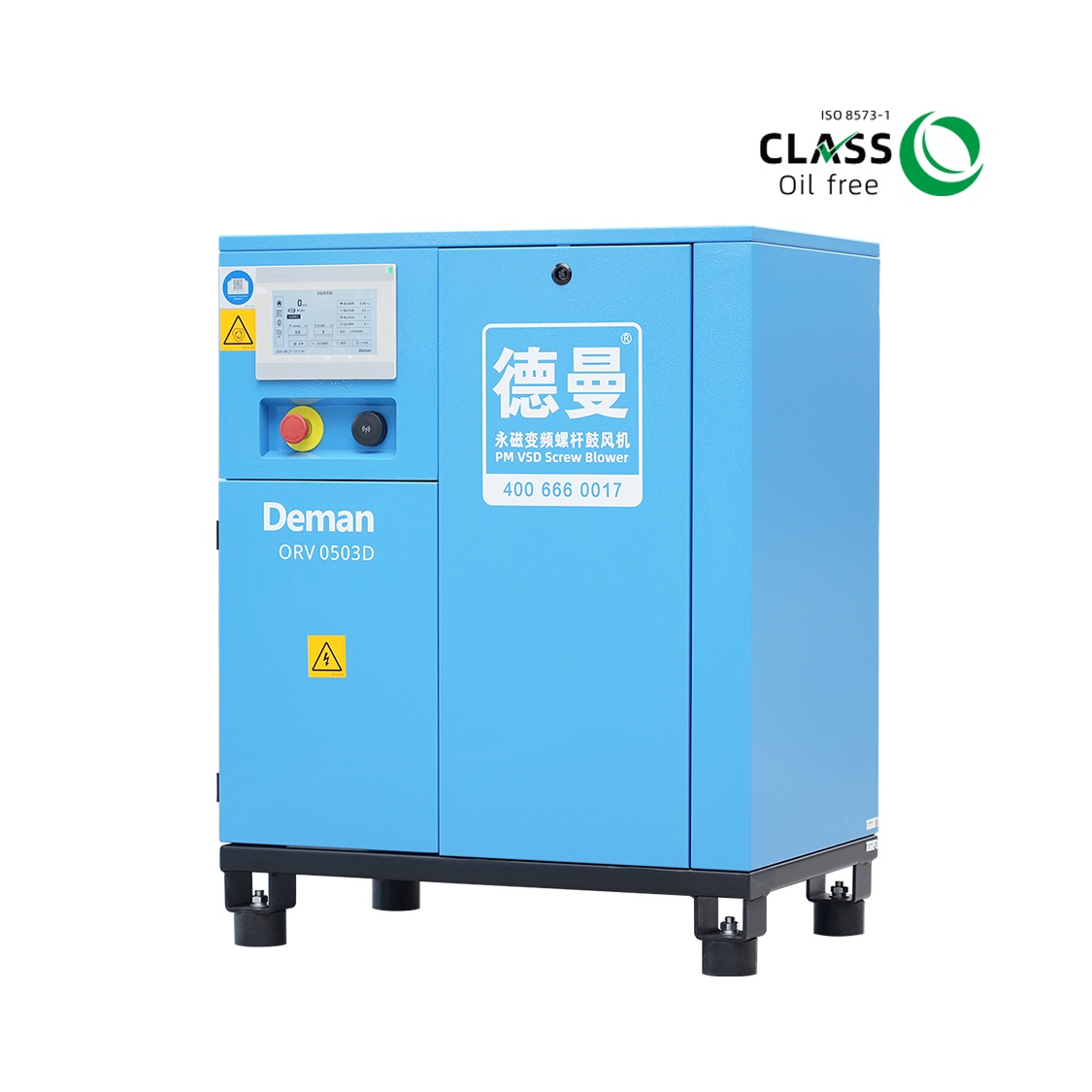
For a food, pharmaceutical, electronics, or medical air buyer, the TCO frame changes shape. The contamination cost of a single oil-aerosol breakthrough event can exceed the cumulative filter savings of several years. In this buyer profile, the higher machine price of the oil-free compressor is paid back by the avoided contamination risk, and the TCO comparison reverses by year four to year six of operation. The Deman PM VSD oil-free screw blower portfolio is positioned for this buyer profile, where Class 0 air purity is a hard requirement rather than a quality preference.
3. The process-critical buyer — TCO is the wrong frame entirely
For a semiconductor fab, a biotech fermentation line, or a critical medical air system, the TCO frame is the wrong frame entirely. The right frame is risk-adjusted lifecycle cost, where a contamination event is treated as a low-probability high-impact event rather than a recurring line item. In this buyer profile, oil-free is the default choice regardless of TCO, and the question shifts to which oil-free technology (water-injected, dry screw, scroll, centrifugal) and which certification (ISO 8573-1 Class 0, TÜV, ISO 22000) is required.
The 4-Component TCO Model
4 components make up the TCO gap between oil-free and oil-injected compressors over a 10-year horizon. The relative share of each component shifts as the duty cycle, electricity rate, and Class 0 requirement change.
Component 1 — Initial machine price
The initial machine price is the only TCO component that is paid once. Over a 10-year horizon, the initial price is usually a low-teens percentage of the lifecycle cost for both technologies. The oil-free machine price premium is real and should be acknowledged in the TCO model, but it is rarely the dominant component.
Component 2 — Electricity across 10 years
Electricity is typically the largest TCO component, often in the 60-80% range of the lifecycle cost for both technologies at continuous duty, a share documented in the Compressed Air Challenge best-practices guidance for industrial compressed air systems. Two-stage oil-free compression without the sealing effect of oil can lose a small amount of efficiency at the rotor interface, but oil-free compression also eliminates the pressure drop across the oil separation and filtration stage, which partially offsets the rotor-level loss. For variable speed drive oil-free compressors with permanent magnet motors, the net electricity comparison is usually within a small single-digit percentage of an equivalent VSD oil-injected compressor.
Component 3 — Filters and consumables across 10 years
Filters and consumables is the component that drives most of the TCO gap. On the oil-injected side, this line item grows over time: oil separator element replacement, coalescing filter cartridge replacement, activated carbon filter replacement, lubricant top-off, and lubricant change-out at the manufacturer-specified interval. On the oil-free side, the recurring filter load drops to the air filter element at the inlet and the gearbox lubricant in the sealed gear circuit. Over 10 years, this is where the filter savings accumulate most visibly.
Component 4 — Maintenance downtime across 10 years
Maintenance downtime is the component that is hardest to estimate but often the most underestimated. On the oil-injected side, the maintenance workload is more frequent and more time-bound: oil sampling, filter change-outs, lubricant top-offs, and condensate disposal. On the oil-free side, the service interval is longer and the workload is lighter, but the precision components in some oil-free designs can be more expensive to repair when they do fail. The net maintenance cost comparison depends on the duty cycle profile, the local labor rate, and the residual value at year 10.
| TCO component | Typical share of 10-year cost | Direction between oil-free and oil-injected |
|---|---|---|
| Initial machine price | 5-15% | Oil-free carries the premium |
| Electricity across 10 years | 60-80% | Largely comparable at VSD class |
| Filters and consumables across 10 years | 5-15% | Oil-free carries the lower load |
| Maintenance downtime across 10 years | 5-15% | Oil-free carries the lower labor load |
Filter Savings — The First Lever
Filter savings is the first lever, and it accumulates from three places on the oil-injected side that disappear on the oil-free side.
Lever 1a — No oil separator element replacement
On the oil-injected side, the oil separator element is the largest recurring filter cost. The element separates the lubrication oil from the compressed air stream, and it accumulates differential pressure over its service life. Replacement intervals vary by duty cycle and by ambient conditions, but the cost recurs across the 10-year horizon. On the oil-free side, there is no oil in the compression chamber and therefore no oil separator element to replace.
Lever 1b — No coalescing filter cartridge replacement
On the oil-injected side, the coalescing filter cartridge downstream of the compression stage captures residual oil aerosol to meet the target ISO 8573-1 class. The cartridge has a finite service life, and the replacement cost recurs at the manufacturer-specified interval. On the oil-free side, the compression stage does not introduce oil into the air stream, so the coalescing filter on the oil side is not required for contamination control.
Lever 1c — No lubricant top-off or change-out
On the oil-injected side, the lubricant in the compression chamber requires periodic top-off and full change-out at the manufacturer-specified interval. The lubricant cost and the labor cost recur across the 10-year horizon, as the Compressed Air Best Practices TCO analysis walks through in detail. On the oil-free side, the gear circuit uses a sealed oil volume in a separate loop, and the service interval is much longer. Over 10 years, this is one of the larger cumulative savings on the oil-free side.
| Recurring line item on the oil-injected side | Typical replacement interval | Status on the oil-free side |
|---|---|---|
| Oil separator element | Every few thousand operating hours | Not required (no oil in compression chamber) |
| Coalescing filter cartridge | Every few thousand operating hours | Not required for contamination control |
| Activated carbon filter | Every one to two years | Not required for contamination control |
| Lubricant top-off | Continuous, between change-outs | Not required (sealed gear circuit) |
| Lubricant full change-out | Every several thousand operating hours | Greatly extended interval |
Higher Machine Price — The Second Lever
Higher machine price is the second lever, and it is amortized over the equipment life. The premium reflects the more complex compression stage (two-stage design with intercooling, special rotor coatings, precision tolerances) and the certification scope (ISO 8573-1 Class 0 testing, TÜV verification, ISO 22000 for food-grade applications).
Lever 2a — Two-stage compression with intercooling
Oil-free screw compressors typically use a two-stage compression design with intercooling between stages to manage the higher discharge temperatures that result from the absence of oil cooling. The two-stage design adds rotor count, bearing count, and intercooler hardware, which translates into a higher machine price relative to a single-stage oil-injected compressor of equivalent free air delivery.
Lever 2b — Special rotor coatings and precision tolerances
Because there is no oil film to seal the rotor interface, oil-free rotors require special coatings (PTFE-based or similar) and tighter manufacturing tolerances to minimize internal leakage. The coating cost and the precision tolerance cost both contribute to the higher machine price. The Deman PM VSD oil-free screw blower series uses high-efficiency permanent magnet motors with precision-balanced rotors to keep this trade-off in balance.
Lever 2c — Certification scope (ISO 8573-1 Class 0, TÜV, ISO 22000)
For Class 0 applications, the certification scope adds cost: ISO 8573-1 Class 0 testing at an independent lab, TÜV verification where required, ISO 22000 food safety management system certification for food and pharmaceutical applications. The ELGi standard and certification guide and the Atlas Copco Class 0 reference walk through the certification layers required for contamination-sensitive applications. These certification costs are amortized into the machine price, but they are real and they explain part of the price gap relative to a stock oil-injected compressor.
| Source of the premium | Contribution to price gap |
|---|---|
| Two-stage compression with intercooling | Major contributor |
| Special rotor coatings and precision tolerances | Major contributor |
| Class 0 certification scope | Moderate contributor |
| High-efficiency permanent magnet motor (VSD class) | Moderate contributor |
The Break-Even Year — When Filter Savings Catch Up
Year 4 to Year 6 is the typical break-even range for Class 0 applications at medium to high duty cycle, with the exact year depending on local electricity rates, the filter change-out schedule, and the residual value of the equipment at year 10.
Why the break-even year falls in year 4 to year 6
Because electricity dominates the TCO at 60-80% and the electricity line item is roughly comparable between the two technologies, the TCO gap is driven mostly by the initial price premium on one side and the recurring filter and consumable cost on the other side. The filter savings on the oil-injected side accumulate over the first three to four years and reach a level that offsets the initial price premium on the oil-free side. After the break-even year, the oil-free TCO continues to fall behind the oil-injected TCO because the recurring filter and consumable cost on the oil-injected side keeps accumulating, a trajectory consistent with the industry TCO analyses published on the oil-injected vs oil-free decision.
What moves the break-even year earlier or later
Three variables move the break-even year. First, electricity rate: in regions with higher electricity rates, the filter savings on the oil-injected side accumulate faster relative to the machine price premium. Second, duty cycle: in continuous-duty operations, the filter change-out cycles are more frequent and the savings accumulate faster. Third, contamination cost: in Class 0 applications, the avoided contamination cost is a TCO component that the oil-free side captures but the oil-injected side does not, which pulls the break-even year earlier.
Five Pitfalls That Flip the TCO Narrative
5 pitfalls flip the TCO narrative, and a buyer who falls into any one of them arrives at a TCO answer that does not match the operating reality.
Pitfall 1 — underestimating contamination cost
Contamination cost is the largest hidden TCO component in Class 0 applications. A single oil-aerosol breakthrough event that reaches a downstream process can trigger a product recall, a batch rejection, a regulatory non-conformance, or a customer audit failure, scenarios documented across the pharmaceutical and food and beverage Class 0 references. The cost of any one of these events can exceed the cumulative filter savings of several years. The pitfall is treating contamination cost as a probabilistic line item rather than as a low-probability high-impact event. For Class 0 applications, the TCO model should treat contamination cost as a hard floor, not as an expected value.
Pitfall 2 — ignoring condensate disposal cost
Oil-injected compressors generate contaminated condensate that requires disposal as a regulated waste stream in most jurisdictions. The disposal cost per liter is small, but the volume across 10 years of operation is meaningful. The pitfall is omitting the condensate disposal cost from the TCO model. On the oil-free side, the condensate is largely free of oil contamination and the disposal cost drops accordingly.
Pitfall 3 — assuming identical electricity consumption
Some TCO comparisons assume identical electricity consumption between oil-free and oil-injected compressors of equivalent free air delivery. In practice, the comparison depends on the specific design: two-stage oil-free with intercooling may consume slightly more electricity at the rotor interface, but the elimination of oil separation pressure drop partially offsets the rotor-level loss. The pitfall is using a single fixed electricity assumption across both technologies. The electricity comparison should be done on the specific models under evaluation, at the actual duty cycle profile, in line with the methodology the DOE 2025 air compressor regulations now require for oil-flooded rotary compressors in the 35-1,250 cfm range.
Pitfall 4 — overestimating residual value
The residual value at year 10 is often overestimated in TCO models. The pitfall is assuming a high residual value based on the original machine price, without accounting for the fact that a 10-year-old compressor of either technology has a limited secondary market. A conservative residual value assumption, expressed as a low single-digit percentage of the original price, is more realistic for both technologies.
Pitfall 5 — missing the Class 0 requirement entirely
The most consequential pitfall is missing the Class 0 requirement from the TCO model. If the application requires Class 0 air purity, the TCO comparison collapses into a different question: not whether oil-free is more expensive than oil-injected, but whether oil-injected with multi-stage filtration can deliver Class 0 reliably over a 10-year horizon. The Sullair Class 0 vs technically oil-free analysis and the Atlas Copco ISO class reference both confirm that Class 0 cannot be reliably produced by downstream filtration alone. In most published lifecycle analyses, the answer reverses in favor of oil-free once Class 0 is treated as a hard requirement.
12-Question TCO Checklist Before Placing the Order
For industrial buyers evaluating an oil-free vs oil-injected compressor decision, the following 12-question checklist covers the variables that move the 10-year TCO outcome.
- Has the application Class 0 air purity requirement been confirmed in writing against ISO 8573-1?
- Has the duty cycle profile (hours per year, load profile, peak vs average) been quantified for the 10-year horizon?
- Has the local electricity rate been projected across the 10-year horizon, including any expected tariff changes?
- Has the filter and consumable change-out schedule been requested from both vendors in writing?
- Has the residual value assumption been set conservatively (low single-digit percentage of original price)?
- Has the condensate disposal cost been included in the TCO model for the oil-injected side?
- Has the contamination cost been included as a hard floor for Class 0 applications?
- Has the maintenance labor rate (including benefits and overhead) been quantified?
- Has the certification scope (ISO 8573-1 Class 0, TÜV, ISO 22000) been confirmed for the oil-free vendor?
- Has the VSD class and the permanent magnet motor specification been confirmed for both vendors?
- Has the warranty scope and the service network been mapped to the buyer's operating locations?
- Has the TCO model been stress-tested against electricity rate increases of 20-50% across the 10-year horizon?
For industrial buyers comparing oil-free options across vendors, the oil-free blower portfolio page lays out the current Class 0 product line and the certification scope. For buyers evaluating the specific two-stage PM VSD architecture, the oil-free screw blower series page covers the rotor design, the permanent magnet motor specification, and the air-end serviceability. For buyers who want the underlying technology comparison before the TCO model, the oil-injected vs oil-free differences guide walks through the compression chamber, the air purity path, and the maintenance scope side by side.
Frequently Asked Questions
Is oil-free always more expensive over 10 years than oil-injected?
Not necessarily. The total cost of ownership over a 10-year horizon depends on how the four cost components shift between the two technologies: machine price, electricity, filters and consumables, and maintenance downtime. For applications that do not require Class 0 air purity, oil-injected compressors with multi-stage filtration often deliver a lower 10-year TCO. For Class 0 applications such as food, pharmaceutical, electronics, and medical air, the filter savings and the avoided contamination cost on the oil-injected side can offset the higher machine price by year four to year six of operation, depending on duty cycle and local energy rates.
What are the four cost components in a 10-year compressor TCO model?
A 10-year compressor TCO model is usually decomposed into four components: the initial machine price, the electricity cost across 10 years of operation, the recurring filter and consumable cost (oil separators, coalescing filters, activated carbon filters, lubricant, desiccant), and the maintenance downtime cost including labor and lost production. The relative share of each component shifts as the duty cycle, electricity rate, and Class 0 requirement change. Electricity typically dominates at 60-80% of the lifecycle cost, while the initial machine price is often only 5-15% of the total over 10 years.
How much can filter savings offset the higher machine price of an oil-free compressor?
Filter savings on the oil-free side come from three places: no oil separator element replacement, no coalescing filter cartridge replacement, and no compressor lubricant top-off or change-out. Over a 10-year horizon, these recurring filter and consumable costs on the oil-injected side accumulate into a meaningful share of the TCO, and they grow with the duty cycle. The offset against the higher machine price is therefore larger in high-duty-cycle applications and smaller in low-duty-cycle applications.
What is the break-even year between oil-free and oil-injected TCO?
The break-even year is the operating year at which the cumulative cost of the oil-free compressor catches up with the cumulative cost of an oil-injected compressor paired with multi-stage filtration. In published lifecycle studies, the break-even year for Class 0 applications typically falls between year four and year six for medium-duty continuous-duty operations, and earlier for high-duty-cycle operations. The exact break-even year depends on local electricity rates, the number of filter change-out cycles, the cost of contamination-driven downtime, and the residual value of the equipment at year 10.
Does an oil-free compressor consume more electricity than an oil-injected compressor of the same rated output?
In some designs, yes. Two-stage oil-free compression without the sealing effect of oil can lose efficiency at the rotor interface, which can translate into a small electricity penalty. However, oil-free compression also eliminates the pressure drop across the oil separation and filtration stage, which partially offsets the rotor-level loss. For variable speed drive (VSD) oil-free compressors with permanent magnet motors, the net electricity comparison is usually within a small single-digit percentage of an equivalent VSD oil-injected compressor, depending on the duty cycle profile.
What hidden costs on the oil-injected side are often missed in a TCO comparison?
Three hidden costs on the oil-injected side are often missed: the disposal cost of contaminated condensate and used filter elements, the labor cost for periodic oil sampling and lubricant change-out, and the contamination cost when trace oil reaches a downstream process. The third category is the largest by an order of magnitude in contamination-sensitive applications, because a single contamination incident can exceed the cumulative filter savings of several years. This is why the TCO question collapses into a different question once Class 0 purity is a hard requirement.
When is oil-injected with multi-stage filtration the right TCO answer?
Oil-injected compressors paired with multi-stage filtration (coalescing filter, activated carbon filter, desiccant dryer) are the right TCO answer when the application does not require Class 0 air purity, when the duty cycle is moderate to low, when electricity rates are low, and when the contamination cost is not a hard constraint. In these conditions, the lower machine price outweighs the higher recurring filter and consumable cost over a 10-year horizon, and the simplicity of the oil-injected design keeps the maintenance workload predictable.
About the Author
Mr. Ryan is an air compressor solutions expert at Deman (Ningbo Deman Compressor Co., Ltd.), a national High-tech Enterprise and "Little Giant" firm founded in 1998, combining German quality standards with Chinese manufacturing expertise. Specialized in VSD oil-injected compressors, two-stage PM VSD systems, and intelligent compressed air solutions, Deman brings 29+ years of experience, 127 patents, and a ten-year warranty commitment to global manufacturers and industrial buyers sourcing energy-efficient, reliable air compressor systems.
Connect with Deman:
For a 10-year TCO comparison on the Deman PM VSD oil-free screw blower portfolio, contact the Deman engineering team through the oil-free blower portfolio page.