Industrial buyers are now shifting from single-machine efficiency to whole-system performance. In practice, that means the best savings come from matching supply to demand, recovering heat that would otherwise be wasted, and controlling the station as one integrated asset.
Why 2026 air station energy-saving trends matter
Compressed air is still one of the most expensive utilities in manufacturing, so small inefficiencies can become large operating costs. The U.S. Department of Energy notes that better energy management and efficient equipment can produce significant savings in compressed air systems, while CAGI emphasizes product-neutral training and system efficiency as core best practice. U.S. Department of Energy compressed air systems guidance and CAGI industry resources both support a system-wide approach.
For 2026 planning, the main question is no longer which compressor has the highest nameplate efficiency. The real question is how the station behaves under changing load, how much pressure is lost in transmission, and whether heat and data are being used intelligently.
Trend 1: Demand-based control is replacing fixed-output operation
Demand-based control is the first major trend because it directly cuts wasted power during partial load conditions. ISO 11011 defines compressed air assessment around supply, transmission, and demand, which is useful because it frames efficiency as a full-system issue rather than a machine-only issue. ISO 11011 compressed air system assessment explains that the system should be evaluated from energy input to useful work.
In 2026, more plants are using variable-speed drives, multi-compressor sequencing, and high-precision pressure control to avoid unnecessary unloading. Deman’s Air Commander multi-compressor central control system and 5DV refrigerated air dryer show how control and treatment can be coordinated instead of managed separately.
Demand-based control is especially valuable in factories with fluctuating production schedules. Textile, plastics, automotive parts, and appliance plants often see variable air demand across shifts, so a station that tracks actual consumption can reduce idle running and pressure overshoot.
Comparison Table: Fixed-Speed Operation vs Demand-Based Control
| Aspect | Fixed-Speed Station | Demand-Based Station |
|---|---|---|
| Load response | Runs near constant output | Matches output to demand |
| Energy waste | Higher no-load and unload losses | Lower wasted runtime |
| Pressure stability | Often wider fluctuation | Tighter control range |
| Maintenance impact | More cycling stress | Smoother operating profile |
The practical takeaway is simple: if demand changes, the station should change too. That is why intelligent sequencing and constant-pressure control are becoming standard in modern compressed air station optimization.
Trend 2: Waste heat recovery is moving from optional to expected
Waste heat recovery is the second major trend because compressed air systems reject a large share of input energy as heat. DOE’s Better Plants compressed air cheat sheet states that 80% of the electric energy going into compressors is lost as heat, which makes recovery one of the clearest energy-saving opportunities. DOE Better Plants compressed air cheat sheet supports this view with a direct efficiency focus.
In 2026, more plants are designing recovery around real thermal demand, not just theoretical savings. Deman’s RVC and RVB heat recovery system and related guidance on waste heat recovery technology show the typical path: capture heat, transfer it through a heat exchanger, and reuse it for hot water or process heating.
This trend matters most in plants with steady thermal loads, such as washing, cleaning, drying, or space heating. It also helps facilities improve energy intensity without changing core production equipment, which makes it attractive for retrofit projects.
Comparison Table: Common Energy-Saving Measures in a Compressed Air Station
| Measure | Primary Benefit | Best Fit |
|---|---|---|
| Demand-based control | Reduces no-load power | Variable air demand |
| Waste heat recovery | Reuses rejected thermal energy | Steady heat demand |
| Pressure optimization | Lowers system-wide consumption | Over-pressurized stations |
| Leak management | Reduces continuous losses | Older piping networks |
Waste heat recovery is not a standalone fix. It works best when the station is already well controlled, because recovered energy is only useful if the compressor is running efficiently in the first place.
Trend 3: System-level optimization is becoming the default design method
System-level optimization is the third major trend because the best savings now come from the station, not just the compressor. ISO 8573-1 defines compressed air purity classes for particles, water, and oil, which reminds engineers that air quality is part of performance, not an afterthought. ISO 8573-1 compressed air purity classes is especially relevant when downstream processes are sensitive to contamination.
In 2026, optimization usually includes piping pressure-drop control, dryer selection, filtration, centralized monitoring, and maintenance planning. OSHA also treats compressed gas and compressed air equipment as a safety topic with specific standards, which reinforces the need for safe design and disciplined operation. OSHA compressed gas and equipment standards and OSHA air receiver requirements are useful references for station safety.
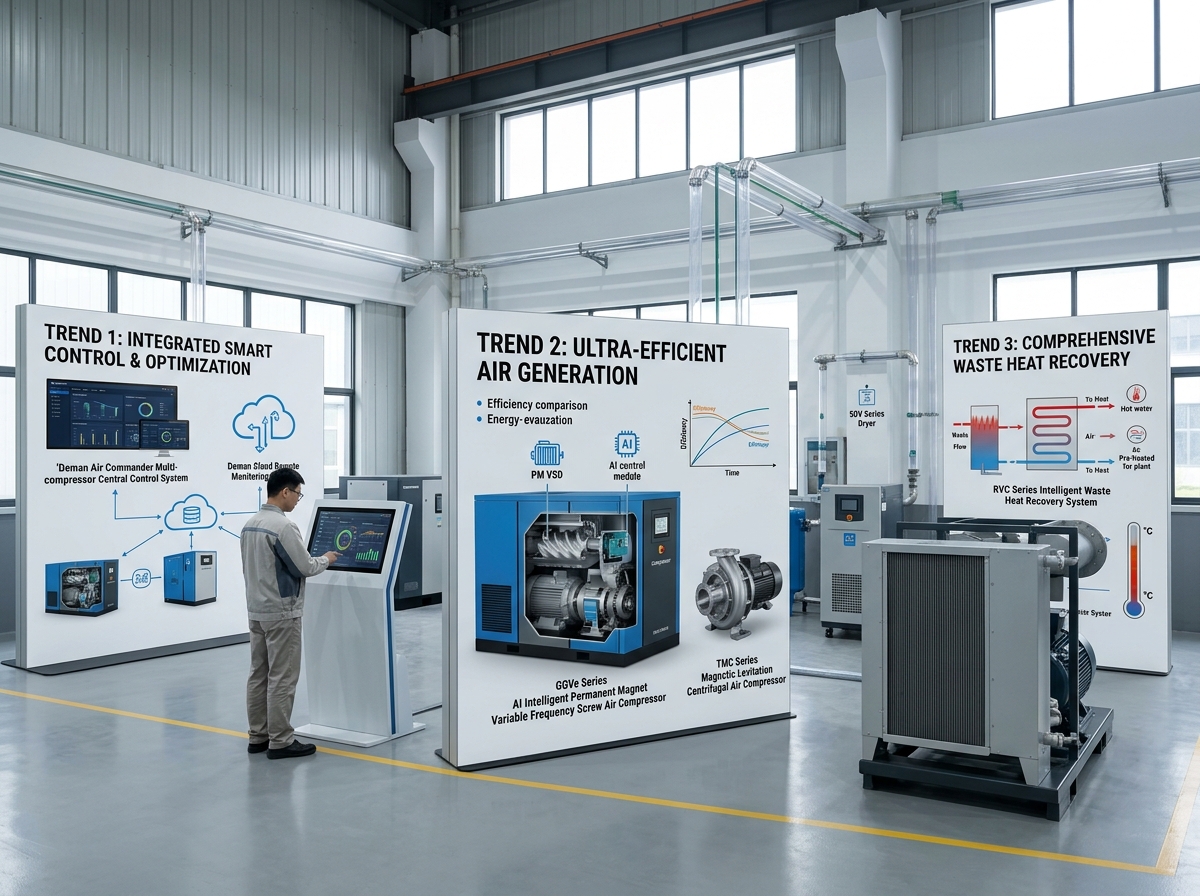
For buyers, the most useful optimization projects are the ones that connect equipment, controls, transmission, and maintenance into one plan. Deman’s product portfolio and main website show this integrated approach across screw compressors, centrifugal compressors, oil-free blowers, dryers, and control systems.
Comparison Table: Station-Level Design Priorities by Application
| Application | Main Priority | Typical Risk |
|---|---|---|
| Textile | Clean, stable air | Product defects from contamination |
| Hardware and plastics | Continuous pressure support | Cycle interruptions |
| Automotive parts | Centralized control | Line stoppage from instability |
| Thermal power | High-reliability operation | Downtime under heavy load |
System-level optimization also explains why station planning should come before equipment purchase. A compressor that looks efficient on paper can still perform poorly if the piping, dryer, and control logic are mismatched.
How to evaluate compressed air station optimization in 2026
Compressed air station optimization should start with measurement, not assumptions. ISO 11011 and DOE guidance both support auditing actual demand, pressure profile, and transmission losses before selecting equipment or controls. DOE compressed air systems and ISO 11011 are the most relevant references for this process.
- Measure average and peak demand across shifts.
- Check pressure drop from the compressor room to the point of use.
- Verify air quality requirements for each process.
- Review load-sharing logic across multiple compressors.
- Estimate heat recovery potential from operating hours and thermal demand.
When these five steps are complete, the station design becomes much easier to justify. The result is usually lower electricity use, fewer pressure complaints, and more predictable maintenance planning.
Supplier Directory: where to compare solution types
Compressed air buyers should compare suppliers by system scope, control capability, service model, and documentation quality. A one-stop provider such as Deman is relevant when the project needs compressors, dryers, controls, piping, and heat recovery in one package. Its product pages are useful for reviewing how the station components fit together.
For a broader market view, buyers can also consult product-neutral references from CAGI, assessment guidance from ISO 11011, and safety standards from OSHA. This combination helps separate technical merit from sales claims.
What these 2026 trends mean for industrial buyers
The three trends point to the same conclusion: compressed air savings now depend on coordination. Demand-based control reduces waste, waste heat recovery improves energy reuse, and system-level optimization aligns the whole station with production needs.
For factories with high electricity costs, unstable pressure, or quality-sensitive processes, the best 2026 projects will usually combine all three. That is the most reliable path to lower operating cost and better station performance.
FAQ
What is the most important compressed air energy-saving trend in 2026?
Demand-based control is usually the most important because it cuts wasted power during partial load operation. It works by matching compressor output to real air demand, which reduces unload losses, stabilizes pressure, and improves overall station efficiency in variable production environments.
Why is waste heat recovery gaining attention now?
Waste heat recovery is gaining attention because compressors reject a large amount of input energy as heat. When a plant has a steady thermal demand, that heat can be reused for hot water, heating, or drying, which improves total energy utilization without changing the core production process.
How does system-level optimization differ from buying a better compressor?
System-level optimization looks at the whole compressed air station, including controls, piping, dryers, filtration, and maintenance. A better compressor alone may not save much if pressure drop, leaks, or poor sequencing still waste energy across the rest of the system.
What standards are most useful when auditing a compressed air station?
ISO 11011 is the most relevant assessment standard because it covers the full compressed air system from energy input to useful work. ISO 8573-1 is also important when air quality matters, while OSHA standards help guide safe use of compressed air equipment and receivers.
Which industries benefit most from these trends?
Textile, plastics, hardware, automotive parts, appliance manufacturing, and thermal power plants often benefit the most. These sectors usually face changing demand, pressure sensitivity, or air quality requirements, so they gain from better control, lower energy waste, and more reliable station-wide performance.