
Size a rotary screw compressor for laser cutting by matching the laser manufacturer's required flow and pressure at the point of use, then adding verified capacity for peak demand, pressure losses, air treatment, and future expansion. Do not size from laser wattage alone: confirm required SCFM or l/min, working pressure, air quality, duty cycle, receiver volume, and the performance of the complete compressed-air system.
- Use the laser supplier's required flow and pressure as the starting point, not laser power alone.
- Design for stable pressure at the cutting head after filtration, drying, piping, and peak-demand losses.
- A rotary screw compressor for laser cutting should be evaluated with its dryer, filters, receiver, controls, and maintenance plan.
- High-pressure applications may require a dedicated compressor, booster, or a supplier-approved pressure architecture.
Laser cutting air directly influences assist-gas stability, cut quality, nozzle performance, and equipment reliability. Published laser-compressor guidance commonly discusses working pressures from 10 to 16 bar for integrated laser systems, while compressor-sizing guidance recommends using Standard CFM and allowing a design margin rather than selecting a machine from nominal horsepower alone. This guide explains how to convert the machine requirement into a dependable laser cutting compressor sizing decision, with attention to air quality, storage, controls, and total operating cost.
Start with the laser manufacturer's actual air requirement
The laser machine specification is the controlling document because two machines with similar laser power can have different assist-air requirements. Request the required flow at a stated pressure, the acceptable pressure range, the air-quality class or cleanliness requirement, and whether the figure applies continuously or only during cutting. The compressor must deliver the required flow at the machine inlet, not merely at the compressor outlet.
Laser wattage is useful for initial planning but is not a complete sizing variable. Material type, thickness, nozzle diameter, cutting speed, assist-gas strategy, and whether compressed air replaces nitrogen or oxygen can change consumption. A fiber laser used for thin sheet may have a very different demand profile from a high-power machine cutting thick plate.
Record these inputs before requesting a quotation
- Required flow in SCFM, CFM, or l/min, including the reference conditions used by the manufacturer.
- Minimum and normal operating pressure at the laser inlet.
- Maximum pressure permitted by the machine, regulator, nozzle, and piping.
- Number of lasers operating simultaneously and their coincidence factor.
- Cutting materials, thickness range, nozzle sizes, and expected operating schedule.
- Required dew point, particulate filtration, oil carryover, and condensate controls.
- Available electrical supply, ambient temperature, installation altitude, and room ventilation.
Use a repeatable sizing calculation
The practical sizing formula is compressor delivered flow equal to simultaneous process demand plus other plant demand, multiplied by a documented design margin. The margin should compensate for measured uncertainty, pressure drop, future demand, and control behavior; it should not conceal an unknown or poorly measured load.
Standard CFM is the preferred comparison basis when evaluating compressor capacity because stated flow values can use different reference conditions. Quincy Compressor's sizing guidance specifically recommends relying on Standard CFM and factoring in a 30% allowance during selection; treat that figure as a selection guideline, then confirm the final design with the laser manufacturer and a compressed-air specialist.
For a single laser, a simplified planning equation is: required compressor flow = laser flow at the specified pressure + simultaneous auxiliary demand + verified leakage allowance, followed by the selected design margin. If several machines cut at the same time, use their actual coincidence rather than simply adding every nameplate value unless all machines can operate at full demand simultaneously.
| Design input | Numerical reference | How to use it |
|---|---|---|
| Selection allowance | 30% | Use as a published sizing guideline from Quincy, not as a substitute for measured demand. |
| Integrated laser working-pressure range | 10 to 16 bar | Use only when it matches the specific laser and process specification. |
| Receiver sizing reference | Up to 10 gal per CFM | Use as a CAGI-referenced design guideline and validate against cycling, pressure stability, and compressor controls. |
These numerical references are starting points rather than universal machine settings. The relevant sources are Quincy Compressor's rotary-compressor sizing guidance, the laser-focused pressure information published by Ziqi's integrated laser compressor guide, and the receiver guidance discussed by Kaishan's system-design article. Final capacity must still be based on the equipment datasheets and site conditions.
Choose pressure at the laser, not pressure at the compressor
Pressure stability at the cutting head matters more than the compressor's maximum rated pressure. Pressure is lost through dryers, filters, regulators, valves, undersized hoses, long pipe runs, quick couplers, and contaminated filter elements. A compressor rated for the nominal pressure may therefore fail to maintain the laser's minimum inlet pressure during a cutting peak.
Specify the pressure budget from the compressor discharge to the machine inlet. Include the normal operating pressure, the minimum pressure required at the laser, and the allowable pressure drop across every component. A pressure regulator should control the process pressure without becoming a hidden restriction, and gauges should be installed before and after critical treatment equipment so pressure loss can be diagnosed.
High-pressure cutting applications require a separate engineering check because a standard 8 or 10 bar package may not be suitable for a 16 bar process. The Chicago Pneumatic laser-cutting compressor page illustrates that dedicated rotary screw packages are marketed for laser applications, including higher-pressure configurations. Do not assume that a booster can be added without checking flow, temperature, storage, controls, and the laser manufacturer's approval.
Size the complete air system, not only the screw element
The complete air system determines whether a selected compressor performs reliably. A suitable installation normally includes the compressor, receiver, dryer, filters, condensate management, distribution piping, controls, and the final point-of-use regulator.
Air treatment protects both process and equipment
Dry, clean air is essential because moisture, oil aerosol, and particles can affect valves, regulators, nozzles, and cut consistency. A refrigerated dryer is often suitable for general industrial service, while applications with stricter dew-point or contamination requirements may need a higher-grade drying and filtration arrangement. Confirm the required quality with the laser OEM rather than selecting filters from pressure rating alone.
Filter pressure drop must be included in the capacity calculation. A filter that is acceptable when new may create a much larger restriction as it loads with contaminants, so differential-pressure indicators and a defined replacement method are valuable. Condensate should be managed in accordance with local environmental requirements and the equipment manufacturer's instructions.
Receiver volume stabilizes short demand changes
An air receiver can buffer short cutting peaks, reduce rapid compressor loading and unloading, and help stabilize pressure. It cannot permanently correct an undersized compressor because stored air is eventually depleted during sustained demand. Receiver selection should consider the compressor control mode, cut-cycle pattern, minimum and maximum pressure settings, and the allowable pressure fluctuation at the laser.
| System stage | Pressure-check point | Primary numerical question |
|---|---|---|
| Compressor discharge | Before treatment | What pressure and delivered flow are available? |
| After dryer and filters | At treated-air outlet | How many bar are lost across treatment? |
| Before laser regulator | At distribution end | Does the pressure remain above the laser minimum at peak flow? |
| Laser inlet | Point of use | What flow and pressure are actually delivered during cutting? |
Match compressor technology to the shop's load profile
A rotary screw compressor is usually appropriate when a shop needs continuous or frequently recurring industrial air, but the best control method depends on the load profile. A fixed-speed unit can be efficient near a steady design load, while a variable-speed unit can reduce inefficient unloaded operation when demand varies substantially. The choice should be based on measured demand, minimum stable operating range, motor efficiency, service conditions, and total lifecycle cost.
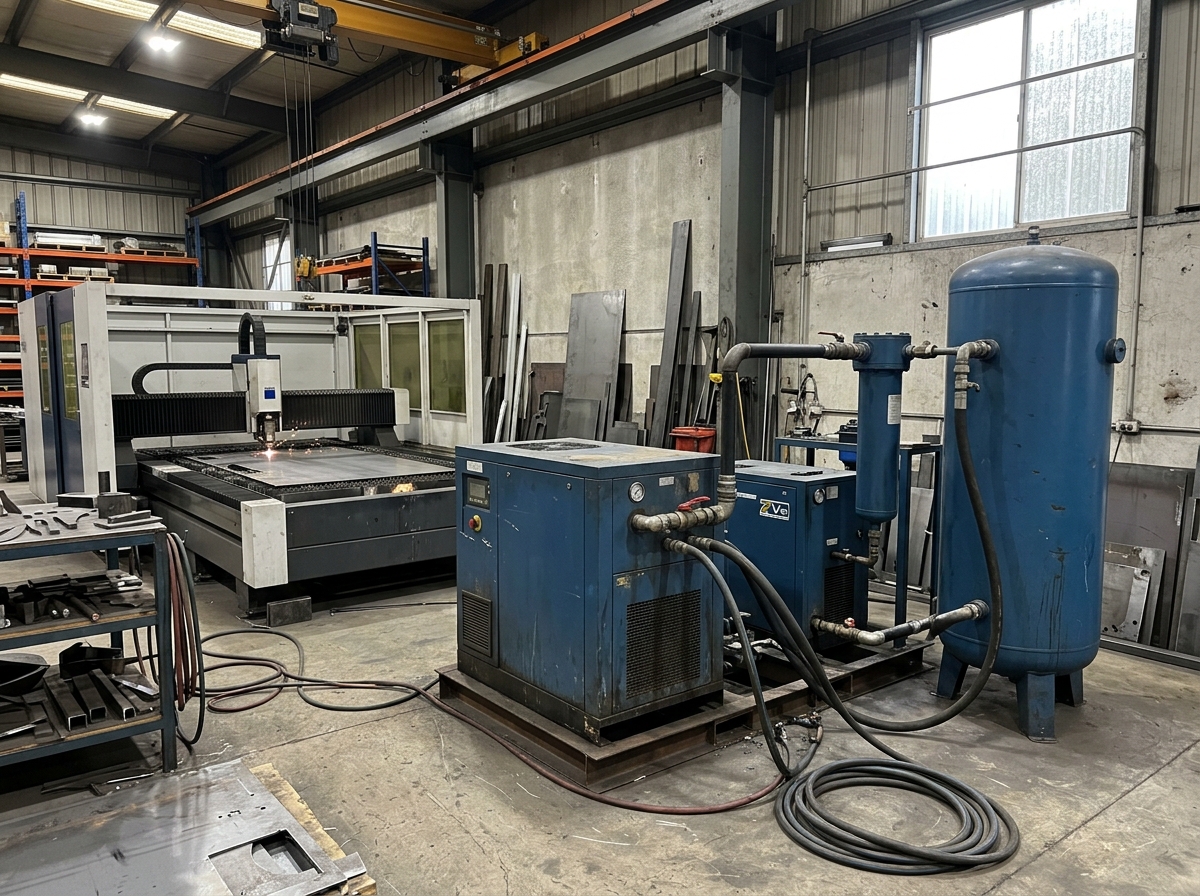
Multiple machines may justify lead-lag or master controls rather than several independent compressors operating at partial load. Coordinated control can assign the lead machine, start standby capacity when needed, and prevent multiple units from running inefficiently. Remote monitoring can also identify abnormal pressure trends, rising temperature, filter restriction, or repeated alarms before they become production interruptions.
Energy savings should be calculated from operating hours, measured kW, control behavior, pressure settings, leakage, and electricity tariffs. Avoid accepting an unsupported percentage or payback claim; request the assumptions, measurement method, and baseline used by the supplier.
Scenario-based selection guidance
A single-laser shop should prioritize a verified point-of-use flow test, an adequately sized treatment train, and a receiver that smooths cutting pulses. The installation should also leave practical space for maintenance and provide a clear path for condensate removal.
A multi-laser shop should calculate simultaneous demand and identify the highest-demand operating combinations. A staged system with a trim compressor, base-load compressor, receiver, and master controller may provide better efficiency than several identical units, but only a load study can validate that architecture.
A high-pressure shop should confirm whether the required pressure is generated directly by the compressor or by a booster. Compare delivered flow at the final pressure, discharge temperature, storage volume, noise, maintenance, and control response rather than comparing nameplate pressure alone.
A shop replacing bottled nitrogen with compressed air should validate the cutting process on its actual materials and thicknesses. Air may be appropriate for some applications, but the change can affect edge appearance, oxidation, throughput, and customer specifications; process trials are more reliable than a generic cost claim.
Commissioning checklist for laser cutting compressor sizing
- Obtain the laser OEM's flow, pressure, and air-quality requirements in writing.
- Measure or estimate all simultaneous compressed-air loads, including non-laser users.
- Calculate pressure losses through treatment, piping, valves, regulators, and hoses.
- Select compressor capacity at the required pressure and reference flow condition.
- Confirm receiver size, control range, dryer capacity, filter rating, and condensate handling.
- Verify voltage, ventilation, ambient temperature, service access, and noise constraints.
- Commission the system at the laser inlet during the highest realistic cutting demand.
- Record pressure, flow, dew point, filter differential pressure, and compressor power for the baseline.
Frequently asked questions
1. Can I size the compressor from laser wattage?
No. Laser wattage may correlate with process capability, but it does not provide the complete flow, pressure, duty-cycle, and air-quality requirement. Use the machine datasheet and process conditions.
2. What pressure should a laser cutting compressor provide?
The correct pressure is the value specified by the laser manufacturer for the selected material, nozzle, and assist-air process. Published laser-compressor guidance includes 10 to 16 bar ranges, but that range is not a universal setting.
3. Should I use a rotary screw or reciprocating compressor?
A rotary screw unit is commonly considered for recurring industrial demand because it is designed for extended operation, but a reciprocating unit may suit intermittent or smaller loads. Compare actual duty cycle, flow, pressure, noise, maintenance, and lifecycle cost.
4. Is a variable-speed compressor always more efficient?
No. Variable speed can reduce inefficient unloaded operation under changing demand, but savings depend on the load profile, control range, installation, and operating hours. A measured load study is the reliable basis for the decision.
5. How much receiver capacity does a laser shop need?
Receiver capacity depends on demand peaks, pressure band, compressor controls, and required pressure stability. Industry guidance cited by Kaishan references up to 10 gallons per CFM as a design guideline, but the final volume should be engineered for the actual system.
6. Does the compressor need an air dryer?
Most laser systems need controlled moisture and contamination because water and particles can affect regulators, valves, nozzles, and cut quality. Select the dryer and filters from the required dew point, pressure, flow, and air-quality specification.
7. How can I prevent production downtime?
Use correct capacity, a documented maintenance schedule, differential-pressure monitoring, condensate management, remote alarms, and a contingency plan for critical components. Commissioning measurements at the laser inlet are especially important.
About Deman
Deman focuses on complete compressed-air solutions rather than treating the compressor as an isolated machine. Its approach considers equipment selection, air treatment, receivers, piping, controls, energy use, monitoring, and the needs of the final production process. For a laser shop, the next step is a documented load and pressure review that connects the laser specification with a practical, serviceable system design. Prepare the machine datasheet, operating schedule, and site constraints before requesting a quotation.