

Introduction
Sourcing industrial air compressors from China can lower equipment costs and widen your options, but the process involves more than comparing quotes. Buyers need to assess factory capability, product specifications, certifications, shipping terms, import duties, and after-sales support before placing an order. This guide explains each step in a practical sequence, from identifying the right supplier and verifying quality to calculating total landed cost and managing logistics. By the end, you will have a clear framework for reducing sourcing risk, avoiding common procurement mistakes, and importing air compressors with better cost control and confidence.
Why Import Air Compressors from China
China has established itself as the dominant global manufacturing hub for industrial machinery, accounting for roughly 30% to 40% of the world's air compressor exports. For businesses looking to scale their operations, importing directly from Chinese manufacturers presents a highly strategic procurement avenue. However, navigating cross-border trade requires a deep understanding of supplier ecosystems, logistical requirements, and hidden cost drivers.
A successful import strategy goes beyond simply finding the lowest price. It demands careful evaluation of factory capabilities, regional manufacturing specializations—such as the compressor clusters in Zhejiang and Guangdong provinces—and a rigorous approach to mitigating supply chain risks.
Cost and manufacturing advantages
The primary driver for sourcing from China is the substantial reduction in capital expenditure. Due to mature supply chains, localized raw material sourcing, and immense economies of scale, buyers typically realize cost savings ranging from 20% to 45% compared to purchasing equivalent units from Western manufacturers. Furthermore, Chinese factories offer extensive customization capabilities, allowing buyers to specify motor brands, inverter types, and cooling systems without facing exorbitant engineering fees.
Best-fit buyer profiles
Direct importation is not suitable for every buyer. The ideal profiles for this procurement route include mid-to-large manufacturing plants, automotive industrial facilities, and regional equipment distributors. These entities usually have the capacity to handle minimum order quantities (MOQs), which typically range from 1 to 5 units for heavy industrial equipment, and possess the technical staff required to manage installation and routine maintenance independently.
Risk and landed cost overview
While the initial FOB (Free on Board) price may appear highly attractive, buyers must accurately calculate the total landed cost to assess true profitability. Ocean freight for heavy machinery can fluctuate significantly, often adding $1,500 to $3,000 per 20-foot container. Additionally, importers must account for tariffs—such as the 25% Section 301 duties currently applied to many Chinese imports in the United States—alongside potential supply chain delays and the risk of receiving sub-standard aftermarket support if the supplier is not thoroughly vetted.
How to Select the Right Industrial Air Compressor
Procuring the correct industrial air compressor requires aligning the equipment's technical capabilities with the specific demands of the facility. An undersized unit will run continuously and wear out prematurely, while an oversized unit wastes significant electrical energy.
Evaluating the operational parameters involves looking closely at duty cycles, ambient operating conditions, and the required air purity standards of the end-use application.
Compressor types, pressure, and flow
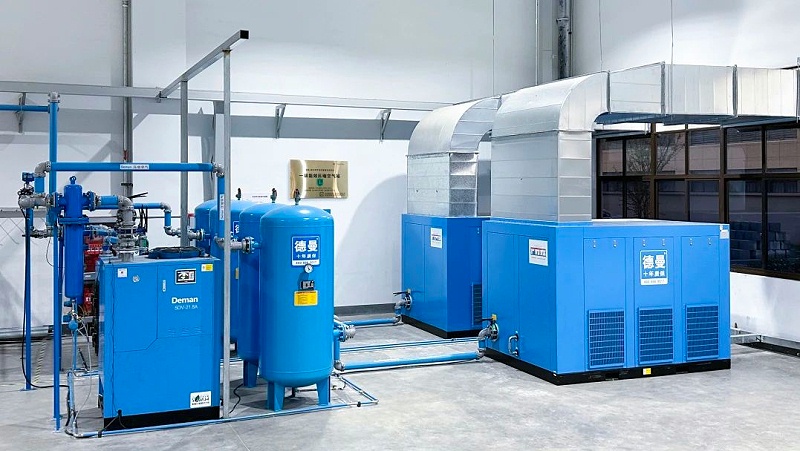
The most critical metrics in compressor selection are operating pressure, typically measured in PSI or Bar, and volumetric flow rate, measured in CFM or cubic meters per minute. Standard pneumatic tools generally require 100 to 125 PSI, while specialized applications like PET bottle blowing demand a high pressure air compressor capable of delivering 400 to 600 PSI. Rotary screw models are heavily favored for continuous industrial use, whereas reciprocating piston types are reserved for intermittent duty cycles.
Key technical specifications
Beyond pressure and flow, buyers must specify electrical requirements to ensure compatibility with their local grid. Chinese standard industrial voltage is 380V/50Hz, whereas North American facilities typically operate on 460V/60Hz or 230V/60Hz. Failure to specify the correct motor winding and electrical components will render the machine unusable upon arrival. Other vital specifications include the motor power rating (kW or HP), the type of cooling system (air-cooled vs. water-cooled), and the ingress protection (IP) rating of the electrical enclosure, which should be at least IP54 for dusty environments.
Performance and maintenance comparison
Different compressor designs yield vastly different maintenance schedules and operational lifespans. Understanding these trade-offs is essential for calculating the total cost of ownership over a 5-to-10-year horizon.
| Compressor Type | Duty Cycle | Maintenance Interval | Typical Lifespan | Noise Level |
|---|---|---|---|---|
| Rotary Screw | 100% Continuous | 2,000 - 4,000 hours | 40,000+ hours | 65 - 75 dB |
| Piston / Reciprocating | 50% - 60% Intermittent | 500 - 1,000 hours | 15,000 hours | 80 - 90 dB |
| Centrifugal | 100% Continuous | 8,000 hours | 60,000+ hours | 75 - 85 dB |
How to Source and Vet Suppliers
The Chinese market is saturated with thousands of trading companies and original equipment manufacturers (OEMs). Distinguishing a genuine factory with robust quality control from a middleman is the most critical phase of the sourcing process.
Effective vetting requires a combination of digital due diligence, verification of technical certifications, and, when possible, third-party factory audits.
Sourcing channels and factory verification
While B2B platforms like Alibaba and Made-in-China are excellent starting points, relying solely on their verification badges is insufficient. Buyers should request the supplier's business license and verify their registered capital; a reputable industrial manufacturer typically holds a registered capital exceeding 5 million RMB. Furthermore, buyers should cross-reference export records using customs databases and consider hiring local third-party inspection agencies to conduct on-site factory audits prior to placing a deposit.
Certifications and quality control
Industrial machinery must comply with stringent safety and performance standards. A reliable supplier should readily provide ISO 9001 quality management certificates and CE documentation (such as compliance with EN 1012-1 for European markets). For pressure vessels like the air receiver tank, ASME certification or its regional equivalent is mandatory to pass local safety inspections. Top-tier Chinese manufacturers operate with a defect rate of under 1.5% and conduct 48-hour continuous run tests before shipping.
Evaluating price versus supplier reliability
Aggressively negotiating for the lowest possible price often results in unseen compromises in component quality. For example, a heavily discounted screw air compressor might utilize a generic, low-efficiency airend that fails within 10,000 hours, compared to a premium SKF-bearing equipped airend designed to last over 40,000 hours. Buyers must demand a detailed Bill of Materials (BOM) specifying the brands of core components—such as the motor, inverter, and contactors—to accurately evaluate whether a price quote reflects a genuine bargain or compromised reliability.
How to Import Air Compressors Step by Step
Executing the import process requires strict adherence to international trade protocols. From the moment a commercial invoice is generated to the day the equipment arrives at the destination facility, each step must be meticulously managed.
Importers must coordinate closely with freight forwarders, customs brokers, and the supplier to ensure all documentation aligns perfectly with regulatory requirements.
From inquiry to order confirmation
The process begins with a highly detailed Request for Quotation (RFQ) that outlines all technical specifications, packaging requirements, and warranty terms. Once terms are agreed upon, the supplier will issue a Proforma Invoice (PI). Standard payment terms in the industry are a 30% T/T (Telegraphic Transfer) deposit to initiate production, with the remaining 70% balance paid after the buyer receives video proof of the completed unit and a copy of the Bill of Lading. Manufacturing lead times generally range from 25 to 40 days, depending on the level of customization.
Compliance, shipping, and customs
Air compressors are heavy, bulky items that are almost exclusively shipped via sea freight. Buyers must decide between Less than Container Load (LCL) for single units or Full Container Load (FCL) for bulk orders. The universally recognized HS Code for air compressors is typically 8414.80, though the exact suffix varies by destination country. To clear customs smoothly, the importer's broker will require the Bill of Lading, Commercial Invoice, Packing List, and any necessary origin certificates to apply for preferential tariff rates if applicable.
Landed cost breakdown
Understanding the breakdown of landed costs is essential for securing adequate financing and determining the final ROI of the import operation.
| Cost Component | Typical Percentage of Total Landed Cost | Example Calculation (Based on $10,000 FOB) |
|---|---|---|
| FOB Factory Price | 65% - 75% | $10,000 |
| Ocean Freight (LCL/FCL) | 10% - 15% | $1,500 |
| Customs Duties & Tariffs | 5% - 25% (Varies by country) | $2,500 (Assuming 25% tariff) |
| Insurance & Port Fees | 2% - 5% | $400 |
| Local Inland Transport | 3% - 6% | $600 |
| Total Landed Cost | 100% | $15,000 |
How to Make the Final Import Decision
The final decision to proceed with an international purchase should be an analytical process, weighing the immediate capital savings against long-term operational realities.
By anticipating common pitfalls and prioritizing lifecycle costs over upfront price tags, buyers can secure equipment that acts as a reliable utility for their production lines.
Common importing mistakes
One of the most frequent errors inexperienced importers make is neglecting the aftermarket supply chain. Consumables such as oil filters, air filters, and separator cores must be replaced regularly (often every 2,000 to 4,000 hours). Failing to order a 12-to-24-month supply of these spare parts alongside the main unit forces the buyer to pay exorbitant express air-freight costs later. Another critical mistake is failing to verify local environmental regulations, such as minimum energy efficiency ratings required by state or national energy departments.
Price versus energy efficiency
While a standard fixed-speed compressor is cheaper to purchase, it is rarely the most economical choice over time. Over a standard 5-year operational lifecycle, electrical consumption accounts for roughly 70% to 80% of a compressor's Total Cost of Ownership (TCO). Upgrading to a Variable Speed Drive (VSD) model typically increases the FOB price by 15% to 25%, but it can yield energy savings of up to 35% annually by matching motor speed to fluctuating air demand. Buyers must calculate this payback period before finalizing their order.
Decision checklist for buyers
Before authorizing the initial 30% deposit, buyers should execute a final decision checklist. This includes verifying that all electrical specifications match the destination facility, confirming the supplier's warranty policy (including how replacement parts are shipped), securing a firm freight quote from a licensed forwarder, and ensuring the local customs broker has pre-cleared the HS code and documentation requirements. Only when all these variables are quantified should the import transaction proceed.
Further reading:
Key Takeaways
- The most important conclusions and rationale for air compressor
- Specs, compliance, and risk checks worth validating before you commit
- Practical next steps and caveats readers can apply immediately
Frequently Asked Questions
What compressor type is best for continuous factory use?
A rotary screw air compressor is usually best for 24/7 industrial operation because it supports continuous duty, lower noise, and longer service life than piston models.
Which electrical specs should I confirm before ordering from China?
Confirm voltage, frequency, phase, motor winding, and plug/control standards. For example, many Chinese units are 380V/50Hz, while US plants often need 460V/60Hz.
What costs should I include besides the FOB compressor price?
Include ocean freight, insurance, import duty, Section 301 tariffs if applicable, customs clearance, inland delivery, and installation parts to calculate true landed cost.
How can I verify a Chinese air compressor supplier?
Check business licenses, export records, factory audit reports, test certificates, warranty terms, and spare-parts support. Request performance data and a video factory inspection before payment.
Can DEMANAC help with customized industrial air compressor orders?
Yes, DEMANAC can support customization such as pressure, flow, motor brand, inverter type, cooling method, and local power requirements for your application.