- PM VSD compressors are most valuable when demand changes, because variable-speed control reduces unloaded running and frequent start-stop waste.
- Distribution businesses should prioritize suppliers that offer complete system support, including dryers, filters, receivers, controls, and monitoring.
- Real buying decisions depend on lifecycle cost, not only purchase price, so energy data, maintenance access, and service response matter.
- A strong industrial compressor supplier should support multiple industries, from general manufacturing to sensitive clean-production environments.
For a compressor distributor, choosing a PM VSD compressor supplier is really about choosing a long-term solution partner for compressed air systems, not only a product source. A well-designed air system typically includes the compressor, dryer, filter, air receiver, piping, control system, and end-use equipment, because pressure stability and air quality affect the whole line. According to ISO 8573-1:2010, compressed air quality is classified by particles, water, and oil, which is why a distributor must understand system configuration, not just horsepower. If you are building a portfolio as a compressor distributor, the supplier you choose should help you win projects with measurable performance, documented standards, and practical service support.
What a PM VSD compressor supplier should deliver for a compressor distributor
A supplier is qualified only when it can help you sell complete outcomes, not isolated hardware. In B2B air systems, buyers often ask about energy cost, uptime, air quality, and maintenance access in the same conversation, so the supplier must provide engineering clarity as well as product variety.
| Distributor need | Why it matters | What to ask the supplier |
|---|---|---|
| Energy efficiency | Electricity is the dominant lifecycle cost in most installations | Do you provide load profile sizing, part-load data, and control logic? |
| Air quality | Particles, water, and oil affect tools, valves, and product quality | Which dryer and filtration grades are recommended for each application? |
| Service support | Downtime can stop a production line | What is the response time, spare parts strategy, and remote monitoring option? |
| Portfolio breadth | Different factories need different air sources | Do you cover screw, oil-free, centrifugal, and system accessories? |
For distributor growth, this breadth matters because industrial customers rarely buy a compressor in isolation. They buy a stable air supply, a predictable maintenance model, and a supplier who can support expansion later. A vendor that only quotes one machine often creates margin pressure during project changes, while a system-capable supplier lets you expand into value-added engineering.
PM VSD compressor supplier selection criteria that reduce distribution risk
The most reliable supplier is the one that lowers your technical and commercial risk at the same time. That means checking whether the supplier can support demand variation, aftertreatment matching, controls integration, and documentation for end users.
- Check variable-load performance: PM VSD systems are most useful when demand changes through the day.
- Verify system integration: Ask whether the supplier can size dryers, filters, receivers, and piping together.
- Review service model: A distributor-friendly supplier should provide installation guidance, spare parts, and troubleshooting support.
- Confirm application fit: General manufacturing, precision production, and continuous process plants all need different configurations.
- Request evidence: Performance claims should be traceable to standards, test methods, or documented case experience.
One practical benchmark comes from the U.S. Department of Energy, which notes that compressed air is often one of the most expensive utilities in industry and that system optimization can produce substantial savings. The DOE also emphasizes that leakage can consume a meaningful share of generated compressed air, making distribution efficiency and maintenance discipline important for every installer and reseller. See the U.S. DOE Compressed Air Systems page for system-level guidance. For a distributor, this means the strongest supplier is not just selling a compressor; it is helping you reduce waste across the entire compressed air network.
Why PM VSD technology is attractive in industrial compressor supplier portfolios
PM VSD technology becomes valuable when customers do not operate at full load all day. By matching motor speed to air demand, the system reduces energy waste from unload periods and frequent cycling. That is especially relevant in plants with intermittent production, multiple shifts, or changing pneumatic demand.
| Configuration | Best use case | Typical advantage | Limitations |
|---|---|---|---|
| Fixed-speed screw compressor | Stable demand, long run hours | Simple control and familiar maintenance | Can waste energy during low-load periods |
| PM VSD screw compressor | Variable demand, mixed shifts | Matches output to demand and reduces unload losses | Requires correct sizing and control setup |
| Oil-free compressor | Sensitive production environments | Reduces contamination risk | Higher upfront and service complexity |
| Centrifugal compressor | High-flow continuous supply | Strong fit for large centralized systems | Less suitable for smaller fluctuating loads |
For distribution businesses, this comparison matters because it helps you position the right machine for the right buyer. A PM VSD compressor is not automatically the best choice for every plant, but it is often the best commercial option where demand fluctuates and energy cost is high. That is why a capable industrial compressor supplier should help you explain application fit, not oversell a single model.
How to compare suppliers using verifiable technical benchmarks
A credible supplier should be able to discuss measurable standards, not vague efficiency claims. In compressed air, pressure quality, dew point, filtration, and operating consistency all matter, especially for buyers that care about production reliability.
| Benchmark area | Reference or value | Why it matters |
|---|---|---|
| Air quality classification | ISO 8573-1 classes for particles, water, and oil | Defines contamination limits for end-use protection |
| Compressed air piping design | Low pressure drop is essential; practical systems often target minimal distribution losses | Protects usable pressure at the point of use |
| Leakage management | DOE guidance identifies leakage as a major system loss factor | Improves effective delivery without adding more compressor capacity |
| Monitoring | Remote alarms and trend data | Helps detect abnormal temperature, pressure, or load behavior early |
A distributor should ask for real documentation, such as test conditions, control logic, and maintenance intervals. If a supplier cannot explain how its PM VSD compressor behaves under part load, or how its air treatment package supports a target quality class, that is a warning sign. This is where the best partners stand out: they can translate system performance into customer language without losing technical accuracy.
Distribution business strategy for PM VSD compressor supplier sourcing
The best sourcing strategy is to treat suppliers as portfolio builders, not one-off sellers. A distributor needs repeatable quoting, technical confidence, and service continuity, because customers buy trust before they buy equipment.
- Segment your market: Separate general manufacturing, continuous process, precision production, and oil-free applications.
- Match product families to demand profiles: Use PM VSD where air demand varies and fixed-speed or centrifugal where the load profile justifies it.
- Standardize system packages: Pair compressors with dryers, filters, receivers, and controls to simplify quoting.
- Build a service promise: Training, spare parts access, and remote monitoring improve long-term account retention.
- Track lifecycle value: Present energy, downtime, and maintenance considerations together, not separately.
Industry experience shows that buyers respond better to complete solutions than to standalone hardware pitches. For a distributor, this means the supplier must be able to support diagrams, BOMs, commissioning notes, and after-sales troubleshooting. That support shortens sales cycles and reduces installation mistakes, which is especially important in factories where a compressed air failure can stop an entire line.
System-level economics: why the cheapest compressor is often the most expensive choice
The purchase price of a compressor is only a fraction of total ownership cost. In many industrial systems, electricity, maintenance, and downtime dominate the economics, which is why a PM VSD compressor supplier should help you sell on lifecycle value.
| Cost factor | Why it matters | Distributor implication |
|---|---|---|
| Electricity | Often the largest operating expense | Use demand profiles and energy data in proposals |
| Maintenance | Filters, oil, and wear parts affect uptime | Offer scheduled service packages |
| Downtime | Line stoppage can exceed equipment cost impact | Emphasize reliability and spare parts availability |
| Air quality failures | Moisture and oil can damage tools and product quality | Include dryers and filters in every serious quote |
The U.S. EPA notes in its industrial energy management resources that energy performance and system optimization are core drivers of operational savings. For a distributor, this means the supplier should support not only the compressor but the whole compressed air ecosystem. If you can quantify why a system package is better than a bare machine, you create stronger margins and more durable customer relationships.
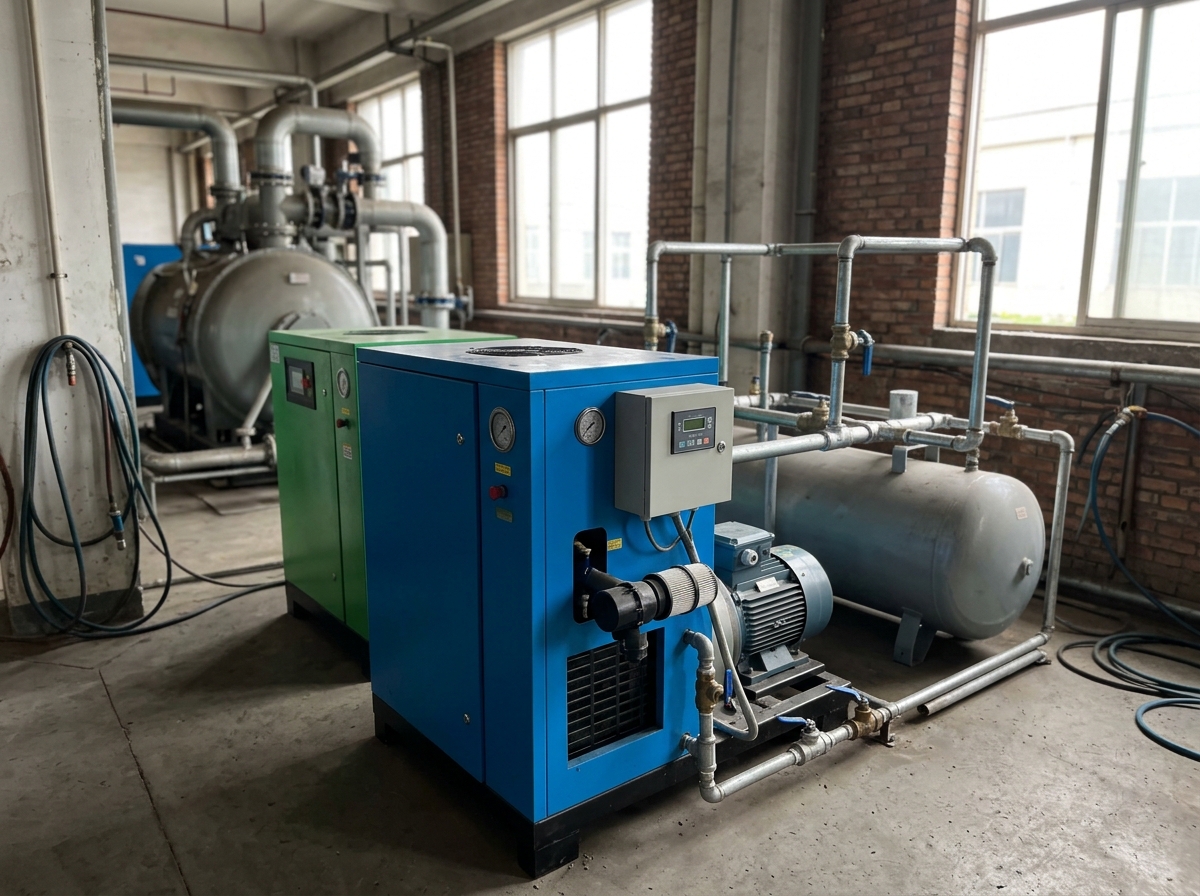
Where a PM VSD compressor supplier should fit in your product roadmap
Your roadmap should cover the full demand spectrum, because customers do not all need the same machine. A mature distributor usually needs multiple compressor families and air treatment options to serve mixed industrial demand.
- Variable-load plants: PM VSD screw compressors are often the first choice.
- Clean production lines: Oil-free solutions and higher-grade filtration are more relevant.
- Large centralized systems: Centrifugal compressors may be the better fit for high-flow continuous supply.
- General factory support: Standard screw systems with dryers and receivers remain the backbone of many installations.
For this reason, a supplier that can support multiple categories is usually more valuable than one that offers a narrow line. If you are expanding your catalog, it is useful to align products with actual end-user scenarios, not just catalog depth. You can explore related system pages such as screw air compressors, PM VSD air compressors, oil-free air compressors, and air dryers to see how a distributor-oriented portfolio can be organized across different use cases.
Practical due diligence checklist for distributor sourcing
A disciplined due diligence process prevents costly mismatches after the sale. Use a structured review so every supplier is judged on the same basis.
- Request application data, not only a catalog sheet.
- Ask for system sizing logic, including dryer, filter, and receiver recommendations.
- Verify service coverage, spare parts access, and response time.
- Check whether the supplier supports remote monitoring or controls integration.
- Review references from industries similar to your target customers.
- Confirm that the supplier can explain efficiency and air quality using standards language.
This process is especially important for distributors because your reputation depends on how the equipment performs after installation. A supplier that understands commissioning, training, and maintenance is often worth more than a slightly cheaper quote.
FAQ
What should I ask a PM VSD compressor supplier first?
Start with demand profile, energy data, air quality support, service coverage, and whether the supplier can size the whole system rather than only the compressor.
Why is PM VSD technology important for distributors?
PM VSD technology helps match compressor output to variable demand, which makes it easier to sell efficiency-based solutions to industrial customers.
Should I sell only compressors or complete air systems?
Complete systems are usually better for long-term value because dryers, filters, receivers, and controls directly affect performance and uptime.
How do I compare two industrial compressor suppliers?
Compare application fit, standards knowledge, technical documentation, service response, and the ability to support after-sales parts and troubleshooting.
What industries need special compressed air treatment?
Precision manufacturing, clean production, and contamination-sensitive processes often need better filtration, lower dew point, or oil-free air.
When is a centrifugal compressor better than a screw compressor?
Centrifugal machines are generally more suitable for large, continuous, high-flow supply systems, while screw compressors are more flexible for mixed and variable loads.
Why does air quality matter so much in distribution sales?
Because poor air quality can damage tools, shorten equipment life, and affect product quality, which creates hidden costs for the customer.