- Start with the application: required flow, pressure, duty cycle, and air quality determine the right OEM screw air compressor specification.
- Check whether the manufacturer can supply the full compressed air system, including dryer, filters, receiver tank, piping, and controls.
- Prefer suppliers that can explain energy efficiency, part traceability, and maintenance planning in measurable terms.
- Request project references, test data, and service documentation before approving a private label compressor partnership.
Choosing an OEM screw air compressor manufacturer in China is no longer just about finding a factory with a competitive price. In modern compressed air systems, performance depends on the complete setup: compressor, dryer, filters, receiver tank, piping, controls, and the downstream equipment that actually uses the air. That is why industrial buyers should compare suppliers on engineering depth, system integration, and lifecycle cost. For example, the U.S. Department of Energy notes that compressed air systems are often among the most inefficient utilities in a plant, making system-level optimization essential rather than optional. If you are evaluating a screw air compressor, a compressed air system, or a air treatment solution, the decision should begin with your real operating conditions, not a generic catalog spec.
What an OEM screw air compressor manufacturer in China should deliver
A credible OEM screw air compressor manufacturer should provide engineering, manufacturing, and after-sales support as a single package. In practice, that means the supplier must understand pressure stability, load cycles, inlet conditions, cooling method, control logic, and maintenance intervals. A private label compressor program is only useful if the underlying product is stable enough to represent your brand without excessive field issues.
For many buyers, the real test is whether the manufacturer can adapt the machine to the application. A general-purpose 7.5 kW unit for a small workshop is very different from a variable-speed machine serving a multi-shift production line. The best suppliers can explain why a permanent magnet variable-frequency design reduces unloaded operation and why multi-machine coordination can cut wasted runtime in plants with fluctuating demand.
| Evaluation item | Why it matters | Typical evidence to request |
|---|---|---|
| System engineering | Air quality and energy use depend on the full system, not only the compressor | P&ID, airflow calculation, pressure drop estimate |
| Control capability | Stable pressure reduces waste and downstream process variation | Controller logic, remote monitoring demo, load/unload data |
| After-treatment options | Dryness, oil carryover, and particle control affect product quality | Dryer and filter specification sheets |
| Customization depth | Private label success depends on consistent adaptation for your market | Branding scope, enclosure options, voltage, certifications |
Why compressed air system knowledge matters for an OEM private label compressor
Compressed air is a utility system, not a standalone machine purchase. That is the central idea many first-time buyers miss. The compressor is only one part of the energy chain, and losses can occur in drying, filtration, piping, and point-of-use pressure drops. The U.S. Department of Energy states that a 1 psi reduction in system pressure can reduce energy consumption by about 0.5% in compressed air systems, which is why pressure management matters so much.
That number is useful because it shows how small design decisions influence operating cost. If a supplier cannot discuss pressure setpoints, line losses, and control strategy, they are unlikely to optimize the full system. This is especially important for buyers who need a rotary screw air compressor with stable delivery in continuous production, or a variable-speed compressor for demand swings.
| System element | Typical function | Buyer risk if ignored | Measured effect to watch |
|---|---|---|---|
| Compressor | Generates compressed air | Wrong sizing or high idle loss | kW per m3/min |
| Dryer | Removes moisture | Condensation, corrosion, product defects | Dew point |
| Filters | Removes particles and oil mist | Tool wear and contamination | Micron rating, oil carryover |
| Receiver tank | Buffers demand peaks | Pressure fluctuation and short cycling | Pressure stability |
| Piping | Distributes air to use points | Pressure drop and leakage | Delta P across line |
How to compare China OEM compressor manufacturer options objectively
The best comparison method is to score suppliers on evidence, not sales language. A serious China OEM compressor manufacturer should be able to provide application references, component lists, controller screenshots, test procedures, and service plans. If they serve international buyers, they should also understand voltage differences, export packaging, documentation, and spare-part logistics.
Another useful filter is whether the factory can explain performance in standards-based language. For example, the ISO 1217 standard defines acceptance and performance testing for displacement compressors, while ISO 8573-1 defines compressed air purity classes for particles, water, and oil. Those standards matter because they let buyers compare products more fairly across brands and markets.
| Comparison factor | Strong supplier | Weak supplier | What to verify |
|---|---|---|---|
| Testing method | Uses documented acceptance testing | Only shares brochure numbers | ISO 1217 test reference |
| Air quality design | Matches dryer and filtration to use case | One-size-fits-all package | ISO 8573-1 target class |
| Energy explanation | Explains kW, load profile, and pressure loss | Only mentions low power | Operating curve and duty cycle |
| Service support | Provides parts and maintenance schedule | No clear spare-part policy | Lead time and service scope |
What technical data should be requested from a private label compressor supplier
A private label compressor supplier should give you more than a logo placement option. You need technical documents that prove the machine can survive your duty cycle and ambient conditions. At minimum, request motor specifications, flow curve, pressure range, cooling method, noise level, control mode, and recommended maintenance intervals.
For airflow quality, ask for the intended filtration and drying arrangement. Many industrial applications use refrigerated drying because it fits general manufacturing needs well, while sensitive processes may require adsorption drying and finer filtration. Air quality targets should be set by application, not preference. The NIST SI Units reference is also useful when aligning metric documentation across global procurement teams, especially when pressure, flow, and temperature data are reviewed by engineers in different regions.
- Rated working pressure in bar or psi
- Free air delivery at the rated pressure
- Specific power in kW per m3/min or CFM
- Noise level in dB(A)
- Motor efficiency class and starting method
- Ambient temperature range and cooling requirement
- Spare-parts availability and maintenance intervals
To reduce risk, compare the supplier’s declared values with real test conditions. A unit that performs well at 25 C may behave differently in a hot, dusty workshop. Ask whether the manufacturer validates performance at elevated ambient temperature and whether the control system protects against overload, high discharge temperature, and oil degradation.
Energy efficiency in an OEM screw air compressor is a system outcome
Energy efficiency is the main cost driver for most compressed air users. Industry guidance from the U.S. Department of Energy indicates that in many plants, compressed air can account for a significant share of electricity use, which is why buyers should focus on lifecycle cost rather than purchase price alone. In practical terms, a more efficient compressor with better control logic can outperform a cheaper machine very quickly when run for many hours per day.
Permanent magnet variable-frequency technology is valuable because it follows demand more closely, reducing no-load losses and frequent start-stop waste. Multi-machine control can add another layer of savings by staging units according to real demand instead of running multiple machines inefficiently at partial load. Waste heat recovery can also improve overall energy utilization by capturing compressor heat for process or facility use when the application allows it.
| Energy strategy | Primary benefit | Best use case | Buyer question |
|---|---|---|---|
| Variable speed control | Reduces wasted unloaded operation | Demand fluctuates through the day | How wide is the turndown range? |
| Multi-machine sequencing | Improves plant-level efficiency | Multiple compressors in one station | Does the controller balance runtime? |
| Pressure optimization | Reduces energy use from excess pressure | Systems with long pipelines | What is the minimum stable pressure? |
| Heat recovery | Captures useful thermal energy | Facilities with steady heat demand | Where will recovered heat be used? |
How to verify quality and trust before signing an OEM agreement
Trust comes from traceable evidence, not promises. A dependable OEM screw air compressor manufacturer should welcome factory audits, explain component sourcing, and provide clear quality checkpoints from incoming inspection to final testing. You should also ask how serial numbers, batch records, and service records are managed so that future warranty claims are easy to handle.
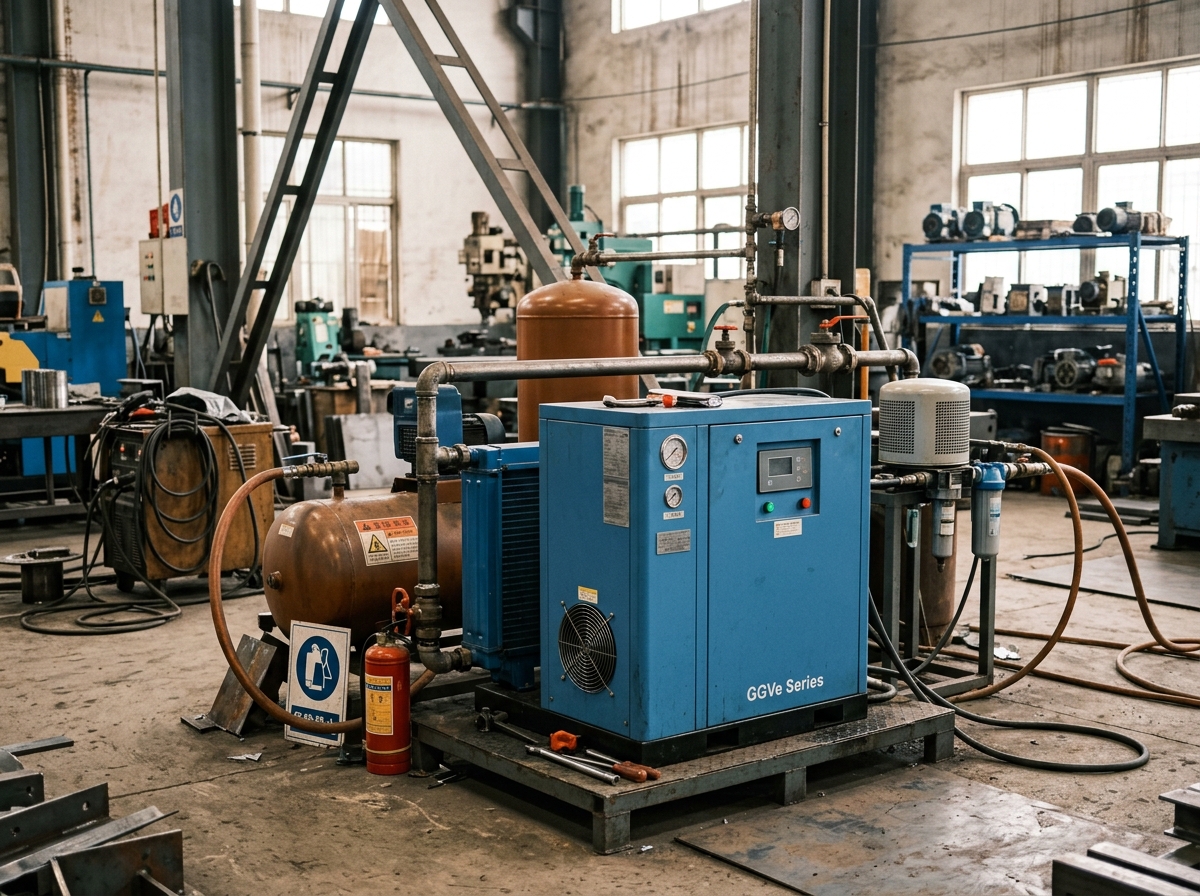
For industrial procurement teams, the most useful evidence includes a sample inspection report, a performance test sheet, and a spare-parts list. If possible, request a live remote demo or a recorded factory test. A factory that can show consistent workflow for assembly, leak testing, and final run-in is usually a safer long-term partner than one that only offers polished brochures.
- Confirm the application profile: flow, pressure, hours per day, and air quality target.
- Review the full system design, not just the compressor unit.
- Ask for standards-based test data and project references.
- Check warranty, parts supply, and service response time.
- Validate branding scope, packaging, manuals, and export support.
If your business needs a supplier for a industrial air compressor or a broader compressed air solution, this evidence-based process will help you separate real manufacturers from trading-only listings.
Common mistakes when selecting a China OEM compressor manufacturer
The most common mistake is buying by headline price instead of duty-cycle fit. A low-cost machine may look attractive until maintenance, downtime, and energy bills are included. Another frequent error is choosing a compressor before defining air quality needs. If the downstream process is sensitive to moisture or oil, the wrong dryer and filtration package can create quality failures that cost far more than the original equipment savings.
Buyers also overestimate how much the compressor alone can solve. Without proper piping, pressure regulation, and leak management, even a good machine can underperform. As the U.S. Department of Energy compressed air guidance emphasizes, system optimization is a major part of efficient operation. That is why serious buyers should treat the supplier as a systems integrator, especially when sourcing an OEM screw air compressor for a private label program.
- Do not specify only horsepower; specify flow, pressure, and duty cycle.
- Do not ignore air treatment; moisture and oil control affect reliability.
- Do not skip pressure-drop checks in long piping networks.
- Do not approve branding before technical validation.
Frequently asked questions about OEM screw air compressor manufacturers in China
What should I ask first when contacting a China OEM compressor manufacturer?
Start with flow, pressure, operating hours, air quality target, and ambient conditions. Those five inputs determine whether the supplier can recommend the right machine and supporting equipment.
Is a private label compressor different from a standard compressor?
Yes. A private label compressor is usually a standard or customized product sold under your brand, so you need more control over documentation, packaging, service parts, and quality consistency.
How important is compressed air quality for manufacturing?
Very important. Moisture, oil, and particles can damage tools, affect product quality, and shorten equipment life. Air purity should be matched to the process, often using ISO 8573-1 as the reference framework.
Should I choose a variable-speed compressor or a fixed-speed model?
If your demand changes significantly through the day, variable speed is often better because it tracks load more closely. If demand is steady and predictable, a fixed-speed model may still be appropriate.
What documents should a supplier provide before purchase?
Ask for technical specifications, test procedures, wiring diagrams, maintenance schedules, spare-parts lists, and warranty terms. For export projects, also request packaging and shipping details.
Can one compressor support the whole factory?
Usually not efficiently. Many factories benefit from a system approach that includes multiple compressors, control sequencing, storage, and proper air treatment.
How do I know if the manufacturer is reliable?
Look for test data, project references, documented procedures, and clear after-sales support. A reliable manufacturer can explain both product performance and system design in measurable terms.