


- Measure peak and average demand before selecting compressor capacity.
- Separate high-pressure blow air from lower-pressure plant air whenever the process allows it.
- Specify dryness, particulate control, oil control, and pressure stability together.
- Use sequencing controls, leak management, and correctly sized storage to reduce wasted energy.
- Evaluate lifecycle cost, service access, redundancy, and expansion plans rather than purchase price alone.
For an air compressor for PET production, the correct answer is a complete, measured system rather than a standalone machine. The U.S. Department of Energy states that compressed-air leaks can waste 20% to 30% of compressor output, which shows why piping, storage, controls, and maintenance matter as much as compressor efficiency. This guide explains how to select a PET bottle compressor for reliable blow molding, stable product quality, and controlled operating cost.
What an Air Compressor for PET Production Must Do
The compressor must deliver stable air at the pressure and flow required by the blow-molding process without creating avoidable moisture, oil, or particulate risk.
PET bottle lines commonly use compressed air in more than one way. High-pressure air may support preform stretching and bottle blowing, while lower-pressure air may serve actuators, valves, grippers, conveyors, filling equipment, packaging machines, and general plant services. Treating these loads as one identical demand profile can produce an oversized compressor, unstable pressure, or unnecessary energy consumption.
The first practical step is to collect operating data from the complete line. Ask the equipment supplier for required pressure, free air delivery, permitted pressure variation, air quality class, start-up demand, and duty cycle. Also record the number of machines operating simultaneously, planned production shifts, seasonal demand, and future line expansion.
Separate Process Air from Plant Air
Separating high-pressure process air from general plant air can improve both control and operating efficiency.
A bottle producer may need a dedicated high-pressure system for blow molding and a separate low-pressure network for pneumatic controls. Where technically appropriate, independent pressure zones prevent the entire station from operating at the highest pressure required by only one process. A pressure-and-flow study should confirm whether separate compressors, boosters, storage vessels, or pressure-reduction stations are economically justified.
| Planning item | Illustrative measured value | Why it affects selection |
|---|---|---|
| Production demand | 1,000 bottles per minute | Indicates the recurring process load to be confirmed with line data |
| High-pressure blow air | 40 bar system rating | Shows when a booster or dedicated high-pressure package may be required |
| Plant pneumatic air | 7 bar distribution pressure | Represents a separate lower-pressure utility zone in this example |
| Future capacity allowance | 20% planning reserve | Provides a decision checkpoint for expansion, not a universal sizing rule |
The values in this table are an illustrative engineering worksheet, not a specification for every PET line. Replace them with verified values from the blow-molding machine manufacturer, compressor performance test, and site measurements.
PET Bottle Compressor Sizing: Flow, Pressure, and Duty Cycle
Compressor capacity should be based on measured simultaneous demand, required pressure at the point of use, and the actual operating pattern.
Do not size a PET bottle compressor only from the motor power or nominal receiver volume. Compare the required free air delivery with the compressor package output at the intended discharge pressure. The calculation should include pressure losses through dryers, filters, valves, hoses, piping, and any high-pressure booster.
Peak demand is important, but average demand determines much of the energy cost. A line with short, frequent blow cycles may create sharp demand peaks even when average consumption appears moderate. Storage near the high-pressure demand can help absorb short peaks, but storage cannot correct a compressor that is fundamentally too small or a network with severe leakage.
Duty cycle also changes the best compressor technology. A rotary screw compressor is commonly considered for continuous industrial operation and variable plant demand. A centrifugal compressor may be appropriate for a large facility with high, steady flow and strong maintenance capability. Reciprocating or booster equipment may have a role where pressure is high but the required flow is limited. The right choice depends on measured demand, not on the technology label alone.
Use a System Curve Instead of a Single Pressure Number
The required compressor discharge pressure must cover process pressure plus distribution and treatment losses.
Map the pressure at the compressor outlet, after the dryer, after the filters, at the receiver, and at the farthest production machine. If the end-of-line pressure falls during simultaneous blowing, investigate pipe diameter, valve capacity, storage location, and control logic before simply increasing compressor pressure. Higher pressure can increase leakage and waste, while failing to solve a restriction at the point of use.
Air Quality for PET Bottle Production
Air quality should be specified across particles, water, oil, and pressure stability because each risk can affect equipment reliability or bottle quality.
Drying protects valves, cylinders, instrumentation, and piping from condensation. Filtration removes particles and oil aerosols according to the required application. Oil-free compression may be appropriate where contamination sensitivity is high, but an oil-injected compressor with suitable separation and treatment can be acceptable for other plant services when the required air quality is properly defined.
Use the ISO 8573-1 compressed air quality standard as a framework for specifying contamination classes instead of using vague terms such as clean air or dry air. The standard addresses particles, water, and oil as separate quality dimensions. The selected class should come from the blow-molding equipment supplier, product risk assessment, and quality management requirements.
| Air quality dimension | Risk at a PET line | Engineering response | Verification method |
|---|---|---|---|
| Particles | Valve wear, blocked orifices, product contamination | Particulate filtration and clean distribution piping | Filter specification and periodic inspection |
| Water | Condensation, corrosion, sticking pneumatic components | Refrigerated or desiccant drying selected for the dew-point requirement | Pressure-dew-point measurement |
| Oil | Process contamination and filter loading | Oil-free compression or suitable coalescing and adsorption treatment | Oil carryover testing where required |
| Pressure stability | Inconsistent bottle formation or machine alarms | Receivers, correct pipe sizing, fast control, and separated pressure zones | Logged pressure at the machine inlet |
A refrigerated dryer is often suitable for general industrial air, while a desiccant dryer may be needed when the required pressure dew point is lower or the installation is exposed to colder conditions. Selecting the dryer without considering regeneration air, pressure drop, ambient temperature, and maintenance can undermine the efficiency of the entire bottle production air system.
Energy Efficiency in a Bottle Production Air System
The largest energy opportunity usually comes from matching supply to demand across the complete system.
The U.S. Department of Energy compressed-air guidance identifies leakage, inappropriate uses, pressure management, controls, and heat recovery as important areas for improvement. Its warning that leaks can waste 20% to 30% of compressor output makes leak detection a practical first action before purchasing additional capacity.

Variable-speed drive technology can reduce unloaded running when demand changes, but it is not automatically the best solution for every load profile. A variable-speed compressor should operate within its efficient control range and be paired with fixed-speed base-load machines where appropriate. Multiple compressors should be managed by a sequencing controller that assigns trim and base-load roles instead of allowing each machine to react independently.
Heat recovery can improve total energy utilization when the facility has a consistent demand for hot water or process heat. The recovery project must compare available heat, temperature requirements, operating hours, and installation cost. It should not be presented as a guaranteed saving without a site-specific thermal balance.
- Repair leaks and eliminate open-blow applications before increasing compressor pressure.
- Measure pressure drop across dryers, filters, separators, and long pipe runs.
- Use a master controller to coordinate compressor loading, unloading, and standby capacity.
- Place storage close to rapid demand changes when the process analysis supports it.
- Use remote monitoring to trend pressure, temperature, running hours, alarms, and service indicators.
How to Compare Compressor Technologies
Technology selection should follow the load profile, required air quality, service environment, and consequences of downtime.
| Technology | Best-fit operating pattern | Key advantage | Important limitation |
|---|---|---|---|
| Variable-speed rotary screw | Changing industrial demand | Can adjust output to demand within its control range | Efficiency depends on correct sizing and control range |
| Fixed-speed rotary screw | Stable base-load demand | Simple, established continuous-duty architecture | May run inefficiently when frequently unloaded |
| Centrifugal | Large, steady-flow central plants | Suited to high continuous flow | Less attractive for highly variable or low-flow operation |
| Booster | Higher-pressure demand from a defined zone | Raises pressure without pressurizing the entire plant network | Requires careful control and upstream capacity planning |
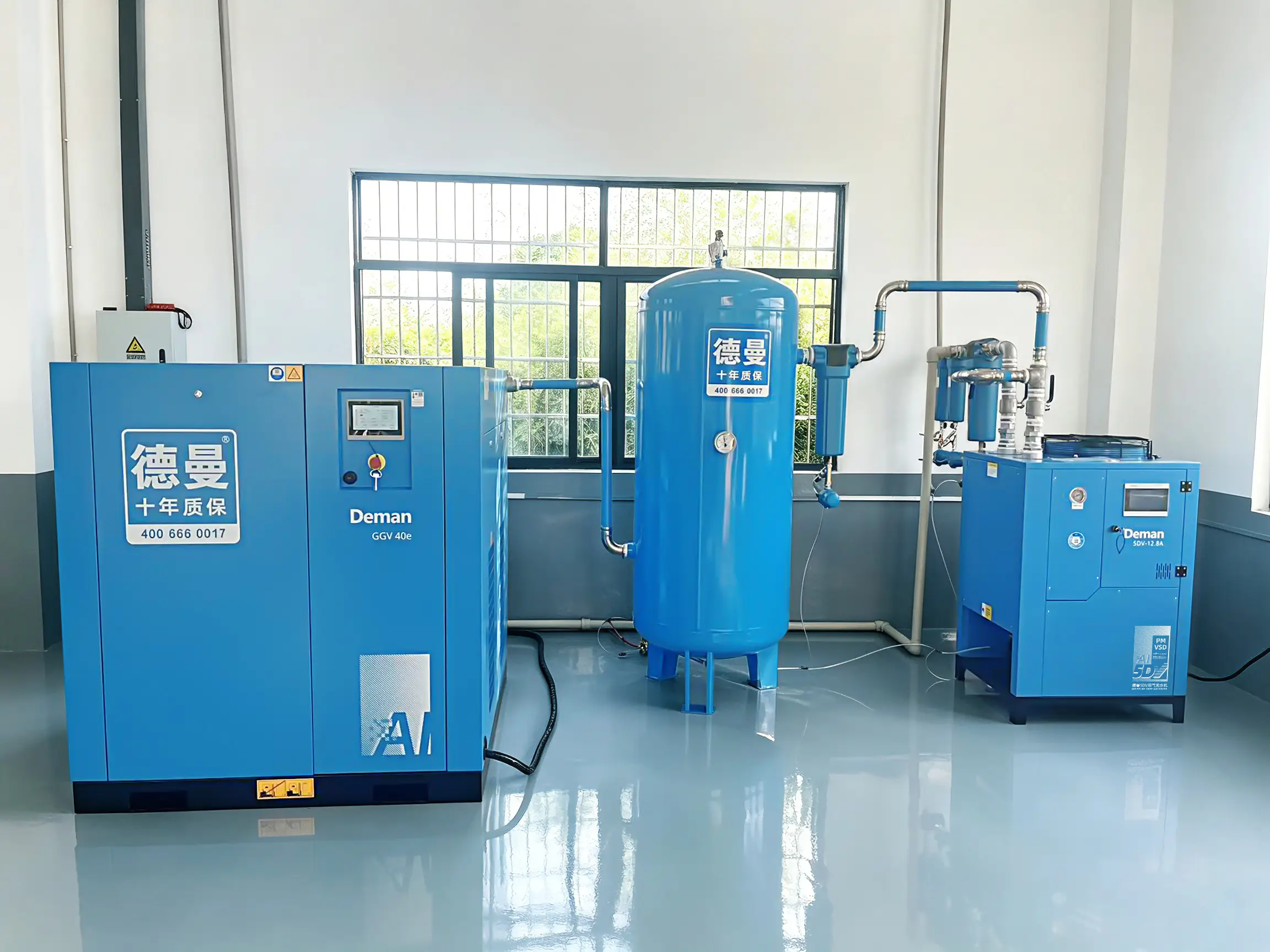
A practical PET project may combine technologies. For example, a stable plant-air base load can use a rotary screw package, while a dedicated high-pressure section uses a booster and local receiver. The final arrangement should be validated with a logged demand profile and a lifecycle-cost comparison.
Reliability, Redundancy, and Maintenance
Redundancy should be based on the production loss caused by a compressor failure, not on a generic rule.
If one failure can stop the entire bottle line, consider duty and standby capacity, independent electrical protection, bypass arrangements, spare filtration, and accessible service space. The standby machine must be connected to a control strategy that can start it safely and maintain acceptable pressure during a fault.
Maintenance planning should cover compressor elements, oil or separator systems where applicable, air filters, dryers, drains, cooling surfaces, valves, sensors, and condensate management. Follow the equipment manufacturer schedule and adjust it for ambient dust, operating temperature, running hours, and measured contamination. Remote monitoring can identify rising discharge temperature, abnormal pressure behavior, excessive starts, or increasing dryer load before a breakdown becomes a production event.
The Compressed Air and Gas Institute provides industry resources on compressor performance, testing, and system practices. Use supplier performance data that clearly states test conditions and package configuration, rather than comparing motor ratings alone.
Purchase Checklist for PET Production
A reliable purchase specification converts the production process into measurable acceptance criteria.
- Document bottle size range, line speed, machine count, operating shifts, and future expansion.
- Record required pressure and flow at every process connection, including start-up and peak demand.
- Define air quality by particles, water, and oil rather than by a general cleanliness statement.
- Request compressor, dryer, filter, receiver, controller, and piping pressure-drop data.
- Compare initial cost, electricity, consumables, planned service, spare parts, and downtime exposure.
- Confirm local service capability, response arrangements, commissioning procedures, and operator training.
- Require a commissioning plan that verifies pressure, flow, dew point, alarms, and control sequence at the machine.
The strongest project process is plan first, sell second. A site survey, demand log, air-quality review, and lifecycle-cost model reduce the risk of buying a machine that meets a catalog rating but fails at the production point.
FAQ
What type of compressor is best for PET bottle production?
There is no universal best type. Variable-speed rotary screw equipment often suits changing industrial demand, while centrifugal equipment may suit large plants with steady flow. High-pressure bottle blowing may also require a dedicated booster or pressure system.
Does PET bottle blowing require oil-free air?
It depends on the contamination risk defined by the process, product, and equipment supplier. Oil-free compression can reduce contamination concerns, while treated oil-injected air may be suitable for some utility applications. Specify the required air quality class before choosing the compressor type.
How should a PET bottle compressor be sized?
Use measured simultaneous flow, required pressure at the machine, pressure losses, start-up demand, operating hours, and planned expansion. Do not size from motor power alone or add an arbitrary reserve without checking the demand profile.
Why are dryers and filters important in a bottle production air system?
They control water, particles, and oil that may damage pneumatic components, increase maintenance, or create process contamination. Their pressure drop, maintenance needs, and operating conditions must be included in the system design.
Can a variable-speed compressor reduce energy use?
It can reduce inefficient unloaded operation when demand varies, but results depend on correct sizing, control range, system pressure, leakage, and sequencing. A measured audit is more reliable than assuming a fixed saving percentage.
Is an air receiver necessary for PET production?
A receiver can stabilize pressure, support short demand peaks, reduce rapid compressor cycling, and provide a buffer during control changes. Its location and volume should be selected from the process demand pattern and pressure-control strategy.
What service support should a buyer request?
Request commissioning, preventive maintenance, spare-parts availability, remote diagnostics, alarm response, air-quality verification, and a clear escalation process. For continuous production, service response and engineering support can be as important as the compressor purchase price.
About the Supplier
Deman provides engineered compressed-air solutions for industrial users, including compressor packages, drying and filtration equipment, storage, controls, and system optimization. Its project approach focuses on matching equipment to production demand, air quality, pressure stability, lifecycle cost, and service requirements. For a PET bottle project, review the available industrial air solutions and contact the team through the verified website to discuss a measured system design.