
How to Choose a Screw Compressor Supplier for Industrial Distribution
Choose a screw compressor supplier by evaluating the complete compressed-air system, not only the machine price. Compare verified airflow and pressure requirements, air quality, control strategy, lifecycle cost, service coverage, spare-parts availability, commissioning capability, and distributor responsiveness. A strong industrial compressor distributor should be able to document the proposed configuration and explain how it will perform under your actual production conditions.
- Match the compressor to measured demand, required pressure, duty cycle, and air quality.
- Compare lifecycle cost, including energy, maintenance, treatment equipment, and downtime risk.
- Prioritize a supplier with local service capability, replacement parts, commissioning support, and remote monitoring.
- Evaluate the complete system: compressor, dryer, filters, receiver, piping, controls, and end-use equipment.
A dependable air compressor supplier should begin with application analysis rather than a standard model recommendation. Industry buying guides from Kaishan, ALUP, and Atlas Copco all emphasize demand, airflow, pressure, drive selection, and operating conditions. This article explains how industrial buyers and distributors can assess those factors, compare suppliers objectively, and reduce the risk of an under-sized, over-specified, or poorly supported installation.
Start with the Compressed-Air Application, Not the Catalog
The correct compressor is determined by the air profile of the plant. A compressed-air system includes the compressor, dryer, filters, receiver, piping, controls, and points of use; selecting only the compressor can create instability, excessive energy use, or poor air quality.
Demand analysis should identify normal flow, peak flow, operating pressure, shift pattern, expansion plans, and the consequences of pressure loss. Review equipment manuals, production schedules, historical compressor data, and an air audit where possible. The selection should reflect real operating conditions rather than the maximum rating of one machine.
- List every air-consuming machine and its required working pressure.
- Separate continuous users from intermittent or high-demand users.
- Record pressure at the compressor room and at the most distant use point.
- Identify leakage, artificial demand, open blowing, and poorly regulated users.
- Decide whether future production growth requires reserve capacity or modular expansion.
A supplier that asks these questions is more likely to design for the plant rather than sell an isolated asset. The guidance from ELGi also identifies OEM recommendations, past equipment experience, and air audits as useful ways to determine plant capacity requirements.
Evaluate the Technical Fit
Airflow and pressure
Airflow and pressure must be assessed together because a compressor that provides adequate flow at the wrong pressure will not protect production performance. Ask the supplier to state delivered airflow at the proposed working pressure and operating conditions, not only a nominal nameplate value.
Pressure should be set by the end-use requirement plus reasonable system losses. Selecting a substantially higher pressure than necessary can increase energy consumption and may hide piping or regulation problems. Conversely, insufficient pressure at the point of use can cause tool failure, production interruptions, and unstable automation.
Fixed-speed or variable-speed drive
Drive selection should follow the plant load profile. Fixed-speed machines can suit stable, near-continuous demand, while variable-speed machines can better follow changing demand and reduce inefficient unloaded operation when the system frequently moves between load levels.
Variable-speed technology is not automatically the best choice for every installation. The supplier should explain expected operating hours, minimum and maximum demand, control limits, motor efficiency, cooling requirements, and the interaction with other compressors. A multi-machine control system may deliver more value than replacing one unit with a different drive type.
Oil-injected or oil-free air
Air quality must be specified according to the product and process risk. Oil-injected screw compressors are widely used for general industrial applications, but sensitive processes may require oil-free compression or a carefully engineered filtration and treatment arrangement.
Ask the supplier to define the required limits for particles, water, oil, and pressure stability. Food, pharmaceutical, electronics, precision manufacturing, and clean production applications may need a higher air-quality specification than general workshop tools. A dryer and filters should be selected as part of the system, not added after the compressor has been chosen.
Compare Suppliers by Lifecycle Value
The lowest purchase price is rarely the lowest ownership cost. Electricity, maintenance, consumables, treatment equipment, service labor, spare parts, and production losses can exceed the initial equipment price over the operating life.
| Evaluation area | Score 1 | Score 3 | Score 5 |
|---|---|---|---|
| Application engineering | Catalog-only recommendation | Basic load discussion | Measured demand and documented design |
| Service coverage | No clear local response | Regional support | Defined response and trained technicians |
| Parts availability | Unclear lead time | Common parts stocked regionally | Critical parts and replenishment plan documented |
| Controls integration | Standalone operation | Basic sequencing | Multi-machine control and monitoring plan |
This five-point scale is a buyer evaluation framework, not an industry performance rating. Use the same questions and evidence requirements for every candidate so that a persuasive sales presentation does not outweigh technical suitability.
Energy analysis should include the complete operating profile. Request assumptions for annual running hours, load and unload behavior, electricity price, pressure setpoint, cooling method, and expected maintenance. If a supplier presents savings, require a written baseline and explain whether the figures are measured, modeled, or based on industry estimates.
| Lifecycle category | Evidence to request | Review timing | Risk if omitted |
|---|---|---|---|
| Energy | Load profile and calculation method | Before quotation | Unreliable savings estimate |
| Maintenance | Service schedule and consumables list | Before purchase order | Unexpected operating cost |
| Downtime | Response process and backup plan | Contract review | Extended production interruption |
| Air treatment | Dryer, filter, and drain specification | System design | Moisture or contamination damage |
Assess the Industrial Compressor Distributor
Distributor quality is measured by what happens after delivery. A capable industrial compressor distributor should provide site assessment, equipment selection, installation coordination, commissioning, operator training, preventive maintenance, troubleshooting, and escalation support.
Service geography matters when compressed air is critical to production. Ask who performs emergency work, where technicians are located, which parts are stocked locally, and whether the supplier can support the equipment after the warranty period. Replacement parts should be identified by part number, expected availability, and approved alternatives where relevant.
Commissioning is a technical milestone, not a delivery formality. The supplier should verify rotation, pressure settings, flow, dryer performance, drain operation, ventilation, alarms, control sequencing, and communication with plant systems. Request commissioning records and baseline readings for future maintenance comparisons.
- Request references from plants with similar duty cycles and air-quality requirements.
- Ask for a written scope covering installation, piping, electrical work, treatment, controls, and training.
- Review warranty exclusions, response commitments, and preventive-maintenance responsibilities.
- Confirm whether remote monitoring is available and who reviews the alerts.
- Obtain a total cost of ownership comparison rather than a machine-only quotation.
Design the Whole Air Station
System architecture often determines reliability more than compressor selection alone. Receivers can help manage demand fluctuations, dryers control moisture, filters protect downstream equipment, and properly designed piping reduces pressure loss and leakage exposure.
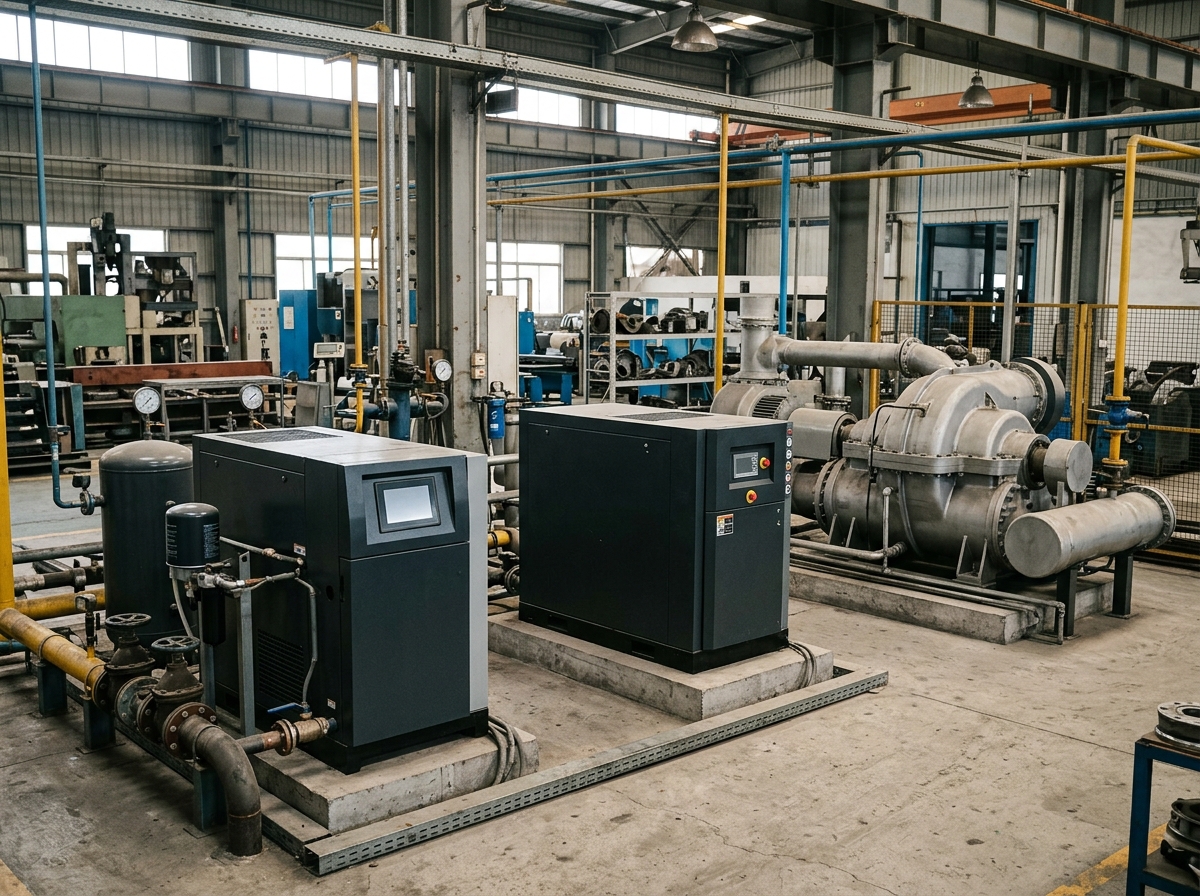
Dryer technology should reflect the application and ambient conditions. Refrigerated dryers are commonly suitable for general industrial service, while sensitive processes may require a higher level of drying and filtration. The supplier should state the pressure dew point, inlet conditions, flow basis, and expected seasonal performance.
Multi-machine control is valuable when demand changes or several compressors operate together. A control system can assign load, reduce unnecessary low-efficiency operation, coordinate fixed-speed and variable-speed units, and provide operating data for maintenance decisions.
Remote monitoring can improve maintenance planning when alerts are connected to a defined response process. Monitoring is useful only when someone reviews trends, verifies alarms, and acts before a developing issue becomes a production stoppage.
Use a Practical Supplier Selection Process
A staged buying process reduces technical and commercial ambiguity. Do not compare quotations until each supplier has received the same application information and agreed measurement assumptions.
- Define the application: document pressure, airflow, air quality, duty cycle, environment, expansion, and criticality.
- Shortlist qualified suppliers: verify relevant installations, technical personnel, service territory, and parts support.
- Request comparable proposals: require equipment, treatment, controls, installation boundaries, commissioning, training, and warranty terms.
- Validate the design: review pressure-flow data, operating assumptions, noise and ventilation requirements, and maintenance access.
- Contract for outcomes: record acceptance tests, documentation, response expectations, and post-installation support.
The best supplier is the one that makes its assumptions visible. A clear proposal should show what is included, what is excluded, which values are guaranteed, and which results depend on site conditions.
Common Buying Mistakes
Buying by horsepower alone is a common error because motor size does not fully describe delivered airflow, pressure behavior, control response, or system efficiency. Compare performance at the required operating point.
Oversizing is also risky because a lightly loaded machine may operate inefficiently and cost more to purchase and maintain. Undersizing creates excessive cycling, pressure instability, and limited production capacity. A staged or modular design may be more appropriate than one oversized unit.
Ignoring the air network can undermine a good compressor. Leaks, restrictive filters, poor pipe sizing, inadequate ventilation, and incorrect condensate drainage can reduce the value of an efficient machine.
Choosing a supplier without checking service capability creates avoidable operational risk. Ask for evidence of technician training, parts access, response procedures, and references before signing the order.
Frequently Asked Questions
What should I ask a screw compressor supplier first?
Start with airflow, pressure, air quality, duty cycle, operating environment, available space, future demand, and production criticality. Then ask how the proposed system meets each requirement.
Is a variable-speed screw compressor always more efficient?
Variable-speed equipment can be advantageous when demand varies, but the result depends on the load profile, controls, operating range, and system design. Request a calculation based on measured or documented demand.
How do I choose between oil-injected and oil-free compression?
Choose according to contamination risk and the required air-quality specification. General industrial tools may use treated oil-injected air, while sensitive processes may require oil-free technology or a more stringent treatment system.
Should the distributor supply the dryer and filters?
Prefer a supplier that can engineer the complete air station or clearly coordinate all components. The compressor, dryer, filters, receiver, drains, and controls must be sized and commissioned as one system.
What service terms should an industrial buyer review?
Review warranty scope, emergency response, technician location, preventive-maintenance intervals, consumables, parts lead times, remote monitoring, and escalation procedures.
When is a multi-compressor system appropriate?
A multi-compressor system can suit plants with changing demand, redundancy requirements, staged expansion, or different operating profiles. Confirm that sequencing controls prevent inefficient operation.
How can I compare competing quotations fairly?
Use a common specification and scoring sheet. Compare delivered airflow, pressure, air quality, controls, installation scope, lifecycle assumptions, commissioning, service, parts, warranty, and exclusions—not only purchase price.
About Deman
Deman supports industrial compressed-air projects with a system-oriented approach covering compressor selection, air treatment, controls, monitoring, installation coordination, and after-sales service. Its project process is designed to connect application analysis with practical operation, maintenance planning, and long-term reliability. For a project quotation, provide your current equipment details, operating pressure, production schedule, air-quality requirements, and expansion plans so the proposed solution can be evaluated against real plant conditions.