- Retrofit success depends on matching compressor control to actual load profile, not nameplate horsepower alone.
- Permanent magnet variable frequency technology is most effective when demand swings, idle time, or pressure instability are common.
- Air quality, pressure drop, and control logic can erase or amplify energy savings, so the full air system must be reviewed.
- For multi-compressor plants, centralized sequencing often outperforms single-unit optimization.
- A proper 2026 retrofit business case should include kW per m3/min, pressure band, maintenance burden, and payback period.
Factories planning a permanent magnet variable frequency air compressor retrofit in 2026 should treat the project as a compressed-air system decision, not a simple equipment replacement. The reason is straightforward: compressed air is usually one of the most expensive utilities in a plant, and even small pressure changes can create meaningful energy losses. The U.S. Department of Energy notes that for many industrial systems, a pressure reduction of 2 psi can cut energy use by about 1 percent, while air leaks alone can waste a large share of system output if not controlled. That is why a retrofit should begin with demand profiling, not vendor brochures. For plants seeking a system-level approach, the logic behind screw air compressors, smart control systems, and after-treatment equipment matters as much as the motor itself.
Why a permanent magnet variable frequency air compressor fits retrofit projects
A permanent magnet variable frequency air compressor fits retrofit projects best when the plant has uneven demand, frequent idle periods, or unstable pressure at the point of use. Traditional fixed-speed compressors often cycle between loaded and unloaded states, and that inefficiency becomes more visible as plants automate and production schedules become more variable. Permanent magnet motors improve part-load efficiency because they respond more precisely to demand, while variable frequency control reduces unnecessary compression during low-load periods. In retrofit work, that combination matters most in plants that cannot afford a full system shutdown or a complete utility rebuild.
The key technical advantage is control, not just motor technology. A well-tuned variable frequency system maintains a tighter pressure band, which can reduce waste caused by overpressurization. In many plants, the compressor is intentionally set higher than needed to protect downstream tools from pressure drops. That practice creates hidden energy loss. A retrofit should therefore also evaluate piping layout, filter condition, and dryer pressure drop. For plants with multiple machines, an integrated platform such as Air Commander can coordinate load sharing and reduce the number of compressors running inefficiently at the same time.
What 2026 retrofit buyers should measure before choosing a compressor
The right compressor is the one that matches the plant’s actual air profile, not the one with the biggest catalog number. Before choosing a unit, factories should measure average demand, peak demand, minimum demand, pressure stability, air quality requirements, and operating hours. A retrofit that ignores these variables often overspends on capacity or underperforms on savings. This is especially true in mixed-use plants where pneumatic tools, automation clamps, blow-off points, and process air all share the same header.
| Retrofit metric | Why it matters | Typical target range | Measurement method |
|---|---|---|---|
| System pressure | Higher pressure increases energy cost | Plant-specific; often 6 to 10 bar | Header gauge and logger |
| Pressure band | Tight control reduces waste | Often within 0.1 to 0.2 bar in stable systems | Trend data from controller |
| Load profile | Determines VFD value | Variable demand favors PM VFD | Flow meter and run-time analysis |
| Air quality class | Affects product quality and maintenance | Defined by ISO 8573-1 classes | Lab testing and dew point monitoring |
Air quality should never be treated as an afterthought. ISO 8573-1 classifies compressed air by solid particles, water, and oil, and that classification helps plants translate process needs into equipment requirements. Textile, electronics, food-related packaging, and precision assembly lines often need stricter air treatment than general workshop use. When air quality is critical, the compressor choice must be matched with dryers, filters, drains, and maintenance practices. A compressor that saves energy but compromises air quality is not a real retrofit win.
Permanent magnet variable frequency air compressor vs fixed-speed compressor
The biggest difference between the two systems is how they respond to demand swings. Fixed-speed units generally run at one speed and rely on load/unload or staging logic, while permanent magnet variable frequency units modulate output more precisely. In retrofit scenarios, this usually improves efficiency when demand varies throughout the shift. The trade-off is that a variable frequency system adds control complexity, so it should be paired with accurate sensors and proper commissioning.
| Feature | Permanent magnet variable frequency | Fixed-speed compressor | Retrofit implication |
|---|---|---|---|
| Part-load efficiency | Higher under variable demand | Lower during unloading | Good for fluctuating plants |
| Pressure control | More precise | Less precise | Useful for sensitive processes |
| Startup stress | Soft, controlled | Higher mechanical stress | Can help reduce wear |
| Control complexity | Higher | Lower | Needs proper commissioning |
For factories with multiple compressors, sequencing matters more than single-unit efficiency. A plant that runs two poorly coordinated compressors can waste more energy than a plant using one properly controlled unit. This is why retrofit buyers should ask how the controller handles base load, trim load, standby rotation, and alarm logic. In system-centric projects, green piping systems can also make a measurable difference by reducing pressure drop in distribution lines.
How to estimate energy savings from a factory retrofit
Energy savings in compressed-air retrofits come from three main sources: reduced unloaded running, reduced overpressurization, and reduced pressure losses in the distribution system. The U.S. Department of Energy has long emphasized that compressed air should be treated as a plant utility with measurable leaks, drops, and misuse. A plant that simply replaces an old compressor with a new one may see improvement, but the full gain usually comes from system optimization.
Because savings vary by load pattern and operating hours, it is better to use a measured baseline than a generic promise. In a plant that runs 6,000 hours per year, even a small efficiency improvement can produce meaningful annual savings. For example, if a retrofit reduces average power draw by 10 kW, annual electricity reduction equals 60,000 kWh. At an electricity price of 0.10 USD per kWh, that is 6,000 USD per year. The real value can be higher in plants with longer runtime or higher utility rates. This is why a 2026 retrofit should be justified by logged data, not marketing assumptions.
When the plant has multiple air users, an intelligent control layer can make savings more stable. remote monitoring helps maintenance teams detect abnormal pressure, temperature, or downtime trends early, which reduces emergency service calls and avoids the slow efficiency drift that often goes unnoticed.
Selection checklist for a 2026 factory retrofit
The safest way to select a permanent magnet variable frequency air compressor is to work from process requirements backward. That means specifying the air demand first, then matching the machine to the process, and only then comparing brands or models. This approach reduces oversizing and prevents expensive downstream corrections.
- Measure average and peak air demand over at least one production cycle.
- Record the minimum acceptable pressure at the furthest point of use.
- Identify whether the load is steady, intermittent, or highly variable.
- Check whether air must be dry, oil-free, or particle-controlled.
- Map pressure drops across filters, dryers, valves, and piping.
- Decide whether one compressor, multiple units, or a sequenced system is needed.
- Compare total lifecycle cost, not just purchase price.
These steps matter because a retrofit is often constrained by existing foundations, pipework, electrical service, and production schedules. A compressor that looks ideal in a spec sheet may be impossible to install cleanly in a crowded utility room. In those cases, modular planning and phased installation can be more valuable than a single large replacement. Factories with limited downtime often benefit from a staged retrofit strategy that keeps production running while the air system is modernized.
| Selection factor | Why it affects retrofit success | Common mistake | Better practice |
|---|---|---|---|
| Installed capacity | Oversizing increases wasted energy | Buying for peak only | Size to logged demand |
| Motor control | Determines part-load efficiency | Ignoring load variation | Use variable frequency where demand swings |
| Air treatment | Protects product quality | Keeping old dryers and filters | Review the full treatment train |
| Controls integration | Improves whole-plant efficiency | Running units independently | Use centralized sequencing |
Standards and verified numbers that matter in compressor retrofits
Retrofit decisions become more reliable when they are grounded in standards and verifiable test methods. Compressor performance should be benchmarked using ISO 1217:2009, which defines acceptance testing for displacement compressors. Air quality should be referenced against ISO 8573-1:2010, which classifies contaminants in compressed air. For plants seeking industrial energy management structure, ISO 50001 provides a system framework for continuous energy improvement.
Those standards are useful because they shift retrofit conversations from vague claims to measurable outcomes. For example, pressure, flow, temperature, and dew point can all be logged and compared before and after the project. That makes it easier to prove whether the retrofit improved specific energy consumption. It also helps buyers compare suppliers on equal footing, especially when two machines appear similar but perform differently under load.
One practical reference point is the DOE guidance that leak rates, pressure drops, and inappropriate uses can consume a meaningful share of compressed-air output. Another useful benchmark is the relationship between pressure and power: every extra psi costs energy, so high-pressure setpoints should be justified by real process need. In many plants, that logic alone can unlock savings before any equipment replacement begins.
Where permanent magnet variable frequency compressors deliver the most value
Permanent magnet variable frequency air compressors deliver the most value in factories with demand variation, frequent shifts, and pressure-sensitive processes. They are especially attractive in metalworking, plastics, automotive parts, home appliance assembly, and textile plants, where pneumatic systems and automation often share the same air network. In these environments, the benefit is not only lower electricity use but also better pressure stability, fewer nuisance alarms, and smoother production.
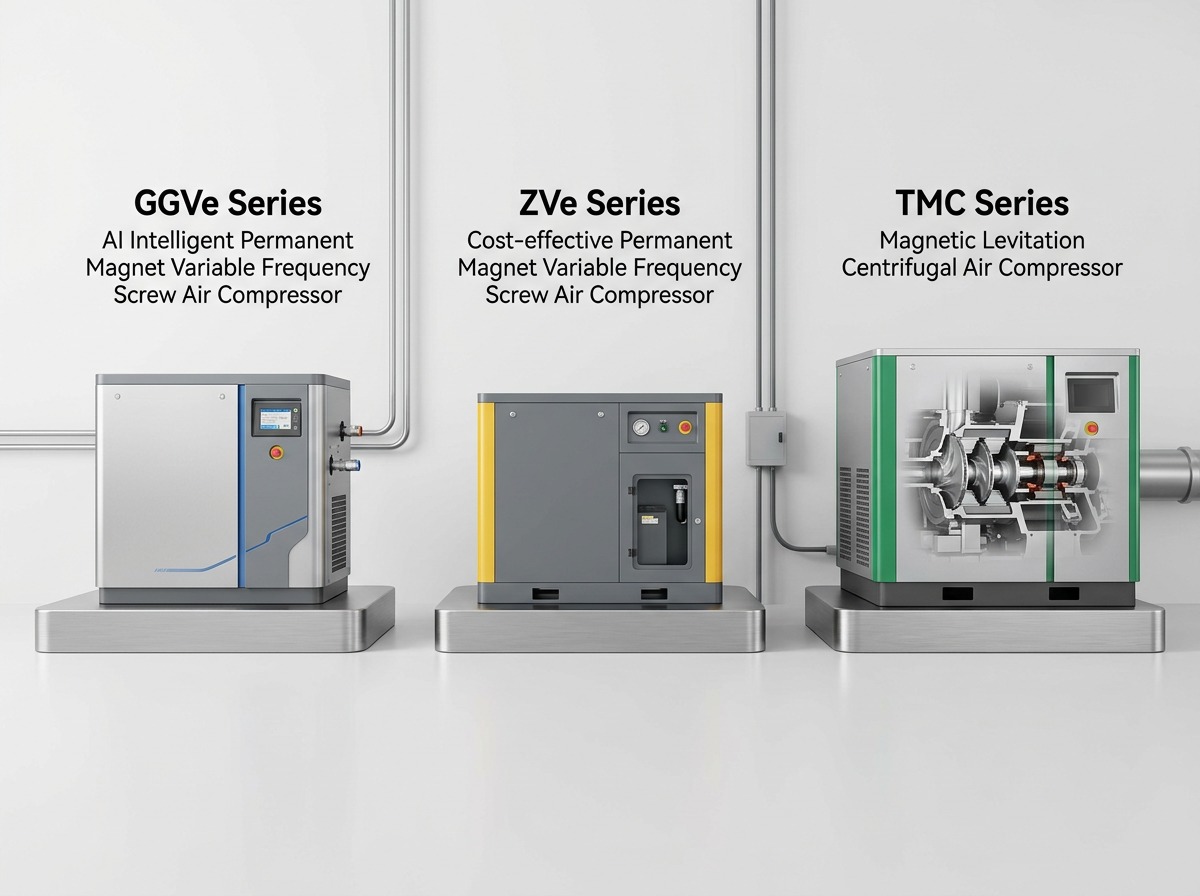

The technology is less compelling in sites with nearly constant air demand and a well-optimized base-load system. In those cases, other solutions such as centralized sequencing, additional storage, or different compressor types may produce better whole-plant economics. For very large continuous loads, another architecture may fit better than a single variable-speed approach. That is why the phrase “best compressor” is incomplete without the plant context.
Factories that prioritize long-term reliability should also evaluate maintenance access, spare part availability, and remote diagnostics. system-oriented planning matters because compressor efficiency can fall over time if filters clog, condensate drains fail, or pressure settings drift. A modern retrofit should therefore include service visibility, not just equipment replacement.
Common retrofit mistakes to avoid
Most retrofit failures come from system blind spots, not from the compressor itself. The most common mistake is selecting equipment by horsepower without measuring actual flow demand. The second is keeping the old distribution network even when it has high leakage or severe pressure drop. The third is ignoring air treatment, which can lead to product contamination or accelerated wear. The fourth is failing to commission the control logic, leaving savings on the table.
- Do not size for the worst case if the worst case is rare.
- Do not assume a variable frequency drive automatically solves all energy waste.
- Do not leave leak repair for “later” after the new compressor is installed.
- Do not compare machines without the same test basis and duty profile.
- Do not overlook dryer pressure drop when calculating actual delivered pressure.
Factories that avoid these mistakes usually achieve more predictable retrofit outcomes. The strongest projects combine measured audit data, proper sizing, control integration, and disciplined maintenance. In other words, the compressor is only one part of the answer.
Practical buying guidance for 2026 retrofit teams
Retrofit teams should think in terms of total lifecycle value. That means considering electricity cost, maintenance frequency, downtime risk, air quality risk, and the ability to expand later. A lower purchase price can be expensive if the unit is difficult to control or poorly matched to the plant’s air pattern. A slightly higher initial investment can be justified if it lowers energy use and stabilizes production.
For factories that want to standardize operations across multiple sites, remote monitoring and central control are especially valuable. They allow maintenance teams to compare operating trends, spot deviations, and plan service before failures escalate. In multi-site operations, that visibility often produces value beyond the compressor room itself, because it supports maintenance planning, energy reporting, and uptime management.
The most reliable 2026 retrofit strategy is therefore simple: audit first, design the system second, and buy the compressor last. If the plant follows that sequence, a permanent magnet variable frequency air compressor can be an effective upgrade rather than an isolated purchase.
FAQ
What is the main advantage of a permanent magnet variable frequency air compressor in a retrofit?
The main advantage is better part-load efficiency and tighter pressure control when air demand changes throughout the day.
When does a factory not need a variable frequency compressor?
When demand is nearly constant and the existing system is already well sequenced, a variable frequency unit may offer limited additional savings.
How should factories size a retrofit compressor?
They should size it from logged average and peak demand, minimum pressure at the point of use, and distribution losses, not from the old nameplate rating.
Which standards should buyers use to compare compressors?
ISO 1217:2009 for performance testing and ISO 8573-1:2010 for air quality are the most practical starting points.
How much energy can pressure reduction save?
The U.S. Department of Energy notes that reducing pressure by 2 psi can lower energy use by about 1 percent in many compressed-air systems.
Why is system design as important as the compressor itself?
Because leaks, pressure drop, poor sequencing, and inadequate air treatment can erase the gains from a high-efficiency machine.
What should be monitored after retrofit?
Pressure, flow, power draw, dew point, alarm history, and runtime balance should all be tracked to verify savings and maintain performance.