
- Size the compressor station around measured demand, pressure requirements, and future production changes.
- Use magnetic-bearing or oil-free centrifugal technology when continuous, high-flow operation and clean air are central priorities.
- Evaluate dryers, filters, storage, piping, controls, and end-use equipment as one connected system.
- Compare lifecycle cost, redundancy, service access, monitoring, and downtime risk instead of purchase price alone.
- Use multi-machine control and demand-based sequencing to prevent inefficient operation at partial load.
Choosing a magnetic centrifugal compressor requires more than comparing motor power or nameplate flow. A large factory must coordinate compression, drying, filtration, storage, distribution, controls, and production demand. ISO 8573-1 classifies compressed-air purity across particles, water, and oil, making air quality a three-part design requirement rather than a single specification. This guide explains how to select the right architecture, avoid common sizing mistakes, and protect long-term production performance.
Start With the Factory Air Demand Profile
The first selection decision should be based on the factory's real demand profile, not its installed equipment total. A compressor station may serve pneumatic tools, automation, packaging, instrumentation, blow-off applications, process equipment, and cleaning points. Each use can have a different pressure, flow, duty cycle, and air-quality requirement.
Collect operating data across shifts, production recipes, weekends, seasonal conditions, and planned expansion. A short peak-demand event can require a different control strategy from a stable process that runs continuously. If the station is sized only for the highest theoretical demand, it may spend much of its operating life in an inefficient low-load condition. If it is sized only for average demand, production may suffer when several high-flow users start together.
Demand analysis should separate base load, variable load, intermittent peaks, artificial demand, and leakage. This separation helps determine whether the plant needs one large centrifugal machine, several machines in a coordinated sequence, or a hybrid station that combines centrifugal and screw compressors.
| Screening factor | Score 1 | Score 3 | Score 5 | Why it matters |
|---|---|---|---|---|
| Flow stability | Highly variable | Mixed demand | Continuous and stable | Centrifugal technology generally becomes more attractive as high-flow demand becomes steadier. |
| Air-quality sensitivity | General utility air | Moderate process sensitivity | Contamination-sensitive production | Oil-free architecture and appropriate treatment may reduce contamination risk. |
| Pressure tolerance | Wide pressure range | Moderate control requirement | Narrow pressure window | Controls, storage, and network design become more important when pressure stability is critical. |
| Downtime impact | Low | Moderate | Production-critical | High-consequence plants need redundancy, monitoring, and a clear service plan. |
The scores in this table are a planning rubric, not equipment performance data. A site survey should replace assumptions with measured flow, pressure, temperature, and operating-hour information.
Understand When a Magnetic Centrifugal Compressor Fits
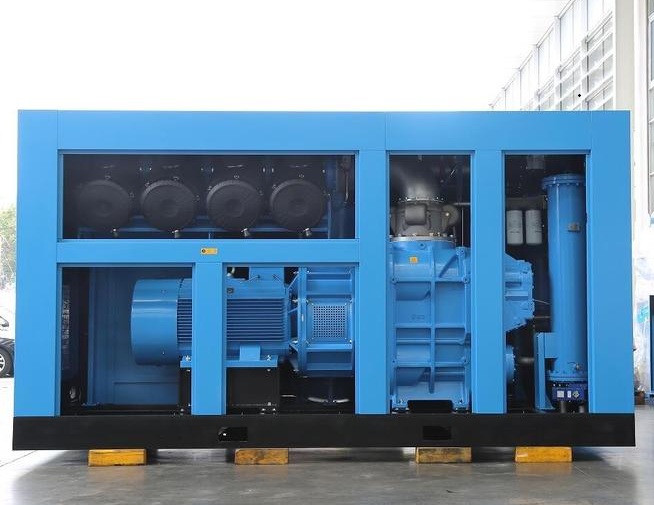
A magnetic centrifugal compressor is most suitable when a factory needs high-volume compressed air, continuous operation, low oil-contamination risk, and efficient control across a stable operating range. Centrifugal compression uses dynamic compression: an impeller increases air velocity and a diffuser converts that velocity into pressure. Magnetic bearings support the rotating assembly without conventional oil-lubricated bearing contact.
Magnetic-bearing technology can simplify the air-end oil path because the compression train does not require the same bearing-oil arrangement used by many conventional machines. That does not eliminate the need for filtration, drying, drainage, cooling, or disciplined maintenance. Air quality still depends on the complete system and the factory environment.
A centrifugal machine also has operating boundaries that must be respected. Surge is an unstable condition associated with insufficient flow through the compressor, while choke or stonewall operation can occur at very high flow and reduced pressure rise. Proper anti-surge control, a suitable turndown strategy, and correctly sized storage help keep the compressor within its stable operating region.
Large factories should not treat magnetic centrifugal technology as a universal replacement for every compressor type. A screw compressor may be more practical for variable demand, distributed production areas, or lower-flow applications. A hybrid station can use a centrifugal compressor for the stable base load and a variable-speed screw compressor for trim demand. The best architecture depends on the measured profile.
Compare Compressor Technologies by Duty, Not Marketing Labels
The correct comparison is between operating roles, not simply between machine categories. Every option should be assessed against flow stability, pressure requirements, air quality, control response, footprint, service capability, and lifecycle cost.
| Technology | Best-fit duty | Typical control priority | Oil-management priority | Primary selection risk |
|---|---|---|---|---|
| Magnetic centrifugal | Large, stable, continuous flow | Anti-surge control and efficient sequencing | Very high | Oversizing or operation below the stable range |
| Oil-free centrifugal | High-flow clean-air applications | Stable pressure and capacity control | Very high | Insufficient trim capacity during variable demand |
| Variable-speed screw | Variable industrial demand | Fast response to changing flow | High | Lifecycle cost or maintenance complexity not fully evaluated |
| Fixed-speed screw | Stable medium-to-high demand | Load and unload coordination | High | Unload losses during low demand |
| Reciprocating | Specialized or intermittent duty | Start-stop management | Application dependent | Unsuitable selection for a large continuous base load |
These categories describe selection logic rather than universal performance rankings. Manufacturer data, site measurements, and independent commissioning records should be used for final comparison.
Specify Air Quality Before Selecting the Air End
Air quality should be specified by the contamination risk at the point of use. A general plant-air header may not need the same treatment as an instrument-air network, clean manufacturing area, food-contact process, or precision assembly line.
Use the ISO 8573-1 classification framework to define required particle, water, and oil classes. The compressor technology is only one part of the result. Intake conditions, pipe corrosion, receiver cleanliness, dryer performance, filter loading, condensate management, and downstream contamination can all affect delivered air.
Oil-free compression can be valuable where oil carryover could affect product quality or sensitive equipment, but an oil-free compressor does not automatically produce dry or particle-free air. Select the dryer and filters according to pressure dew point, ambient conditions, flow range, allowable pressure drop, and maintenance access.
A refrigerated dryer is commonly suitable for general industrial applications, while adsorption drying may be required when the process demands a lower pressure dew point. The treatment train should be designed around the most sensitive user, or sensitive users should receive a dedicated point-of-use solution instead of forcing the entire plant to operate at an unnecessarily expensive air-quality level.
Design the Complete Large Factory Compressor System
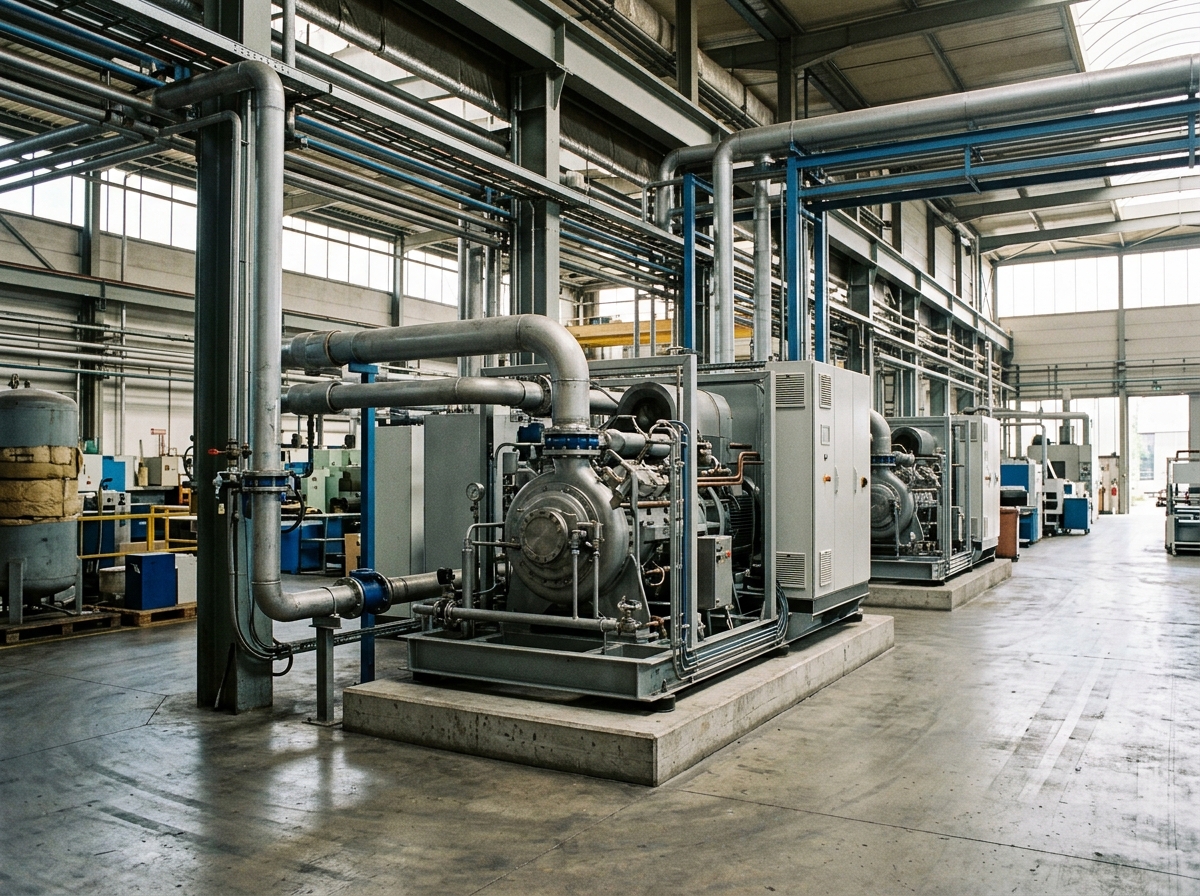
System design usually has a greater effect on practical efficiency than the compressor nameplate alone. The station should be evaluated as a chain consisting of the compressor, aftercooler, dryer, filters, receiver, piping, control system, and end-use equipment.
Pressure loss in the distribution network directly affects compressor discharge pressure and energy use. Long headers, undersized branches, restrictive valves, dirty filters, poorly designed elbows, and dead-end piping can create unstable pressure at production equipment. A lower-pressure machine cannot compensate for a poorly designed network without operational consequences.
Storage should be positioned according to its function. A primary receiver can help stabilize the compressor station, while a secondary receiver near a high-volume intermittent user can reduce local pressure fluctuation. Storage is not a substitute for correcting leaks or selecting the correct compressor capacity, but it can improve control response and reduce unnecessary cycling.
Condensate management is also part of reliability. Drains must be appropriate for the operating environment, accessible for inspection, and integrated with the site's environmental procedures. Poor drainage can damage filters, increase pressure loss, and allow water to reach production equipment.
The U.S. Department of Energy compressed-air guidance treats compressed air as a system rather than an isolated machine. That principle is especially important in large factories, where network losses, demand changes, and treatment requirements can outweigh small differences in compressor package efficiency.
Use Controls, Sequencing, and Monitoring to Protect Efficiency
Multi-machine control should assign compressor roles according to live demand. One machine may cover the stable base load, another may trim changing demand, and a reserve unit may remain available for maintenance or unexpected production requirements.
A sequencing controller should coordinate pressure bands, start and stop priorities, compressor loading, dryer operation, receiver pressure, and alarm conditions. Poor sequencing can cause several machines to operate partially loaded, defeating the purpose of high-efficiency equipment.
Remote monitoring is valuable when it converts data into an operational response. Useful signals include discharge pressure, flow, power, bearing condition, vibration, temperature, filter differential pressure, dryer status, drain alarms, and operating hours. Trends are generally more useful than isolated readings because they can reveal gradual fouling, leakage, sensor drift, or changes in production demand.
- Define a normal operating envelope for pressure, flow, temperature, and power.
- Set alarms for abnormal trends rather than relying only on emergency shutdowns.
- Link maintenance tasks to condition indicators where the manufacturer permits condition-based servicing.
- Review controller records against production schedules to identify artificial demand and low-load operation.
- Keep manual override procedures available for communication or controller failures.
The Compressed Air and Gas Institute provides industry resources that can support specification and evaluation discussions, but site-specific engineering and manufacturer documentation remain necessary for final design decisions.
Evaluate Total Cost of Ownership
Purchase price is only one part of the economic decision. A large factory should compare electricity, maintenance, treatment consumables, cooling requirements, spare parts, commissioning, service coverage, downtime exposure, and future capacity changes.
Waste-heat recovery may improve total energy utilization when the plant has a consistent demand for hot water, space heating, or another compatible thermal load. The recovery project should be evaluated by matching the recovered heat profile with the actual thermal demand. Installing recovery equipment without a reliable heat sink can reduce the expected value.
| Cost category | Key question | Evidence to request | Screening score 1-5 |
|---|---|---|---|
| Energy | How does power vary with flow and pressure? | Measured or documented part-load data | 1-5 |
| Maintenance | Which components require scheduled service? | Maintenance tasks, intervals, and spare-parts list | 1-5 |
| Reliability | What happens if one unit is unavailable? | Redundancy plan and recovery procedure | 1-5 |
| Air treatment | What is the pressure drop and consumable burden? | Filter and dryer performance documentation | 1-5 |
| Service | How quickly can qualified support respond? | Local service coverage and escalation process | 1-5 |
The score column is a procurement framework for comparing proposals consistently; it is not a claimed efficiency or cost result. Ask suppliers to state assumptions clearly, including operating hours, electricity price, pressure setpoint, ambient temperature, cooling method, and expected demand profile.
Common Selection Mistakes in Large Factory Projects
The most expensive mistake is selecting a compressor before understanding the process. A technically efficient machine can still perform poorly if its operating range does not match demand.
- Using installed capacity as actual demand: connected equipment ratings do not prove simultaneous consumption.
- Ignoring future operating changes: production expansion, additional shifts, and new process lines can alter the base and peak profile.
- Choosing a single oversized machine: this may reduce flexibility and create low-load operating challenges.
- Treating pressure as a compressor-only issue: distribution losses and restrictive treatment equipment can create the real problem.
- Separating air quality from production risk: contamination requirements should be defined by the most sensitive process.
- Buying monitoring without an operating plan: alarms have little value if no person owns the response.
Practical Procurement Checklist
Before requesting final quotations, prepare a common technical brief for every supplier. This makes proposals easier to compare and exposes hidden assumptions.
- Measured flow profile covering production and non-production periods.
- Required header pressure and allowable pressure variation at critical users.
- Ambient temperature, altitude, cooling-water conditions, and installation constraints.
- Required particle, water, and oil quality at each critical point of use.
- Preferred redundancy philosophy and maximum acceptable production interruption.
- Control-system communication requirements and remote-monitoring expectations.
- Maintenance access, spare-parts availability, commissioning scope, and operator training.
- Lifecycle-cost assumptions, warranty terms, and documented service responsibilities.
A factory should also request a commissioning plan. It should explain how flow, pressure, power, air quality, controls, alarms, and dryer performance will be checked after installation. Acceptance criteria should be agreed before equipment delivery, not after a performance dispute.
FAQ
Is a magnetic centrifugal compressor suitable for every large factory?
No. It is generally more attractive for high-flow, continuous, and relatively stable demand. Variable production, distributed loads, or frequent low-load operation may favor a variable-speed screw compressor or a hybrid station.
Does magnetic bearing technology automatically mean the air is oil-free?
Magnetic bearings can reduce the need for conventional oil-lubricated bearing arrangements, but the complete package and air path must be reviewed. Confirm the manufacturer's definition of oil-free performance and specify downstream filtration and drying separately.
How should a factory determine compressor capacity?
Use measured flow and pressure data across operating conditions. Separate base load, peak demand, intermittent users, leakage, and future expansion. Then test the proposed operating sequence against the required stable range of each compressor.
Can a centrifugal air compressor handle changing demand?
It can handle a defined operating range when equipped with suitable capacity control, anti-surge protection, storage, and sequencing. If demand changes rapidly or frequently falls below the stable range, a trim compressor may be needed.
Which dryer is best for a large factory compressor system?
A refrigerated dryer is often suitable for general industrial air, while adsorption drying may be required for lower pressure dew points or moisture-sensitive processes. The correct choice depends on the point-of-use requirement, ambient conditions, flow, and acceptable pressure loss.
How important is the compressed-air pipe network?
It is critical. Pipe sizing, layout, valves, filters, leaks, elevation changes, and receiver placement affect pressure stability and operating cost. A high-performance compressor cannot fully compensate for excessive distribution loss.
What should buyers ask about service and reliability?
Ask about local technical support, spare parts, response procedures, preventive maintenance, remote diagnostics, training, warranty limits, and the plan for operation during a compressor or controller outage. These details directly affect production risk.
About the Supplier
Deman develops industrial compressed-air solutions for manufacturing environments, combining compressor selection with air treatment, storage, controls, monitoring, and system planning. Its portfolio approach supports centrifugal and screw-compressor applications, while project discussions can address air quality, energy management, redundancy, and service requirements. For a large factory project, share measured demand and process conditions with the engineering team before requesting a configuration or quotation.