
How Much Can a 110kW PM VSD Compressor Save on Energy Costs?
A 110kW PM VSD compressor can reduce compressor energy costs when plant demand varies, but the actual saving depends on operating hours, load profile, pressure, leakage, controls, and electricity price. Industry sources commonly cite potential VSD energy savings of about 30% to 35% in suitable applications; a site-specific measurement is required before turning that range into a financial forecast.
- A 110kW PM VSD compressor is most valuable when air demand changes during shifts or production cycles.
- A 30% energy reduction is an estimate for a suitable application, not a guaranteed result.
- Annual savings should be calculated from measured load, operating hours, electricity price, and baseline compressor performance.
- Leak repair, pressure optimization, sequencing, and heat recovery can materially affect the final business case.
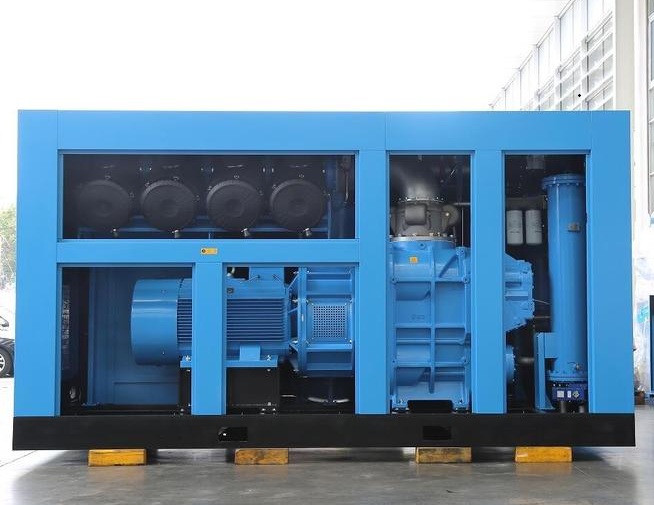
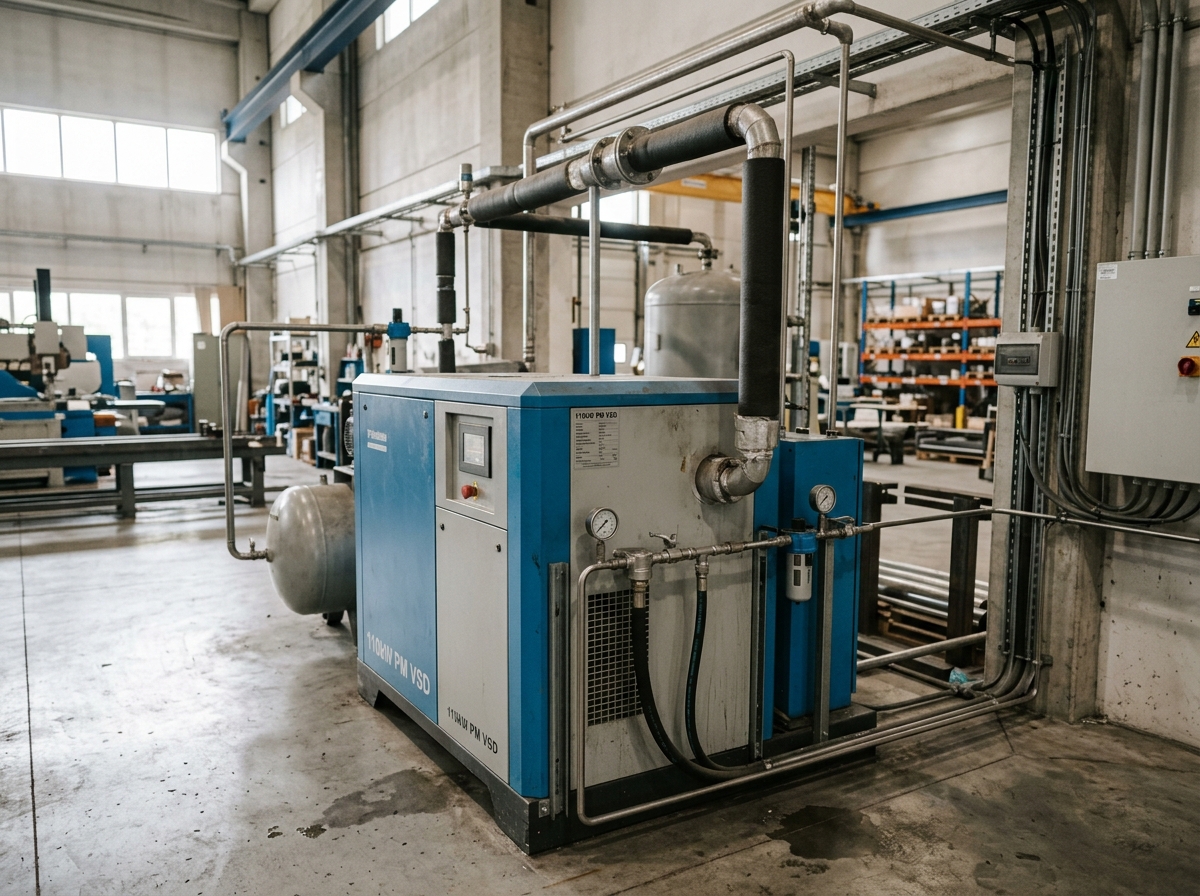
The 110kW PM VSD compressor is designed to match compressed-air output more closely with real demand, reducing inefficient unloaded operation and unnecessary cycling. This matters because compressed air can represent 10% to 15% of a facility's electricity expenses, according to USA Compressor. This guide explains how to estimate savings, when permanent-magnet variable-speed technology is appropriate, and why the entire air system matters more than the compressor alone.
How the Energy Saving Mechanism Works
The main saving comes from producing only the air the plant needs at a given time. A fixed-speed compressor typically runs at a relatively constant motor speed and uses control methods such as load and unload, while a variable-speed drive changes motor speed to follow demand. When demand is below the compressor's full output, this control approach can reduce wasted energy associated with unloaded running and frequent starts.
Permanent-magnet motor technology can improve the drive package's efficiency, but the result depends on the complete compressor design and operating point. A PM motor should therefore be evaluated together with the air end, inverter, cooling system, controls, pressure setpoint, and maintenance plan rather than treated as an isolated efficiency claim.
VSD technology is most useful when demand fluctuates materially. A plant with stable, continuous demand near full capacity may obtain less benefit than a facility with multiple shifts, intermittent production, changing flow requirements, or substantial off-peak periods. The Kaishan energy-efficiency comparison reports that a VSD compressor can reduce energy consumption by about 33% in an appropriate application, while actual results vary by operating conditions.
How to Estimate Annual Compressor Energy Savings
The most reliable forecast starts with the existing compressor's measured electricity use, not its nameplate power alone. A 110kW motor rating does not mean the machine consumes exactly 110kW continuously because real input power changes with pressure, speed, cooling demand, control mode, and system conditions.
The basic calculation is straightforward: annual energy cost equals average input power multiplied by annual operating hours and the electricity tariff. Estimated savings equal baseline annual energy cost multiplied by the expected percentage reduction.
| Calculation item | Illustrative value | How to use it |
|---|---|---|
| Rated motor power | 110 kW | Use as a capacity reference, not as measured average consumption |
| Operating schedule | 4,000 hours per year | Replace with actual production and idle hours |
| Electricity tariff | $0.10 per kWh | Use the blended industrial rate, including relevant demand charges where applicable |
| Baseline full-power energy | 440,000 kWh per year | 110 kW multiplied by 4,000 hours; an illustrative upper-bound calculation |
| Baseline energy cost | $44,000 per year | 440,000 kWh multiplied by $0.10 per kWh |
The illustrative baseline above is not a quotation or guaranteed operating result. If a measured project baseline were $44,000 per year and the verified reduction were 30%, the energy saving would be $13,200 per year. At 33%, the saving would be $14,520 per year. These figures are arithmetic examples based on stated assumptions, not a prediction for every 110kW installation.
| Verified reduction | Annual energy reduction | Annual cost saving at $0.10 per kWh |
|---|---|---|
| 10% | 44,000 kWh | $4,400 |
| 20% | 88,000 kWh | $8,800 |
| 30% | 132,000 kWh | $13,200 |
| 33% | 145,200 kWh | $14,520 |
| 35% | 154,000 kWh | $15,400 |
Payback depends on installed project cost as well as energy savings. For example, if an installation cost $50,000 and generated $13,200 in verified annual energy savings, the simple energy-only payback would be approximately 3.8 years. A complete investment case should also include maintenance, production reliability, controls, installation, financing, taxes, demand charges, and the value of recovered heat.
Which Operating Conditions Favor a 110kW PM VSD Compressor?
Variable-speed equipment performs best when compressed-air demand changes enough to create avoidable part-load losses. The following conditions usually justify a detailed assessment:
- Multiple production lines operate at different times or with changing air requirements.
- The existing fixed-speed machine spends significant time unloaded or in frequent load and unload cycles.
- Night-shift or weekend demand is substantially lower than peak demand.
- Several compressors operate without coordinated sequencing.
- Pressure must be maintained within a narrow range, but demand varies quickly.
- Leakage and artificial demand have already been addressed or are included in the project plan.
A VSD is not automatically the best choice for every duty. If a plant has a steady, high flow requirement for nearly all operating hours, a fixed-speed base-load compressor combined with a properly sized VSD trim machine may be more economical. The correct arrangement depends on the demand profile, minimum flow, maximum flow, pressure band, redundancy requirement, and expansion plan.
System Factors That Can Change the Result
System optimization often produces savings that are as important as the compressor upgrade itself. A compressed-air installation includes the compressor, dryer, filters, receiver, piping, controls, and end-use equipment. Evaluating only the compressor can hide pressure losses and demand problems elsewhere in the system.
Leak management should come before final savings validation. A compressor that supplies leaks is still wasting electricity, even when its motor uses efficient technology. The Atlas Copco compressed-air cost guide identifies leak repair, pressure optimization, compressor upgrades, and waste-heat recovery as important cost-saving opportunities.
Pressure reduction can also lower energy consumption, but it must be completed carefully. Reducing pressure too far may cause actuators, tools, valves, or process equipment to malfunction. The correct approach is to measure pressure at the compressor room and critical end-use points, identify the required minimum, and then optimize the control setpoint and distribution network.
Sequencing is essential when more than one compressor operates together. A master controller can assign base load and trim load, prevent multiple machines from running inefficiently at low output, and maintain a stable pressure band. The controller should be configured around measured demand rather than simply alternating machines by runtime.
Heat recovery can improve the overall energy case when the facility has a consistent need for hot water, space heating, or process heat. Recovered heat should be treated as a separate, verified benefit because its value depends on temperature requirements, usage schedule, installation design, and the alternative heat source.
A Practical Measurement and Verification Process
A short measurement campaign is more credible than a nameplate comparison. Before purchasing, collect at least the following information:
- Record compressor input power, discharge pressure, flow, and operating mode at suitable time intervals.
- Map demand across production shifts, breaks, weekends, and seasonal periods.
- Inspect leaks, inappropriate open blowing, pressure regulators, and end-use controls.
- Document dryer and filter pressure drop, receiver capacity, and distribution-pipe restrictions.
- Model the proposed PM VSD compressor at minimum, average, and peak demand.
- Compare annual energy, maintenance, downtime risk, and installation costs.
- Verify the result after commissioning using the same measurement boundaries as the baseline.
Measurement boundaries should remain consistent before and after the project. For example, comparing only compressor motor energy before installation with total compressor-room energy afterward can distort the result because dryers, fans, pumps, and controls may have different consumption patterns.
Reliability, Air Quality, and Lifecycle Cost
Energy efficiency should not compromise air quality or production continuity. Filters and dryers must be selected for the required pressure dew point, particle removal, oil control, and flow capacity. A general manufacturing plant may use a refrigerated dryer, while moisture-sensitive or contamination-sensitive processes may require a higher level of drying and filtration.
Lifecycle value includes more than electricity. Planned maintenance, service access, spare parts, control diagnostics, warranty terms, training, and response time can influence the total cost of ownership. Remote monitoring can help identify abnormal temperature, pressure, vibration, or operating trends before they become an unplanned shutdown.
Reliability is particularly important where a compressor failure can stop an entire production line. In those cases, a slightly lower energy bill may not justify reducing redundancy. A robust design may include standby capacity, receiver storage, automatic sequencing, and an appropriate service agreement.
Buyer Checklist for a 110kW PM VSD Compressor
The best buying decision is based on the plant's measured duty rather than the motor rating alone. Ask suppliers to provide:
- Input power and flow data across the expected operating range.
- Guaranteed pressure, flow, and performance conditions for the quotation.
- Control range, minimum stable output, and response behavior during rapid demand changes.
- Required service intervals and estimated annual maintenance cost.
- Sound, cooling, installation, and electrical requirements.
- Compatibility with existing dryers, filters, receivers, network controls, and backup equipment.
- Commissioning, measurement, training, and after-sales support arrangements.
Independent comparison is valuable because savings claims can use different pressure, tariff, runtime, and load assumptions. The Natural Resources Canada compressed-air reference guide illustrates why operating schedule and electricity cost are central to compressed-air economics, even when equipment capacity is known.
Frequently Asked Questions
1. How much can a 110kW PM VSD compressor save?
A suitable variable-demand application may achieve savings in the range often cited for VSD systems, including about 30% to 35% in some industry examples. The actual result can be lower or higher because it depends on the baseline machine, operating hours, pressure, leakage, electricity price, and load profile.
2. Is 33% energy saving guaranteed?
No. The 33% figure is an industry example reported for suitable conditions, not a universal guarantee. A supplier should provide assumptions and a measurement-based estimate for the specific site.
3. Is a PM motor better than a standard induction motor?
A PM motor can support high efficiency, particularly when paired with appropriate variable-speed control, but the complete compressor package determines real-world performance. Compare measured input power, flow, pressure, control range, and lifecycle cost.
4. When is a fixed-speed compressor preferable?
Fixed-speed equipment may be appropriate for a stable base load operating close to full capacity for most of the schedule. A mixed system with fixed-speed base load and VSD trim can also be effective when demand has both steady and variable components.
5. Should leaks be repaired before replacing the compressor?
Yes, leak repair should normally be part of the baseline and project plan. Otherwise, the new compressor may be sized around avoidable demand and the predicted energy saving may be overstated.
6. Does lowering pressure always reduce energy costs?
Lowering pressure can reduce energy use, but only when end-use equipment continues to operate correctly. Measure pressure at critical points and confirm process requirements before changing the setpoint.
7. What information is needed for a reliable quotation?
Provide required flow, working pressure, operating hours, shift pattern, ambient conditions, air-quality class, current equipment, future expansion, redundancy needs, electricity tariff, and available measurement data. This allows suppliers to evaluate the compressor and the complete air system together.
About Deman
Deman develops compressed-air solutions for industrial users that need dependable output, controlled operating costs, and practical lifecycle support. Its approach considers equipment selection, air treatment, storage, piping, controls, monitoring, and maintenance rather than focusing on a compressor in isolation. For a project assessment, share your measured demand profile, pressure requirements, operating schedule, and existing equipment so the proposed configuration and savings model can be reviewed against real plant conditions.