



 Why German Automotive Plants Are the Ideal Use Case for PM VSD Compressors
Working in the compressed air industry for 29 years, I have advised dozens of German automotive plants on their compressed air system optimization. The pattern is remarkably consistent: the plant operates a central compressed air station with three to five fixed-speed screw compressors cascaded to meet a base load of 40-60 percent of the total installed capacity, with two or three units modulating or unloading during low-demand periods. The specific power consumption of this configuration is typically 8.0-9.0 kW per cubic metre per minute at 8 bar — far above what the latest PM VSD technology can achieve.
Let me be direct about why German automotive plants are different from other industrial facilities. An automotive assembly plant’s compressed air demand varies by a factor of 3-5 between shift changes and production peaks. A typical 120,000 m² plant operating two assembly lines with welding, painting, and pneumatic tooling consumes 80-200 m³/min of compressed air at 7-10 bar, with demand spikes of 30-50 percent during body shop welding cycles and paint booth robot purges. Fixed-speed compressors simply cannot follow this load profile efficiently.
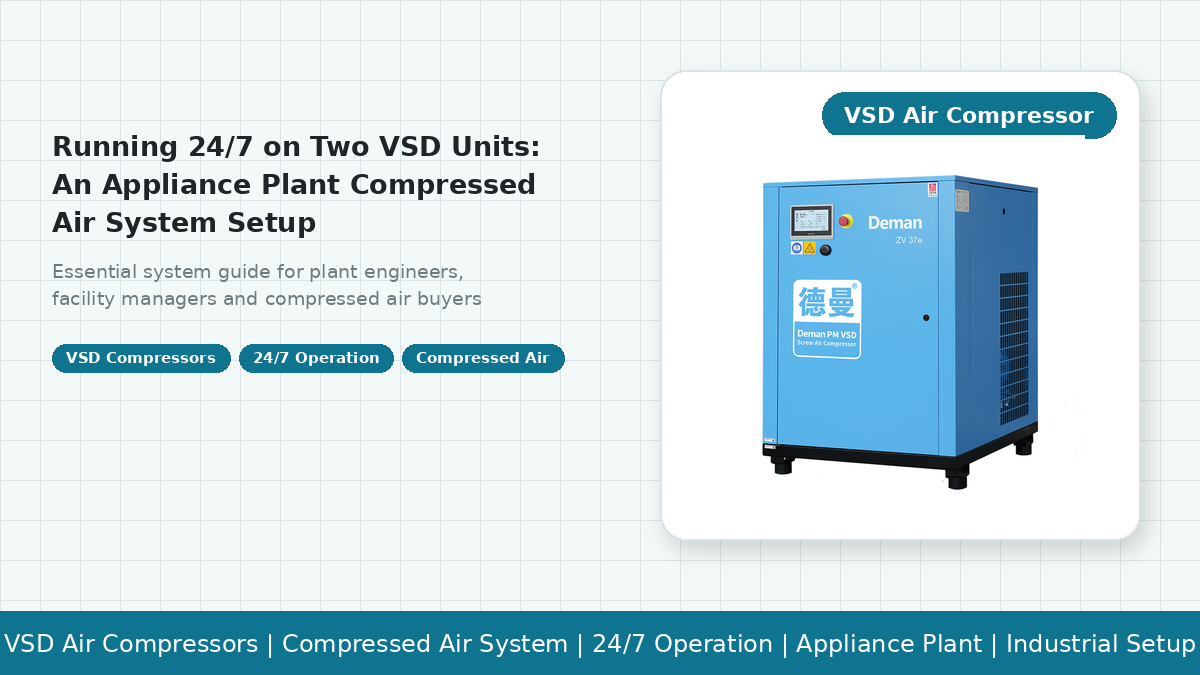
In this guide, I explain how PM VSD screw compressor technology — specifically the two-stage PM VSD design that Deman has developed under our German design partnership — delivers 35-50 percent energy savings in this demanding operating environment. I use the Deman D22-355 PM two-stage PM VSD series as a reference, but the engineering principles apply across any properly specified two-stage PM VSD system.
The Technology: How Permanent Magnet VSD Differs from Standard VSD
Not all variable speed drives are created equal. The PM motor is the key differentiator.
Permanent Magnet Synchronous Motor vs. Induction Motor
A standard VSD compressor uses an induction motor with a variable frequency drive. The induction motor has a rotor that must be magnetized by the stator current — creating a lagging power factor and I²R losses in the rotor bars. A permanent magnet synchronous motor uses neodymium-iron-boron (NdFeB) magnets embedded in the rotor, eliminating the rotor current entirely. The result is a motor efficiency of 95-97 percent across the full speed range (20-100 percent), compared to 89-93 percent for an induction motor at the same operating conditions.
The efficiency difference is most pronounced at partial load — exactly where a VSD compressor spends most of its operating life. At 30 percent of rated speed, a PM motor maintains 94-95 percent efficiency. An induction motor at 30 percent speed drops to 84-88 percent because the rotor magnetizing current requirement does not scale linearly with load. Over a year of operation where the compressor runs at 50-70 percent average speed — typical for a German automotive plant’s compressed air profile — the PM motor saves 18-25 percent of the motor’s electrical energy consumption alone, before considering the savings from the VSD control itself.
Two-Stage Compression: The Second Efficiency Lever
Deman’s two-stage PM VSD design adds interstage cooling between the first and second compression stages. Air leaving the first stage at approximately 3.5-4.5 bar and 120-150°C passes through an intercooler before entering the second stage, where it is compressed to the final discharge pressure of 8-10 bar. The interstage cooling reduces the specific compression work by 12-18 percent compared to single-stage compression because the air enters the second stage at 35-45°C instead of 120-150°C — the compression work is proportional to the absolute inlet temperature.
The two-stage design also reduces the bearing load on each stage because the pressure differential across each stage is lower — approximately 4 bar per stage in a two-stage design versus 8-9 bar across a single stage. This translates to 2-3 times longer bearing service life and lower vibration levels. In a German automotive plant running 24/6 production, the extended service interval between major overhauls shifts from 40,000 operating hours (single-stage) to 60,000-80,000 operating hours (two-stage), reducing the total lifecycle maintenance cost by approximately 25-35 percent.
Energy Savings Quantified: A Bavarian Automotive Plant Case Study
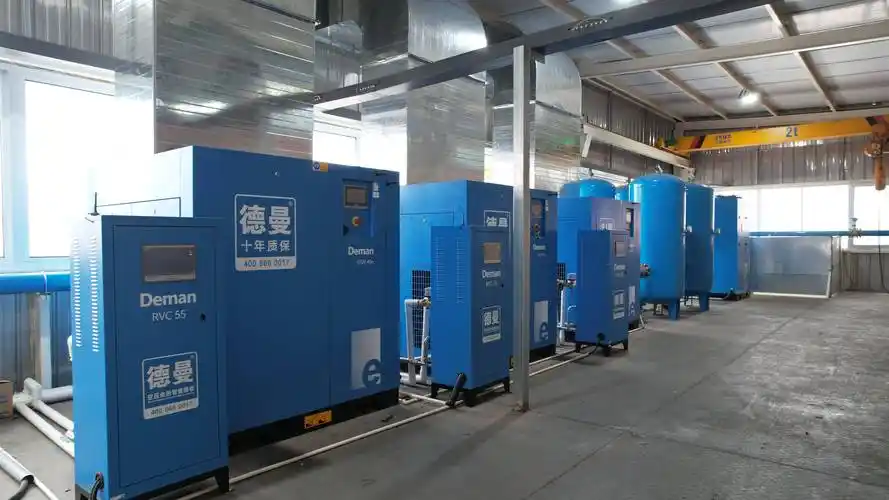
The best illustration I have of PM VSD energy savings comes from a Deman installation at an automotive component plant in Bavaria that produces transmission components for a premium German automaker. We replaced three 250 kW fixed-speed screw compressors with Deman D22-355 PM two-stage VSD units in 2024.
| Parameter | Before (Fixed-Speed) | After (PM VSD) |
|---|---|---|
| Compressor configuration | 3 × 250 kW fixed-speed | 2 × 200 kW Deman D22-355 PM |
| Average operating power | 385 kW (continuous) | 252 kW (75% avg speed) |
| Annual operating hours | 7,200 h | 7,200 h |
| Annual energy consumption | 2,772,000 kWh | 1,814,000 kWh |
| Specific power at 8 bar | 8.2 kW/(m³/min) | 6.2 kW/(m³/min) |
| Annual energy cost (EUR 0.21/kWh) | EUR 582,120 | EUR 380,940 |
| Annual CO₂ emissions (German grid mix) | 1,302 tonnes | 853 tonnes |
The 34.6 percent energy cost reduction (EUR 201,180 per year) came from combined PM motor efficiency and two-stage compression. The total project cost for the two Deman D22-355 PM units including installation, piping modifications, and commissioning was EUR 295,000. Simple payback: 17.6 months. The plant’s energy manager documented the project in the ISO 50001 annual energy review, earning a 12-point improvement in the plant’s DIN EN 16247-1 energy audit score.
Integration with German Automotive Plant Compressed Air Networks
Installing a PM VSD compressor is not simply a swap-out. The compressed air network must be evaluated for compatibility with the VSD’s load-following characteristics.
Receiver Tank Sizing for VSD Systems
A PM VSD compressor responds to pressure changes faster than a fixed-speed compressor — typical response time from 20 percent to 100 percent flow is 3-5 seconds versus 10-15 seconds for a fixed-speed unit with a standard controller. However, the VSD system still requires adequate receiver capacity to prevent short-cycling during rapid demand fluctuations. For a German automotive plant, I recommend a minimum wet-side receiver capacity of 500 litres per 10 m³/min of installed VSD compressor capacity, plus an additional 200 litres per 10 m³/min for the dry-side receiver after the refrigerant or desiccant dryer. The receiver tank acts as the system’s kinetic buffer, allowing the VSD compressor to ramp smoothly rather than hunting on every pneumatic tool activation on the assembly line.
Pressure Band Optimization
The standard fixed-speed compressor operates with a pressure band of 1.0-1.5 bar between the cut-in and cut-out pressures — for example, loading at 7.0 bar and unloading at 8.5 bar. A PM VSD compressor can operate within a pressure band as narrow as 0.3-0.5 bar (e.g., 7.5-8.0 bar) because the VSD adjusts speed continuously. The narrower band reduces the average system pressure, which directly reduces energy consumption by approximately 0.7-0.8 percent per 0.1 bar of pressure reduction. For the Bavarian plant case study above, narrowing the pressure band from 1.5 bar to 0.4 bar reduced the average system pressure by 0.55 bar, contributing an additional 3.8 percent energy saving beyond the PM and two-stage compression benefits
Grid Integration and Demand-Side Management for German Industrial Sites
German industrial electricity pricing has become more volatile since the Energiewende accelerated the renewable energy transition. PM VSD compressors contribute to grid stability — and to the plant's electricity cost reduction — through two mechanisms that fixed-speed compressors cannot provide.
Peak Demand Shaving with Smart VSD Control
The Deman D22-355 PM series includes a built-in peak shaving function that is integrated with the plant's energy management system. When the EMS signals that the plant's total power draw is approaching the maximum demand threshold set by the utility contract — typically 85-95 percent of the contracted peak demand — the compressor's VSD controller reduces the motor speed by 5-15 percent for a configurable period of 2-10 minutes. The reduction in compressed air output is compensated by the wet-side and dry-side receiver tanks. Over a typical 15-minute peak shaving window, the 200 kW compressor reduces its power draw from 200 kW to 150-180 kW — a 10-25 percent reduction that can prevent the plant from exceeding the contracted demand threshold and triggering the penalty tariff (typically EUR 1.50-3.00 per kVA of excess demand per month in German utility contracts).
Frequency Response and Grid Support Capability
The PM motor and VSD combination can provide primary frequency response to the German grid. When the grid frequency drops below 49.8 Hz (indicating a generation shortage), the VSD controller can reduce compressor load within 200ms by lowering motor speed. The reduction is limited to 20 percent of the compressor's rated power to maintain sufficient compressed air supply for critical plant operations. This frequency support capability generates revenue under the German Balancing Market mechanism — a typical 200 kW PM VSD compressor configured for primary frequency response can earn EUR 3,000-8,000 per year depending on the contracted balancing power volume and the frequency deviation events in the grid year.
Frequently Asked Questions
Can a PM VSD compressor be retrofitted into an existing fixed-speed compressor footprint?
In most cases, yes. Deman’s D22-355 PM series is designed with the same footprint dimensions as standard ISO 8573-1 compressor packages of equivalent capacity. The 200 kW unit occupies 2,800 × 1,600mm floor space with a height of 2,000mm — compatible with existing compressor room layouts in German industrial plants. The electrical connection requires a VFD-rated power feed, which may require upgrading the existing motor cable from a standard induction motor cable to a shielded VFD cable with ferrite EMC filtering. The compressed air connection is standard DN125 or DN150 flange. I recommend a site survey before ordering to confirm the existing electrical cable rating, floor loading capacity, and ventilation ducting compatibility.
What is the ten-year warranty that Deman offers, and what does it cover?
Deman offers a ten-year warranty on the PM motor and the main compressor rotor for our D22-355 PM series, covering manufacturing defects in materials and workmanship. The warranty requires annual maintenance performed by a Deman-certified service partner using genuine Deman replacement parts. The PM motor warranty covers the permanent magnet rotor assembly, the stator windings, and the sealed bearings. The rotor warranty covers the screw rotor set and the housing. Standard wear items — air filters, oil filters, separator elements, oil, and seals — are excluded from the ten-year warranty and covered under the standard 2-year parts warranty. The ten-year warranty is supported by Deman’s registered capital of 50 million RMB and our 127 active patents, and is registered with the German TÜV SÜD certification body for our ISO 9001 quality management system.
What maintenance interval does the two-stage PM VSD compressor require?
The standard maintenance interval for the Deman D22-355 PM series is every 2,000 operating hours for oil and filter change, with a major overhaul (bearing replacement and rotor inspection) at 40,000-50,000 hours for the low-pressure stage rotor and 50,000-60,000 hours for the high-pressure stage rotor — the differential is because the LP stage runs at higher temperature. The PM motor bearings are sealed and rated for 60,000 hours of service life. For a typical German automotive plant running 7,200 hours per year, the oil and filter service interval is approximately 3.3 months, and the major overhaul interval is 6-7 years. Deman offers a costed maintenance plan with guaranteed parts pricing for the full warranty period.
Does the PM VSD compressor meet the German TA Luft clean air regulation?
Yes. Deman PM VSD compressors with the optional activated carbon filtration package meet the TA Luft (Technische Anleitung zur Reinhaltung der Luft) requirements for residual oil content below 0.1 mg/m³ at the compressor outlet. The standard Deman D22-355 PM fitted with the high-efficiency coalescing filter + activated carbon adsorber configuration delivers residual oil content of 0.03-0.08 mg/m³ — compliant with TA Luft Class 2 (< 1 mg/m³) and Class 1 (< 0.1 mg/m³) as defined in ISO 8573-1:2010. For German automotive paint shop applications requiring oil-free compressed air — where the paint finish quality is directly affected by compressor oil carryover — Deman recommends the two-stage configuration with the Class 1 filter package and quarterly oil carryover testing.
What is the noise level of the Deman D22-355 PM compressor?
The Deman D22-355 PM two-stage VSD compressor produces a noise level of 72-78 dB(A) at 1 metre distance in full-speed operation, depending on the specific enclosure configuration. The low-speed operation at 50-70 percent speed (typical for the Bavarian plant case study) produces 65-70 dB(A). The noise reduction compared to a 250 kW fixed-speed compressor (typically 80-85 dB(A) full load) comes from three factors: the PM motor operates at lower electromagnetic noise than an induction motor, the two-stage compression has a smoother pressure pulse profile, and the VSD reduces the compressor speed during the majority of operating hours. For German automotive plants with noise emission limits below 70 dB(A) in the compressor room, Deman offers a super-silenced enclosure option that reduces noise to 62-68 dB(A) full load