










Introduction
In plants where compressed air runs around the clock, small efficiency gains translate into major cost savings. A two-stage screw compressor improves performance by dividing compression into two lower-ratio steps instead of forcing the entire pressure rise through one stage, reducing heat generation, leakage losses, and wasted power. This article explains the mechanical reasons that design lowers specific energy consumption, how intercooling and optimized rotor loading contribute to better output per kilowatt, and where the technology delivers the strongest return. It also sets up a practical comparison with single-stage systems so readers can judge whether two-stage screw compression fits their pressure, duty-cycle, and lifecycle cost targets.
Why Two-Stage Screw Compression Gains Attention
Compressed air systems are critical utilities in industrial manufacturing, often consuming between 10% and 30% of a facility's total electricity. As energy prices fluctuate and environmental mandates tighten, industrial operators are re-evaluating their equipment strategies to optimize power consumption. The two-stage screw compressor has emerged as a preferred solution for high-demand applications, offering substantial efficiency gains over traditional single-stage designs by fundamentally altering how air is pressurized.
Energy costs, load variability, and lifecycle goals
Over a typical 10-year lifecycle, energy consumption accounts for roughly 75% to 82% of a rotary screw compressor's total cost of ownership, dwarfing initial capital expenditures and routine maintenance. When facilities experience high load variability or run continuous shifts, energy waste compounds rapidly. Two-stage screw technology directly addresses these lifecycle goals by significantly reducing the electrical input required to generate a given volume of air.
Organizations aligning with international energy management standards, such as ISO 50001, frequently transition to two-stage systems to meet stringent carbon reduction targets. By maximizing the output per kilowatt consumed, these compressors help plants stabilize operating expenses even during periods of extreme energy cost volatility.
Where two-stage compression delivers the most value
The value of two-stage compression peaks in environments requiring continuous, heavy-duty operation—typically defined as running more than 4,000 to 6,000 hours annually. Industries such as glass manufacturing, automotive assembly, and chemical processing see the fastest return on investment.
In these settings, high-capacity air demands (often exceeding 500 CFM) at standard industrial pressures (90 to 125 psi) make the 10% to 15% energy savings of a two-stage unit highly lucrative. For a large manufacturing plant, this efficiency improvement routinely translates to tens of thousands of dollars saved annually, easily justifying the initial capital upgrade.
How a Two-Stage Screw Compressor Improves Efficiency
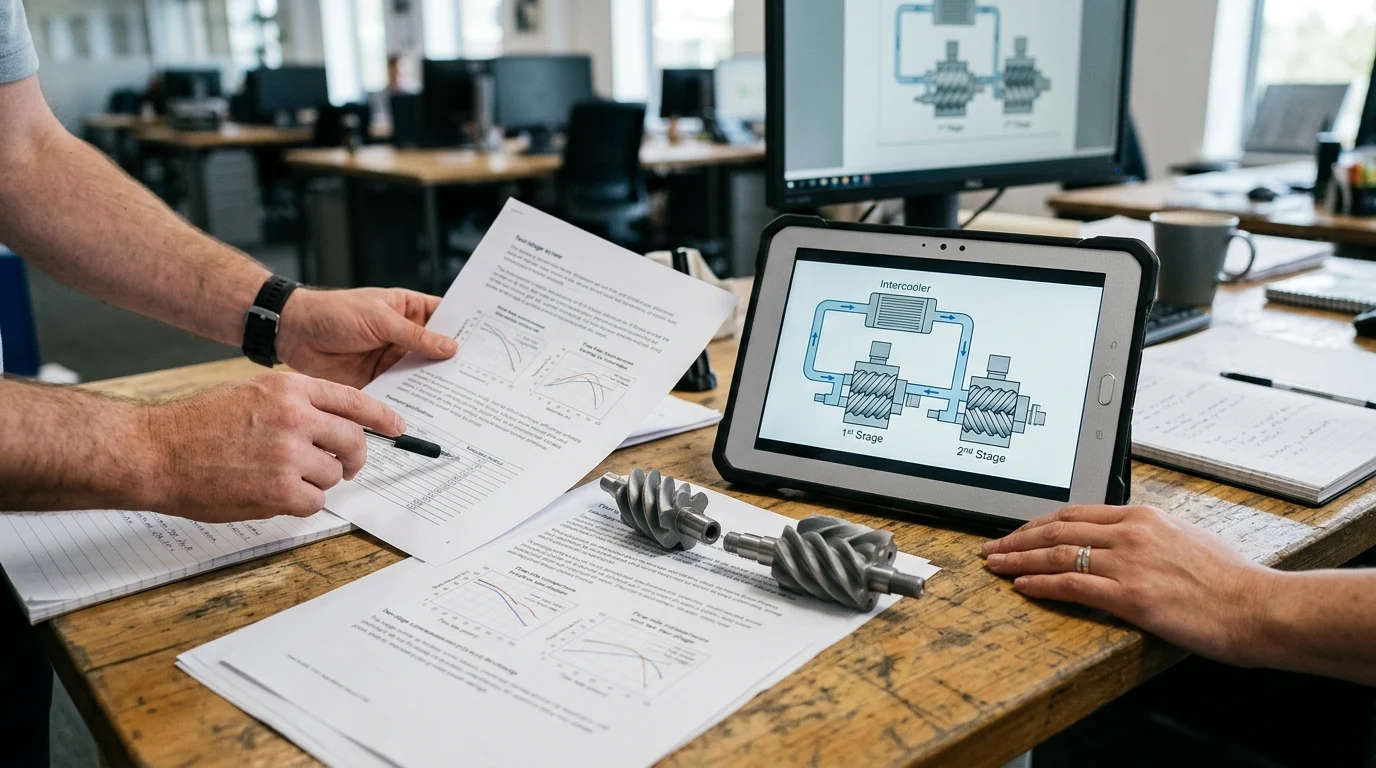
The fundamental advantage of a two-stage screw compressor lies in thermodynamics. By dividing the compression work across two distinct airends, the system minimizes thermal energy losses and maximizes volumetric efficiency.
Compression process, pressure ratio split, and intercooling
In a single-stage unit, air is compressed from atmospheric pressure (14.5 psia) to the final discharge pressure (e.g., 115 psia) in one step, creating a high pressure ratio of about 8:1. A two-stage screw compressor splits this workload.
The first stage compresses the air to an intermediate pressure (typically around 40 to 45 psia, a ratio of roughly 3:1). A cooling curtain of oil or a dedicated intercooler then reduces the air temperature before it enters the second stage, which boosts it to the final pressure. This intercooling step is critical; cooler air is denser, meaning the second stage requires significantly less mechanical energy to complete the compression cycle.
Specific power, discharge temperature, and leakage control
Efficiency is mathematically expressed as specific power (kW/100 CFM). Two-stage systems typically improve specific power by 11% to 15% compared to single-stage counterparts. Because the pressure differential across each rotor set is lower, internal leakage—or 'slip'—is drastically reduced, improving overall volumetric efficiency.
Furthermore, the intermediate cooling lowers the final discharge temperature by 30°C to 40°C. Lower operating temperatures protect the lubricating oil from rapid thermal degradation, extend the life of internal seals and bearings, and significantly reduce the moisture load on downstream refrigerated or desiccant air dryers.
Operating conditions that most affect performance
Real-world efficiency depends heavily on site conditions. High ambient temperatures (exceeding 35°C or 95°F) challenge the intercooling process, potentially eroding the specific power advantage if the cooling system is undersized or poorly ventilated.
Altitude also plays a role; at elevations above 1,500 meters, the thinner air alters the optimal pressure ratio split between the two stages. Maintaining tight control over the plant's pressure setpoint is equally vital, as over-pressurizing the system by just 2 psi increases energy consumption by approximately 1%, regardless of the compressor's staging design.
Two-Stage vs Single-Stage Screw Compressors
Deciding between a single-stage and a two-stage screw compressor involves analyzing capital budgets against long-term operational expenditures. While both utilize rotary screw technology, their systemic impacts differ considerably.
Efficiency, cost, and system comparison
Single-stage compressors are the industry standard for moderate usage, favored for their lower initial capital cost and simpler mechanical design. However, two-stage units dominate in high-efficiency metrics. A two-stage compressor typically commands a 20% to 30% premium in upfront purchasing cost but delivers a 10% to 15% reduction in energy consumption over its lifetime.
| Specification | Single-Stage Screw | Two-Stage Screw |
|---|---|---|
| Typical Pressure Ratio | 8:1 (Single step) | ~3:1 (Per stage) |
| Energy Efficiency | Baseline | 10% to 15% better |
| Initial Capital Cost | Baseline | 20% to 30% higher |
| Specific Power (kW/100 CFM) | ~18.5 to 20.0 | ~16.0 to 17.5 |
| Ideal Annual Usage | < 4,000 hours | > 4,000 hours |
Key trade-offs to consider
The primary trade-off is mechanical complexity. Two-stage systems feature two sets of rotors, additional bearings, and more complex fluid routing. This increases the physical footprint of the machine and can elevate the cost of major overhauls, such as airend rebuilds.
However, because the workload is shared and operating temperatures are lower, the bearings and rotors in a two-stage unit often experience less mechanical stress. This reduced wear can potentially extend the mean time between failures (MTBF) from an average of 40,000 hours to over 60,000 hours. Buyers must weigh the higher initial cost and specialized servicing against the massive lifecycle energy savings.
Design, Installation, and Maintenance Best Practices
To fully capitalize on the thermodynamic advantages of a two-stage screw compressor, industrial facilities must implement rigorous design, installation, and maintenance protocols. Poor system integration can quickly negate the machine's inherent efficiencies.
Sizing, controls, and installation steps
Accurate sizing is the first critical step. Oversizing a two-stage compressor can lead to frequent load/unload cycling, which destroys energy efficiency and increases mechanical wear. Pairing a two-stage airend with a Variable Speed Drive (VSD) is highly recommended for facilities with fluctuating demand, allowing the compressor to maintain a steady pressure while matching output to exact plant requirements with turndown ratios ranging from 20% to 100%.
During installation, adequate ventilation is paramount. Because the intercooler extracts significant heat from the first stage, the compressor room must be designed to handle high thermal rejection rates. This typically requires specialized ducting to remove heat at a rate of approximately 2,500 BTU/hr per installed horsepower, ensuring the ambient temperature remains within the optimal 10°C to 30°C band.
Lubrication, filtration, condensate handling, and service
Maintenance for two-stage units demands strict adherence to lubrication and filtration schedules. Due to the precision tolerances between the two rotor stages (often machined as tight as 0.0015 inches), oil degradation can severely impact the sealing film, leading to internal slip.
Operators should conduct comprehensive oil analysis every 2,000 hours to monitor viscosity and particulate contamination. Furthermore, because intercooling causes moisture to drop out of the compressed air between stages, the intermediate condensate drains must be inspected weekly. Failure to remove this condensate can result in water ingress into the second stage, causing catastrophic hydro-locking or accelerated bearing wear.
How Buyers Should Evaluate Two-Stage Screw Compressors
Procuring a two-stage screw compressor requires a rigorous financial and operational assessment. Buyers must move beyond sticker price and evaluate the total cost of ownership (TCO) using site-specific utility data.
Payback, operating profile, and total cost criteria
The payback period for the premium cost of a two-stage compressor is directly tied to the facility's operating profile and local electricity rates. In regions where electricity costs exceed $0.12 per kWh, the return on investment (ROI) for a two-stage upgrade can be realized in as little as 12 to 18 months. Buyers must calculate TCO by combining capital costs, 10-year energy expenditures, and projected maintenance.
| Cost Component (10-Year TCO) | Single-Stage (100 HP) | Two-Stage (100 HP) |
|---|---|---|
| Initial Equipment Cost | $30,000 | $38,000 |
| Annual Energy Cost ($0.12/kWh) | $70,000 | $60,000 |
| 10-Year Energy Total | $700,000 | $600,000 |
| 10-Year Maintenance | $40,000 | $48,000 |
| Total Estimated Lifecycle Cost | $770,000 | $686,000 |
Note: Example assumes 8,000 hours/year operation at full load. Actual figures vary by manufacturer, efficiency ratings, and site conditions.
When a two-stage system is the right choice
A two-stage system is the definitive right choice when a facility runs multiple shifts (exceeding 4,000 hours annually), operates in a high-cost energy market, and requires a steady, high-volume supply of air (typically 200 HP / 150 kW and above).
For smaller operations, or plants where the compressor only runs intermittently to support basic pneumatic tools, a single-stage unit remains more economically viable. Ultimately, industrial buyers should conduct a comprehensive compressed air audit—logging current CFM demand, pressure fluctuations, and kW usage over a standard two-week period—before committing to a two-stage capital investment.
Key Takeaways
- The most important conclusions and rationale for Two-Stage Screw
- Specs, compliance, and risk checks worth validating before you commit
- Practical next steps and caveats readers can apply immediately
Frequently Asked Questions
How much energy can a two-stage screw compressor save?
In many heavy-duty plants, it cuts specific power by about 11% to 15% versus a single-stage unit, especially at 90 to 125 psi and long annual run hours.
When is a two-stage screw compressor worth the higher upfront cost?
It usually pays back fastest in continuous or high-demand use, such as 4,000 to 6,000+ hours per year, large CFM demand, and sites focused on lowering lifecycle energy cost.
Why does intercooling improve compressor efficiency?
Intercooling lowers air temperature between stages, making the air denser before second-stage compression. That reduces required power, lowers discharge temperature, and eases the load on downstream dryers.
What operating conditions can reduce two-stage compressor performance?
High ambient heat, poor ventilation, high altitude, and excessive pressure setpoints can reduce gains. Even 2 psi of unnecessary pressure can raise energy use by about 1%.
Where can I compare two-stage screw compressors and air treatment options on DEMANAC?
You can review compressor models at demanac.com/rotary-screw-compressors/ and matching dryers or filters at demanac.com/after-treatment/ to build a more efficient compressed air system.