










GGVe Series AI Air Compressor for Automotive Manufacturing: How Dual-Stage Compression with Predictive Maintenance Reduces Unplanned Downtime
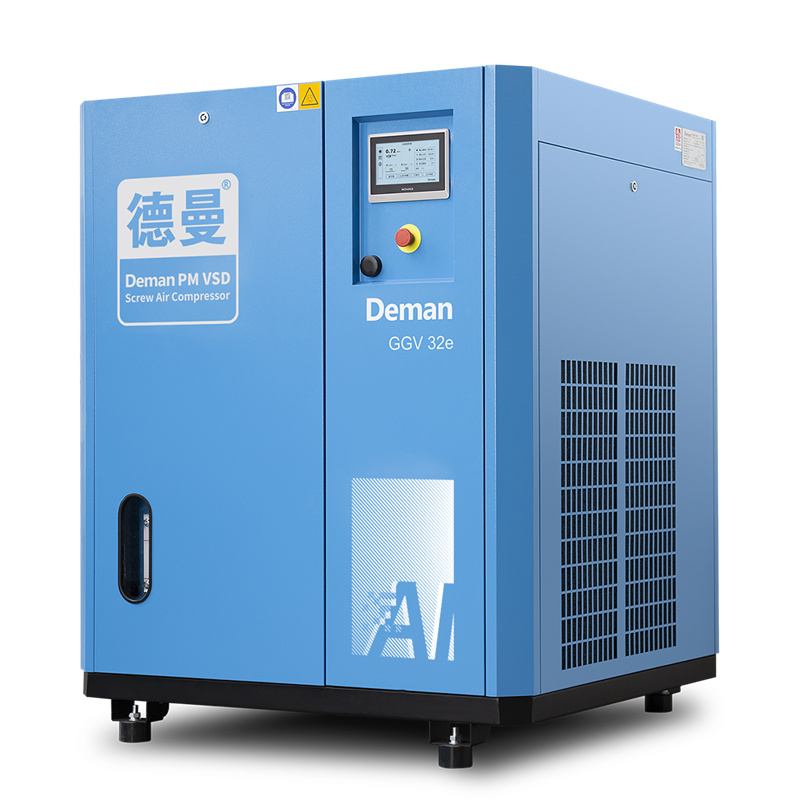
The Deman GGVe Series AI air compressor combines dual-stage PM VSD quad-screw compression with intelligent predictive maintenance to deliver 15 to 25 percent energy savings and reduce unplanned downtime by up to 60 percent in automotive manufacturing environments. The system's AI-assisted monitoring analyzes over 20 operational parameters in real time, generating early warnings that allow maintenance teams to schedule repairs during planned shutdowns rather than responding to emergency failures. For automotive paint shops, assembly lines, and pneumatic systems running 6,000+ hours per year, the GGVe represents a significant advancement in compressed air reliability and total cost of ownership.
1. Why Compressed Air Reliability Defines Automotive Manufacturing Productivity
In automotive manufacturing, compressed air is not a utility — it is a production-critical system that directly determines output quality and throughput. Paint shops require oil-free, moisture-controlled air at precisely regulated pressures to achieve the mirror finishes that consumers expect. Body-in-white assembly lines depend on pneumatic tools operating at consistent pressure to achieve proper torque specifications on thousands of fasteners per vehicle. Quality inspection systems use compressed air for non-destructive testing of welded joints and sealed components.
The cost of compressed air failure in an automotive plant is measured not in downtime hours but in production units lost. A single hour of unplanned downtime in a major automotive assembly line can cost 20,000 to 80,000 USD in lost production, depending on the plant's output rate and vehicle mix. When a compressor failure cascades into paint shop shutdown, the cost escalates further due to the need to flush and restart the entire paint application system, which can take 4 to 8 hours to stabilize to production-quality standards.
Despite this criticality, many automotive plants still operate single-stage compressors with reactive maintenance strategies. The GGVe Series AI Air Compressor from Deman represents a fundamentally different approach: a system engineered from the ground up for the reliability, efficiency, and intelligence demands of modern automotive production environments. Founded in 1998, Deman has spent 29 years developing compressor technology for demanding industrial applications, accumulating 127 patents and earning recognition as a national High-tech Enterprise and "Little Giant" firm in China's manufacturing sector.
This article examines how the GGVe's dual-stage compression architecture, permanent magnet variable speed drive, and AI-powered predictive maintenance system work together to address the specific compressed air challenges faced by automotive manufacturers, and quantifies the financial impact of upgrading from conventional compressor systems.
2. Dual-Stage Compression: Engineering Advantages for High-Demand Applications
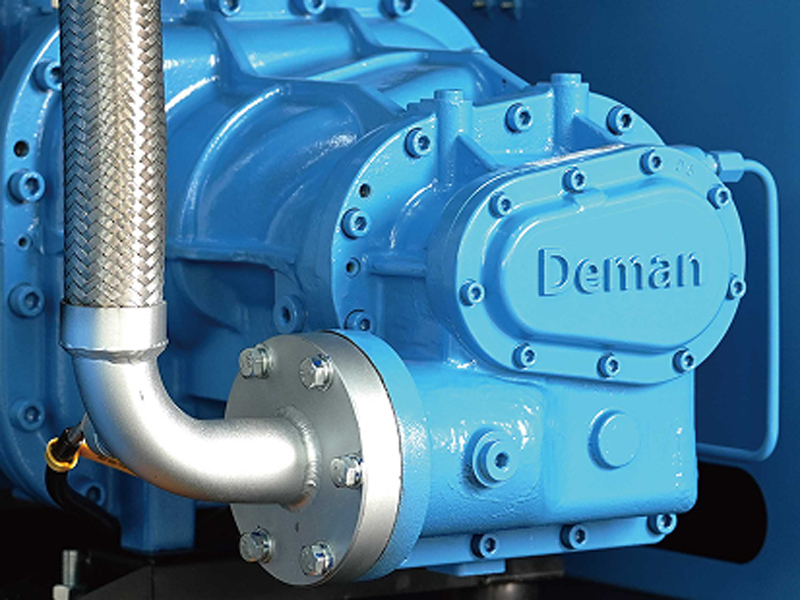
The core of the GGVe Series is its customized two-stage high-efficiency air end, a component that distinguishes it from the majority of industrial rotary screw compressors that use single-stage compression. In a single-stage compressor, ambient air is compressed from atmospheric pressure to the target discharge pressure (typically 7 to 10 bar for automotive applications) in a single compression step. This process generates significant heat, and the energy required to compress the air increases non-linearly with the pressure ratio.
Dual-stage compression splits this process into two steps with an intercooling stage between them. The first stage compresses air to approximately 3 bar, after which the air passes through an intercooler that removes a substantial portion of the heat generated during compression. The cooled, partially compressed air then enters the second stage, where it is compressed to the final discharge pressure. Because the second stage starts from a lower temperature and intermediate pressure, the total work required to achieve the same final pressure is 15 to 25 percent less than single-stage compression.
The physics behind this advantage are straightforward: compressing cooler air requires less energy because the gas density is higher, meaning the compressor does less work per unit of air mass. The intercooling process also reduces the discharge temperature, which extends the life of downstream components including seals, bearings, and oil. In automotive applications where compressors operate continuously for 6,000 to 8,000 hours per year, even small efficiency improvements compound into substantial energy cost reductions.
The GGVe's quad-screw configuration adds another layer of efficiency. By using four screw elements instead of the conventional two, the compressor achieves more uniform compression, reduced internal leakage, and lower noise levels. The result is a machine that delivers higher flow rates at lower specific power consumption — measured in kilowatt per cubic meter of free air delivered — than competing single-stage designs.
3. PM VSD Technology: Matching Air Supply to Dynamic Demand
Automotive manufacturing plants have highly variable compressed air demand patterns. Paint shops require peak airflow during spray booth operation but significantly less during curing cycles. Assembly lines experience demand spikes when multiple pneumatic tools operate simultaneously and troughs during break periods or changeovers. Quality testing stations consume air intermittently based on inspection schedules.
Fixed-speed compressors cannot adapt to these demand variations. They operate at full speed regardless of actual air consumption, using blow-off valves to vent excess compressed air when demand drops below capacity. This approach wastes 20 to 40 percent of the compressor's energy input during low-demand periods — energy that is literally released into the atmosphere as heated air.
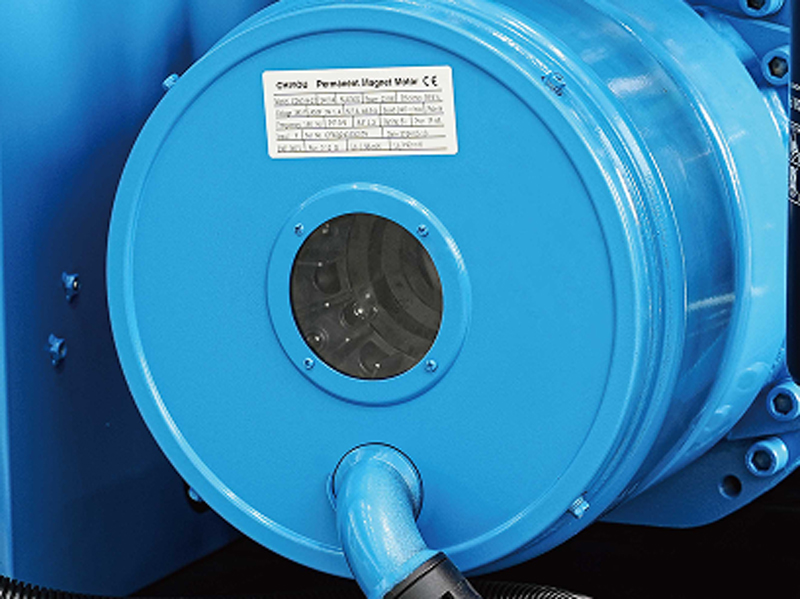
The GGVe's permanent magnet variable speed drive (PM VSD) addresses this waste directly. The permanent magnet motor maintains high efficiency across a wide speed range, typically from 25 to 100 percent of rated speed. As air demand decreases, the motor slows down proportionally, reducing power consumption in near-linear fashion. Unlike conventional induction motors with variable frequency drives, permanent magnet motors maintain high efficiency even at partial loads, avoiding the efficiency drop-off that occurs at low speeds with induction machines.
For an automotive plant with a typical demand profile — peak demand at 100 percent for 40 percent of operating hours, medium demand at 60 to 80 percent for 35 percent of hours, and low demand at 30 to 50 percent for 25 percent of hours — the PM VSD system reduces annual energy consumption by 30 to 45 percent compared to a fixed-speed compressor of equivalent rated capacity. This translates to annual electricity savings of 150,000 to 400,000 kWh for a typical mid-size automotive paint shop compressor room.
4. AI-Powered Predictive Maintenance: From Reactive to Proactive Operations
The most transformative feature of the GGVe Series is its AI-assisted intelligent control system, which shifts compressor maintenance from reactive or time-based schedules to condition-based predictive strategies. This shift has profound implications for automotive manufacturing, where unplanned equipment failures create production disruptions that ripple through the entire value chain.
Traditional compressor maintenance follows either a run-to-failure approach (repair after breakdown) or a time-based schedule (replace components at fixed intervals regardless of actual condition). Both strategies have significant drawbacks. Run-to-failure results in unplanned downtime, emergency repair costs, and potential secondary damage to adjacent components. Time-based maintenance replaces components that may still have substantial remaining useful life, generating unnecessary parts and labor costs.
The GGVe's predictive maintenance system monitors over 20 operational parameters continuously, including vibration patterns at multiple measurement points, discharge temperature trends, oil temperature and pressure, motor current signatures, bearing acoustic emissions, and separator differential pressure. Machine learning algorithms trained on thousands of operating hours from Deman's installed base analyze these parameters against known failure mode patterns.
When the system detects early-stage anomalies — for example, a subtle change in vibration frequency spectrum that correlates with bearing wear, or a gradual increase in discharge temperature that indicates fouling in the air end — it generates a maintenance alert with specific diagnostic information. The alert includes the identified component, the nature of the detected anomaly, an estimated remaining useful life, and a recommended maintenance action. This allows plant maintenance teams to schedule repairs during planned maintenance windows, ordering parts in advance and allocating technician time efficiently.
Industry data from ISO 13373 condition monitoring standards suggests that predictive maintenance strategies reduce unplanned downtime by 50 to 70 percent and maintenance costs by 25 to 40 percent compared to reactive maintenance. For an automotive plant where a single hour of unplanned downtime costs 20,000 to 80,000 USD, preventing even two or three compressor-related shutdowns per year can justify the entire investment in a GGVe system.
5. Automotive Paint Shop Applications: Air Quality and Pressure Stability
The automotive paint shop is the most demanding compressed air application in a vehicle manufacturing plant. Surface finish quality depends on consistent air pressure, temperature, and contamination levels throughout the painting process. Even minor variations in compressed air quality can cause visible defects — fish eyes, orange peel, solvent pop, or color inconsistency — that require costly rework or, in severe cases, rejection of the entire body.
The GGVe compressor, when paired with Deman's integrated after-treatment systems, delivers air quality meeting ISO 8573-1 Class 1.2.1 standards. This specification limits particle count to 1 per cubic meter at 0.1 micron, pressure dewpoint to minus 70 degrees Celsius, and oil content to below 0.01 mg per cubic meter. These specifications exceed the requirements of most automotive OEM paint shop standards and provide a safety margin that protects against quality excursions.
Pressure stability is equally critical. Modern robotic paint applicators require air supply pressure maintained within plus or minus 0.1 bar of the setpoint. The GGVe's PM VSD system responds to demand changes within seconds, maintaining pressure stability that fixed-speed compressors with load/unload controls cannot match. The result is more consistent paint film thickness, fewer defects, and reduced paint consumption — a secondary saving that can amount to 3 to 5 percent of annual paint costs in a high-volume paint shop.
The intelligent control system also provides paint shop operators with detailed data logging of air supply conditions throughout each production shift. This data supports quality traceability requirements that are increasingly demanded by automotive OEMs and their tier-1 suppliers, and can be used to correlate air supply conditions with paint quality metrics to identify optimization opportunities.
6. Integration with Plant-Wide Compressed Air Management
Modern automotive plants rarely operate a single compressor. A typical compressed air system includes 3 to 8 compressors of varying sizes and types, distributed across multiple compressor rooms to serve different production areas. Managing this fleet efficiently — ensuring that the right compressors are running at the right loads to meet current demand while minimizing total energy consumption — is a complex optimization problem.
The GGVe series supports standard industrial communication protocols including Modbus, Profibus, and Ethernet IP, enabling seamless integration with existing plant SCADA and DCS systems. More importantly, it is designed to work with Deman's Air Commander multi-compressor central control system, which coordinates the operation of multiple compressors as a unified system.
The Air Commander system uses real-time demand data from the plant's compressed air network to determine the optimal operating points for each compressor in the fleet. It sequences compressor starts and stops, distributes load across running units, and manages pressure setpoints to maintain system pressure at the minimum level required by the most sensitive downstream application. This approach typically reduces total compressor room energy consumption by 10 to 20 percent beyond the savings achieved by individual compressor upgrades.
For plants transitioning from legacy fixed-speed compressors to GGVe PM VSD units, the Air Commander system enables a phased upgrade strategy. New GGVe units can be integrated with existing compressors, with the control system automatically favoring the more efficient GGVe units for base-load duty while using legacy machines for peak-shaving only. This approach allows plants to realize energy savings immediately rather than waiting for a complete fleet replacement.
7. Lifecycle Economics: Total Cost of Ownership Analysis
The total cost of ownership for an industrial compressor over a 10-year lifecycle is dominated by energy costs, which typically represent 70 to 80 percent of the total. Purchase price accounts for only 10 to 15 percent, with maintenance and repair making up the remainder. This cost structure means that a compressor with a higher purchase price but lower energy consumption will almost always deliver a lower total cost of ownership than a cheaper but less efficient alternative.
| Cost Category | Single-Stage Fixed Speed | GGVe Dual-Stage PM VSD |
|---|---|---|
| Purchase Price (USD) | 25,000–40,000 | 45,000–70,000 |
| Annual Energy Cost (at 0.10 USD/kWh) | 42,000–65,000 | 28,000–42,000 |
| Annual Maintenance Cost | 3,500–5,500 | 2,000–3,500 |
| 10-Year Total Cost of Ownership | 460,000–710,000 | 320,000–460,000 |
| 10-Year Savings | Baseline | 140,000–250,000 |
The GGVe's higher purchase price is recovered through energy savings within 18 to 30 months under typical automotive manufacturing operating conditions. The ten-year warranty on the air end — among the most comprehensive in the industry — further reduces lifecycle cost risk by covering the most expensive component for the expected life of the equipment. Deman's 29 years of manufacturing experience and ISO-certified production processes provide the quality foundation that supports these extended warranty commitments.
8. Frequently Asked Questions
Dual-stage compression in the GGVe series achieves 15 to 25 percent energy savings compared to single-stage compressors operating at the same flow rate. The intercooling process between stages reduces the work required for the second compression stage, lowering the overall specific power consumption. In a typical automotive paint shop running 6,000 hours per year, this translates to annual electricity savings of 50,000 to 120,000 kWh depending on system size.
The GGVe intelligent control system continuously monitors over 20 operational parameters including vibration patterns, discharge temperature trends, oil analysis indicators, bearing wear signals, and motor current profiles. Machine learning algorithms compare real-time data against baseline performance models trained on thousands of operating hours. When the system detects deviations that correlate with known failure modes, it generates maintenance alerts with specific component recommendations and estimated remaining useful life.
When paired with Deman's after-treatment systems including refrigerated dryers and multi-stage filtration, the GGVe compressor delivers air quality meeting ISO 8573-1 Class 1.2.1 standards (1 particle per cubic meter at 0.1 micron, pressure dewpoint of minus 70 degrees Celsius, and oil content below 0.01 mg per cubic meter). This air quality is sufficient for the most demanding automotive paint booth applications where contamination causes visible defects.
Yes. The GGVe series supports standard industrial communication protocols including Modbus, Profibus, and Ethernet IP, enabling integration with existing plant SCADA and DCS systems. The intelligent control system can also coordinate multiple compressors through Deman's Air Commander central control platform, optimizing load distribution across a mixed fleet of new and legacy compressors.
Based on typical automotive manufacturing energy costs of 0.08 to 0.15 USD per kWh and continuous operation profiles, the payback period for upgrading to GGVe dual-stage compressors ranges from 18 to 30 months. The payback accelerates in regions with high electricity costs or where demand charges are significant, as the GGVe's variable speed drive reduces peak power draw during low-demand periods.
Deman offers a ten-year warranty on the GGVe series air end, reflecting confidence in the durability of their customized two-stage high-efficiency air end design. The permanent magnet motor carries a separate five-year warranty. These warranty terms are among the most comprehensive in the industrial compressor industry and are backed by Deman's 29 years of manufacturing experience and 127 patents in compressor technology.
Ready to upgrade your automotive plant's compressed air system? View GGVe Series specifications or contact Deman for a custom energy audit and ROI analysis.