
How to Choose the Right Compressor for a Factory Expansion Project
Choose a factory expansion compressor by mapping the new and existing air demand, required pressure, air-quality class, operating pattern, electrical capacity, installation space, and lifecycle cost. Size the complete compressed air system—not only the compressor—so dryers, filters, receivers, controls, piping, and end-use equipment work together reliably as production grows.
- Start industrial compressor selection with measured airflow demand and required pressure.
- Separate average demand, peak demand, intermittent demand, and future expansion capacity.
- Match compressor technology and air treatment to process requirements, not just purchase price.
- Evaluate controls, piping pressure loss, maintenance access, monitoring, and total cost of ownership.
A factory expansion compressor should be selected as part of a complete compressed air system. Atlas Copco identifies two primary sizing inputs: the airflow required and the pressure required by the process. In addition, a practical design must address four air-quality concerns—particles, oil, moisture, and pressure stability—because unsuitable air can reduce equipment life or affect product quality. This guide explains how to turn those requirements into a dependable expansion plan.
1. Define the Expansion Demand Before Comparing Equipment
The first decision is the demand profile, because a compressor that matches only the average load may fail during production peaks. Create an equipment register for every pneumatic tool, actuator, process machine, packaging line, cleaning point, and planned installation. Record the required flow, operating pressure, duty pattern, operating hours, and expected commissioning date.
The required airflow is the combined demand of active users plus an appropriately justified allowance for future production. Do not simply add every nameplate flow figure without considering whether all devices operate simultaneously. Instead, document simultaneity assumptions and test them against production schedules, shift patterns, and planned capacity.
| Step number | Demand input | Decision output |
|---|---|---|
| 1 | Connected pneumatic equipment | Equipment register and individual flow requirements |
| 2 | Operating schedule and simultaneity | Expected average and peak demand profile |
| 3 | Required process pressure | Pressure target at the point of use |
| 4 | Expansion timetable | Phased capacity and installation plan |
| 5 | Measured system performance | Validation of design assumptions |
The best sizing exercise combines calculations with measurement wherever possible. Existing plants can use compressor logs, flow meters, pressure records, and production data to reveal unloaded operation, pressure swings, and night or weekend leakage. For a greenfield area, use equipment documentation and confirm the assumptions with the machine supplier before final procurement.
2. Set Pressure Without Creating Artificial Energy Demand
The correct pressure is the minimum stable pressure that allows the most demanding process to operate at its specified point of use. A higher compressor discharge setting does not automatically improve production; it can increase energy use and may conceal undersized piping, restrictive filters, or inadequate local storage.
Calculate pressure loss across the complete route, including treatment equipment, valves, flexible hoses, elevation changes, and the longest branch. The pressure target should be established at the end-use connection, then translated into a compressor-room requirement after allowing for system losses. This approach is consistent with the guidance from Atlas Copco's compressor sizing guide, which emphasizes evaluating both flow and pressure.
Pressure stability matters as much as the nominal setpoint. A production line may experience faults when pressure drops during simultaneous demand, even if the compressor has enough theoretical capacity. Review receiver volume, control response, piping diameter, and the location of high-demand users before increasing compressor pressure.
3. Select the Compressor Technology for the Duty Cycle
Compressor technology should follow the plant's load pattern, required air quality, and continuity requirements. There is no universal best machine for every expansion because a high-flow continuous process has different needs from a variable-shift manufacturing plant.
| Technology or configuration | Best-fit operating profile | Primary selection question |
|---|---|---|
| Variable-speed screw | Variable demand with frequent changes | Can it follow demand without inefficient unloaded operation? |
| Fixed-speed screw | Stable, sustained base load | Will the load remain sufficiently consistent for efficient operation? |
| Centrifugal | Large-flow, continuous centralized supply | Is the plant demand high and stable enough for this operating range? |
| Oil-free configuration | Processes sensitive to oil contamination | What air-quality specification does the product or process require? |
| Multi-compressor system | Variable demand, redundancy, or phased growth | Can sequencing allocate the right machines to the current load? |
Variable-speed technology is valuable when demand changes because it can adjust output to match consumption and reduce inefficient unloaded running or frequent starts. It should not be selected solely because it is variable speed; the operating envelope, motor efficiency, controls, service requirements, and actual demand profile must be reviewed together.
Rotary screw compressors suit many medium and large manufacturing applications that need continuous supply. Centrifugal compressors can be appropriate for large-flow, highly continuous installations, particularly where a centralized air station is justified. A multi-compressor arrangement may provide better flexibility than one oversized unit because it can stage capacity as the factory expands and maintain service during planned maintenance.
Oil-free air is a process choice rather than a marketing preference. Precision manufacturing, sensitive automation, and clean production may require protection against oil contamination. Other applications may use oil-injected equipment with suitable separation and filtration. Confirm the required air-quality class with the process owner, quality department, and equipment manufacturer.
4. Design the Complete Compressed Air System
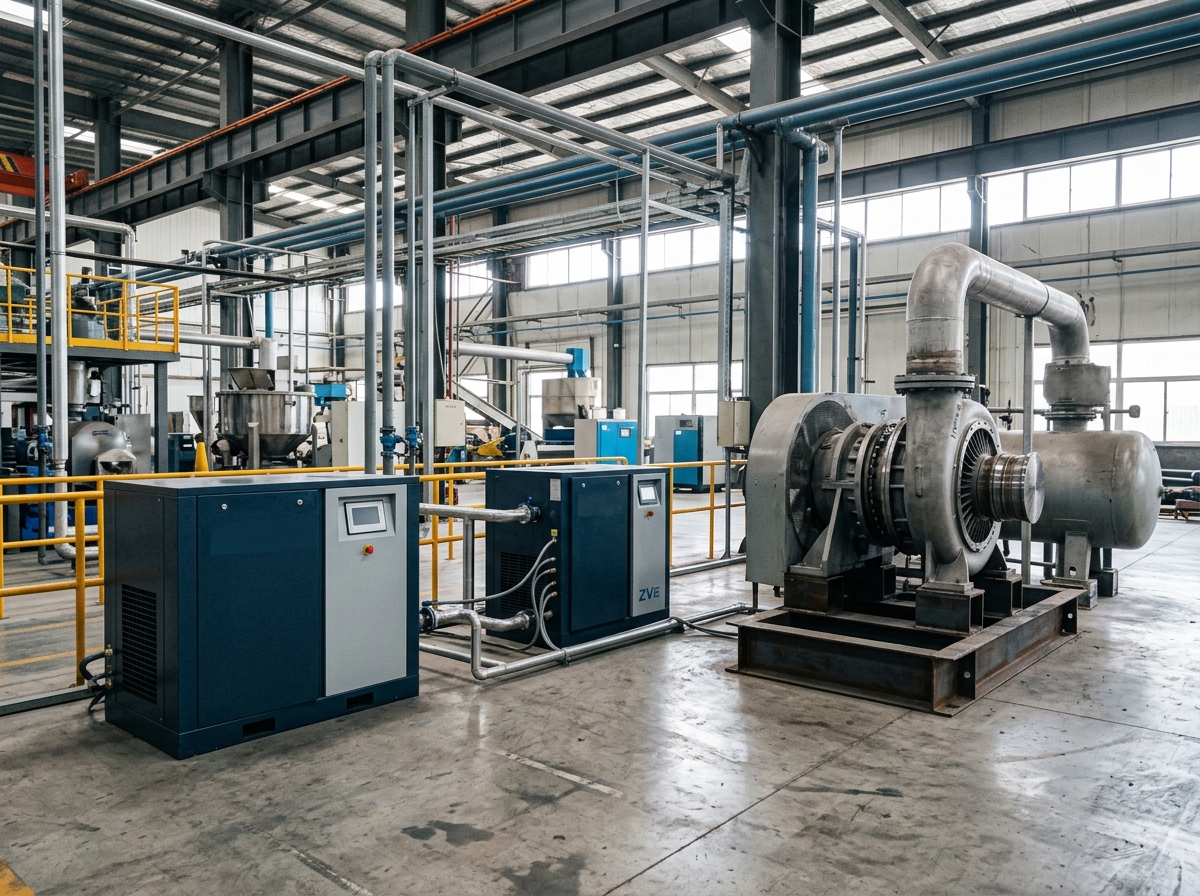
The compressor is only one component of the system, and neglecting the supporting equipment can undermine the expansion. A complete arrangement normally includes compressors, air receivers, dryers, filters, condensate management, distribution piping, control logic, monitoring, and point-of-use equipment.
Air treatment should be selected from the contamination risks and process specification. Refrigerated dryers are suitable for many general industrial applications, while demanding processes may require a higher level of drying or filtration. Filters should be selected for the required particle and oil control without creating unnecessary pressure loss. Condensate must also be managed in accordance with applicable environmental and site requirements.
Storage improves system behavior when it is positioned and sized for the demand pattern. A receiver can help absorb short demand changes, reduce control cycling, and support stable pressure, but it cannot correct an undersized compressor or a poorly designed distribution network. Consider central storage for general demand and local storage for short, high-flow events where appropriate.
Distribution piping directly affects pressure loss, leakage, and end-use stability. Plan the expansion as a properly looped network where practical, provide isolation points for future branches, minimize restrictive fittings, and make maintenance access part of the layout. A new production hall should not be connected through a small legacy branch simply because that route is convenient.
5. Compare Lifecycle Cost, Not Just Purchase Price
Lifecycle cost is usually driven by electricity, maintenance, downtime exposure, and system losses, so the lowest quotation may not be the lowest-cost solution. Ask each supplier to state the assumptions behind performance, operating hours, control strategy, service intervals, and included accessories.
| Cost category | Questions to document | Evidence to request |
|---|---|---|
| Capital | What equipment and installation work are included? | Itemized quotation and scope boundary |
| Energy | How will consumption change at average and peak load? | Performance data and operating assumptions |
| Maintenance | Which parts, labor, and services are required? | Maintenance schedule and service terms |
| Reliability | What happens during planned or unplanned downtime? | Redundancy plan and response commitment |
| Expansion | Can capacity be added without redesigning the station? | Future connection and control strategy |
Energy optimization should address the whole station rather than one compressor model. Variable-speed operation, sequencing, appropriate receiver placement, leak reduction, lower pressure loss, and heat recovery can each contribute when they match the plant's conditions. Remote monitoring can identify abnormal trends early, such as rising discharge temperature, pressure instability, excessive unloaded time, or filter restriction.
Heat recovery deserves a place in the feasibility review when the factory has a compatible hot-water or process-heating demand. The benefit depends on operating hours, temperature requirements, recovery equipment, and the distance between the compressor room and the heat user. Treat it as a measured energy-integration opportunity rather than an automatic saving.
6. Plan Reliability, Commissioning, and Future Growth
Reliability must be designed before the first compressor is ordered because an air interruption can stop automated equipment, disrupt quality, and delay production. Determine whether the expansion requires standby capacity, independent air paths, dual power arrangements, or temporary connection points for maintenance.
- Confirm the design flow and pressure at the most demanding end use.
- Verify electrical supply, ventilation, heat rejection, drainage, lifting access, and service clearances.
- Check dryer, filter, receiver, and condensate specifications against the air-quality requirement.
- Program sequencing and alarms for the expected commissioning and expansion stages.
- Test pressure, flow, dew point, air quality, and control response after installation.
- Record baseline operating data so future efficiency improvements can be measured.
Commissioning should validate the system under representative production conditions, not only during an unloaded start-up. Inspect the farthest and most sensitive points, confirm that pressure remains stable during peak events, and verify that the control system starts and stops equipment in the intended order.
Future capacity should be staged rather than purchased blindly. Reserve space, piping branches, electrical provisions, and control capability for the next expansion phase, while avoiding an oversized operating configuration that runs inefficiently during the first production period.
7. A Practical Procurement Checklist
A clear request for quotation produces more comparable proposals and reduces the risk of equipment-to-process mismatch. Include the following information in the tender package:
- Required airflow units and reference conditions.
- Minimum and maximum operating pressure at the point of use.
- Average, peak, intermittent, and future demand assumptions.
- Required air-quality performance for particles, oil, moisture, and pressure stability.
- Operating hours, shift pattern, ambient conditions, and installation location.
- Available voltage, electrical constraints, ventilation requirements, and noise limits.
- Dryer, filtration, storage, condensate, piping, controls, and monitoring scope.
- Redundancy expectations, spare-parts support, response time, and operator training.
- Commissioning tests, documentation, warranty terms, and performance acceptance criteria.
For additional selection context, compare this checklist with Brabazon's industrial air compressor selection guidance and the manufacturing-focused overview from Contracting Business. These sources also emphasize beginning with demand, pressure, and the equipment that will consume the air.
Frequently Asked Questions
1. How do I calculate the required compressor flow for a factory expansion?
List the flow requirement of every air-consuming device, identify which devices operate at the same time, and build average and peak demand scenarios. Validate the assumptions with measurements from the existing plant or with confirmed equipment data. Include future capacity only when the expansion schedule and expected demand are sufficiently defined.
2. Should I choose a fixed-speed or variable-speed compressor?
Choose based on the demand profile. Variable-speed equipment is generally more suitable when demand changes substantially, while fixed-speed equipment can be effective for a stable base load. A staged combination may be better than either technology alone when the factory has both continuous and variable users.
3. Is a larger compressor safer for an expansion project?
Not necessarily. Oversizing can create inefficient operation, poor control behavior, and unnecessary capital cost. A better approach is to model current and future demand, provide suitable storage and controls, and reserve a practical path for adding capacity.
4. When is an oil-free compressor necessary?
Oil-free equipment may be appropriate where oil contamination could affect the product, process, or quality system. The decision should follow the required air-quality specification and risk assessment. Filtration and maintenance requirements must also be included in the comparison.
5. What type of dryer does a manufacturing plant need?
A refrigerated dryer suits many general industrial applications. Processes with stricter moisture requirements may need a higher-performance drying arrangement. Select the dryer from the required pressure dew point, ambient conditions, flow range, and downstream process sensitivity.
6. How can I reduce compressed air energy waste?
Start with leakage detection and repair, correct pressure settings, reduced piping restriction, suitable storage, efficient sequencing, and demand-based compressor control. Review the complete station before replacing a single machine, because system losses may be outside the compressor room.
7. What information should I give a compressor supplier?
Provide flow and pressure requirements, demand timing, air-quality needs, operating hours, ambient conditions, electrical data, installation constraints, future expansion plans, and reliability expectations. The more clearly these conditions are documented, the easier it is to compare technically equivalent proposals.
About Deman
Deman develops industrial compressed air solutions for manufacturers, engineering contractors, and international project teams. Its approach combines compressor selection with air treatment, controls, piping coordination, monitoring, and lifecycle planning. For a factory expansion, request a site assessment and project review that covers demand, pressure, air quality, reliability, installation constraints, and future capacity before equipment is finalized.