When Can Energy Saving Air Compressors Benefit Automotive Assembly Lines?
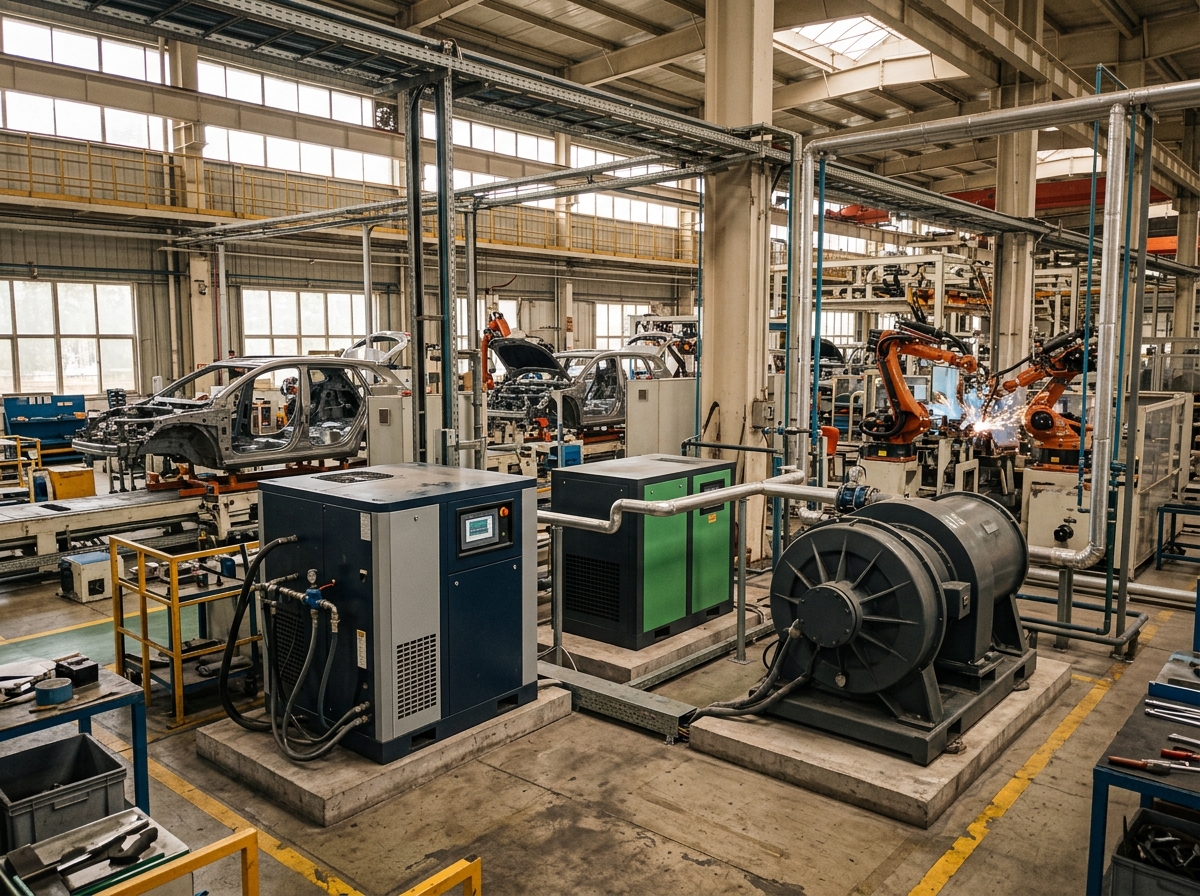
An energy saving air compressor benefits an automotive assembly line when its capacity, control method, air treatment, and distribution network match the plant's actual demand. The strongest business case usually appears where demand varies by shift, leaks are unmanaged, pressure is unstable, or older compressors operate unloaded for long periods. A system-level audit should come before equipment selection.
- An energy efficient compressor for automotive assembly must be evaluated as part of a complete compressed air system, not as a standalone machine.
- Variable speed control, multi-machine sequencing, leak management, and correctly sized storage can reduce avoidable energy use when demand changes.
- Automotive plant energy reduction depends on both kilowatt-hour savings and the prevention of quality loss, downtime, and maintenance interruptions.
- Air quality, pressure stability, reliability, and lifecycle cost are as important as nameplate motor efficiency.
Compressed air supports fastening, clamping, pneumatic tooling, material handling, painting support, actuator control, and automated inspection across automotive production. The opportunity is substantial because compressed air waste often comes from the complete system rather than only the compressor. One industry source reports that leak detection and repair can save up to 20% of compressed air output, although actual results depend on leak condition and operating pressure; see the discussion from Seize-Air. This article explains when an upgrade makes sense, how to calculate the opportunity, and which exceptions require a different design.
When an Energy Saving Air Compressor Creates the Most Value
The clearest benefit occurs when compressed air demand changes significantly during production. A fixed-speed compressor is generally most efficient near its intended operating range, but automotive plants often experience variation between shifts, lines, tooling cycles, weekends, and maintenance periods. A variable speed drive can adjust motor speed to follow demand, reducing unloaded operation and repeated starts when the system is correctly sized and controlled.
A demand profile is more important than a motor label when choosing an energy efficient compressor for automotive assembly. A compressor that is highly efficient at full load may perform poorly if the plant normally operates at partial load. Conversely, a fixed-speed unit may remain appropriate for a steady base load when paired with a correctly sized trim compressor and a sequencing controller.
Leak reduction should come before oversizing the compressor. Leaks create artificial demand, so adding capacity may increase electricity use without improving production. The automotive compressed air guidance from Air Best Practices presents a phased approach that includes stabilizing air pressure, optimizing treatment, and managing leaks. That sequence reflects a practical principle: reduce unnecessary demand before purchasing generation capacity.
Pressure instability is another strong upgrade signal. If operators increase compressor setpoints to compensate for pressure loss in filters, dryers, regulators, or undersized piping, the plant may pay for higher generation pressure while the tools still receive inconsistent air. A system review should identify the pressure required at the least-tolerant endpoint, then examine losses between the compressor room and that endpoint.
How Automotive Plant Energy Reduction Works
Energy reduction comes from coordinating generation, storage, treatment, distribution, and end uses. A compressed air system includes the compressor, dryer, filters, receiver, pipe network, controls, and pneumatic equipment. Optimizing only the compressor can leave major losses untouched.
1. Match compressor architecture to the load
Load shape determines whether a variable speed, fixed-speed, rotary screw, or centrifugal arrangement is suitable. Rotary screw compressors are broadly adaptable for many medium and large manufacturing sites. Centrifugal compressors can be appropriate for high-volume, continuous-duty plants with stable demand. Neither category is automatically more efficient in every automotive application.
A mixed fleet can be more efficient than a single-machine installation. Base-load compressors can cover stable demand, while a trim machine responds to fluctuations. Multi-machine control can assign load according to real-time demand and prevent several units from operating inefficiently at low load.
2. Control pressure instead of simply increasing it
Stable pressure supports repeatable fastening, clamping, actuation, and tooling performance. The correct control strategy uses adequate storage, appropriate setpoints, and a pressure profile based on measured endpoint requirements. Excessive pressure can increase leakage and consumption, while insufficient pressure can cause quality defects or tool failure.
3. Treat air quality as a production requirement
Air quality decisions should reflect the process risk, not a generic product category. Automotive plants typically need to consider particles, oil aerosol, moisture, and pressure stability. Dryers and filters protect valves, cylinders, tools, and downstream processes from contamination and corrosion.
Refrigerated dryers suit many general industrial applications, while sensitive painting, electronics, precision, or clean production processes may require higher levels of filtration and drying. Oil-free air may be justified where contamination could affect a finish, process, or product. The article from FS-Elliott discusses the relationship between reliable oil-free compressed air, product quality, and automotive manufacturing efficiency.
4. Recover useful heat where the plant has a demand for it
Heat recovery can improve total energy utilization when recovered heat has a consistent nearby use. Potential applications include hot water preheating, space heating, or process heating. The business case depends on temperature requirements, operating schedules, installation cost, and the distance between the compressor room and the heat user. Heat recovery should therefore be evaluated as a site integration project rather than assumed as an automatic saving.
Diagnostic Indicators Before Selecting Equipment
A measured baseline prevents a capacity mismatch. The audit should capture compressor power, loaded and unloaded states, discharge pressure, flow, temperature, dryer condition, receiver performance, and production schedules. Measurements should cover representative operating conditions rather than one convenient shift.
| Audit stage | Minimum review points | Suggested planning score | Decision use |
|---|---|---|---|
| 1 | Load profile, shift pattern, idle demand | 1 to 5 | Choose base-load and trim strategy |
| 2 | Pressure at plant and critical endpoints | 1 to 5 | Locate distribution and control losses |
| 3 | Leak survey and artificial demand | 1 to 5 | Prioritize repair before added capacity |
| 4 | Air quality and treatment condition | 1 to 5 | Specify dryer and filtration levels |
| 5 | Maintenance history and downtime exposure | 1 to 5 | Compare lifecycle risk and redundancy |
The scoring column is a practical project framework, not a universal engineering standard. A low score indicates a relatively controlled condition; a high score indicates an issue that deserves immediate investigation. The audit team should define scoring criteria before comparing suppliers.
Comparing Upgrade Options for an Assembly Plant
The best option depends on the source of waste. Replacing a compressor may be justified when the existing unit is unreliable, inefficient at the prevailing load, difficult to service, or unable to meet required air quality. In other cases, controls, leak repair, storage, or piping improvements may produce better value than a new compressor.
| Option | Primary target | Typical implementation phase | Main verification metric |
|---|---|---|---|
| Leak repair | Artificial demand | 1 | Leak flow and compressor operating hours |
| Receiver optimization | Short demand peaks | 1 to 2 | Pressure stability and cycling behavior |
| Sequencing control | Multiple-machine loading | 2 | Loaded, unloaded, and standby time |
| Variable speed trim unit | Changing demand | 2 to 3 | Specific power across the load range |
| Heat recovery | Useful thermal demand | 3 | Recovered heat delivered to the process |
Specific power should be compared across the operating range rather than at one catalog point. The comparison should also include maintenance intervals, service access, controls compatibility, dryer power, filter pressure drop, and the cost of production interruption during installation.
Automotive Assembly Scenarios
A multi-shift body shop with fluctuating tool use may benefit from a variable speed trim compressor and centralized sequencing. The practical objective is to cover the stable base load efficiently while allowing the trim machine to follow short-term changes without forcing every compressor to modulate independently.
A paint-related process requires a different priority order. Air cleanliness, moisture control, and pressure stability may be more important than choosing the lowest purchase-price compressor. The specification should define filtration, dryer performance, condensate management, monitoring, and verification at the point of use.
A plant with frequent line stoppages should treat reliability as an energy issue as well as a maintenance issue. A compressor failure can stop tools and actuators, create scrap, and require emergency operation of less efficient equipment. Redundancy, remote monitoring, critical spares, and service response should be evaluated alongside energy performance.
A facility planning expansion should design the system before ordering equipment. Future production cells, pipe routes, receiver placement, electrical capacity, and treatment requirements can materially change the correct configuration. The principle of planning before selling helps prevent equipment that is technically capable but poorly matched to the real operating case.
Implementation Checklist
A staged program makes automotive plant energy reduction easier to verify and finance.
- Define production requirements, operating shifts, critical tools, air quality, and acceptable pressure variation.
- Measure flow, pressure, power, temperature, and compressor operating states across representative production conditions.
- Repair major leaks and remove inappropriate uses such as open blowing where a mechanical or low-pressure alternative is available.
- Review storage, pipe sizing, filters, dryers, regulators, and endpoint pressure before increasing compressor capacity.
- Model base-load and peak-load operation, including standby, maintenance, and future expansion conditions.
- Install controls and monitoring that show demand, energy use, alarms, and maintenance trends.
- Verify results against the baseline and document the effect on energy, pressure, quality, and uptime.
Frequently Asked Questions
1. What is an energy saving air compressor?
It is a compressor selected and controlled to deliver required air with less avoidable energy use. The term can refer to efficient motor and compression technology, variable speed control, intelligent sequencing, or a complete optimized system.
2. Is variable speed always the best choice for automotive assembly?
No. Variable speed is useful when demand varies, but a fixed-speed base-load machine may be more efficient for stable demand. A measured load profile should determine the architecture.
3. How can leaks affect an automotive plant?
Leaks create continuous artificial demand, increase compressor runtime, and can reduce pressure at production points. Leak repair should be prioritized according to flow, operating hours, accessibility, and production impact.
4. Should a plant replace the compressor before fixing the pipe network?
Usually not. The plant should first investigate pressure loss, leakage, treatment restrictions, and inappropriate end uses. A new compressor cannot correct every distribution problem.
5. When is an oil-free compressor necessary?
Oil-free air may be appropriate when oil contamination could affect painting, precision production, sensitive automation, or product quality. The decision should be based on process risk and the required air-quality specification.
6. What information should be requested from a compressor supplier?
Request performance across the expected load range, control logic, air quality assumptions, service requirements, dryer and filter effects, monitoring capability, warranty terms, commissioning method, and lifecycle cost assumptions.
7. How should savings be verified after installation?
Compare post-installation power, flow, pressure, loaded time, unloaded time, leak condition, and production performance with the pre-project baseline. Verification should account for changes in shifts, output, weather, and equipment usage.
About Deman
Deman approaches compressed air as an integrated industrial system rather than a single machine. Its solution perspective covers compressor selection, variable speed operation, multi-machine control, air treatment, storage, piping, remote monitoring, heat recovery, and end-use analysis. For automotive projects, the practical focus is matching equipment to demand, protecting air quality, reducing operational risk, and supporting measurable lifecycle value. Discuss your load profile, production schedule, and upgrade objectives with a qualified project team before specifying equipment.