
Which Energy Saving Air Compressor System Fits Injection Molding Plants?
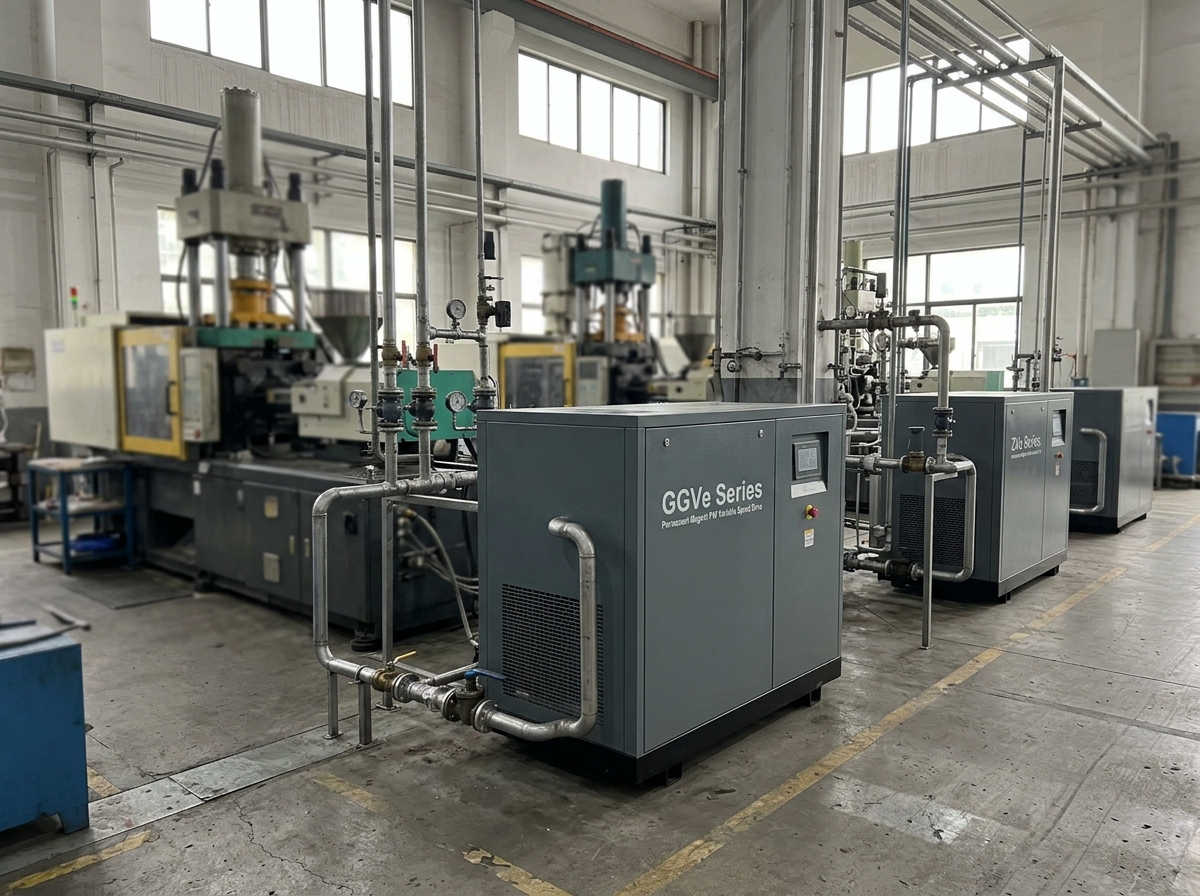
A permanent magnet VSD air compressor is usually the best starting point for injection molding plants with changing demand, while a fixed-speed screw compressor can efficiently cover a stable base load. The right industrial air compressor system solution must also include storage, drying, filtration, controls, leak management, and a correctly designed distribution network.
- Choose an energy saving screw air compressor according to the plant load profile, not machine count alone.
- Use permanent magnet VSD technology where compressed air demand changes between cycles, shifts, or production recipes.
- Combine compressors with receivers, dryers, filters, multi-machine controls, monitoring, and efficient piping.
- Evaluate lifecycle electricity, maintenance, air quality, pressure stability, and downtime risk before purchase.
Injection molding plants need compressed air that is stable, clean, and available at the correct pressure, but their demand is rarely constant. Molding machines, robots, material handling equipment, pneumatic valves, purging systems, and auxiliary devices may load the compressor room at different times. The U.S. Department of Energy's Better Buildings and Better Plants compressed air guidance notes that a properly managed system can reduce energy use and maintenance while improving uptime and reliability. This article explains how to select an energy saving screw air compressor and design the complete system around actual production conditions.
Start with the plant load profile, not the compressor brochure
The most important selection decision is matching supply capacity to the plant's real demand pattern. A compressor that is too small may cause pressure drops and production interruptions, while several oversized machines may spend too much time unloaded or operating inefficiently.
Injection molding demand commonly changes when machines start, molds are changed, production orders shift, or the plant moves between day and night operation. A load study should therefore record flow, pressure, operating hours, compressor loading, and major demand events. Where possible, use measured data from flow meters, pressure sensors, and compressor controllers instead of relying only on installed motor power.
| Assessment item | Decision scale | Why it matters |
|---|---|---|
| Demand variation | Score 1-5 | Higher variation supports VSD or a hybrid compressor arrangement. |
| Operating continuity | Score 1-5 | Higher continuity increases the value of redundancy and service planning. |
| Pressure sensitivity | Score 1-5 | Higher sensitivity requires better controls, storage, and piping design. |
| Air quality requirement | Score 1-5 | Higher requirements demand carefully selected filtration and drying. |
| Expansion likelihood | Score 1-5 | Higher scores justify modular capacity and future connection points. |
The scoring table is a planning tool rather than a manufacturer performance guarantee. A qualified compressed air audit should validate the final capacity, pressure, and control strategy.
When a permanent magnet VSD air compressor is the right choice
A permanent magnet VSD air compressor is most suitable when plant demand fluctuates significantly. Variable-speed control changes motor speed to follow required airflow, reducing the need to run at full speed when the molding department is using less air.
The energy benefit comes from matching output to demand and reducing inefficient unloaded operation, not from the motor label alone. The compressor should be correctly sized, operated within its efficient range, and integrated with storage and sequencing controls. The Atlas Copco overview of air compressors in plastics manufacturing also identifies VSD compressors as an energy-efficiency option for injection molding applications.
VSD is particularly attractive in plants with multiple molding cells, variable shift schedules, frequent product changes, or auxiliary equipment that cycles on and off. It may be less advantageous as the only compressor in a plant with a very stable, continuous base load. In that case, a fixed-speed screw compressor can provide the base load while a VSD unit trims changing demand.
VSD, fixed-speed, or hybrid arrangement?
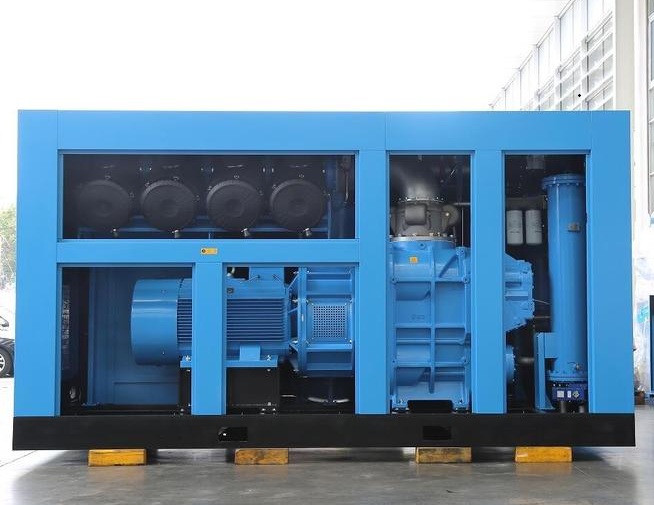
A hybrid arrangement often provides the best balance between efficiency, reliability, and operating flexibility. One fixed-speed unit can carry the stable minimum demand, while one VSD unit responds to peaks and transitions. In larger plants, multiple machines can be sequenced so that compressors operate closer to efficient load conditions rather than all running lightly loaded.
| Plant condition | Preferred arrangement | Primary control objective |
|---|---|---|
| Stable demand for long periods | Fixed-speed screw base load | Keep the base machine efficiently loaded. |
| Wide demand variation | Permanent magnet VSD | Follow airflow changes and limit unloaded running. |
| Stable base plus changing peaks | Fixed-speed plus VSD trim unit | Separate base-load and variable-load duties. |
| High continuity and expansion needs | Sequenced multi-compressor system | Share operating hours and maintain standby capacity. |
The final arrangement should be based on measured demand, minimum and maximum flow, pressure requirements, duty hours, and the consequences of a compressor failure.
Why the complete industrial air compressor system solution matters
A compressed air system is more than the compressor package. It includes compressors, dryers, filters, receivers, piping, controls, monitoring, and end-use devices. Optimizing only the compressor can leave major losses in pressure drop, leakage, poor condensate management, or inappropriate point-of-use equipment.
Storage and pressure control
Receiver capacity helps absorb short demand peaks and reduces unnecessary compressor cycling. A properly located receiver can also separate supply-side and demand-side behavior, making the control system more stable. The receiver should be selected and installed according to applicable pressure-vessel regulations, drain requirements, and the plant's actual demand pattern.
Pressure should be established from the most demanding legitimate end use, then verified at the point of use. Increasing compressor discharge pressure to compensate for undersized piping or blocked filters can increase energy use without improving production.
Drying and filtration
Air treatment should be selected according to the molding process and the sensitivity of downstream equipment. A refrigerated dryer is often suitable for general industrial service, while more demanding applications may require a higher level of drying and filtration. Filters should address particles, oil aerosols, and moisture, with pressure-drop monitoring to prevent a clean-air solution from becoming an energy penalty.
Air quality should be specified using measurable requirements rather than vague terms such as premium air. Define the allowable particle, oil, and water conditions for pneumatic controls, product-contact processes, instrumentation, and maintenance tools. The Quincy Compressor discussion of energy efficiency in plastics connects compressed air management with productivity in injection molding and related plastics operations.
Piping and leak management
A well-designed distribution network protects pressure stability and reduces wasted compressor output. Ring mains, appropriately sized headers, short branch connections, isolation valves, and accessible drains can improve serviceability. The design must also allow for future molding machines without forcing the original system to operate at excessive pressure.
Leak detection should be a recurring maintenance activity rather than a one-time project. Listen for leaks during nonproduction periods, confirm suspected leaks with suitable instruments, repair the cause, and record the result. Unnecessary open blowing, oversized nozzles, and poorly regulated air knives should be reviewed alongside conventional pipe leaks.
Control architecture and monitoring for injection molding plants
Multi-machine control is the main mechanism for coordinating compressors as one supply system. A central controller can assign lead, trim, and standby duties based on demand, pressure, operating hours, and fault status. This avoids the common problem of several compressors running at low efficiency while another machine remains underused.
Remote monitoring adds value when it exposes trends that operators cannot see from a local display. Useful signals include discharge pressure, flow, motor load, temperature, dew point, filter differential pressure, alarms, service status, and loaded versus unloaded time. Monitoring should support action: a rising pressure drop should trigger filter inspection, while a demand change should prompt a capacity review.
For plants with critical production schedules, resilience should be designed into the control sequence. Consider automatic restart rules, protected power supply where appropriate, spare parts availability, service response, and a safe operating mode if communications fail. Reliability is part of energy economics because one air-related stoppage can affect cycle consistency, labor utilization, and material quality.
How to compare lifecycle value
The lowest purchase price is not necessarily the lowest-cost choice. Compare the expected electricity requirement, maintenance parts, service labor, dryer and filter consumption, installation work, controls, heat recovery potential, and the cost of production interruptions.
Energy modeling should use the measured load profile and local electricity tariff. Avoid promising a universal percentage saving because results depend on operating hours, pressure, leakage, ambient conditions, control settings, and the existing equipment. As an example of the range of efficiency claims made in the plastics sector, ENGEL states that selected injection molding solutions can reduce injection molding energy consumption by up to 67%; that figure concerns the broader molding solution, not a guaranteed compressor saving, and should not be transferred directly to an air system project. See the ENGEL energy consumption information for context.
- Measure current flow, pressure, load profile, and operating schedule.
- Separate base demand, intermittent demand, leakage, and inappropriate end uses.
- Define air quality, pressure stability, redundancy, and future expansion requirements.
- Compare fixed-speed, VSD, and hybrid arrangements using lifecycle cost.
- Specify the receiver, dryer, filters, drains, piping, controller, monitoring, and commissioning plan.
- Verify performance after installation and establish a maintenance and leak-management schedule.
Practical selection checklist
A procurement specification should describe the complete operating requirement rather than simply request a compressor motor size. Ask suppliers to document assumptions and identify which performance values are guaranteed under the proposed conditions.
- What is the measured minimum, average, and peak demand?
- What pressure must be maintained at the most distant molding machine?
- Will the system operate continuously, intermittently, or across multiple shifts?
- What air quality is required for controls, tooling, and product-sensitive processes?
- What happens if the largest compressor is unavailable?
- How will the controller prevent unnecessary starts, stops, and unloaded operation?
- How will leaks, filter pressure drop, dew point, and energy trends be monitored?
- Is heat recovery useful for process water, space heating, or another nearby load?
Frequently asked questions
1. Is a permanent magnet VSD compressor always the most efficient option?
No. It is usually valuable when demand varies, but a fixed-speed compressor may be efficient for a stable base load. A hybrid system can be better when the plant has both steady and fluctuating demand.
2. How many compressors does an injection molding plant need?
The number depends on measured flow, pressure, operating schedule, redundancy requirements, and expansion plans. Machine count alone is not a reliable sizing method.
3. Does a larger receiver reduce electricity use?
A correctly selected receiver can reduce short cycling and help stabilize pressure, but it does not correct leaks, poor controls, or an oversized compressor. Receiver volume must be matched to the system's demand behavior.
4. Which dryer should be used for injection molding?
A refrigerated dryer is often suitable for general industrial compressed air. Use a more advanced drying and filtration arrangement when the process, environment, instrumentation, or product quality requires it.
5. Should injection molding plants use oil-free compressors?
Oil-free air is appropriate when oil contamination is unacceptable or tightly controlled. The decision should follow the actual process risk, air quality specification, and total lifecycle cost rather than a general assumption.
6. Can lower pressure reduce compressor energy consumption?
Potentially, but only after confirming that every legitimate end use still receives adequate pressure. Fixing leaks, reducing artificial demand, cleaning filters, and improving piping may deliver more useful results than simply changing the setpoint.
7. What should be included in commissioning?
Commissioning should verify airflow, pressure at representative end points, dryer performance, control sequencing, alarms, condensate drainage, leak condition, and the recorded baseline for future energy and maintenance reviews.
About Deman and the next step
Deman develops industrial compressed air solutions around application analysis rather than single-machine sales. Its project approach can combine screw compressors, permanent magnet VSD technology, air treatment, storage, piping, multi-machine controls, remote monitoring, and service planning. For injection molding plants, the practical next step is a load and system assessment that identifies the correct capacity, pressure, air quality, redundancy, and expansion strategy before equipment is specified. Contact the engineering team to discuss your plant conditions and project objectives.