






Distributor Margin Math: PM VSD Compressor Lines Explained
OEM Knowledge Base · Channel Economics
Distributor Margin Math: PM VSD Compressor Lines Explained
PM VSD rotary screw compressor lines are not just an energy-efficiency story for end users — they are a structurally different margin stack for the distributors who carry them. This guide walks through the four margin layers a distributor earns on a PM VSD line such as Deman’s ZVe single-stage PM VSD unit, and the unit-economics decisions that turn that line into a ten-year P&L rather than a one-shot box sale.
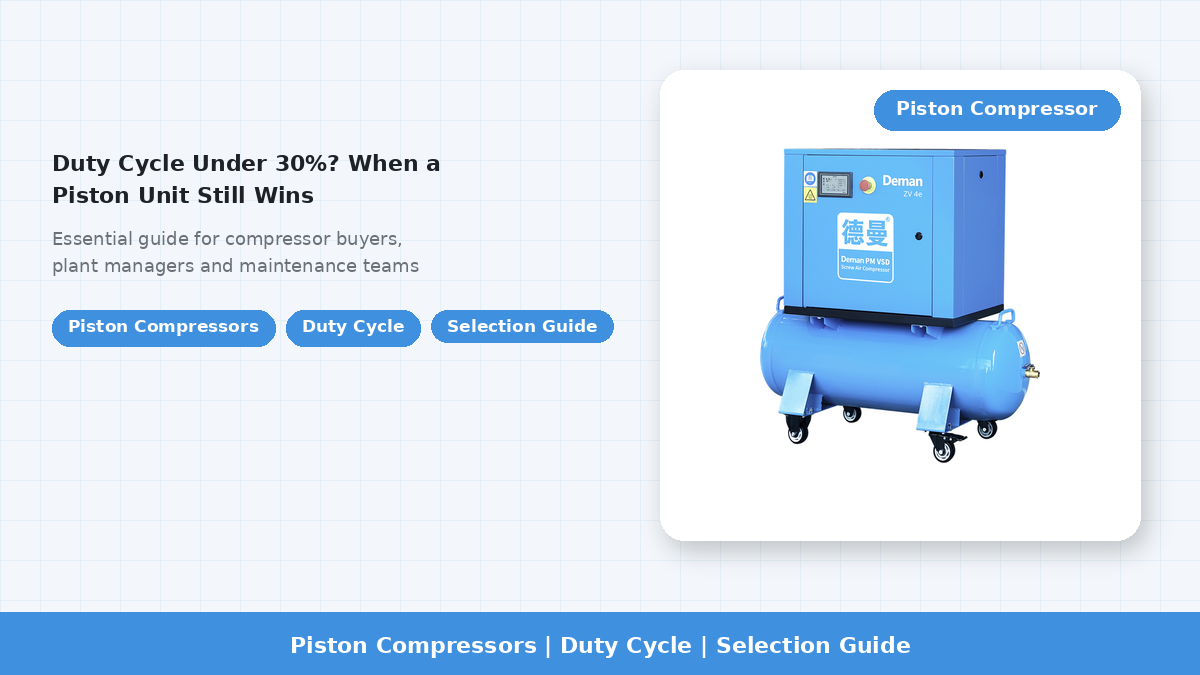
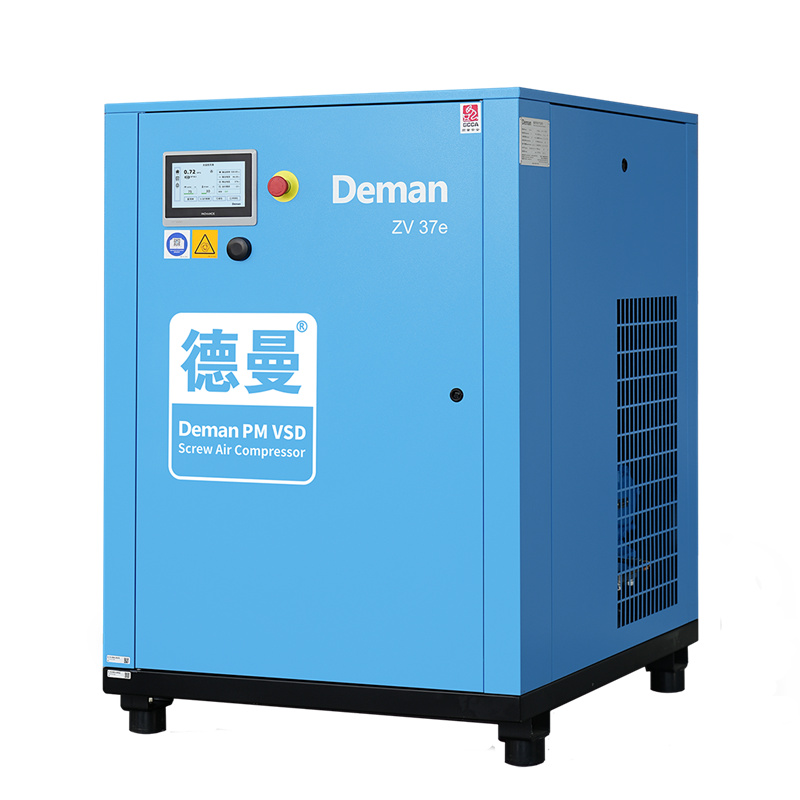
— ZVe Series single-stage PM VSD air compressor, the entry-tier PM VSD line for light-duty factory use.
TL;DR — The Short Answer
- Unit sale — the first margin layer; PM VSD supports a wider channel discount than fixed-speed because of the energy-savings ROI story sold to the end user.
- Aftermarket services — installation, commissioning, and warranty admin; this is where most distributors convert a one-box sale into a five-year customer relationship.
- Spare-parts recurring revenue — air filter, oil filter, oil separator, and lubricant; the highest-margin recurring line on the P&L.
- Energy-efficiency rebate capture — PM VSD lines often qualify for utility, government, or OEM-bonus efficiency rebates the distributor can capture and re-invest in deal margin.
- Ten-year warranty economics — a long warranty programme changes the distribution risk profile; distributors must price and train the service labour that backs it.
Channel Economics
The Four-Layer Margin Stack
Distributors in industrial equipment talk about margin in single percentages, but the actual P&L line for a PM VSD line is built from four distinct revenue streams. Each layer has its own margin profile, its own payment terms, and its own service burden. Missing one of them is how a “low-margin” line quietly becomes unprofitable.
Because a PM VSD compressor is installed and serviced for a 10-year-plus horizon — not a one-time transaction — the four revenue streams compound on the same customer relationship, which is why the line earns its place even when the first-unit margin is lower than a simpler fixed-speed line.
Layer 1 — Unit sale
The first box sold, including any accessories, shipping, and the distributor’s installation margin. PM VSD units have a higher unit cost than equivalent fixed-speed units, which compresses the per-unit gross margin in percentage terms, but the absolute per-unit margin is typically higher because the end-user ROI justifies a wider channel discount.
Layer 2 — Commissioning and warranty administration
The end-user typically pays a separate commissioning fee (piping, electrical, control integration, IoT setup), and the distributor earns a margin on that fee or absorbs it as a service cost depending on the channel model.
Layer 3 — Recurring spare-parts revenue
Air filter, oil filter, oil separator element, and lubricant. Each PM VSD unit consumes its parts on a service schedule; the distributor who stocks and sells these parts owns a recurring margin stream that compounds over the unit’s service life.
Layer 4 — Energy-efficiency rebate capture
In many regions, PM VSD purchases qualify for utility rebates, government efficiency grants, or OEM bonus programmes. The distributor who handles the rebate paperwork converts a non-revenue support task into either a customer loyalty tool or an additive margin layer.
P&L insight: The first-layer unit sale often looks like the headline margin because it is the largest single number, but on a 10-year customer P&L basis, layers 3 and 4 typically contribute more total margin than layer 1. This is why line-selection in industrial equipment is a long-horizon decision, not a per-quote one.
Product Strategy
PM VSD vs Fixed-Speed: Different Margin Profile
Fixed-speed rotary screw compressors sell on price and availability. PM VSD rotary screw compressors sell on the electricity bill. That difference in the end-user value proposition reshapes every margin layer in the distributor’s P&L.
| Margin layer | Fixed-speed | PM VSD | Why the difference |
|---|---|---|---|
| Unit margin | Compressed — commodity benchmark | Supported by ROI story | PM VSD end users pay for energy savings, not for unit cost |
| Aftermarket services | Standard servicing | Higher-value IoT and VSD tuning | PM VSD units require firmware updates and tuning reviews |
| Spare parts recurring | Standard filter cycle | Same filters, longer service intervals | PM VSD parts margin per filter is similar; volume per year is lower |
| Energy rebate capture | Rare | Common | Efficiency programmes typically target VSD technology |
| Warranty risk | Lower parts cost, higher wear rate | Higher parts cost, lower wear rate | PM motors and inverters cost more to replace but fail less often |
— Source: distributor P&L patterns across industrial compressor channels; qualitative comparison.
Distribution insight: The two product classes do not compete head-to-head on price. They compete for the same end-user slot at the factory, and the distributor’s job is to position them differently. A fixed-speed line that competes on price is a commodity business; a PM VSD line that competes on electricity bill is a value business — and value businesses support wider channel margins.
Unit Economics
Unit Margin: How the ROI Story Supports a Wider Discount
The reason a PM VSD line supports a wider channel discount than fixed-speed is not generosity on the OEM’s part — it is end-user economics. A PM VSD unit that delivers an energy reduction in the typical industrial-compressor band can pay back the end-user’s incremental purchase cost in months rather than years. That payback story gives the distributor room to defend a wider gross margin.
Because the end-user evaluates a PM VSD purchase on electricity saved rather than equipment price, the unit-sale negotiation is structurally different from a fixed-speed deal, and a well-trained distributor can defend a wider channel margin than the OEM’s RRP would suggest.
How to position the ROI in the customer conversation
- Establish the baseline. Annual kWh of compressed-air consumption, current electricity tariff, annual operating hours.
- Apply the savings estimate. PM VSD units in typical duty cycles reach a meaningful energy reduction versus fixed-speed under partial-load conditions.
- Compute payback. Incremental purchase cost vs annual saving — typically a multi-year but bounded payback.
- Layer financing. Many factories lease compressed-air equipment, which moves the payback conversation off the capex budget.
- Capture the rebate. Wherever a utility or government efficiency programme applies, include the rebate value in the financial structure.
Service Revenue
Aftermarket & Service Margin: Where Distributors Earn for Years
The biggest single mistake distributors make when taking on a new PM VSD line is to compete on the unit price and forget to scope the aftermarket. The unit sale closes once, but the service relationship lasts a decade.
| Service line | Frequency per unit | Margin profile | Capability required |
|---|---|---|---|
| Commissioning & site handover | Once at install | Higher per-event margin | Electrical + mechanical + software |
| Preventive maintenance visit | Quarterly / semi-annual | Stable per-visit margin | Lubricant + filter change, firmware update |
| IoT dashboard & alerts | Continuous | Recurring subscription margin | Connectivity + dashboards |
| Efficiency tuning & re-commissioning | Annual / biannual | Premium service margin | VSD parameter review, leak audit |
| Warranty admin & RMA handling | On incident | Cost-and-margin neutral | OEM RMA portal access, parts staging |
— Source: PM VSD aftermarket service stack, distributor channel practice.
Service insight: For a PM VSD unit carrying a 10-year warranty, the distributor who keeps that unit under an annual service contract earns predictable revenue for ten years, which is a meaningfully different risk profile from a box-sale-only model.
Recurring Revenue
Spare-Parts Margin: Filters, Oil, Separators
The spare-parts line is consistently the highest-margin layer in an industrial compressor P&L. PM VSD units use the same consumable parts as fixed-speed units (air filter, oil filter, oil separator, lubricant), so the distributor can carry one inventory set across a product family.
| Part | Typical service interval | Stock-keeping strategy |
|---|---|---|
| Air filter element | Every ~2,000 operating hours | Stock at every service-depot site |
| Oil filter | Aligned with lubricant change | Stock at every service-depot site |
| Oil separator element | Every ~4,000–6,000 operating hours | Stock at regional depot |
| Lubricant (rotary screw fluid) | Aligned with oil separator | Stock in bulk at regional depot |
| Inverter (long-life component) | Incident-driven, not scheduled | OEM RMA replacement, not distributor stock |
| PM motor bearing | Multi-year, incident-driven | OEM RMA replacement, not distributor stock |
— Source: manufacturer-published service schedule for ZVe Series; distributor stocking practice.
Parts insight: Because PM VSD units typically run cooler and at lower average loads than fixed-speed units, the parts service interval is often longer, but the parts themselves carry similar margins. The result is slightly lower annual parts revenue per unit, but the lifespan revenue (total over 10+ years) is comparable because of lower catastrophic-failure risk.
Product Spotlight
The ZVe Single-Stage PM VSD as a Margin Entry Point
Among Deman’s PM VSD product family, the ZVe single-stage unit occupies a deliberate position as the entry tier. It is built for factories operating below ~2,000 hours per year, where the end user benefits from PM VSD efficiency without paying for the higher-output two-stage or quad-screw configurations.
From a distributor-margin perspective, the ZVe’s value is that it lets a new distributor enter the PM VSD line at lower minimum-order and inventory-commitment levels, then grow into the higher-output GGVe dual-stage and quad-screw models as the customer base matures.
| Attribute | ZVe characteristic | Distributor implication |
|---|---|---|
| Pressure control | Stable within +0.01 MPa via patented PID VSD control | Supports the efficiency claim that drives the ROI story |
| Inverter partner | Inovance (Chinese industrial automation major) | Stable inverter supply, well-known service network in Asia |
| Motor technology | Permanent magnet with efficient heat dissipation | Lower warranty exposure than induction motor at similar output |
| IoT layer | 7-inch colour touchscreen + IoT cloud dashboard | Subscriptable service feature; recurring margin opportunity |
| Maintenance design | External oil separator, accessible filter layout | Faster PM visits — more service events per day |
| Target duty cycle | Factories operating <2,000 hours/year | Clear end-user profile makes lead qualification faster |
| Warranty | 10-year programme (subject to Deman terms and service registration) | Differentiator vs short-warranty competitors |
— Source: manufacturer datasheet, ZVe Series Single-stage PM VSD Air Compressor.
For distributors who have carried only fixed-speed lines and are now stepping into PM VSD for the first time, the ZVe is a structured way to build the new capability — inverter diagnosis, IoT onboarding, PM-motor service training — without immediately committing to the higher-output lines that demand the same skills at higher unit cost.
For the broader range context, including the higher-output GGVe dual-stage and integrated ZVe configurations, see the full PM VSD compressor product line on the Deman site.
Cost Side
OEM Discount Tiers, Payment Terms, and Container Math
The margin math on PM VSD lines is not only revenue-side; it is also cost-side. The OEM discount tier, payment terms, inventory-turn rate, and container-fill ratio all flow through the distributor’s landed cost.
The four cost-side levers
- Discount tier — the percentage break the OEM gives the distributor above a specific annual-volume threshold. Tiers typically step at 20, 50, 100, and 200+ container-equivalent units per year.
- Payment terms — the gap between payment-out and collection-in; longer OEM credit terms compress the working-capital burden and free up credit for higher volumes.
- Inventory turn rate — days of inventory the distributor holds, which determines whether the discount-tier break actually reaches the bottom line or just sits on a shelf.
- Container fill ratio — whether a 20’ or 40’ container is filled with the SKU mix the distributor can sell through; under-filling the container erodes the landed-cost advantage.
Cost-lever insight: The biggest cost-side mistake distributors make on PM VSD lines is optimising one lever (typically discount tier) without checking the others. A high discount tier that leads to over-filled inventory and slow turns erodes the margin advantage once carrying cost is loaded back in.
Decision Map
When PM VSD Beats Fixed-Speed on Channel Margin
| If your situation is… | PM VSD earns more over 10 years | Fixed-speed may earn more on a 3-year view |
|---|---|---|
| High electricity tariff, multi-shift factory | Yes | No |
| Low electricity tariff, single-shift factory | Depends | Often |
| End user wants energy-efficiency rebate support | Yes | No |
| End user is price-driven, no service appetite | No | Yes |
| Distributor has service depot and parts stock | Yes | No |
| Distributor is box-mover with no service capacity | No | Often |
— Source: channel decision framework; qualitative scenarios.
Decision rule: If the end user’s load profile and the distributor’s service capability both point at PM VSD, the line earns more on a 10-year horizon than fixed-speed can. If either lever points at fixed-speed, the line probably does not earn enough on a 10-year horizon to justify taking it on.
Adoption Framework
Should Your Channel Add a PM VSD Line?
| If your situation is… | Recommended path | Why |
|---|---|---|
| Existing compressor distributor, no PM VSD today | Start at the ZVe entry tier; build inverter / IoT capability | Lowest-cost way to learn the new technology stack |
| Industrial distributor with service depots and parts stock | Add the full PM VSD family, including GGVe dual-stage | Service capacity already in place; four-layer margin stack activates immediately |
| EPC / system integrator with project-based demand | Add ZVe + integrated tank variant | Smaller footprint suits new-factory installations |
| Pricing-only box-mover with no service | Stay on fixed-speed unless service capacity is built first | PM VSD economics require the distributor to own the service layer |
| Distributor in a low-electricity-tariff region | Niche-position PM VSD for energy-rebate-eligible projects only | Beats fixed-speed only where the rebate or tariff gap supports the story |
— Source: PM VSD line adoption decision matrix.
One-line summary: Add a PM VSD line when your channel can carry both the inverter / IoT skill set and the recurring service obligation. If either is missing, the four-layer margin stack collapses back to a one-layer unit-sale business.
Next Step · Quote
Need a distributor-side conversation about PM VSD?
Send us your target region, your existing service-depot footprint, and the volume band you can commit to in year one. The Deman export team in Ningbo will return a tier structure, a parts pricing schedule, and a recommended starting SKU mix across the ZVe / GGVe / integrated family.
Contact the Deman export team Why distributors source Chinese compressors
FAQ
Frequently Asked Questions
Q.01What is the typical distributor margin on a PM VSD compressor line?+
Margins vary widely by region, channel role (master distributor vs sub-distributor vs dealer), and product mix, so a single number is rarely correct for more than one market at a time. The most useful framing is the four-layer margin stack (unit, commissioning, spare parts, rebate) rather than a single per-unit percentage, because on a 10-year customer P&L, the recurring layers typically dominate the headline unit-sale layer.
Q.02Why does a PM VSD line support a wider channel discount than fixed-speed?+
Because the end user is buying electricity savings, not equipment, the negotiation is structurally different. A distributor who can present a credible payback calculation based on the customer’s specific duty cycle can defend a wider gross margin than the OEM’s recommended price would suggest.
Q.03What is the ZVe single-stage PM VSD best suited for?+
The ZVe is built for factories operating below approximately 2,000 hours per year, where the end user benefits from PM VSD efficiency without paying for the higher-output two-stage or quad-screw configurations. It is also a natural entry SKU for a distributor building PM VSD capability for the first time.
Q.04How does the 10-year warranty change a distributor’s margin math?+
A long warranty moves service cost from the customer into the OEM-distributor channel, so the distributor must price for and be trained to handle the warranty service labour. In return, the distributor who delivers consistent warranty service wins customer loyalty that compounds across the unit’s full life.
Q.05Is the spare-parts margin higher on PM VSD or fixed-speed units?+
Per filter, the margin is similar because the consumables are functionally the same. Per year, PM VSD units typically consume filters on a longer interval because of lower operating temperatures and part-load usage. Over the full service life, total lifetime parts revenue is comparable, but the timing is spread out.
Q.06What does the distributor need to invest in to carry a PM VSD line?+
The minimum viable investment is service-technician training in inverter diagnosis, PM-motor handling, and IoT dashboard setup, plus the stocking capital for filters and lubricant. Without these, the distributor cannot deliver the recurring revenue layer that makes the line financially attractive.
Q.07Where does energy-efficiency rebate capture fit in the margin math?+
In markets with utility or government efficiency programmes, the rebate is a non-trivial financial term that the distributor can capture on the customer’s behalf. Some distributors treat it as a margin layer; others treat it as a competitive lever that helps close the unit deal. Either way, handling it well strengthens the long-term customer relationship.
Q.08How does container-fill ratio affect PM VSD line margin?+
PM VSD units are physically larger and heavier than fixed-speed units at the same nominal output, so container-fill matters more. Mixing SKUs to fill a container, rather than loading it with a single model, generally improves the landed-cost-per-unit figure the distributor can defend.
Q.09Are higher-output GGVe or two-stage PM VSD lines more profitable per unit than the ZVe?+
Higher-output PM VSD lines typically carry a higher absolute margin per unit but demand stronger inverter / IoT diagnostic skills from the distributor service team. The right way to build a PM VSD portfolio is usually to start at the ZVe entry tier, build the service capability, then promote into the GGVe or two-stage family as the customer base supports it.
Last verified: 2026-10-10 · Published on Deman OEM Knowledge Base