






Compressor Vibration Limits: ISO 10816 in the Field
Compressed Air Engineering · Condition Monitoring
Compressor Vibration Limits: ISO 10816 in the Field
If your customer hands you an ISO 10816 limit in a purchase order or an acceptance test, the first thing worth knowing is that ISO 10816 has been withdrawn. The current standards are ISO 20816-1 and ISO 20816-3, and they were written with turbomachinery in mind rather than with oil-injected screw compressors in mind.
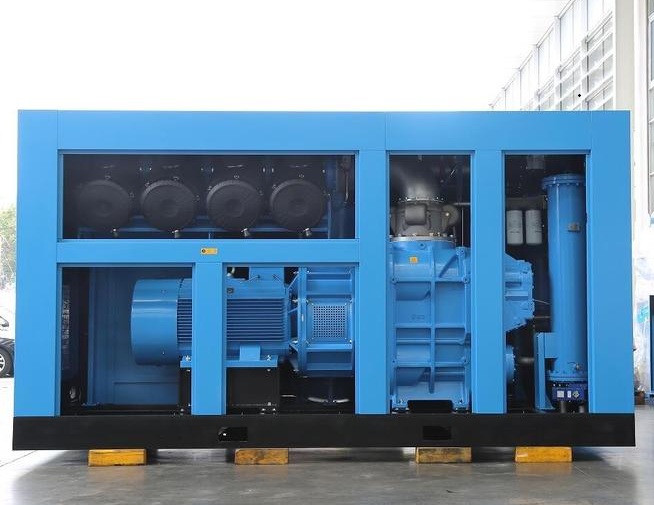
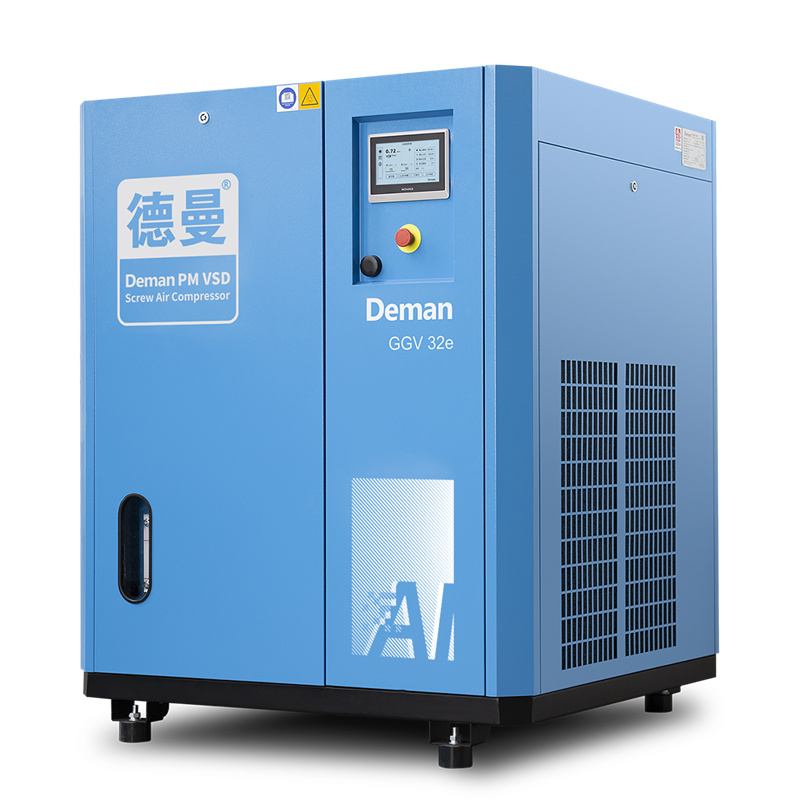
A GGVe series PM VSD screw compressor. The anti-vibration feet at the base of the frame are exactly the mounting detail that decides whether ISO 20816 criteria describe the machine or describe the room it stands in.
TL;DR — The Short Answer
- ISO 10816-1:1995 and ISO 10816-3:2009 are both withdrawn. The live standards are ISO 20816-1:2016 for general guidelines and ISO 20816-3:2022 for industrial machinery above 15 kW, which names rotary compressors explicitly.
- ISO 20816-3 covers machines with a power rating above 15 kW and operating speeds between 120 r/min and 30,000 r/min, so a 22 kW screw compressor at 1,450 r/min falls squarely inside its scope.
- The zone boundaries run from 50 µm shaft displacement for small machines to 700 µm for large ones, with the equivalent broad band velocity figures running from 1.4 to 11.0 mm/s r.m.s.
- ISO 20816-1 covers radial shaft vibration only. It explicitly excludes axial shaft vibration and it explicitly excludes torsional vibration, which are two of the failure modes a screw compressor actually produces.
- ISO 20816-1 states that its criteria relate only to vibration produced by the machine itself, so a high reading on a poorly founded machine may be telling you about your foundation rather than about your airend.
- ISO 20816-3 states that its numbers are guidelines that shall be applied with due regard to specific machine features, which is the clause that makes the standard usable rather than binding on a screw compressor.
- Converting every displacement and velocity pair back through v = 2πfA gives an implied frequency between 2.26 and 4.46 Hz, while a screw compressor motor runs at 24 to 50 Hz on 1×, so these are broadband structural limits rather than rotor speed limits.
- In service, the fastest way to separate a real fault from a measurement artefact is to work in order: basic tightening, then bearing inspection, then airend alignment.
The Standard
Is ISO 10816 still current, and what replaced it?
ISO 10816 is withdrawn and has been replaced by the ISO 20816 series, where ISO 20816-1 gives general guidelines and ISO 20816-3 covers industrial machinery above 15 kW. This is not a pedantic point. A purchase order written in 2015 that cites ISO 10816 is citing a document that no longer exists in its current form, and the supplier who signs against it is being asked to certify against a withdrawn reference.
According to the ISO catalogue, ISO 20816-1:2016 Mechanical vibration, Measurement and evaluation of machine vibration, Part 1: General guidelines is published as Edition 1 from November 2016, runs to 34 pages and was last reviewed and confirmed in 2021. Its ISO life cycle lists ISO 7919-1:1996, ISO 10816-1:1995 and ISO 10816-1:1995/Amd 1:2009 all as withdrawn predecessors.
Its sibling ISO 20816-3:2022 is published as Edition 1 from October 2022 and carries the same pattern, with ISO 7919-3:2009, ISO 10816-3:2009 and ISO 10816-3:2009/Amd 1:2017 all listed as withdrawn. Both current parts are maintained by ISO/TC 108/SC 2 under ICS 17.160, and both currently sit at stage 90.92, which means they are published but queued for revision. That is the version landscape you are working against in 2026.
Scope
What ISO 20816 actually measures, and what it refuses to measure
ISO 20816-1 covers absolute and relative radial shaft vibration, and it explicitly excludes axial shaft vibration, torsional vibration, and any vibration transmitted to the machine from an external source. Those three exclusions matter more for a screw compressor than the zone numbers do.
The standard's own wording is worth quoting because it settles most arguments. Its scope states that it applies to measurements of both absolute and relative radial shaft vibration with regard to monitoring radial clearances, but excludes axial shaft vibration. It also notes that the evaluation criteria relate only to the vibration produced by the machine itself and not the vibration transmitted to it from outside.
Read that last sentence as a field instruction. A compressor on an inadequate slab, tied into pipework with no flexibility, sitting a metre from a chiller pump, can read well above a zone boundary without a single internal component being wrong. If you measure before you isolate the transmission path, you will spend the next week chasing a fault that is actually in the room.
On torsional vibration the standard is equally clear that it is out of scope, pointing instead to references such as ISO 3046-5, ISO 22266-1 or VDI 2039. On a drive train with a coupling or a belt stage that is not an academic distinction. Because ISO 20816-1 also notes that it applies to measurements on other rotating elements where those are found to be more suitable, a non-contact measurement taken on the airend housing can be assessed against these guidelines provided the limitations of the method are set out. That is the practical route for most screw compressor work, because installing proximity probes into a sealed oil-injected airend is not realistic.
Zone Boundaries
How to read the ISO zone boundaries
The zones are boundaries between machine classes of acceptability, not a pass or fail line: Zone A/B separates newly commissioned from long-term operation, Zone B/C separates unrestricted from restricted operation, and Zone C/D marks where damage becomes likely. A machine sitting in Zone C is not condemned, but leaving it there is a decision somebody has to sign.
For flexible bearings, the widely tabulated zone boundaries are as follows. Verify these figures against your own purchased copy of the standard before writing them into a contract, because the tabulated values live inside a paywalled document and this article is not a substitute for it.
| Machine classification | Zone A/B | Zone B/C | Zone C/D |
|---|---|---|---|
| Group 1, shaft height 15 to 160 mm, displacement (µm) | 50 | 100 | 200 |
| Group 1, shaft height 15 to 160 mm, velocity (mm/s r.m.s.) | 1.4 | 2.8 | 4.5 |
| Group 2, shaft height above 160 mm, displacement (µm) | 120 | 250 | 500 |
| Group 2, shaft height above 160 mm, velocity (mm/s r.m.s.) | 2.3 | 4.5 | 7.1 |
| Group 2, shaft height above 300 mm, displacement (µm) | 180 | 350 | 700 |
| Group 2, shaft height above 300 mm, velocity (mm/s r.m.s.) | 3.5 | 6.3 | 11.0 |
Two points about how those numbers are constructed catch people out. The first is bearing type: the table above is for flexible bearings, and a rigidly mounted machine sits against a tighter set of boundaries. The second is that the machine classification depends on shaft height and power, not on what the machine does, so a compressor is classified the same way as a pump of the same size and mounting.
Frequency Analysis
Why the displacement and velocity limits are not interchangeable
The displacement and velocity figures in the zone table are not two different ways of writing the same limit, because each pair implies a specific dominant frequency, and that frequency is much lower than the running speed of a screw compressor motor. This is the single most useful thing you can work out from the table before you ever put a sensor on the machine.
The relationship is straightforward. For a sinusoidal vibration, velocity equals two pi times frequency times amplitude, so the frequency implied by a zone pair is the velocity figure divided by two pi times the displacement figure once the units are reconciled. Running that calculation across all nine zone pairs gives the following.
| Classification | Displacement (µm) | Velocity (mm/s) | Implied frequency (Hz) |
|---|---|---|---|
| Group 1, 15 to 160 mm, Zone A/B | 50 | 1.4 | 4.46 |
| Group 1, 15 to 160 mm, Zone B/C | 100 | 2.8 | 4.46 |
| Group 1, 15 to 160 mm, Zone C/D | 200 | 4.5 | 3.58 |
| Group 2, above 160 mm, Zone A/B | 120 | 2.3 | 3.05 |
| Group 2, above 160 mm, Zone B/C | 250 | 4.5 | 2.86 |
| Group 2, above 160 mm, Zone C/D | 500 | 7.1 | 2.26 |
| Group 2, above 300 mm, Zone A/B | 180 | 3.5 | 3.09 |
| Group 2, above 300 mm, Zone B/C | 350 | 6.3 | 2.86 |
| Group 2, above 300 mm, Zone C/D | 700 | 11.0 | 2.50 |
Every value falls between 2.26 and 4.46 Hz. That is not a coincidence, and it tells you something specific about how these limits were built: they are broadband structural vibration limits for machines whose energy sits in the low frequency range, which is characteristic of large hydrodynamic-bearing turbomachinery sitting on flexible supports.
Now put a screw compressor next to that. A 1,450 r/min motor runs at 24.2 Hz on 1× and a 2,900 r/min motor runs at 48.3 Hz. Because a screw compressor's rotor speed sits roughly five to twenty times above the frequency band implied by the ISO zone pairs, a reading dominated by 1× motor frequency is not a reading in the same units as the table, and converting one to the other will mislead you.
Applicability
Which ISO 20816 part applies to a rotary screw compressor?
ISO 20816-3:2022 is the applicable part, because it covers machines with a power rating above 15 kW and operating speeds between 120 r/min and 30,000 r/min, and its scope list names rotary compressors directly. A 22 kW screw compressor at 1,450 r/min is comfortably inside both limits.
The rest of that scope list is worth knowing, because it tells you which other standards you are dealing with instead. It covers steam turbines and generators below and above 40 MW, industrial gas turbines below 3 MW, turbofans, electric motors where the coupling is flexible, rolls and mills, conveyors, variable speed couplings, and blowers or fans. A variable speed coupling appearing in the list is relevant, because that is a component most VSD screw compressors cannot be separated from.
Two further inclusions make the standard more useful than many people assume. Machinery including a geared stage can fall within its scope, so a geared compressor train is covered rather than excluded. And the standard itself redirects you elsewhere for the detail: gearbox acceptance testing is referred to ISO 20816-9, and fan criteria are generally only applicable above 300 kW or for fans which are not flexibly supported, with ISO 14694 referenced for practical fan assessment.
Interpretation
Why ISO 20816 is a screening tool here, not a damage predictor
ISO 20816-3 states that its numerical values are guidelines based on worldwide machine experience that shall be applied with due regard to specific machine features which can cause these values to be inappropriate, and that clause is what makes the standard usable on a screw compressor rather than binding on it.
There are three specific machine features that make a screw compressor different from the reference machine, and you should be able to name all three when a customer asks why your machine reads higher than their old one.
The bearing type is the first. The zone limits were developed around hydrodynamic journal bearings running on an oil film with a defined stiffness. A screw compressor airend runs on rolling element bearings, where the frequency content and the way a defect propagates both differ, and where the classic rising-sideband and 2× running speed patterns that trained vibration analysts look for behave differently.
The mounting is the second. A compressor is a flexible machine on anti-vibration feet. That is correct engineering and it is what stops the machine transmitting into the building, but it also means the response between base motion and structural motion is not the rigid-body assumption behind many acceptance procedures. Look at the feet in the photograph above and you are looking at the component that creates this ambiguity.
The oil-injected process is the third. Spraying oil into the compression chamber is what makes an oil-injected screw compressor efficient at low cost, and it introduces broadband acoustic and mechanical energy that has nothing to do with mechanical integrity. A high broad band reading on an oil-injected machine may simply be a well-lubricating machine doing its job.
There is a fourth point that is about interpretation rather than machine design. ISO 20816-3 also states that machine condition is assessed by considering both the shaft vibration and the associated structural vibration, as well as specific frequency components, which do not always relate to the broad band severity values presented. In practice that means a modest steady overall level with a growing discrete component is more worrying than a steady level sitting just under a zone boundary. The number alone never tells you which situation you are in.
Field Procedure
How to investigate a high reading in the field
Work the causes in order of cost and likelihood: basic tightening first, then bearing inspection, then airend alignment. This is the order our own fault diagnosis guidance uses, and it exists because the two cheap causes and the one expensive cause all produce a reading that looks similar on a trend chart.
- Confirm the reading is real before you act. Re-measure at the same position, in the same units and with the same bandwidth. Check the measurement definition, because velocity in mm/s r.m.s. and displacement in µm peak-to-peak are not interchangeable, and confirm no external source is driving the reading.
- Check basic tightening. Torque-check the foundation or frame bolts, the machine feet, the coupling or belt guard fasteners and the pipework supports. Soft foot and loose structural fixings are the most common cause of an apparently high reading and the cheapest to correct.
- Inspect the anti-vibration mounting and pipework flexibility. Missing, damaged or incorrectly installed mounts let the machine transmit its motion into the slab rather than absorbing it, and rigid pipework can do the same thing by a different route.
- Inspect the bearings. Listen for a change in bearing noise, check for shaft play with the machine stopped and locked out, and review the trend rather than only the current value. A bearing fault usually grows as a discrete component instead of stepping.
- Check the cooling system. Verify the fan, the radiator or air-to-air exchanger and the drive arrangement. An unbalanced or fouled fan is easy to miss and easy to fix once you know to look for it.
- Check airend alignment and internal clearance. Do this last, because everything above can masquerade as a coupling problem and you will waste a shutdown if you start here.
- Set a baseline with five qualifiers. Record the corrected reading, the units, the measurement position, the load, and the oil and temperature conditions, then define the trend that should trigger the next visit.
Our air compressor fault diagnosis guide sets out that same logic across the other fault classes, including the rule that an overheating alarm should be investigated on the oil circuit and the air-cooling system together rather than on one alone. Vibration is the easiest fault to trend and the easiest to misread, which is why the order matters.
Design
What compressor design actually does about vibration
Vibration on a screw compressor is mostly designed out rather than monitored out, and the design choices that reduce it are visible in the specification if you know which ones to ask about. The most obvious is the cooling fan, which is a rotating mass mounted directly on the enclosure. On our GGVe series the change to a centrifugal fan is specified as reducing vibration by 10 percent while increasing cooling air pressure by more than 25 percent, which is the kind of trade worth having.
Three further choices matter. Direct drive transmission removes a belt or gear stage from the load path, which removes a misalignment source and a wear source at the same time. Upgraded airend bearings extend the interval before bearing-related vibration becomes a question. And the screw element itself, in the GGVe case a 5:6 ratio third generation asymmetric profile on a two-stage airend starting from 9 kW, determines the compression process and therefore the excitation the structure has to cope with.
Beyond the hardware, continuous monitoring changes how a limit is used. The GGVe platform reports key operating indicators to a cloud service around the clock and raises early warning alerts when those indicators deviate, which turns vibration from a periodic snapshot into a trend. Because an early warning on a drifting indicator catches a problem long before the broad band number crosses a zone boundary, trend monitoring is the practical route and the single acceptance reading is only the record of where you started.
For context on machine class, our heavy-duty screw compressor range spans fixed-speed, VSD and permanent magnet machines from light duty through to large industrial units, and each of those categories has a different vibration baseline. Compare like with like when a customer quotes a limit from a different machine class.
Specification
How to put vibration limits into a purchase specification
A vibration limit in a contract should specify the standard edition, the machine classification, the measurement position, the units, the load condition and the mounting arrangement, and a limit that omits any of those six is unenforceable in practice. Here is what I would ask a supplier to state in writing before signing.
- Which standard and which edition. Ask for ISO 20816-3:2022 by name, not ISO 10816, and if the site engineer insists on ISO 10816, ask them to confirm they mean the withdrawn document.
- The machine classification used. Group 1 or Group 2, and the shaft height assumption, because that alone moves the boundary by a factor of three or more.
- Measurement position and units. Housing or structure, radial, and whether the figure is velocity r.m.s. or displacement peak-to-peak. An unqualified number is not comparable to anything.
- Load and operating condition. Vibration on a variable speed machine depends on speed and load, so a limit quoted without them cannot be reproduced.
- Mounting arrangement. Whether anti-vibration mounts are supplied and installed, and who is responsible for pipework flexibility. This decides whose problem a high reading becomes.
- Whether a trend is included. Ask what monitoring is part of the package rather than accepting a single acceptance reading as the entire vibration story.
Our GGVe series AI air compressor is the example we usually walk a customer through when these questions come up, because its specification answers most of them directly: direct drive, upgraded airend bearings, the centrifugal cooling fan, IP65 oil-cooled IE5 motor up to 75 kW, exhaust oil content of 2 ppm or less, and continuous cloud monitoring of key operating indicators.
Common Questions
Frequently Asked Questions
Q.01Is ISO 10816 still current?+
No. ISO 10816-1:1995 and its Amendment 1:2009 are both listed as withdrawn, as are ISO 10816-3:2009 and its Amendment 1:2017. They have been replaced by the ISO 20816 series, in which ISO 20816-1:2016 gives general guidelines and ISO 20816-3:2022 covers industrial machinery above 15 kW.
Q.02Which ISO part covers a rotary screw air compressor?+
ISO 20816-3:2022 covers machines with a power rating above 15 kW and operating speeds between 120 r/min and 30,000 r/min, and its scope list names rotary compressors explicitly. It also covers flexible-coupled electric motors, variable speed couplings, blowers and fans.
Q.03What are the ISO 10816 zone boundaries?+
For flexible bearings, the relative shaft displacement zone boundaries are 50, 100 and 200 micrometres for small machines with a shaft height of 15 to 160 mm; 120, 250 and 500 micrometres for Group 2 machines above 160 mm shaft height; and 180, 350 and 700 micrometres for Group 2 machines above 300 mm shaft height. The equivalent broad band velocity figures are 1.4, 2.8 and 4.5 mm/s; 2.3, 4.5 and 7.1 mm/s; and 3.5, 6.3 and 11.0 mm/s r.m.s. Verify these against your own purchased copy of the standard before contractual use.
Q.04What do the zones A, B, C and D mean?+
Zone A/B is the boundary between newly commissioned and long-term operation, Zone B/C is the boundary between unrestricted long-term operation and restricted operation with investigation planned, and Zone C/D is the boundary where damage is likely or possible. A machine sitting in Zone C is not condemned, but leaving it there is a decision somebody has to sign.
Q.05Does ISO 10816 cover axial or torsional vibration?+
No. ISO 20816-1 applies to absolute and relative radial shaft vibration and explicitly excludes axial shaft vibration. It also explicitly excludes torsional vibration, for which separate references such as ISO 3046-5, ISO 22266-1 and VDI 2039 are used instead.
Q.06Can external vibration affect an ISO 20816 measurement?+
ISO 20816-1 states that its evaluation criteria relate only to the vibration produced by the machine itself and not to vibration transmitted to it from outside. In practice a weak foundation, unbraced pipework or a resonance from a neighbouring machine can push a reading up without indicating a compressor fault.
Q.07Why is ISO 20816 a screening tool for a screw compressor rather than a damage predictor?+
ISO 20816-3 states that its numerical values are guidelines based on worldwide machine experience that shall be applied with due regard to specific machine features which can cause these values to be inappropriate. A screw compressor runs rolling-element bearings, sits on anti-vibration feet and injects oil into the compression process, so its vibration signature differs from the hydrodynamic-bearing turbomachinery the zone limits were calibrated around.
Q.08How do I check a vibrating screw compressor in the field?+
Work in order: first check basic tightening of fasteners, foot mounts, coupling and pipework, then inspect the bearings, and only after those two steps return to airend alignment. Skipping to alignment first wastes a shutdown, because loose fasteners and a worn bearing both produce a reading that looks like a coupling problem.
Q.09Does a higher frequency vibration reading mean a worse fault?+
Not by itself. ISO 20816-3 states that machine condition is assessed by considering both shaft vibration and associated structural vibration, as well as specific frequency components which do not always relate to the broad band severity values. A modest overall level with a growing discrete component is often more serious than a steady level near a zone boundary.
Q.10What should I ask a compressor supplier about vibration?+
Ask what the machine's measured vibration was at factory acceptance, in which units and at what measurement position. Ask about the cooling system design because fan-induced vibration is a common contributor, ask whether anti-vibration mounts are supplied, and ask what trend monitoring is included rather than relying on a single acceptance reading.
Next Step · Written Answer
Setting a vibration specification for an air station?
If you are writing a vibration clause into a compressed air tender, send us the machine power, the intended mounting and the acceptance procedure you have to satisfy. We will come back with what the machine is designed to achieve, in the units and at the position the standard requires.
Last verified: 2026-10-23 · ISO publication status, scope statements and lifecycle records verified against the ISO catalogue on 23 October 2026. Zone boundary values are widely reproduced tabulated figures and must be confirmed against your own purchased copy of the standard before contractual use.