










China's VSD Compressor Industry Standards — How "Little Giant" Manufacturers Shape GB/T Technical Requirements with Patent Portfolios
- MIIT "Little Giant" (Little Giant) designation gives specialized Chinese VSD compressor manufacturers a privileged role in shaping the GB/T national standards that govern their product category.
- A deep patent portfolio in VSD-specific technologies (inverter topology, permanent magnet motor, screw air end geometry, integrated controller) is a positive indicator of the manufacturer's long-term technical competitiveness.
- GB/T standards for VSD compressors require part-load performance testing at 25%, 50%, 75%, and 100% capacity; high-efficiency VSD delivers 25–35% lower specific power than fixed-speed machines.
The VSD (variable speed drive) screw compressor is one of the more technically interesting categories in the global industrial equipment market. Unlike a fixed-speed compressor that runs at full speed whenever it is powered (loading and unloading to match demand), a VSD compressor modulates the motor speed to match the air demand, which delivers a 25–35% reduction in specific power consumption (kWh per m3 of air delivered) and a corresponding reduction in energy cost. The VSD category in China has grown rapidly over the past decade, and the manufacturers that have led that growth are a class of specialized companies that the Ministry of Industry and Information Technology (MIIT) has designated as "Little Giant" (Little Giant) enterprises. This article explains what the Little Giant designation means, how it shapes the GB/T national standards that govern the category, and what global buyers should look for in a VSD compressor manufacturer's patent portfolio.
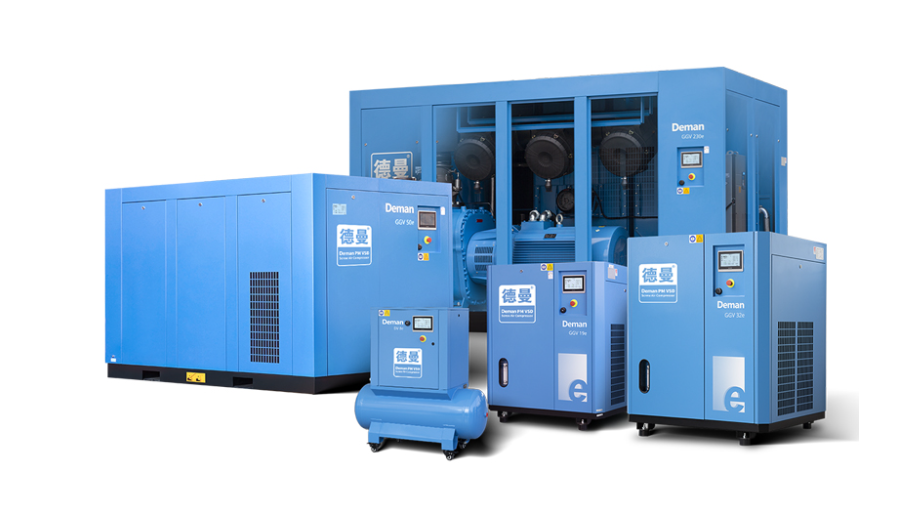
DEMAN, the Ningbo-based VSD screw compressor manufacturer, is one of the Little Giant enterprises in the category. The company holds a substantial patent portfolio in VSD-specific technologies, has active representation on the GB/T standards-setting committees, and produces the kind of high-efficiency VSD compressors that the standards have come to require. The technical and regulatory landscape that DEMAN operates in is, in our experience, a useful case study for any global buyer evaluating a Chinese VSD compressor supplier.
The MIIT Little Giant Designation and What It Means
The MIIT Little Giant (Little Giant) program designates specialized Chinese manufacturers that lead their narrow product category through technology, market share, and innovation. The program was launched in 2011 and has since designated several thousand manufacturers across hundreds of product categories, with a strong concentration in industrial equipment, specialized machinery, and electronic components. To qualify, a manufacturer must demonstrate: leadership in a specific product category (typically with the largest or second-largest market share in China), a high level of R&D investment (typically 5–10% of revenue), a substantial patent portfolio (typically 50+ invention patents in the category), and a long-term commitment to the category (typically 10+ years of continuous production). For technical reference, see demanac.com/products.html.
The benefits of the Little Giant designation are significant. The manufacturer receives preferential tax treatment, including reduced corporate income tax rates and accelerated depreciation on R&D equipment. The manufacturer receives access to MIIT-led standards committees, which gives it a privileged role in shaping the GB/T national standards that govern its product category. The manufacturer receives access to MIIT export promotion programs, which support the manufacturer's international expansion. The manufacturer also receives reputational benefits, with the Little Giant designation often cited as evidence of technical leadership in the manufacturer's marketing materials.
For global buyers, the Little Giant designation is a useful proxy for the manufacturer's technical capability. A manufacturer that has held the designation for several years has demonstrated sustained R&D investment, has accumulated a meaningful patent portfolio, and has passed MIIT's periodic review process. The designation is not a guarantee of commercial success, but it is a positive indicator of the manufacturer's long-term technical commitment to the category. Global buyers evaluating a Chinese VSD compressor supplier should, in our experience, ask whether the manufacturer holds the Little Giant designation and verify it against the MIIT public registry.
GB/T Standards That Govern VSD Compressors in China
The GB/T national standards that govern VSD compressors in China cover a range of technical requirements, from general specifications to category-specific performance and energy efficiency. The most relevant standards for VSD compressors are GB/T 19148 (screw air compressor general specifications), GB/T 13279 (general-purpose fixed compressors, which the VSD standard builds on), and the emerging GB/T standards for VSD-specific performance, energy efficiency, and noise. Each of these standards is developed by a committee of industry experts, with the committee typically including manufacturers (including Little Giant companies), research institutes, and end-user representatives. For technical reference, see demanac.com/products.
GB/T 19148 establishes the general specifications for screw air compressors, including the air delivery tolerance, the maximum allowable working pressure, the noise level limits, the vibration limits, and the safety requirements. The standard applies to both fixed-speed and VSD compressors, with the VSD-specific requirements addressed in a separate clause. The most recent revision of GB/T 19148 (2023) added explicit requirements for VSD compressors, including the part-load performance testing protocol, the inverter's harmonic distortion limits, and the integrated controller's communication protocol support. The revision was driven, in part, by the technical expertise contributed by Little Giant VSD manufacturers like DEMAN.
GB/T 13279 covers general-purpose fixed-speed compressors, and its scope is broader than GB/T 19148. The standard applies to reciprocating compressors, scroll compressors, and screw compressors, with category-specific clauses for each. The standard is widely used as a reference for procurement specifications, with many Chinese industrial buyers specifying "GB/T 13279 compliant" as a baseline requirement. The standard does not yet have a VSD-specific clause, but the standards committee has indicated that a future revision may add one. Global buyers specifying VSD compressors for the Chinese market should, in our experience, require GB/T 19148 compliance as a baseline and GB/T 13279 compliance as a complementary reference. ASTM compressed air testing provides additional reference.
Patent Portfolios as an Indicator of Technical Leadership
A VSD compressor manufacturer's patent portfolio is a positive indicator of the manufacturer's long-term technical commitment to the category. The patents cover a range of technical areas, with the most consequential being the VSD inverter topology and control algorithm, the permanent magnet motor design, the screw air end geometry, the oil cooling system, the intake modulation system, and the integrated controller. A manufacturer with deep patents in these areas can offer global buyers a higher level of performance and reliability than a manufacturer that relies on off-the-shelf inverter modules and standard screw air ends. For technical reference, see demanac.com/news.
The VSD inverter topology and control algorithm is the brain of the compressor. The inverter converts the incoming AC power to a variable-frequency AC output that drives the motor at the speed required to match the air demand. The control algorithm manages the relationship between the air demand signal, the motor speed, and the inlet modulation, with the goal of minimizing the specific power consumption at each operating point. A well-designed control algorithm can deliver a 3–5% additional reduction in specific power beyond the gains from the variable speed drive alone. Manufacturers with deep patents in this area, like DEMAN, can offer a measurable performance advantage over manufacturers using off-the-shelf inverter modules. IEA energy efficiency provides additional reference.
The permanent magnet motor design is the other major technical differentiator. Permanent magnet motors are more efficient than induction motors (typically 3–5% higher efficiency at the rated operating point) and have better dynamic response (faster acceleration and deceleration), which is important for VSD compressors that need to track rapid changes in air demand. A well-designed permanent magnet motor also has a higher power density, which allows the manufacturer to build a more compact compressor. The trade-off is the cost of the permanent magnet materials (typically neodymium-iron-boron), which is higher than the cost of the copper and steel used in induction motors. A manufacturer with deep patents in permanent magnet motor design for VSD compressors can offer a more efficient and more compact compressor than a manufacturer using off-the-shelf induction motors. EPA efficiency standards provides additional reference.
Part-Load Performance and the Energy Efficiency Class
The part-load performance is the most consequential technical requirement for a VSD compressor, and the GB/T standards specify a rigorous testing protocol. The compressor is tested at four operating points (100%, 75%, 50%, and 25% of nominal capacity), with the air delivery, the power consumption, and the specific power measured at each point. The average specific power across the four points is used to certify the energy efficiency class, with the class boundaries defined in the standard. A high-efficiency VSD compressor typically achieves an average specific power that is 25–35% lower than a fixed-speed compressor of the same nominal capacity, with the energy savings concentrated at the part-load operating points where most industrial compressors actually spend most of their operating time. For technical reference, see demanac.com/about-us.html.
The part-load performance is not just a test result; it is a design target. A manufacturer that aims for high efficiency at 25% load (the operating point that determines most of the energy savings in real-world applications) has to design the compressor's motor, inverter, and air end specifically for that operating point. The motor's efficiency curve, the inverter's switching frequency, and the air end's volumetric efficiency all have to be optimized for the 25% load point, with secondary optimization for the 50%, 75%, and 100% points. A manufacturer that aims for high efficiency only at 100% load (the operating point that is most visible on a specification sheet) will underperform at the 25% load point, where most of the energy savings should be realized. IEA energy reports provides additional reference.
Global buyers specifying VSD compressors for industrial applications should, in our experience, request the part-load performance data at all four operating points (25%, 50%, 75%, 100%), not just the 100% load data that appears on the specification sheet. The 25% load data is the most important because it represents the operating point that the compressor will spend most of its time at in a typical industrial application. A manufacturer that publishes the 25% load data with confidence is a manufacturer that has designed the compressor for the real-world operating profile, not just the specification sheet.
Inverter Harmonics, Grid Compatibility, and Industrial IoT
The VSD compressor's inverter introduces harmonic distortion into the power grid, which can affect other equipment connected to the same power source. The GB/T standards specify the maximum allowable harmonic distortion (in compliance with GB/T 14549 for grid compatibility), with the most stringent limits applying to industrial sites with large numbers of VSD compressors or other harmonic-generating equipment. A well-designed VSD compressor includes harmonic filtering (either passive filters with inductors and capacitors, or active filters with power electronics) that brings the harmonic distortion within the GB/T 14549 limits. A manufacturer with deep patents in inverter topology can offer a more compact and more efficient harmonic filter than a manufacturer using off-the-shelf inverter modules. For technical reference, see demanac.com/contact-us.html.
Grid compatibility is increasingly important as industrial sites add more VSD compressors, more solar inverters, and more electric vehicle chargers. The cumulative harmonic distortion from these distributed resources can exceed the GB/T 14549 limits, which can cause equipment malfunctions and grid instability. A VSD compressor manufacturer that has thought about the grid compatibility question will offer harmonic filtering as a standard feature, with the filtering sized to handle the cumulative harmonic load at the destination site. A manufacturer that treats harmonic filtering as an optional add-on is less likely to deliver a compressor that operates reliably on a modern industrial site.
The integrated controller is the third major technical requirement. Modern VSD compressors include a controller that manages the compressor's operation, monitors the compressor's performance, and communicates with the site's industrial control system. The GB/T standards require the controller to support standard communication protocols (Modbus, Profibus, or Ethernet/IP) for integration with industrial IoT systems. A manufacturer with deep patents in controller design can offer a more capable controller than a manufacturer using off-the-shelf controllers. The controller's capabilities (remote monitoring, predictive maintenance, energy reporting) are increasingly the differentiator between VSD compressor lines, and the manufacturer's investment in controller development is a positive indicator of the manufacturer's long-term commitment to the category.
Evaluating a Chinese VSD Compressor Manufacturer: A Buyer's Checklist
For a global buyer evaluating a Chinese VSD compressor manufacturer, the evaluation criteria fall into four categories: technical capability, compliance posture, supply chain resilience, and commercial terms. Technical capability covers the manufacturer's R&D investment, the patent portfolio, the engineering team's experience, and the manufacturing processes. Compliance posture covers the GB/T certifications, the destination-market certifications (CE for the EU, UL for the US, etc.), and the documentation chain. Supply chain resilience covers the manufacturer's production capacity, the lead time, the spare parts availability, and the service network. Commercial terms cover the price, the payment terms, the warranty, and the after-sales support. For technical reference, see compressedairchallenge.org.
For technical capability, the buyer's checklist should include: does the manufacturer hold the MIIT Little Giant designation? How many invention patents does the manufacturer hold in VSD-specific technologies? What is the manufacturer's R&D investment as a percentage of revenue? What is the experience level of the engineering team? What manufacturing processes are in-house, and what is outsourced? For compliance posture, the checklist should include: does the manufacturer hold GB/T 19148 certification? What destination-market certifications does the manufacturer hold? Can the manufacturer provide the technical documentation in English? For supply chain resilience, the checklist should include: what is the manufacturer's monthly production capacity? What is the standard lead time? What is the spare parts availability? Does the manufacturer have a service network in the destination market?
For commercial terms, the checklist should include: what is the per-unit price for the buyer's target configuration? What are the payment terms? What is the warranty period? What is the after-sales support commitment? The buyer's evaluation should weight the four categories based on the buyer's specific priorities. A buyer focused on the lowest upfront cost will weight the commercial terms most heavily; a buyer focused on the lowest total cost of ownership will weight the technical capability most heavily; a buyer focused on the destination-market compliance will weight the compliance posture most heavily. We have seen all three buyer profiles in our work with global VSD compressor buyers, and the right manufacturer depends on the buyer's profile.
Frequently Asked Questions
The Ministry of Industry and Information Technology (MIIT) in China designates 'Little Giant' (Little Giant) status to specialized manufacturers that lead their narrow product category through technology, market share, and innovation. The designation comes with preferential tax treatment, access to MIIT-led standards committees, and a privileged role in shaping the GB/T national standards that govern the manufacturer's product category. For VSD compressors, the GB/T standards most relevant are GB/T 19148 (screw air compressor general specifications), GB/T 13279 (general-purpose fixed compressors), and the emerging GB/T standards for VSD-specific performance, energy efficiency, and noise. Little Giant manufacturers hold seats on the standards-setting committees and contribute technical expertise that, over time, becomes the de facto standard. DEMAN is among the specialized manufacturers that have shaped the recent revisions to these GB/T standards through active committee participation and a substantial patent portfolio in VSD-specific technologies. ISO compressed air standards provides additional reference.
A patent portfolio in VSD compressor technology is more than a defensive asset. It is a positive indication that the manufacturer is investing in the specific technology that defines next-generation compressors. The patents cover a range of technical areas: the VSD inverter topology and control algorithm, the permanent magnet motor design, the screw air end geometry, the oil cooling system, the intake modulation system, and the integrated controller. A manufacturer with deep patents in these areas can offer global buyers a higher level of performance and reliability than a manufacturer that relies on off-the-shelf inverter modules and standard screw air ends. The patent portfolio also signals to global buyers that the manufacturer can defend its technology in the destination market — a critical consideration when the buyer's local distributor or end-customer asks whether the product is at risk of an IP challenge from a competing Chinese manufacturer.
The GB/T standards for VSD compressors specify a number of technical requirements that distinguish them from fixed-speed machines. The most consequential is the part-load performance: a VSD compressor must maintain a high specific power (kWh per m3/min of air delivered) across the full modulation range, typically from 25% to 100% of nominal capacity. The standard requires the part-load performance to be tested at multiple operating points (100%, 75%, 50%, 25%) with the average specific power across the four points used to certify the energy class. A high-efficiency VSD compressor typically achieves an average specific power 25–35% lower than a fixed-speed compressor of the same nominal capacity. Additional requirements cover the inverter's harmonic distortion (must comply with GB/T 14549 for grid compatibility), the acoustic noise (must comply with GB 22337 for industrial noise emission), and the integrated controller (must support the destination-market communication protocols such as Modbus, Profibus, or Ethernet/IP for industrial IoT integration). DEMAN's VSD compressor line, as described on the company's technical documentation, meets all four of these GB/T requirements.