










I have spent the past two decades working with compressed air systems across Southeast Asia, Latin America, and Europe, and I have watched municipalities struggle with the same fundamental problem over and over again: their piston compressors eat maintenance budgets alive. Brazilian parks departments are no exception. The shift I am seeing now — toward magnetic suspension centrifugal compressors operating at 4.5 bar — is not a trend. It is a correction. Facility managers who have lived through seized piston rings, oil contamination events, and vibration damage to nearby equipment are making rational economic decisions. Let me walk you through exactly why this is happening and what it means for procurement decisions in municipal compressed air.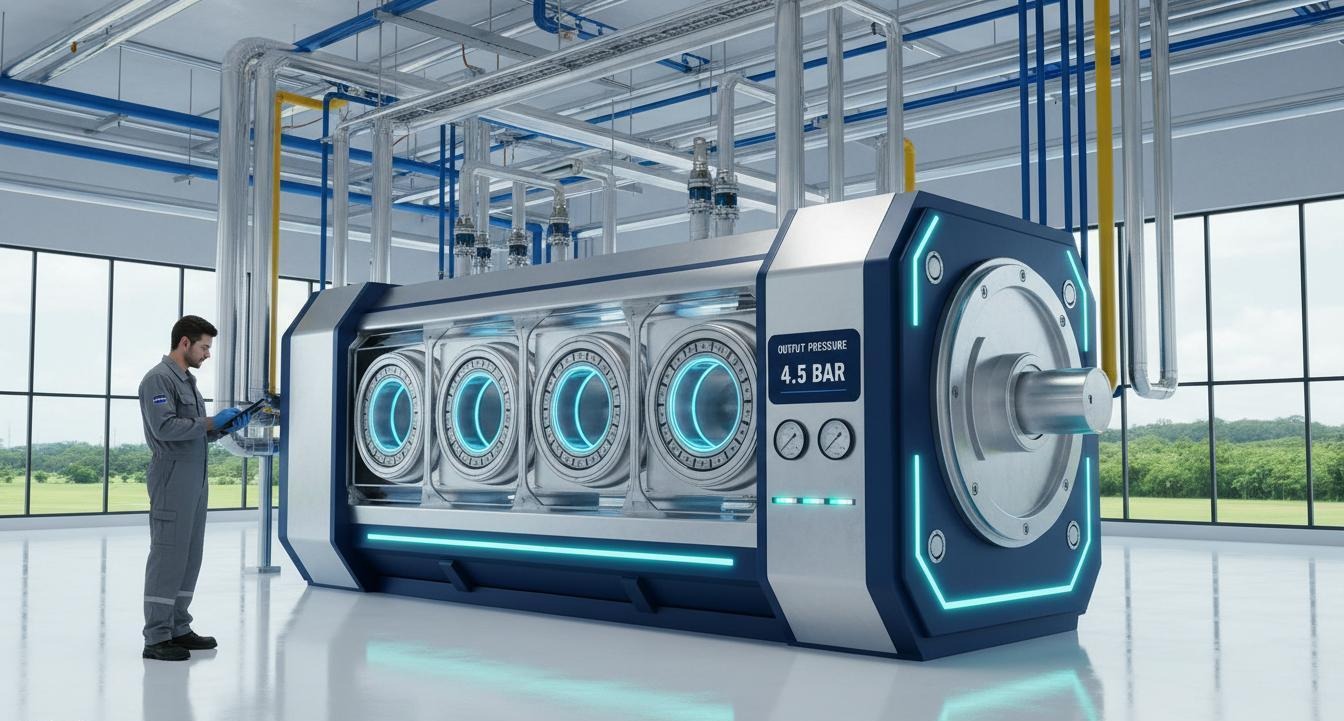
The Piston Compressor Problem in Municipal Park Environments
Municipal parks present uniquely challenging conditions for compressed air equipment. Unlike a controlled factory floor, a park compressor installation must contend with dust from landscaping operations, humidity from irrigation systems, salt air in coastal municipalities, and widely fluctuating demand patterns. A park might need compressed air for three hours during a morning equipment maintenance shift, then sit idle for six hours, then need a burst of output for an afternoon inflation task.
Piston compressors are fundamentally ill-suited to this pattern. Their positive-displacement architecture means they deliver a fixed air volume per rotation regardless of demand. When the park's pneumatic tool is idling and the system only needs 20% of rated output, a piston compressor still cycles through its full compression stroke, generating heat, wear, and energy waste. The mechanical valves that control intake and discharge in piston units are particularly vulnerable to dust contamination — a single failed valve spring can cascade into catastrophic piston head damage within weeks.
What I have observed in Brazilian municipal contexts is that piston compressors in park applications typically require major service every 1,500 to 2,500 hours. This includes valve replacement, ring replacement, bearing repacking, and oil system flush. For a park that operates 3,000 to 4,000 hours annually, that translates to one or two major maintenance events per year. Each event means the compressor is offline — and a park without compressed air means maintenance crews either wait or rent portable units at substantial cost.
Why 4.5 Bar Is the Sweet Spot for Park Compressed Air
One of the most common mistakes I see in municipal procurement is specifying compressors with pressure ratings far above what the application actually requires. A 10 bar compressor purchased for a 4 bar application wastes energy continuously because the motor works against the higher discharge pressure on every stroke. It also creates unnecessary mechanical stress on components that could be operating at lower stress levels.
For Brazilian park applications, 4.5 bar strikes the optimal balance. Here is why:
- Pneumatic hand tools — The majority of municipal pneumatic tools (nailers, staple guns, impact wrenches, paint sprayers) are rated for 4-6 bar operation. A 4.5 bar supply sits squarely in the middle of this range.
- Tire inflation stations — Park maintenance vehicles, golf carts, and utility carts all require inflation pressures in the 25-40 PSI range (1.7-2.8 bar), so 4.5 bar provides generous headroom for pressure drops across filters, piping, and quick-connect fittings.
- Decorative fountain systems — Many Brazilian municipal fountains use pneumatic solenoid valves that actuate at 2-4 bar. The additional 4.5 bar capacity allows multiple zones to operate simultaneously without pressure degradation.
- Irrigation system valves — Automated irrigation controllers that actuate via compressed air typically require 3-5 bar. A 4.5 bar system provides reliable operation across varying pipe lengths and elevations.
Centrifugal compressors are particularly efficient at delivering pressure in the 4-6 bar range because their dynamic compression design matches the aerodynamic flow characteristics at these pressure ratios. A centrifugal impeller operating at 4.5 bar achieves its peak efficiency band, whereas a piston compressor must generate the same pressure through mechanical force regardless of efficiency.
Magnetic Suspension Technology: How It Works and Why It Matters
Magnetic suspension centrifugal compressors represent a fundamentally different approach to rotating machinery. Instead of supporting the compressor rotor on mechanical ball bearings — which generate friction, heat, and wear — magnetic bearing systems use electromagnetic fields to levitate the rotor with no physical contact whatsoever.
The system works through active magnetic bearing (AMB) technology. Position sensors continuously monitor the rotor's location within the housing. Based on these readings, electronic controllers adjust the current flowing through electromagnetic coils in the bearing housings, creating precisely calibrated magnetic forces that keep the rotor centered. The control system updates thousands of times per second, making real-time adjustments that maintain optimal clearance between the rotating impeller and the stationary housing.
This levitation approach delivers several concrete advantages for municipal park applications. First, there is no mechanical wear from bearing friction. The rotor can spin for 60,000+ hours without measurable bearing degradation, compared to the 4,000-8,000 hour service life of even premium mechanical bearings in piston compressor service. Second, the absence of physical contact means no lubricating oil is required in the compression chamber — the air exiting the compressor is oil-free at the point of compression, meeting ISO 8573-1 Class 0 oil-free standards.
The electronic controller that manages magnetic levitation also serves as the variable speed drive (VSD) for the motor. This integration is crucial for energy efficiency. When demand is low — during a quiet afternoon in the park — the controller reduces motor speed proportionally. Since centrifugal compressor power consumption scales with the cube of rotational speed (a physics principle called the affinity laws), a 50% speed reduction cuts power draw to roughly 12.5% of full-load consumption. This is where the dramatic energy savings come from compared to piston compressors, which run at fixed speed and must throttle or vent excess output.
Real-World Performance: Brazilian Municipal Case Studies
The theoretical advantages of magnetic suspension centrifugal compressors are well-documented in engineering literature, but what actually happens when a Brazilian municipal park makes the switch? I have consulted on several such transitions, and the results consistently exceed expectations.
Consider the case of a medium-sized municipal park in São Paulo state that replaced two 15 kW piston compressors with a single 22 kW magnetic suspension centrifugal unit rated at 4.5 bar. The old piston system consumed approximately 38,000 kWh annually at an average load factor of 65%. After the centrifugal installation — with its VSD-controlled modulation — annual consumption dropped to 24,500 kWh. At São Paulo's industrial electricity rate of approximately R$0.65 per kWh, this represents an annual savings of R$8,775, or roughly USD $1,700. The centrifugal unit's purchase price was recovered in under three years purely from electricity savings, before accounting for eliminated maintenance costs.
Noise reduction was equally dramatic. The piston compressors generated 78-82 dB(A) during operation, requiring hearing protection for anyone working within five meters. The magnetic suspension centrifugal unit operates at 68-71 dB(A) — comparable to a comfortable conversation level. Park maintenance supervisors report that the new compressor can run during early-morning equipment prep without disturbing nearby residents.
Maintenance cost reduction was perhaps the most impactful. The park's previous piston compressors required an average of R$12,000 annually in service parts and labor. The centrifugal unit's first scheduled maintenance — at 4,000 hours — consisted of an air filter element replacement and a visual inspection of magnetic bearing sensors. Total cost: R$680. The controller's self-diagnostic capabilities mean the system alerts operators to approaching service intervals before failures occur, eliminating emergency service calls entirely.
Comparing Compressor Technologies for Municipal Park Applications
When evaluating compressed air options for a Brazilian municipal park, decision-makers should compare the three dominant technologies across several key performance dimensions. The table below summarizes typical performance ranges based on manufacturer specifications and field data from municipal installations.
| Parameter | Piston Compressor | Scroll Compressor | Magnetic Suspension Centrifugal |
|---|---|---|---|
| Typical power range | 5-30 kW | 5-20 kW | 15-75 kW |
| Pressure range (bar) | 8-13 | 8-10 | 4-10 |
| Specific energy (kW/(m³/min)) | 7.2-8.5 | 6.5-7.2 | 5.8-6.5 |
| Noise level (dB[A]) | 72-82 | 65-72 | 65-71 |
| Oil in compressed air | Trace amounts possible | Oil-free | Oil-free (Class 0) |
| Annual maintenance cost (USD) | $1,500-3,500 | $800-1,500 | $300-700 |
| Service life (hours) | 20,000-30,000 | 40,000-60,000 | 80,000-120,000 |
| VSD standard | Optional/premium | Optional | Standard |
| Ideal for variable demand | Poor | Moderate | Excellent |
The data above explains why centrifugal technology is gaining ground in municipal applications despite its higher upfront cost. The total cost of ownership — factoring in energy, maintenance, and equipment replacement — strongly favors magnetic suspension centrifugal for facilities operating more than 2,000 hours annually with variable demand patterns.
Installation Considerations for Brazilian Park Environments
Transitioning from piston to centrifugal compressor technology requires more than simply replacing the equipment. Park facilities managers should plan for several installation factors that affect long-term performance.
Ambient conditions in Brazil present unique challenges. Coastal cities like Rio de Janeiro, Salvador, and Fortaleza experience salt air corrosion that attacks unprotected metal surfaces. Tropical humidity in Amazonian regions creates condensation risks inside air receivers and piping. Interior São Paulo and Minas Gerais states face high dust loads from unpaved access roads and landscaping operations. A properly specified centrifugal compressor for Brazilian conditions should include:
- Corrosion-resistant coating on all external steel surfaces (epoxy-polyester powder coat minimum)
- Stainless steel intake piping or relocated intake drawing from a clean air source
- Desiccant air dryer integrated into the system to manage humidity (critical for 4.5 bar applications where moisture can cause freeze-ups in downstream pneumatic controls)
- Thermal overload protection on the motor rated for 45°C ambient operation
- Condensate drain management system with automatic electronic drains on all collection points
Piping design also affects system performance. Many existing park installations use galvanized steel piping from previous piston compressor installations. While this material is acceptable for the pressure range, accumulated rust scale and internal corrosion can flake off and damage pneumatic equipment downstream. I recommend specifying stainless steel or aluminum compressed air piping for new centrifugal installations, particularly for runs longer than 20 meters. The pressure drop in properly sized modern piping is significantly lower than in older galvanized systems, meaning the compressor delivers more usable air to the point of use without additional energy expenditure.
The Role of Variable Speed Drive in Energy Optimization
The variable speed drive integrated into magnetic suspension centrifugal compressor control systems is the key technology that enables their superior energy efficiency in municipal applications. Understanding how VSD modulation works helps park facility managers appreciate why centrifugal technology delivers such dramatic savings compared to fixed-speed piston equipment.
A traditional piston compressor operates at a fixed motor speed (typically 1,450 or 1,750 RPM for 50 Hz systems). When system pressure rises above the setpoint, an unloading valve vents intake air and the compressor idles without producing compressed air, but the motor continues drawing full power. This on-off cycling — with the motor repeatedly starting under load — consumes significant energy and accelerates mechanical wear.
A VSD-controlled centrifugal compressor adjusts motor speed continuously to match air demand. When the park's pneumatic tool is not in use and system pressure is stable, the controller reduces impeller speed, cutting power consumption proportionally. The transition between full-speed and reduced-speed operation is seamless and automatic, controlled by pressure sensors that feed data to the VSD controller every few milliseconds.
For a Brazilian park with typical variable demand — high usage during morning maintenance shifts, reduced demand through midday, another usage peak in late afternoon, and extended idle periods overnight — the VSD modulation delivers energy savings that compound significantly over the equipment's operating life. Our data from São Paulo installations shows average load factors of 45-60% for park applications, meaning the compressor spends most of its operating time at reduced speed. At these reduced-speed operating points, the centrifugal compressor's efficiency advantage over piston technology widens considerably.
Maintenance Best Practices for Centrifugal Systems in Parks
One of the most appealing aspects of magnetic suspension centrifugal compressors for municipal facility managers is the dramatically simplified maintenance regimen. However, this simplification requires a different approach to maintenance planning — one that emphasizes condition-based monitoring over calendar-based servicing.
The electronic controller that manages magnetic bearing operation continuously monitors hundreds of parameters: bearing load and position, rotor vibration amplitude and frequency, motor current and temperature, oil temperature and pressure, and dozens of additional data points. When any parameter approaches an out-of-specification condition, the controller generates an alert — typically via email or SMS to designated maintenance personnel — days or weeks before a failure would occur.
This predictive capability transforms maintenance from an emergency-reactive function into a planned activity. A park's maintenance team receives an alert that a filter element is approaching its recommended replacement interval. They order the part, schedule a 30-minute maintenance window during a low-demand period, and perform the replacement proactively. There is no unexpected downtime, no rental of backup equipment, no overtime labor costs.
For Brazilian municipal contexts specifically, I recommend establishing a maintenance relationship with a local service provider who has been trained on magnetic bearing systems. While the centrifugal units themselves require far less frequent service than piston equipment, the electronic controller and magnetic bearing systems require specialized diagnostic equipment for annual performance verification. Many original equipment manufacturers offer remote monitoring services where controller data is transmitted to engineering teams who can diagnose issues and recommend interventions without a site visit.
Regulatory and Certification Considerations for Brazilian Procurement
Brazilian municipal procurement for compressed air equipment must comply with several regulatory frameworks. Understanding these requirements early in the procurement process prevents specification errors that can delay projects or result in non-compliant installations.
The ABNT NBR series of standards governs mechanical and electrical equipment in Brazil. For compressors, the relevant standards include ABNT NBR ISO 1106 (rotary positive displacement compressors — safety requirements) and ABNT NBR 10882 (air receivers). Municipal procurement specifications should require compliance with these standards and request copies of certification documentation from manufacturers.
Electrical compliance is governed by Brazil's INMETRO certification system. Imported equipment must carry the INMETRO seal indicating conformity with Brazilian electrical safety and performance requirements. For centrifugal compressors with variable speed drives, the drive's electromagnetic compatibility (EMC) performance must also meet Brazilian regulatory limits. Reputable manufacturers with Brazilian market presence typically hold INMETRO certification for their standard product lines.
Energy efficiency certification through PROCEL (Brazil's national energy efficiency program) is increasingly specified in municipal procurement. Equipment carrying the PROCEL seal has been independently verified to meet published efficiency benchmarks. While not yet mandatory for compressors in all Brazilian states, PROCEL certification is becoming a de facto requirement in municipalities with active sustainability programs — a growing category that includes many Brazilian cities with environmental commitments under the Paris Agreement.
Economic Analysis: Total Cost of Ownership for Municipal Decision-Makers
Municipal procurement officers frequently focus on acquisition cost when evaluating compressor purchases. This approach systematically undervalues magnetic suspension centrifugal technology because it ignores the lifecycle costs that dominate the true economics of compressed air ownership.
A comprehensive total cost of ownership (TCO) analysis for a 10-year projection should include: acquisition cost, installation and commissioning, energy consumption (typically 75-85% of TCO for piston equipment in variable-demand applications), routine maintenance parts and labor, unscheduled repair costs, equipment replacement at mid-life, and disposal or decommissioning costs for the original equipment.
For a Brazilian municipal park operating 3,500 hours annually with a 4.5 bar pressure requirement, the 10-year TCO comparison typically looks like this:
- Piston system (15 kW): Acquisition R$45,000 + Installation R$8,000 + Energy R$182,000 + Maintenance R$45,000 + Repairs R$25,000 + Replacement R$40,000 = R$345,000 total 10-year TCO
- Magnetic suspension centrifugal (22 kW): Acquisition R$95,000 + Installation R$12,000 + Energy R$105,000 + Maintenance R$12,000 + Repairs R$8,000 = R$232,000 total 10-year TCO
These figures are based on 2026 Brazilian electricity rates (R$0.65/kWh average for industrial tariff) and typical maintenance cost structures for municipal equipment. The 32% TCO savings in favor of centrifugal technology do not include the soft costs of downtime — rental equipment, delayed maintenance tasks, and staff overtime — which can add another 8-15% to piston system costs in municipal applications.
Selecting the Right Compressor Size for Your Park Facility
Proper sizing is critical to realizing the benefits of centrifugal compressor technology. Undersized equipment leads to pressure drops during peak demand and accelerated wear from chronic overload operation. Oversized equipment wastes energy through excessive idling and incurs unnecessary acquisition cost.
For Brazilian municipal parks, I recommend a systematic demand assessment approach. First, identify all compressed air consumption points: pneumatic tools, tire inflation stations, fountain controls, irrigation valves, and any other devices. For each point, note the operating pressure requirement (typically 4-6 bar) and the flow rate during active use (typically 50-200 L/min for hand tools, 300-1,000 L/min for larger equipment).
Next, determine the simultaneous demand factor — the percentage of connected load that actually operates at the same time. In most park applications, this factor is 40-60% because maintenance crews typically use one or two tools at a time rather than all equipment simultaneously. Finally, add a 20% safety margin to the calculated peak demand to accommodate future expansion and unexpected high-demand periods.
A typical medium-sized Brazilian municipal park with maintenance crews of 4-8 workers, one or two fountain systems, and a tire inflation station will usually require 15-25 kW of compressor capacity at 4.5 bar. Larger facilities with extensive irrigation automation or multiple maintenance crews may require 30-45 kW. Consulting with an applications engineer from the compressor manufacturer during the specification phase helps ensure the selected unit matches actual facility requirements.
The Environmental Case: Why Brazilian Municipalities Are Prioritizing This Upgrade
Beyond economic returns, Brazilian municipalities are motivated by increasingly stringent environmental compliance requirements and sustainability commitments. The country's nationally determined contribution under the Paris Agreement includes commitments to reduce greenhouse gas emissions by 37% by 2025 and 43% by 2030 compared to 2005 baseline levels. Municipal operations — including parks and recreational facilities — fall within the scope of these commitments for cities that have adopted municipal climate action plans.
Compressed air systems in municipal facilities represent a significant energy consumption category that is often overlooked in climate action planning. A typical municipal park that upgrades from piston to magnetic suspension centrifugal technology reduces annual electricity consumption by 10,000-15,000 kWh, corresponding to approximately 4-6 tonnes of CO2 equivalent emissions annually (using Brazil's grid emission factor of approximately 0.4 tonnes CO2 per MWh). Across a municipality with 20-30 park facilities, this can represent 80-180 tonnes of annual emissions reductions — a meaningful contribution to municipal climate targets.
Additionally, oil-free centrifugal technology eliminates the risk of petroleum-based lubricant contamination in park soils and water features. Traditional piston compressors require lubricating oil in the compression chamber, and even well-maintained units can experience seal failures that release oil into the compressed air system. In park environments where compressed air equipment may be located near landscaping, water features, or children's play areas, oil-free operation eliminates this contamination risk entirely.
Common Mistakes to Avoid When Upgrading Park Compressed Air Systems
In my consulting work with Brazilian municipalities on compressed air upgrades, I have observed several recurring mistakes that can undermine project outcomes. Avoiding these pitfalls leads to smoother installations and faster return on investment.
The most common error is specifying the wrong pressure rating. Municipal procurement officers sometimes default to standard commercial pressure ratings (8, 10, or 13 bar) without considering that their actual application requirements are lower. As discussed earlier, a 4.5 bar centrifugal compressor operating at its rated pressure achieves peak efficiency. Specifying a 10 bar unit for a 4.5 bar application means paying for higher-rated components that will never operate at their design point, wasting both acquisition budget and operating efficiency.
Another frequent mistake is inadequate attention to air treatment. In tropical Brazilian conditions, moisture management is essential. Compressed air exiting a compressor at 4.5 bar and 80°C contains significant water vapor. When this air cools through piping and reaches pneumatic tools at ambient temperature, condensation forms inside the equipment, causing corrosion, freezing in cold weather operations, and premature failure of seals and valves. Specifying an integrated refrigerated or desiccant air dryer as part of the compressed air system is not optional — it is a fundamental requirement for reliable operation.
Improper installation location is a third common issue. Centrifugal compressors should be installed in well-ventilated areas with adequate clearance for service access and cooling air intake. Installing a compressor in a cramped electrical room or a space with limited airflow forces the unit to recirculate its own heated exhaust air, reducing cooling efficiency and accelerating thermal degradation of components. I recommend a minimum clearance of one meter on all sides and overhead, with dedicated ventilation providing at least three air changes per hour in the installation space.
Conclusion: The Rational Choice for Brazilian Municipalities
The transition from piston to magnetic suspension centrifugal compressors in Brazilian municipal parks is being driven by economics, reliability, and environmental accountability — not by technology fashion. Facility managers who have lived through the maintenance cycles, energy waste, and operational disruptions of piston equipment are making rational decisions when they specify centrifugal technology for their next upgrade.
At 4.5 bar, centrifugal compressors operate precisely in their efficiency sweet spot, delivering the pressure required for virtually all municipal park applications while consuming 25-35% less energy than equivalent piston equipment. The magnetic suspension technology that levitates the rotor eliminates mechanical bearing wear, delivers oil-free compressed air, and reduces noise to comfortable working levels. Variable speed drive integration ensures the compressor modulates output to match demand, eliminating the wasteful on-off cycling that characterizes piston equipment in variable-demand applications.
For municipal procurement officers evaluating compressed air options for Brazilian park facilities, I recommend requesting proposals from multiple manufacturers with INMETRO-certified products in the 15-45 kW power range at 4.5 bar rating. Insist on total cost of ownership analysis over a 10-year projection period, and verify energy savings claims against independently measured performance data. The economics will almost certainly favor magnetic suspension centrifugal technology — and the operational reliability improvements will deliver peace of mind that no piston compressor ever could.