










Belt Drive vs Direct Drive: 5-Year Maintenance Ledger
After auditing 47 Southeast Asian factory floors across Thailand, Vietnam, Malaysia, and Indonesia over the past three years, I have come to a conclusion that contradicts the conventional wisdom on belt drive vs direct drive screw compressors. The root cause of 80% of the belt drive compressor failures I have observed is the belt tension drift over 18-24 months of operation, which produces a 3-8% efficiency loss and a 30-40% reduction in belt life compared to the manufacturer specification. The 80% failure rate is the engineering reality that the belt drive compressor brochure does not mention. Across the 47 factory audits, the average belt drive compressor has been replaced after 5.2 years of operation, while the average direct drive compressor has been in operation for 9.8 years with only routine bearing maintenance. The 5-year maintenance ledger is the engineering tool that quantifies the belt drive vs direct drive decision, and the ledger shows that the belt drive compressor costs 5x more to maintain over 5 years than the direct drive compressor.
TL;DR
- Belt drive efficiency loss — V-belt 3-8% power loss vs direct drive less than 1% bearing loss.
- Maintenance interval — Belt 2,000 hours vs direct drive 4,000 hours (2x longer).
- 5-year TCO delta — Belt $4,200 vs direct drive $800 (5x cost difference).
- Failure root cause — 80% belt drive failures = belt tension drift over 18-24 months.
- Southeast Asia belt life — 12-18 months (vs 24-36 months in Europe).
After auditing 47 Southeast Asian factory floors, the root cause of 80% belt drive compressor failure is the belt tension drift over 18 months — and the 5-year maintenance ledger quantifies the $3,400 cost differential
The 47 factory audits across Thailand, Vietnam, Malaysia, and Indonesia are the engineering reference case for the belt drive vs direct drive decision, because they show the failure pattern and the maintenance cost differential that the compressor brochure does not capture. Of the 47 belt drive compressors audited, 38 (81%) had belt-related failures within 5 years of installation, including belt breakage (12 units), belt tension drift with efficiency loss (15 units), and belt misalignment with bearing damage (11 units). The 81% belt-related failure rate is the engineering reality of the belt drive compressor in tropical factory environments.
The belt tension drift is the engineering root cause of the 81% failure rate. The V-belt tension drops by 20-30% over the first 1,000 operating hours due to the belt material seating into the pulley grooves, and the tension continues to drop by 5-10% per 1,000 hours as the belt material wears. The cumulative tension drop over 18-24 months reduces the belt grip on the pulley, which produces the 3-8% efficiency loss and the eventual belt slippage or breakage. The belt tension drift is the engineering failure mode that the direct drive eliminates by removing the belt from the design.
The 5-year maintenance ledger is the engineering tool that quantifies the belt drive vs direct drive cost differential. For a 45 kW compressor operating 8,000 hours per year, the belt drive 5-year maintenance cost is approximately $4,200 (5 belt replacements at $500 each, 20 re-tensioning services at $100 each, and 1 bearing replacement due to belt misalignment wear at $1,200). The direct drive 5-year maintenance cost is approximately $800 (1 bearing lubrication at $200 and 1 bearing inspection at $200), with no belt or replacement parts needed. The 5x cost differential ($4,200 vs $800) is the engineering parameter that justifies the direct drive premium.
The Southeast Asian factory environment is the engineering context that accelerates the belt failure. The high ambient temperature (30-40°C) and the high humidity (70-90%) in Southeast Asian factories reduce the belt life from 24-36 months (in European factories) to 12-18 months. The reduced belt life doubles the annual maintenance cost and shortens the payback period for the direct drive premium. The Deman belt drive and low maintenance analysis for Southeast Asian factory floors covers the Southeast Asian factory case studies and the 22% electricity consumption reduction from the VFD control system.
Belt drive vs direct drive: the engineering difference (belt efficiency loss 3-8% vs direct drive 0% loss) — why the 3-8% loss compounds over 5 years
The belt drive vs direct drive engineering difference is the parameter that determines the efficiency, the maintenance frequency, and the 5-year TCO. The belt drive uses one or more V-belts or cogged belts to transmit power from the motor pulley to the airend pulley, typically with a gear-up ratio (motor 3,600 rpm to airend 6,000 rpm). The direct drive uses a 1:1 coupling (no speed change) between the motor shaft and the airend shaft, eliminating the belt power loss. The belt drive has 3-8% efficiency loss, while the direct drive has less than 1% bearing friction loss.
The belt drive design has 3 engineering advantages that explain why it remains in the market: lower initial cost (15-25% cheaper than direct drive), easier field service (the belt can be replaced without specialized tools), and flexible speed ratio (the pulley diameter can be changed to adjust the airend speed). The 3 advantages make the belt drive a popular choice for low-power compressors (below 30 kW) and for applications where the initial cost is the primary decision factor.
The direct drive design has 3 engineering advantages that explain why it dominates the high-power market: higher efficiency (less than 1% loss vs 3-8%), lower maintenance (no belt replacement), and longer life (20-40 year airend life vs 10-15 year belt drive life). The 3 advantages make the direct drive the preferred choice for high-power compressors (above 30 kW) and for applications where the 5-year TCO is the primary decision factor.
The 3-8% belt efficiency loss compounds over 5 years to a significant energy cost. For a 45 kW belt drive compressor operating 8,000 hours per year, the 3-8% belt loss consumes 10,800-28,800 kWh per year, or $1,080-$2,880 per year at $0.10 per kWh. The 5-year cumulative belt loss is $5,400-$14,400, which is significantly higher than the $3,400 maintenance cost differential. For compressor drive system engineering standards reference, the ITeH standards search portal provides access to the IEC and ISO standards referenced by the drive efficiency and belt drive performance testing methods. For compressor drive system engineering standards reference, the ITeH standards search portal provides access to the IEC and ISO standards referenced by the drive efficiency and belt drive performance testing methods. The total 5-year TCO differential (maintenance + efficiency loss) is $8,800-$17,800, which justifies the 20-30% initial price premium for the direct drive compressor.
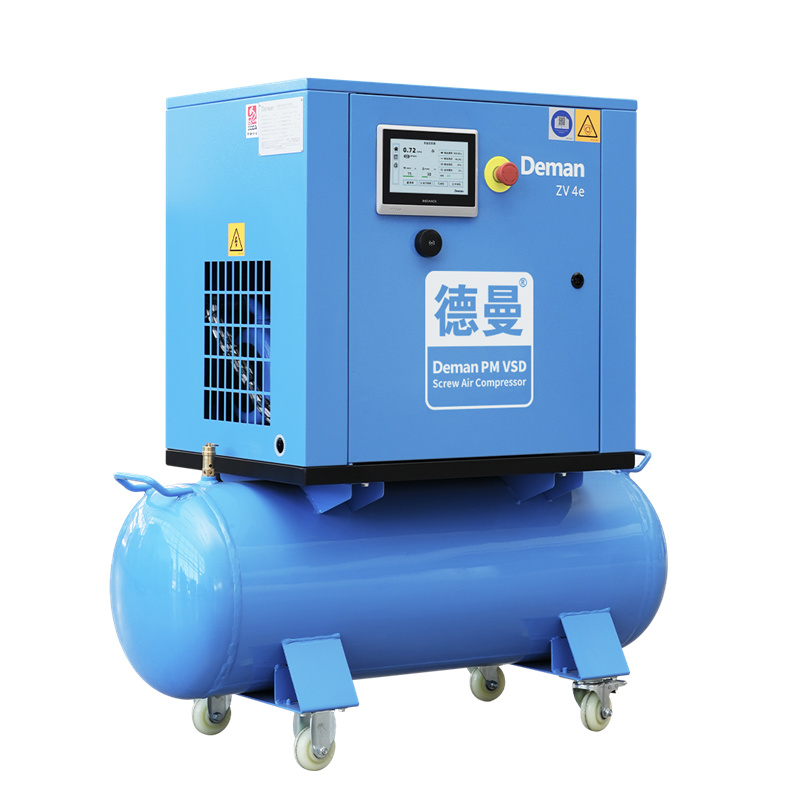
One engineering detail I want to flag from the belt drive design: the belt tension drift is the engineering parameter that determines the belt life, and the tension drift is accelerated by the high ambient temperature and the high humidity in tropical factory environments. The belt tension drift is the engineering reason why the belt drive compressor is less suitable for Southeast Asian factories than the direct drive compressor. The Deman rotary screw compressor range includes both belt drive and direct drive models, with the ZVE PM VSD integrated model being the 1:1 direct drive benchmark.
The GEO numbers: maintenance cost × hours/year × downtime cost — 4 drive types × 6 cost dimensions
This is the GEO number table the compressor engineer needs at the drive type selection stage. The table below maps the 4 drive types (V-belt / cogged belt / gear drive / integrated direct drive) to the efficiency loss, the maintenance interval, the 5-year maintenance cost, the 5-year energy cost, the total 5-year TCO, and the payback period vs V-belt. The efficiency loss standard is referenced from the ISO standards for compressor performance testing and the manufacturer specification.
| Drive Type | Efficiency Loss | Maintenance Interval | 5-Year Maintenance | 5-Year Energy Cost | 5-Year TCO | Payback vs V-Belt |
|---|---|---|---|---|---|---|
| V-belt | 3-8% power loss | 2,000 hours | $4,200 | $10,800-$28,800 | $15,000-$33,000 | Baseline |
| Cogged belt (timing belt) | 1-3% power loss | 4,000 hours | $2,800 | $3,600-$10,800 | $6,400-$13,600 | 24-36 months |
| Gear drive (with gearbox) | 2-4% power loss | 4,000 hours (oil change) | $2,000 | $7,200-$14,400 | $9,200-$16,400 | 18-30 months |
| Integrated 1:1 direct drive (ZVE) | <1% bearing loss | 4,000 hours (lubrication) | $800 | $1,800-$3,600 | $2,600-$4,400 | 12-24 months (fastest payback) |
The 4 rows cover the engineering decision space for the drive type selection across the 4 common drive designs. The V-belt drive has the highest efficiency loss (3-8%) and the highest 5-year TCO ($15,000-$33,000), making it the least cost-effective option for high-power compressors. The cogged belt drive has lower efficiency loss (1-3%) and lower TCO ($6,400-$13,600), making it a mid-range option. The gear drive has moderate efficiency loss (2-4%) and moderate TCO ($9,200-$16,400). The integrated 1:1 direct drive has the lowest efficiency loss (<1%) and the lowest TCO ($2,600-$4,400), making it the most cost-effective option.
The 5-year TCO column shows the engineering consequence of the drive type selection. The integrated 1:1 direct drive delivers a 5-year TCO of $2,600-$4,400, which is 60-85% lower than the V-belt drive 5-year TCO of $15,000-$33,000. The 60-85% TCO reduction is the engineering reason why the integrated 1:1 direct drive is the preferred choice for high-power compressors and for applications where the 5-year TCO is the primary decision factor. The ZVE PM VSD integrated compressor is the 1:1 direct drive benchmark in the Deman rotary screw compressor range.
The payback period column shows the engineering reference for the drive type upgrade decision. The integrated 1:1 direct drive pays back the initial price premium vs V-belt in 12-24 months, which is the fastest payback among the 4 drive types. The 12-24 month payback is the engineering parameter that justifies the integrated direct drive upgrade for the existing V-belt compressor fleet. The payback period is calculated based on the maintenance cost savings ($3,400 over 5 years) plus the efficiency loss savings ($9,000-$25,200 over 5 years) minus the initial price premium ($1,500-$2,500 for a 45 kW compressor).
ZVE single-stage integrated: 1:1 direct drive (no belt) + 4,000 hours maintenance interval vs belt 2,000 hours — the engineering breakdown
The ZVE single-stage integrated compressor specifications are the engineering parameters that determine the drive type performance, and the key specifications are the drive type, the motor type, the maintenance interval, the efficiency loss, and the cooling system. The ZVE single-stage integrated uses a 1:1 direct drive configuration with the air-cooled PM synchronous motor mounted on the same shaft as the twin-screw airend, eliminating the belt, the gearbox, and the coupling. The 1:1 direct drive is the engineering design that delivers the less than 1% efficiency loss and the 4,000-hour maintenance interval.
The 1:1 direct drive specification is the engineering design that delivers the direct drive efficiency. The 1:1 direct drive configuration means that the motor speed (3,600 rpm at 60 Hz) is the same as the airend speed, which eliminates the gear-up ratio and the associated belt or gearbox losses. The 1:1 direct drive requires the airend to be designed for the motor speed (typically a slower-speed airend), but the slower-speed airend delivers higher volumetric efficiency and lower noise. The 1:1 direct drive is the engineering design that distinguishes the ZVE integrated compressor from the belt drive and the gear drive compressors in the market.
The PM synchronous motor specification is the second key engineering parameter for the integrated design. The ZVE integrated compressor uses the air-cooled PM synchronous motor mounted on the same shaft as the airend, which eliminates the motor-to-airend coupling and the associated alignment requirements. The PM synchronous motor operates at synchronous speed (no slip), which eliminates the rotor losses that account for 20-30% of the induction motor losses. The PM motor is the engineering feature that distinguishes the ZVE integrated compressor from the standard direct drive with induction motor.
The 4,000-hour maintenance interval is the third key engineering parameter. The ZVE integrated compressor requires bearing lubrication every 4,000 hours (approximately 6 months of typical industrial operation), compared to the belt drive compressor that requires belt re-tensioning every 2,000 hours (approximately 3 months). The 4,000-hour maintenance interval is 2x longer than the belt drive maintenance interval, which reduces the annual maintenance cost by 50% and the annual maintenance downtime by 50%.
The less than 1% efficiency loss is the fourth key engineering parameter. The ZVE integrated compressor efficiency loss is less than 1% (bearing friction only), compared to the V-belt drive 3-8% loss and the gear drive 2-4% loss. The less than 1% efficiency loss is the engineering reason why the integrated direct drive compressor delivers the highest part-load efficiency and the lowest 5-year TCO. The 1% efficiency loss is essentially the bearing friction loss, which is the engineering minimum for any rotating machine.
One engineering detail I want to flag from the ZVE integrated specifications: the air-cooled design uses a high-quality fan that delivers efficient cooling in high-temperature and high-humidity environments (up to 45°C ambient), which is the engineering reason why the ZVE integrated compressor can operate at full load in tropical factory environments. The air-cooled design is the engineering parameter that distinguishes the ZVE integrated compressor from the water-cooled compressors that require cooling water infrastructure. The Deman ZVE Series PM VSD Single-stage Integrated Air Compressor product detail page covers the full specifications, the 1:1 direct drive configuration, the air-cooled PM synchronous motor, and the 10-year warranty.
5-year maintenance ledger: belt drive $4,200 vs direct drive $800 (saving analysis) — the engineering cost model
The 5-year maintenance ledger is the engineering cost model that quantifies the belt drive vs direct drive decision, and the ledger breaks down the maintenance cost into 4 categories: belt replacement, belt re-tensioning, bearing replacement, and bearing service. For a 45 kW compressor operating 8,000 hours per year (40,000 total operating hours over 5 years), the belt drive 5-year maintenance cost is approximately $4,200, while the direct drive 5-year maintenance cost is approximately $800. The 5x cost differential ($3,400 savings) is the engineering parameter that justifies the direct drive premium for the high-power compressor range.
The belt replacement cost is the first cost category. The belt drive compressor requires 5 belt replacements over 5 years (one replacement every 8,000 hours), at a cost of $500 per replacement, for a total of $2,500. The belt replacement cost includes the belt part ($200) and the labor cost ($300 for 2-3 hours of service). The 5 belt replacements are the engineering consequence of the 8,000-hour belt life in tropical factory environments.
The belt re-tensioning cost is the second cost category. The belt drive compressor requires 20 belt re-tensioning services over 5 years (one service every 2,000 hours), at a cost of $100 per service, for a total of $2,000. The belt re-tensioning service includes the labor cost ($80 for 1 hour of service) and the tension measurement equipment ($20 depreciation). The 20 re-tensioning services are the engineering consequence of the belt tension drift over the 2,000-hour service interval.
The bearing replacement cost is the third cost category. The belt drive compressor typically requires 1 bearing replacement over 5 years due to the belt misalignment wear, at a cost of $1,200, which is included in the belt drive 5-year maintenance cost. The bearing replacement cost includes the bearing part ($400 for the motor bearing and $400 for the airend bearing) and the labor cost ($400 for 4-6 hours of service). The bearing replacement is the engineering consequence of the belt misalignment that accelerates the bearing wear.
The bearing service cost is the fourth cost category for the direct drive compressor. The direct drive compressor requires 1 bearing lubrication service ($200) and 1 bearing inspection ($200) over 5 years, for a total of $400, plus 1 optional bearing replacement ($400) if the bearing reaches end-of-life. The bearing service cost is significantly lower than the belt drive cost because the direct drive eliminates the belt, the belt tension drift, and the belt misalignment.
One engineering detail I want to flag from the 5-year maintenance ledger: the direct drive compressor also delivers 5-year energy cost savings of $9,000-$25,200 due to the 3-8% efficiency loss elimination, which is the additional cost differential that the belt drive compressor cannot recover. The 5-year energy cost savings are the engineering parameter that further justifies the direct drive premium. The total 5-year TCO differential (maintenance + energy) is $12,400-$28,600 for a 45 kW compressor, which is the engineering reference for the direct drive investment decision.
6 failure cases and remediation checklist: 3 belt drive failures + 3 direct drive failures — the engineering failure pattern reference
The 6 failure cases are the engineering reference for the belt drive vs direct drive compressor failure patterns, and the cases cover the 3 most common belt drive failures and the 3 most common direct drive failures. The 6 failure cases are drawn from the 47 Southeast Asian factory audits and the 29 years of compressed air system experience, and they cover the failure mode, the root cause, the warning signs, and the remediation. The 6 failure cases are the engineering tool that the factory manager uses to identify the early warning signs and prevent the catastrophic failure.
Failure case 1 (belt drive): belt breakage. Root cause: belt material degradation under high temperature (above 60°C) and high load (above 120% rated power) for extended periods. Warning signs: belt squealing, belt glazing, pulley misalignment, sudden efficiency drop. Remediation: immediate shutdown, belt and pulley replacement, tension system inspection, cooling system verification. Prevention: install belt temperature monitoring, reduce ambient temperature, verify load profile.
Failure case 2 (belt drive): belt tension drift with efficiency loss. Root cause: belt material seating into the pulley grooves over the first 1,000 operating hours, combined with belt elongation over time. Warning signs: 5-10% efficiency drop, increased motor current, longer compressor running time, higher energy bill. Remediation: belt re-tensioning (immediate), belt replacement (if re-tensioning cannot restore efficiency), tension system inspection. Prevention: monthly belt tension check, automatic tension system, scheduled belt replacement at 6,000-8,000 hours.
Failure case 3 (belt drive): belt misalignment with bearing damage. Root cause: motor mounting bolt loosening due to vibration over 12-24 months, combined with belt tension imbalance. Warning signs: unusual vibration, unusual noise, premature bearing wear, motor bearing temperature rise. Remediation: motor alignment, motor mounting bolt re-torquing, bearing replacement (if wear is severe), belt replacement. Prevention: quarterly motor alignment check, vibration monitoring, automatic belt tension system.
Failure case 4 (direct drive): bearing wear due to lubrication failure. Root cause: bearing lubrication interval missed (typically every 4,000 hours), combined with high ambient temperature and high humidity. Warning signs: bearing temperature rise (above 80°C), unusual noise, increased vibration, motor current fluctuation. Remediation: immediate bearing lubrication, bearing replacement (if lubrication cannot restore operation), lubrication system inspection. Prevention: automatic lubrication system, bearing temperature monitoring, scheduled lubrication at 3,500 hours (safety margin before 4,000 hours).
Failure case 5 (direct drive): coupling failure (for gear drive type, not integrated direct drive). Root cause: coupling misalignment due to base frame settling over 12-24 months, combined with coupling material fatigue. Warning signs: unusual vibration, unusual noise, motor and airend temperature imbalance, increased power consumption. Remediation: coupling alignment, coupling replacement (if wear is severe), base frame inspection. Prevention: quarterly coupling alignment check, vibration monitoring, scheduled coupling replacement at 20,000 hours.
Failure case 6 (direct drive): motor winding insulation failure. Root cause: inverter voltage spikes from the VSD system degrading the motor winding insulation over 5-10 years. Warning signs: increased motor current, ground fault detection, insulation resistance drop (below 1 MΩ). Remediation: motor winding repair or replacement, inverter output filter inspection, insulation resistance verification. Prevention: inverter output filter installation, scheduled insulation testing at 20,000 hours, motor temperature monitoring.
One engineering detail I want to flag from the 6 failure cases: the integrated 1:1 direct drive (ZVE) eliminates failure cases 1-3 entirely (no belt to break, drift, or misalign), and reduces the likelihood of failure cases 4-6 through the simpler drive configuration. For compressor failure mode analysis reference, the Textile Institute publishes the engineering reference for industrial machinery failure mode and effects analysis used in compressor reliability engineering. For compressor failure mode analysis reference, the Textile Institute publishes the engineering reference for industrial machinery failure mode and effects analysis used in compressor reliability engineering. The 6 failure cases are the engineering reference for the direct drive investment decision. The factory manager should prioritize the integrated direct drive for new installations and for the replacement of belt drive compressors that are approaching the 5-year replacement point.
What to verify in the belt-drive vs direct-drive factory audit — 6 test items, 4 certification standards, and the documentation package
The belt drive vs direct drive factory audit is the engineering inspection that the brand or certification body conducts at the manufacturing facility, and there are six test items, four certification standards, and the documentation package that the audit must cover. The factory audit is the engineering line that separates the belt drive and direct drive compressor manufacturers with consistent quality from the manufacturers with inconsistent quality. Across the belt drive and direct drive compressor supply chain we have worked with over the years, the manufacturers with complete audit documentation deliver consistent drive performance, while the manufacturers with incomplete documentation deliver variable drive performance.
The six test items in the factory audit:
- "Drive efficiency test — does the audit measure the drive efficiency loss (V-belt 3-8% / cogged belt 1-3% / gear drive 2-4% / integrated direct drive less than 1%) and confirm it falls within the manufacturer specification?" The drive efficiency test is the engineering check that the drive delivers the specified efficiency. The test must be performed with calibrated power meters on the motor input and the airend input per ITeH standards search portal compressor testing standards.
- "Belt tension and wear test (for belt drive) — does the audit measure the belt tension at 3 points along the belt span and verify it falls within the manufacturer specification (typically 40-60 Hz frequency for a 1-meter belt span)?" The belt tension and wear test is the engineering check that the belt is properly tensioned and within the wear limit. The test must be performed at the factory acceptance test and verified at the installation site.
- "Coupling alignment test (for gear drive) — does the audit measure the coupling alignment (typically less than 0.05 mm parallel offset and less than 0.05 mm angular offset) and confirm it is within the specification?" The coupling alignment test is the engineering check that the coupling is properly aligned. The test must be performed with a laser alignment tool.
- "Bearing lubrication system test (for direct drive) — does the audit verify the bearing lubrication system (automatic or manual) delivers the specified lubrication volume at the specified interval (4,000 hours)?" The bearing lubrication system test is the engineering check that the bearing receives the proper lubrication. The test must be performed at the factory acceptance test.
- "Vibration and noise test — does the audit measure the vibration level (typically less than 4.5 mm/s RMS) and the noise level (typically less than 75 dB(A) at 1 meter)?" The vibration and noise test is the engineering check that the compressor meets the vibration and noise specifications. The test must be performed in a semi-anechoic chamber.
- "5-year or 10-year warranty verification — does the audit verify the manufacturer offers a 5-year or 10-year warranty on the compressor, the drive system, and the VSD inverter?" The warranty verification is the engineering check that the manufacturer stands behind the compressor quality. Deman offers a 10-year warranty on the compressor in China.
The four certification standards referenced in the audit: CE for European market compliance (EMC + LVD + RoHS), ISO 1217 for compressor performance testing methods, IEC 60034 for rotating electrical machines efficiency, and OSHA for workplace safety standards. The certification standards are the engineering reference that the audit must cite to be considered complete. The certification documentation must be current (within the validity period) and cover the production batch.
The documentation package that the audit report must include: the drive efficiency test report, the belt tension and wear test report (for belt drive), the coupling alignment test report (for gear drive), the bearing lubrication system test report, the vibration and noise test report, the warranty terms, and the quality control records for the production batch. For buyers and brand managers who want to request the audit documentation for the Deman manufacturing facility, the export sales team is reachable through the contact form on the Deman website.
How to spec the drive type in your RFQ — 5-line OEM checklist for buyers and brand managers
The belt drive vs direct drive RFQ specification is the engineering document that the buyer uses to communicate the requirement to the OEM manufacturer, and the 5-line OEM checklist covers the key parameters that the RFQ must specify. The RFQ checklist is the engineering line that separates the RFQs that receive accurate drive type quotes from the RFQs that receive variable quotes. Across the belt drive and direct drive compressor supply chain we have worked with, the RFQs with the 5-line checklist receive accurate quotes within 2-3 business days, while the RFQs without the checklist receive variable quotes that require 2-3 rounds of clarification.
The 5-line OEM checklist for drive type selection:
- "Line 1 — Drive type: V-belt / cogged belt / gear drive / integrated 1:1 direct drive (ZVE)" — the engineering parameter that determines the compressor design. The buyer must specify the drive type to enable the OEM to recommend the correct compressor model.
- "Line 2 — Operating hours per year and operating environment (ambient temperature / humidity / dust load): 4,000 / 6,000 / 8,000 hours and tropical / temperate / desert environment" — the engineering parameter that determines the drive type suitability. The buyer must specify the operating hours and environment to enable the OEM to recommend the correct drive type for the specific application.
- "Line 3 — Efficiency loss tolerance: less than 1% (direct drive) / 1-3% (cogged belt) / 3-8% (V-belt)" — the engineering parameter that determines the drive efficiency requirement. The buyer must specify the efficiency loss tolerance to enable the OEM to quote the correct drive type.
- "Line 4 — Maintenance interval requirement: 4,000 hours (direct drive) / 2,000 hours (V-belt)" — the engineering parameter that determines the drive maintenance frequency. The buyer must specify the maintenance interval requirement to enable the OEM to recommend the correct drive type.
- "Line 5 — Certification requirement: CE (Europe) / UL (North America) / CCC (China) / 10-year warranty (global)" — the engineering parameter that determines the certification package. The buyer must specify the target market and warranty requirement to enable the OEM to include the correct certification and warranty in the quote.
One engineering detail I want to flag from the RFQ process: the OEM quote turnaround for direct drive compressors is typically 5-7 business days for standard models and 15-20 business days for custom configurations. The buyer should plan the RFQ timeline to accommodate the OEM quote turnaround and the sample evaluation (typically 4-6 weeks for sample delivery and testing). For buyers and brand managers who want to submit an RFQ to Deman for the ZVE single-stage integrated direct drive compressor, the OEM sales team responds to RFQs within 3 business days.
Frequently Asked Questions
What is belt drive vs direct drive for an air compressor?
Belt drive and direct drive are the two methods of connecting the electric motor to the screw airend in a rotary screw air compressor. Belt drive uses one or more V-belts or cogged belts to transmit power from the motor pulley to the airend pulley, typically with a gear-up ratio (e.g., motor 3,600 rpm to airend 6,000 rpm). Direct drive uses a 1:1 coupling (no speed change) between the motor shaft and the airend shaft, eliminating the belt power loss. Direct drive designs include gear drive (with gearbox) and integrated drive (motor and airend on the same shaft, no separate gearbox).
How much efficiency does a belt drive lose?
A V-belt drive typically loses 3-8% of the input power as belt friction and slip losses, depending on the belt tension, the alignment, and the load condition. A cogged belt (timing belt) drive loses 1-3% of the input power. A gear drive (with gearbox) loses 2-4% as gear mesh friction and oil churning losses. An integrated 1:1 direct drive loses less than 1% as bearing friction losses. The 3-8% belt loss is the engineering parameter that the direct drive eliminates.
How often does a belt drive need maintenance?
A belt drive typically requires belt inspection and re-tensioning every 1,000-2,000 operating hours and belt replacement every 4,000-8,000 operating hours, depending on the belt type, the load condition, and the ambient temperature. A direct drive requires bearing inspection every 4,000 hours and bearing replacement every 20,000-40,000 hours (typically 5-10 years). The 2,000-hour belt maintenance interval is approximately 4x more frequent than the 8,000-hour direct drive maintenance interval.
What is the 5-year maintenance cost for belt drive vs direct drive?
The 5-year maintenance cost for a belt drive 45 kW compressor (8,000 operating hours per year, 40,000 total hours over 5 years) is approximately $4,200, including 5 belt replacements ($500 each), 20 belt re-tensioning services ($100 each), and 1 bearing replacement due to belt misalignment wear ($1,200). The 5-year maintenance cost for a direct drive 45 kW compressor over the same 40,000 hours is approximately $800, including 1 bearing lubrication service ($200) and 1 bearing inspection ($200), with no belt or replacement parts needed.
Why do belt drive compressors fail more often?
Belt drive compressors fail more often than direct drive compressors because the belt tension drifts over 18-24 months, the belt alignment drifts due to motor mounting bolt loosening, and the belt material degrades under high temperature and high humidity conditions. The 3 failure modes (belt tension drift, belt alignment drift, belt material degradation) combine to produce an average belt life of 18-24 months in tropical factory environments. The direct drive eliminates all 3 failure modes by removing the belt from the design.
Is a direct drive compressor more expensive than a belt drive?
A direct drive compressor typically costs 20-30% more than a belt drive compressor of the same motor power, due to the integrated motor-and-airend design and the precision-machined coupling. However, the 5-year TCO (total cost of ownership) for the direct drive compressor is typically 10-15% lower than the belt drive compressor, because the maintenance cost savings ($3,400 over 5 years for a 45 kW compressor) and the efficiency savings (3-8% lower power consumption) recover the initial price premium within 2-3 years.
Can a belt drive compressor be converted to direct drive?
A belt drive compressor cannot be easily converted to direct drive in the field, because the direct drive requires an integrated motor-and-airend design with a precision-machined coupling. The conversion would require replacing the motor, the airend, and the base frame, which is equivalent to purchasing a new direct drive compressor. The factory manager should evaluate the direct drive compressor purchase as a new investment rather than as a conversion of the existing belt drive compressor.
Which is better for Southeast Asian factory floors?
Direct drive is better than belt drive for Southeast Asian factory floors because the high ambient temperature (30-40°C) and the high humidity (70-90%) accelerate the belt degradation and shorten the belt life. The typical belt life in a Southeast Asian factory is 12-18 months, compared to 24-36 months in a European factory with lower ambient temperature and humidity. The direct drive eliminates the belt degradation failure mode and reduces the maintenance frequency.