










Air Compressor Selection: Air-cooled or Water-cooled?
Many customers struggle to decide between air-cooled and water-cooled compressors during equipment selection. Neither option is universally superior; the final choice depends on on-site working conditions and ambient environment.
This article compares the two cooling solutions to support your rational selection.
- Water-cooled Air Compressor
Water-cooled units control operating temperature via circulating cooling water and temperature difference. Water cooling is preferred for compressors above 200 kW.
-Advantages
|
Advantage |
Description |
|
Stable against ambient fluctuation |
Cooling performance unaffected by seasonal temperature changes |
|
Dust-resistant |
Durable in dusty industries such as textile, coating and mining, free from clogging failures caused by dirt buildup |
|
High heat dissipation efficiency |
High specific heat capacity of water enables powerful heat removal, ideal for large-power units |
-Disadvantages
|
Disadvantage |
Description |
|
Strict water quality requirement |
Cooling water must meet standards on hardness, impurities and pH to avoid scaling and internal corrosion |
|
Complicated configuration |
Additional cooling tower, water pump, piping and water treatment system lead to higher upfront investment |
|
Higher running cost |
Continuous consumption of water and pump power plus regular water treatment expenses |
- Air-cooled Air Compressor
Air-cooled compressors discharge heat from radiators through forced air circulation driven by built-in fans.
-Advantages
|
Advantage |
Description |
|
Compact layout |
No auxiliary water tower or pump required, small footprint and easy installation |
|
Lower initial cost |
Cheaper upfront investment versus water-cooled models |
|
Easy maintenance |
Only periodic radiator dust cleaning needed, no scaling or water management issues |
-Disadvantages
|
Disadvantage |
Description |
|
Strict environmental limits |
Unsuitable for dusty, high-temperature (>45℃) or poorly ventilated spaces |
|
Performance sensitive to ambient heat |
Cooling efficiency drops in hot summer, triggering high-temperature alarm or emergency shutdown |
|
Extra exhaust setup required |
Ductwork or exhaust fans needed to vent hot air outdoors for enclosed compressor rooms |
- Quick Comparison Chart: Air-cooled vs Water-cooled
|
Comparison Item |
Air-cooled |
Water-cooled |
|
Cooling Medium |
Ambient air |
Circulating water |
|
Environmental Sensitivity |
High (affected by temperature and dust) |
Low (only restricted by water quality) |
|
Initial Investment |
Low |
High (tower, pump and piping included) |
|
Operating Cost |
Low (only fan power consumption) |
High (pump electricity, water & water treatment cost) |
|
Maintenance Workload |
Simple (regular dust removal) |
Complex (descaling, anti-freezing & anti-corrosion care) |
|
Applicable Power Range |
Small & medium size (≤200 kW normally) |
Medium & large size (recommended ≥200 kW) |
|
Ideal Environment |
Well-ventilated, clean space below 45℃ |
Dusty/hot sites with available qualified cooling water |
- Selection Guidelines
Choose Air-cooled if:
- Small-to-medium power units (75 kW, 110 kW etc.)
- Compressor room well ventilated with ambient temperature ≤40℃
- Low-dust workshops (electronics, pharmaceutical, food packaging)
- Water-scarce regions or sites without space for cooling water facilities
- Priority on low upfront cost and hassle-free maintenance
Choose Water-cooled if:
- Large-power compressors over 200 kW
- Poorly ventilated or high-temperature workshops
- Heavy dust production (textile, cement, coating, foundry)
- Access to qualified local water or existing circulating water system
- Requirement for consistent cooling performance with acceptable higher initial investment
> Friendly Reminder: Keep smooth air intake & exhaust and clean radiators regularly for air-cooled units; conduct periodic water quality testing and cooler cleaning to prevent scaling for water-cooled models.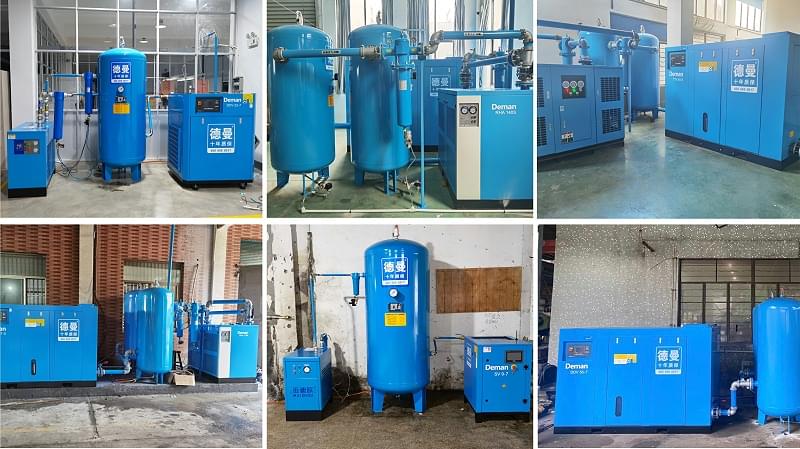
Deman Service Commitment
Deman supplies both air-cooled and water-cooled compressor options. Our professional engineers customize optimal cooling schemes based on your site environment, air consumption demand, budget and maintenance conditions to guarantee long-term stable, high-efficiency and energy-saving compressor operation.