










9 Key Details of Air Compressor Room Management
No matter how high-performance and energy-saving an air compressor is, insufficient room conditions and poor management will reduce operational efficiency and service life significantly. Deman reminds users to follow these nine details during site selection, installation and operation, so as to maximize equipment efficiency and extend service life.
- Choose Spacious and Well-lit Location
Sufficient space shall be reserved for operation, maintenance and repair with adequate lighting. Dim light hinders daily inspection and brings potential safety hazards during maintenance.
Recommendation: Keep a clearance of no less than 1 meter around the equipment for personnel access and spare parts handling.
- Flat and Hard Floor Required
Cement or epoxy flooring is recommended to ensure flatness, hardness and dust resistance. Keep the floor tidy without sundries stacking. Flammable and explosive articles such as oil drums and solvents are strictly forbidden to pile up randomly.
Safety requirement: Equip fire extinguishers and inspect validity regularly.
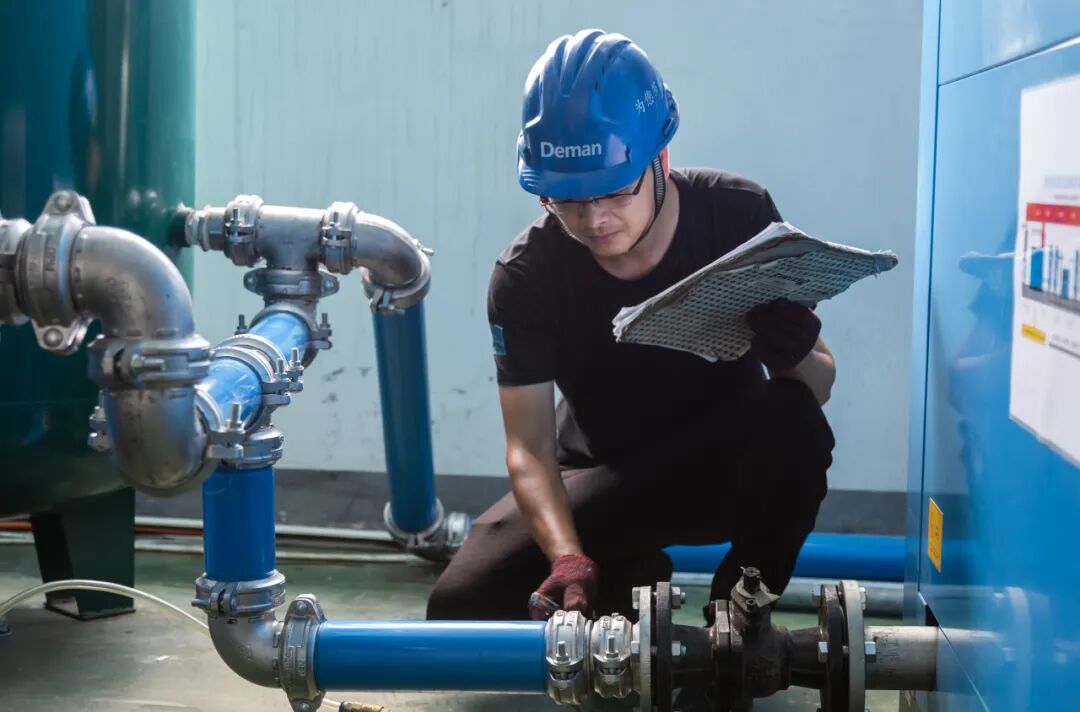
- Keep Clear Distance from Walls
Placing compressors tightly against walls to save space is improper. Proper clearance is mandatory for ventilation and heat dissipation without blocking air inlets and outlets, as well as convenient door opening and component disassembly.
Recommendation: Maintain a wall clearance of over 1 meter, subject to official equipment manuals.
- Maintain Proper Ambient Temperature
The room temperature shall be controlled between 0℃ and 35℃. Long-term inhalation of high-temperature air will raise exhaust temperature, lower air output and accelerate lubricant deterioration. Exhaust fans or air conditioners can be installed in summer to keep temperature steady.
- Ensure Dry, Clean and Ventilated Environment
Locate the compressor room in dry, well-ventilated and low-dust areas. Avoid environments with heavy dust, oil mist, high humidity, corrosive gas, paint vapor and unstable chemical steam, which damage internal parts and threaten operator safety.
- Operators Shall Master Operation Manual
Operation shall not rely solely on experience. Staff must get familiar with manuals before taking post. Stop the machine immediately and contact after-sales service once abnormal noise, alarms or performance degradation occur.
Conduct regular maintenance including filter and lubricant replacement and component inspection to keep optimal operating status.
- Avoid Collision on Pressure Pipes
Hoses, hard pipes and joints are forbidden to collide, be trodden on or hung with heavy loads. Disassembly and repair under live and pressurized state are prohibited to prevent high-pressure air ejection injuries.
Inspect pipelines visually for damage and looseness before startup each time.
- Equip Compressed Air Purification Devices
Raw compressed air contains moisture and oil impurities, which cause pipeline rust, valve jamming, pneumatic component damage and defective products. Untreated air is unfit for breathing and food contact.
Recommendation: Install refrigerated dryers, adsorption dryers and precision filters according to actual air consumption demands.
- Entrust Maintenance and Repair to Professional Teams
Air compressors adopt sophisticated internal structures despite robust appearance. Procurement of equipment, special oil and spare parts, together with routine maintenance and troubleshooting, shall be undertaken by reputable professional companies.
Non-original or inferior oil causes carbon deposition, coking and even main unit locking. Unprofessional repair may aggravate minor faults and bring hidden risks.
These trivial but crucial management norms are summarized from numerous faults and accidents. Standardized management guarantees efficient operation and stable service for over a decade.
Feel free to contact Deman for any consultation on compressor room planning and daily management.