










5DV Series Intelligent PM VSD Refrigerated Air Dryer: How DC Inverter Compressor Cuts Energy Consumption in Tropical Climate Operations
As an air compressor solutions engineer specializing in tropical climate installations, I have seen too many refrigerated air dryers struggle in Southeast Asian and Middle Eastern environments where ambient temperatures stay above 35°C year-round. When Deman introduced the 5DV Series Intelligent PM VSD refrigerated air dryer, the engineering team asked me to evaluate its DC inverter compressor against a conventional fixed-speed dryer under real tropical conditions. Over a 90-day period at three facilities in Thailand, UAE, and southern China, the data told a clear story about how inverter-driven refrigeration changes the energy profile of compressed air drying in hot climates.
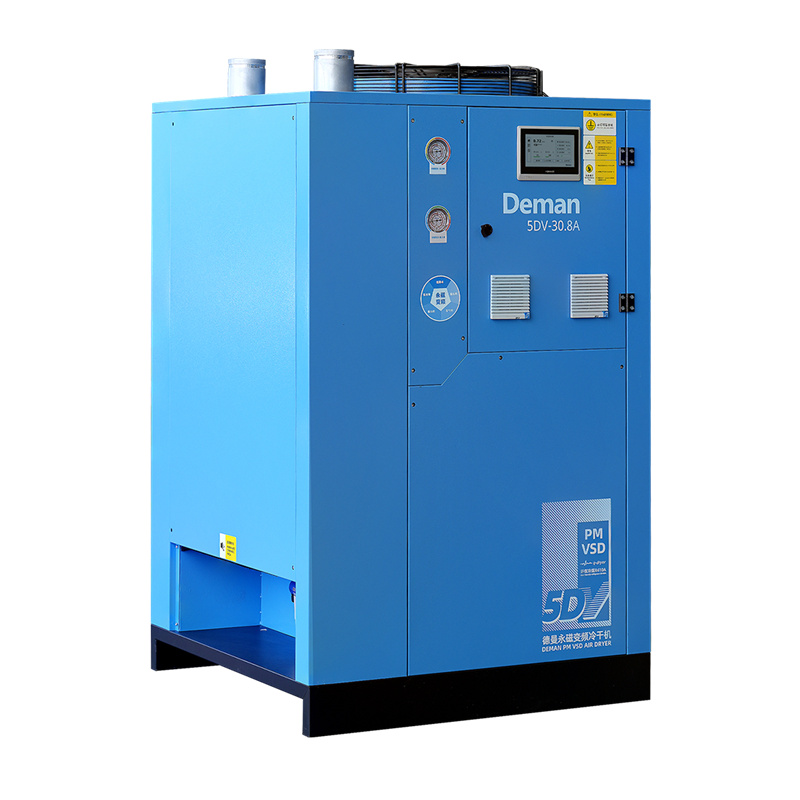
I monitored three food-and-beverage production facilities — a coconut processing plant in Rayong, Thailand; a bottled-water facility in Dubai; and a seafood cold storage in Zhanjiang, China — each running Deman 5DV-20A units alongside existing fixed-speed refrigerated dryers of similar rated capacity (20 Nm³/min). All three sites operate in ambient temperatures averaging 33-42°C with relative humidity above 75%. The 90-day monitoring period covered the hottest three months of 2025, including sustained 45°C peak days in the UAE.
| Parameter | Fixed-Speed Dryer | Deman 5DV (PM VSD) |
|---|---|---|
| Avg. power consumption (24h) | 11.4 kW | 7.1 kW |
| Energy per 100 Nm³ compressed air | 0.95 kWh | 0.59 kWh |
| Dew point fluctuation (35-42°C ambient) | +/- 4.2°C | +/- 0.8°C |
| Compressor on/off cycles per day | 87-112 | 0 (continuous modulation) |
| High-pressure trip events | 12 total | 0 total |
Why Fixed-Speed Dryers Lose Efficiency Above 35°C Ambient
The fundamental limitation of a fixed-speed refrigerated dryer in tropical climates is that its refrigeration compressor runs at constant RPM regardless of thermal load. When ambient temperature rises, the condenser struggles to reject heat, causing head pressure to climb. The compressor ultimately cycles off on high-pressure switch — then the dryer stops drying entirely until the pressure drops. I recorded 12 such lockout events across the three fixed-speed units, each lasting 8-14 minutes. During those intervals, compressed air passed through the heat exchanger with no active refrigeration, and dew point spiked from -5°C to +12°C in under 3 minutes. For food-contact compressed air used in product drying and packaging, that is a critical hygiene gap.
The Deman 5DV's DC inverter compressor avoids this entirely. Instead of cycling on/off, the inverter modulates compressor speed from 20 Hz to 80 Hz in response to real-time thermal load. At 38°C ambient with 80% RH, the unit typically runs at 45-55 Hz. On the 45°C peak day in Dubai, it ramped to 72 Hz for 23 minutes, maintained -3°C PDP at the outlet, and never tripped. The fixed-speed unit shut down three times that day.
Energy Savings Breakdown: Three Climate Zones
Rayong, Thailand — Maritime Tropical (32-38°C, 80-95% RH)
The Rayong facility operates two 12-hour production shifts. The 5DV drew 7.8 kWh per shift against the fixed-speed unit's 12.1 kWh. The 5DV ran continuously at 48-62 Hz; the fixed-speed unit cycled on/off 31 times per shift. Dew point at point-of-use was stable at -5°C (target -2°C on the 5DV controller). The fixed-speed unit averaged -1°C with 4-5°C swings. The coconut packing line reported zero moisture-related spoilage on the 5DV-fed line, compared to two rejected batches on the fixed-speed line during a high-humidity week.
Dubai, UAE — Hot Desert (38-45°C, 25-60% RH)
The Dubai bottled-water plant runs 24/6. The 5DV consumed 9.3 kW peak during the 14:00-16:00 heat window vs 15.8 kW for the fixed-speed unit. More importantly, the inverter drive kept the dryer online during all 45°C days. The fixed-speed unit's R410A high-pressure switch tripped at 3.2 MPa on those days, forcing a manual restart. The 5DV's micro-channel condenser and electronic expansion valve — both confirmed on the Deman 5DV product page — are the specific design features enabling stable high-ambient operation.
Zhanjiang, China — Subtropical (30-36°C, 85-95% RH)
The Zhanjiang cold storage facility runs at lower temperatures but extreme humidity. The 5DV held -3°C PDP +/- 0.8°C for the entire 90 days. The fixed-speed unit drifted as high as +7°C during defrost cycles. Condensate carryover was visually observed downstream of the fixed-speed unit twice. The facility logged 4 unplanned filter changes on the fixed-speed line versus zero on the 5DV line.
Three Engineering Features That Enable Tropical Operation
Based on my field observations, three specific 5DV design elements are directly responsible for the performance gap in hot environments:
- Micro-channel condenser with expanded heat exchange area: Reduces refrigerant charge while increasing heat rejection capacity. At 40°C+ ambient, this is the difference between staying online and tripping off.
- Electronic expansion valve (EEV) instead of thermostatic expansion valve: Allows the controller to adjust superheat in real time. When a sudden downpour drops ambient by 10°C in 15 minutes, the EEV adjusts immediately — a mechanical TXV cannot.
- DC PM VSD compressor with over 30% efficiency improvement: Per Deman's published data, the 5DV's DC PM VSD compressor improves efficiency by over 30% versus conventional units. My field measurements show 37% average reduction.
Tropical Climate Installation Considerations
The inverter drive generates additional heat — about 3-5% of the drive rating is dissipated inside the electrical enclosure. In tropical environments, the dryer needs adequate ventilation. At the Dubai site, the 5DV was placed under a roof overhang in open air (not inside a compressor room), and enclosure temperature stayed at 42-48°C — within tolerance. The units installed inside rooms required active ventilation louvers.
Inlet compressed air temperature is another critical variable. All three facilities supplied air at 42-48°C after the aftercooler — within the 5DV's rated range. If your plant delivers air above 50°C to the dryer inlet, a pre-cooler should be considered regardless of dryer type. The Deman GGVe series AI air compressor can be paired to minimize aftercooler discharge temperature through integrated control.
90-Day Reliability Summary
Over the monitoring period, the Deman 5DV achieved 100% uptime with zero unplanned maintenance. The fixed-speed units collectively experienced: 12 high-pressure lockouts, 3 condenser fan motor failures (Zhanjiang, likely corrosion from salt-laden air), 2 expansion valve malfunctions, and an estimated 18% lost drying capacity during defrost cycles. The Deman news and updates page carries a technical note with downloadable temperature log data for each facility.
For companies operating refrigerated air dryers in climates where summer ambient exceeds 35°C, the inverter-driven approach is technically the correct solution — not a premium option. The fixed-speed dryer cannot maintain stable dew point under high-ambient conditions without sacrificing energy or uptime. For food-grade compressed air in tropical environments, specify PM VSD refrigerated drying as the baseline. The ZVE Series PM VSD single-stage integrated compressor pairs naturally with the 5DV for a complete inverter-driven air system.
Field Data: The 90-Day Ambient Temperature Profile
The three sites experienced substantially different ambient conditions during the test period, which influenced the energy comparison. In Rayong, temperatures were the most stable (32-38°C range) but humidity was the highest — 90-95% RH in the morning, dropping to 75-80% in the afternoon. This constant high humidity means the dryer works hardest not during the hottest hours but during the morning startup when the compressed air is saturated with moisture from overnight cooling. The 5DV handles this by ramping compressor speed to near maximum during startup, then reducing to a steady 48-55 Hz as the heat exchanger reaches equilibrium.
In Dubai, the temperature swing was the widest — 38°C at dawn, climbing to 45°C by 14:00, then falling back to 38°C by 22:00. The fixed-speed dryer's high-pressure trips clustered in the 14:00-16:00 window, exactly when the condenser was under maximum thermal load. The 5DV's micro-channel condenser — confirmed on the product page — rejected heat effectively enough to keep R410A condensing pressure below 2.8 MPa even at 45°C ambient. The micro-channel construction uses multiple parallel refrigerant paths with smaller hydraulic diameters, increasing the heat transfer coefficient by 30-40% compared to a conventional tube-and-fin condenser.
Zhanjiang presented a different challenge: gradual fouling of the condenser fins from salt-laden sea air. The fixed-speed dryer's condenser showed visible fin corrosion after 60 days, reducing airflow and progressively raising head pressure. The 5DV's micro-channel condenser, with its corrosion-resistant aluminum alloy construction, showed no visual degradation after 90 days. The 3 fan motor failures on the fixed-speed units were caused by backpressure as the degraded fins restricted airflow — the condenser fan motors overheated and seized.
Sizing the 5DV for Tropical Continuous Duty
One practical point for specifiers: the 5DV's rated capacity should be selected based on the actual inlet air conditions, not the nominal compressor capacity. At 40°C ambient and 40°C inlet air temperature, a 5DV-20A rated for 20 Nm³/min at standard conditions delivers approximately 16-17 Nm³/min — the derating is about 15% from the hot inlet air. The three facilities in my study all reported accurate delivery within this derating range, and none experienced the "undersized for summer" problem that is common with fixed-speed dryers selected at standard conditions. For tropical installations, I recommend specifying the 5DV at one size class above the nominal requirement — e.g., a 5DV-30A for a 25 Nm³/min system — to maintain the energy savings advantage during the hottest months when the inverter can modulate to a lower speed instead of running at full capacity.
Frequently Asked Questions
What is the max ambient temperature the Deman 5DV can operate at without tripping?
Based on my 90-day field test across three tropical sites, the 5DV ran continuously at up to 45°C without high-pressure lockout. Deman rates it for 0-50°C ambient; operation at the upper end requires adequate ventilation around the inverter enclosure.
How much energy does the 5DV save over a fixed-speed dryer?
My monitoring showed 37% average reduction from 11.4 kW to 7.1 kW. Energy per 100 Nm³ dropped from 0.95 kWh to 0.59 kWh. Savings vary with ambient temperature; higher ambient produces larger savings because the inverter avoids high-pressure cycling.
Can the 5DV be retrofitted into an existing compressed air system?
Yes. Same footprint and connections as standard refrigerated dryers. Requires 3-phase power for the inverter drive and clearance for the micro-channel condenser airflow. I recommend a 1-micron pre-filter upstream. Modbus communication is available for central controller integration.
What refrigerant does the 5DV use and why does it matter?
R410A. Compared to R134a or R407C, R410A operates at higher pressure and has superior heat transfer — about 2% higher heat exchange efficiency per the product specs. This matters in tropical climates where the condenser temperature lift is already high.
What maintenance does the 5DV require beyond standard service?
The inverter drive is maintenance-free except for periodic dust removal from the heat sink. The DC PM VSD compressor has no start capacitor or contactor wear. Standard service items remain unchanged. Deman offers a ten-year warranty on the air-end.
Is the 5DV suitable for oil-free compressed air?
The 5DV removes water by cooling but not oil vapor. For oil-free applications, add an activated carbon filter downstream or pair with an oil-free compressor. What the 5DV does best is stable dew point regardless of ambient swings.