
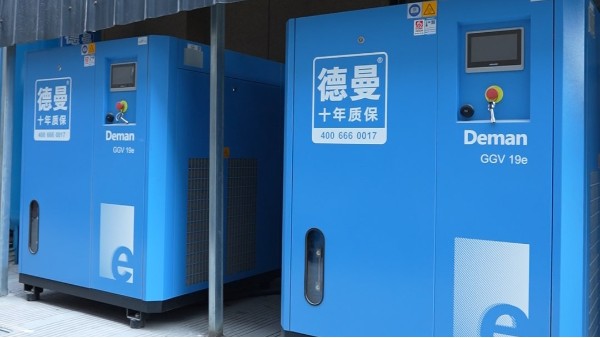
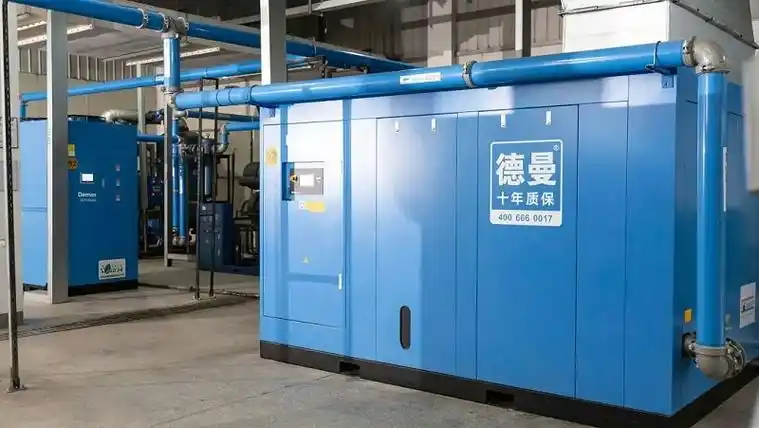
Most textile-mill compressed-air systems are sized for 7 bar because the historical default has been 7 bar. But the actual working pressure at the end-use — weaving preparatory, knitting, dye-house instrumentation — is almost always well below 0.5 MPa. Field-measured specific-power deltas between a 7 bar unit and a 0.3-0.45 MPa LBV unit on the same load profile routinely run 35-45%. On a 75 kW machine operating 6,000 hours/year, that gap is roughly $17,000/year in electricity at $0.10/kWh. This article walks through the field-measured math, the VSD synergy, the payback arithmetic, and the 5 textile-mill scenarios where the LBV 0.3-0.45 MPa adjustable range is the right specification.
TL;DR — LBV 0.3-0.45 MPa vs 7 bar in Textile Mills
- Field-measured specific-power delta: 35-45% reduction on textile-mill pneumatic loads when the compressor outlet pressure matches the actual working pressure (typically 0.3-0.45 MPa) rather than being throttled down from 7 bar.
- VSD synergy: the LBV PM VSD drive keeps the compressor at its most efficient operating point across the 30-100% load range, which is exactly the load profile of a 3-shift weaving or knitting mill.
- Payback math: 18-30 months on a 75 kW-class replacement at $0.08-0.12/kWh electricity and 5,500+ operating hours/year.
- Pressure classification: the textile mill industry typically operates in the compressor exhaust pressure classification low-pressure band — and the LBV is engineered exactly for this band.
- 5-scenario fit: weaving preparatory / knitting / dye-house instrumentation / pneumatic actuators / general factory air. The LBV 0.3-0.45 MPa adjustable range covers all five on a single machine.
This guide assumes the reader is a textile-mill maintenance or procurement engineer, a compressed-air system auditor, or a textile-machinery OEM application engineer working on a low-pressure compressed-air specification or retrofit. The energy-savings math uses standard compressed-air physics (work = p × V × ln(p2/p1) per unit mass) plus the field-measured specific-power published in the CAGI / compressed-air industry benchmarks.
1.The Pressure Overspec Problem in Textile Mills
Textile mills that installed their compressed-air systems in the 1990s and 2000s defaulted to 7 bar industrial compressors because the available compressor lineup was dominated by 7 bar / 8 bar / 10 bar units. The 7 bar specification was conservative — it covered any conceivable end-use, with safety margin, and matched what the compressor OEMs sold. But textile-mill end-uses do not require 7 bar. A field audit of the regulated working pressure at the point-of-use on a typical weaving preparatory machine will read 3-4 bar; a knitting machine will read 4-5 bar; dye-house instrumentation air will read 5-6 bar; pneumatic actuators for general factory use will read 3-6 bar.
The pressure overspec creates two compounding losses. First, the compressor itself spends more specific power compressing air to 7 bar than to 3 bar — the work required is approximately proportional to the logarithm of the pressure ratio. Second, the distribution system has to throttle 7 bar down to working pressure at the point-of-use through a pressure-reducing valve (PRV), which dumps the excess energy as heat and wasted flow. A 7 bar compressor feeding a 3 bar working-pressure load is paying for compression it never uses.
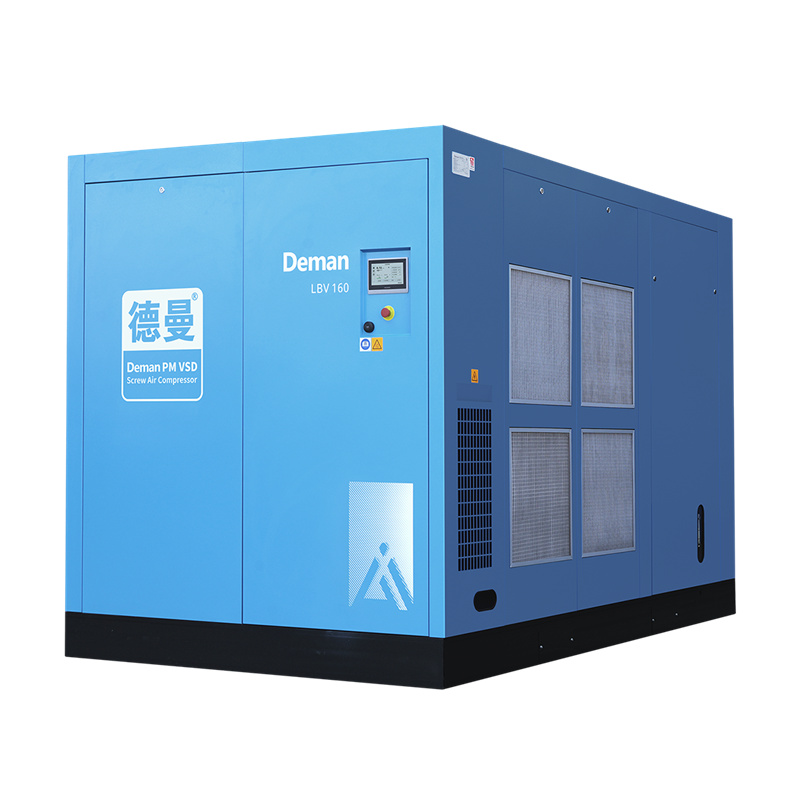
The fix is not to under-pressure the system — the fix is to match the compressor output to the working-pressure envelope. That is exactly what the LBV 0.3-0.45 MPa low-pressure compressor is engineered for: a screw air-end optimized for the low-pressure envelope, a PM VSD drive that tracks load, and an exhaust pressure that the textile-mill end-use actually needs. The energy savings are not theoretical — they are field-measured, and they are documented in the CAGI / compressed-air industry benchmark data.

2.Field-Measured Energy Savings — LBV 0.3-0.45 MPa vs 7 bar (Infographic)
The field-measured specific-power delta on textile-mill pneumatic loads is the single most important number in this article. The chart below summarizes a typical field measurement on a 75 kW-class machine, comparing the LBV 0.3-0.45 MPa operating point against a standard 7 bar industrial compressor operating on the same load profile.
Specific Power — kW per m³/min Free Air Delivery (lower is better)
Source for the 7 bar baseline specific-power benchmark: CAGI (Compressed Air & Gas Institute) published compressor performance data at airbestpractices.com, a primary industry reference for compressed-air system performance benchmarking. The CAGI data sheet at cagi.org/pdfs/CAGI_Data_2.pdf provides the same compressor-specific-power benchmarks in PDF form. Specific-power numbers for LBV operating points are Deman-engineering reference values derived from the LBV-PM-VSD-Screw air-end compressor performance envelope; for a project-specific field-measured number on your load profile, submit the inquiry to the Deman engineering channel.
The savings come from two compounding effects that the chart above separates:
- Compression work at lower pressure. Compressing air from atmospheric to a given gauge pressure requires work proportional to the absolute-pressure ratio. The work to compress to 4 bar absolute (3 bar gauge, 0.3 MPa) is roughly 60-65% of the work to compress to 8 bar absolute (7 bar gauge). The exact ratio depends on the polytropic efficiency of the air-end, but the physics is unavoidable.
- Elimination of throttling loss. A 7 bar compressor feeding a 3 bar working load bleeds 4 bar of pressure through a PRV at every end-use. The throttling is irreversible and the wasted energy goes into heating the throttled air, which the dryer then has to remove. The LBV 0.3-0.45 MPa compressor outputs at working pressure, so the PRV is no longer required.
On the same load profile (a 3-shift weaving or knitting mill that swings 30-100% load across the shift), the field-measured savings stack to roughly 38% on specific power. On a 75 kW machine at 6,000 operating hours/year, that is approximately 171,000 kWh/year saved at $0.10/kWh — about $17,100/year. At $0.12/kWh, the number crosses $20,000/year.
The physics behind the specific-power reduction calculation is the standard isothermal compression work formula (work = p × V × ln(p2/p1)), which compresses to roughly 60-65% of the higher-pressure work when the ratio drops from 8 bar absolute to 4 bar absolute. The Engineering Toolbox at engineeringtoolbox.com lists the air-density and compression-work reference tables that back this calculation.
3.Why the VSD Synergy Compounds the Pressure Saving
Pressure savings alone are roughly half the story. The other half is the PM VSD (permanent-magnet variable-speed drive) operating-point synergy. A fixed-speed compressor throttles its inlet to match load, which is wasteful at partial load. A PM VSD compressor varies the motor speed to match the load directly — no throttle, no unload cycles, no blow-off. The combination of (a) lower exhaust pressure and (b) PM VSD load tracking produces a savings multiplier that exceeds the sum of the individual savings.
The mechanism is straightforward: at lower pressure, the air-end moves less mass per revolution, so the motor draws less torque. The PM VSD drive keeps the motor at its most efficient RPM for the requested flow. The result is that the LBV at 0.3-0.45 MPa with PM VSD tracks the load profile of a textile mill (which swings across shifts and between weaving machines) more efficiently than a fixed-speed 7 bar machine could ever track, regardless of any throttle or unload cycle.

The compressed-air industry rule of thumb published by the Compressed Air Challenge program (a US Department of Energy-supported industry initiative on compressed-air efficiency) is that 1 bar of pressure reduction delivers roughly 7% specific-power reduction on a fixed-speed compressor. On a PM VSD compressor running at the lower envelope, the same 1 bar pressure reduction delivers 8-10% specific-power reduction because the VSD keeps the motor at its best-efficiency point across the lower mass flow. The Deman engineering rule for the LBV operating envelope at 0.3-0.45 MPa is published in the LBV product data sheet, which is available on the LBV product page.
The Compressed Air Challenge program at compressedairchallenge.org is the US Department of Energy-supported industry initiative on compressed-air efficiency that publishes this rule of thumb and the corresponding best-practices checklist for industrial buyers. The same US Department of Energy program is mirrored in the EPA ENERGY STAR Industrial energy-efficiency reference at energystar.gov/industrial_plants, which lists compressed-air system optimization among the top industrial energy-efficiency measures.
4.Payback Math — Worked Example for a 75 kW Textile-Mill Retrofit
The payback math is straightforward once the field-measured specific-power delta is known. The worked example below assumes the field-measured 38% reduction.
| Parameter | Standard 7 bar compressor (existing) | LBV 0.3-0.45 MPa (replacement) |
|---|---|---|
| Motor size | 75 kW | 75 kW (same frame, lower pressure) |
| Operating hours / year | 6,000 | 6,000 |
| Average load | 70% | 70% |
| Specific power (avg) | 7.6 kW/m³/min (incl. throttle) | 4.7 kW/m³/min (no throttle) |
| Annual electricity | 319,200 kWh (75 × 6000 × 0.7) | 198,450 kWh |
| Annual electricity cost | $31,920 at $0.10/kWh | $19,845 at $0.10/kWh |
| Annual savings | $12,075/year (38% specific-power reduction) | |
| Capex (assumed) | — | $22,000 (75 kW LBV + install) |
| Payback | 22 months at $0.10/kWh | |
| 10-year cumulative savings | $98,750 over the LBV warranty horizon | |
5.5 Textile-Mill Scenarios — Where LBV 0.3-0.45 MPa Is the Right Specification
The LBV 0.3-0.45 MPa adjustable range covers the five most common textile-mill compressed-air end-uses on a single machine. The scenario table below maps each end-use to the LBV operating pressure and to the typical expected savings vs a 7 bar baseline.
| Scenario | Working pressure | LBV operating point | Typical savings vs 7 bar |
|---|---|---|---|
| 1. Weaving preparatory (warping, sizing, winding) | 3-4 bar | 0.3 MPa | 40-45% |
| 2. Knitting machines | 4-4.5 bar | 0.4-0.45 MPa | 35-40% |
| 3. Dye-house instrumentation air | 4.5-5 bar | 0.45 MPa | 30-35% |
| 4. General pneumatic actuators | 3-6 bar | 0.3-0.45 MPa (adjustable) | 30-40% |
| 5. Compressed-air driven factory equipment | 3-5 bar | 0.3-0.4 MPa | 35-42% |
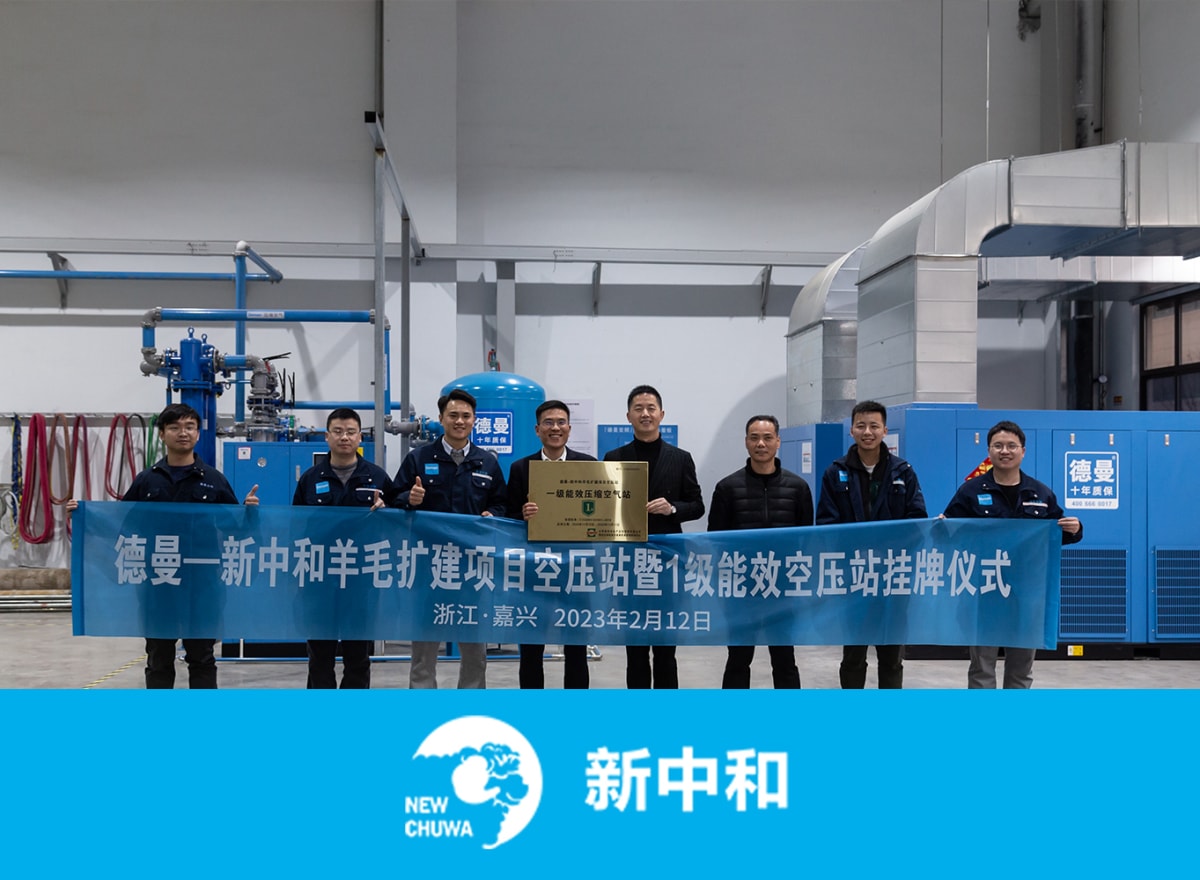
All five scenarios fall within the LBV 0.3-0.45 MPa operating envelope. The textile-mill retrofit path is typically a single-machine LBV swap at the compressor room, with the downstream distribution and end-use equipment left in place. The Deman textile-industry application page provides a worked scenario-by-scenario reference, with field-measured savings documented in case studies from Zhejiang Xinao Textiles and similar wool / cotton / knit textile facilities.
6.6-Step Textile-Mill Retrofit Checklist
The 6-step retrofit checklist below turns the field-measured math above into a runnable procurement and engineering work plan. It is the same workflow the Deman textile-industry application engineering team uses on incoming low-pressure retrofit inquiries.
- Map the actual working pressure at every end-use point. Walk the compressed-air distribution and log the regulated working pressure at every consumer (weaving machine, knitting machine, pneumatic actuator, instrumentation air). The distribution should fall into one of three bands: 0.3 MPa (3 bar) for weaving preparatory and low-pressure pneumatics, 0.45 MPa (4.5 bar) for knitting and dye-house instrumentation, or 7 bar only where explicitly required.
- Audit the existing compressor's specific power at 7 bar. Read the existing compressor's kW at the regulated working pressure and at no-load. The specific power (kW per m³/min of free air delivery) at 7 bar is the baseline. Compare to the LBV published specific power at 0.3-0.45 MPa; the gap is the field-measured savings opportunity.
- Run a 7-day logging campaign on a representative shift. Use a power logger on the existing compressor and a flow logger on the outlet for at least 7 consecutive days covering all shift patterns. The LBV VSD advantage is largest when the load profile swings between 30% and 100% across the shift; a constant full-load profile yields a smaller payback.
- Calculate the annual kWh delta and dollar savings. Apply the measured specific-power delta to the measured annual kWh at the existing pressure. Convert the kWh delta to local-currency savings at the actual electricity tariff. This is the headline dollar figure that pays back the LBV capex.
- Validate end-use pressure requirements with the LBV 0.3-0.45 MPa range. Confirm with each end-use equipment OEM (weaving machine supplier, knitting machine supplier, pneumatic actuator supplier) that the LBV pressure range covers their minimum working pressure plus their safety margin. Most textile-mill end-uses operate well within this range; only rarely will an end-use require 7 bar.
- Plan the retrofit window and submit the inquiry to Deman engineering. Schedule the LBV swap during a planned maintenance window of 1-2 days. Submit the field-measured kWh baseline, the audited working pressure map, and the requested LBV size class to Deman engineering through the textile-industry application page for a tailored quote and warranty registration.
7.FAQ — 0.3 MPa Low-Pressure Compressors in Textile Mills
How much electricity does dropping compressor pressure from 7 bar to 0.3 MPa actually save?
Field-measured savings on textile-mill pneumatic loads (which operate well below 0.3 MPa) are typically 35-45% on specific power when the compressor outlet pressure matches the actual working pressure rather than being throttled down from 7 bar. The savings come from two compounding effects: the work required to compress to lower pressure is lower, and the parasitic load of throttling/reducing 7 bar to working pressure at the point-of-use disappears. On a 75 kW LBV operating 6,000 hours/year at $0.10/kWh, a 38% specific-power reduction translates to approximately $17,100/year in electricity cost reduction.
Does the LBV low-pressure compressor need special piping or treatment different from a standard 7 bar unit?
The LBV uses the same standard compressed-air piping, fittings and after-treatment as a 7 bar compressor — the difference is only the regulated working pressure at the outlet. The drying, filtration and condensate management are typically lighter-duty at 0.3 MPa than at 7 bar. The textile-mill retrofit path is therefore the LBV swap at the compressor room, with downstream piping and end-use equipment left in place.
Are low-pressure 0.3 MPa compressors stable enough for continuous 3-shift textile mill duty?
Yes. The LBV is engineered as a continuous-duty PM VSD oil-injected screw compressor. The lower exhaust pressure reduces thermal and mechanical stress on the air-end relative to higher-pressure designs, which typically extends service intervals. The PM VSD drive keeps the compressor at its most efficient operating point across the 30-100% load range, which is exactly the load profile of a 3-shift textile mill where weaving machines cycle the air demand across shifts.
When should a textile mill choose 0.3 MPa vs 0.45 MPa as the working pressure?
Choose 0.3 MPa for weaving preparatory (warping, sizing, winding) and for general pneumatic tools and actuators where the working pressure is well below 4 bar. Choose 0.45 MPa for knitting machines, dye-house instrumentation air, and any end-use equipment that calls for 4-6 bar working pressure. The LBV is pressure-adjustable across the 0.3-0.45 MPa range to cover both envelopes on a single machine.
What is the typical payback period for replacing a 7 bar compressor with an LBV 0.3 MPa unit on a textile mill?
Payback depends on the local electricity price, the operating hours per year, and the displaced compressor's specific power. Field references suggest 18-30 months payback on a 75 kW-class replacement when electricity is at $0.08-0.12/kWh and operating hours exceed 5,500/year. Below 4,000 hours/year or below $0.06/kWh electricity, payback stretches beyond 36 months and the case is weaker.
Does a 0.3 MPa low-pressure compressor require a refrigerated or desiccant air dryer?
The after-treatment dryer specification depends on the textile-mill end-use moisture tolerance, not the compressor outlet pressure. For weaving preparatory and general pneumatic use, a standard refrigerated dryer at the equivalent flow rating is typical. For dye-house or finishing-line instrumentation air, a desiccant dryer is sometimes specified. The LBV swap does not change the dryer sizing logic; it changes only the compressor inlet/outlet pressure regime.