Leave Your Message
Picking out a Large Air Compressor isn’t just about buying some equipment — it’s a big decision that can impact your whole operation. Think about it: it affects your energy costs, the quality of your products, how much time you spend on maintenance, and your future capacity plans. Sometimes, a machine that looks super efficient on paper ends up performing pretty poorly in real-world conditions — like in a dusty workshop, a hot factory, or a plant with crazy pressure swings.
According to the U.S. Department of Energy, compressed air can make up around 10% to 15% of all industrial electricity use. They also point out that if your system isn’t maintained properly, you might be losing 20% to 30% of your compressor’s output just through leaks. That might sound vague, but picture this: a compressor keeps running after a night shift, feeding air into a cracked hose sitting next to an idle packaging line — and the meter’s still spinning. That’s waste, plain and simple.
Ron Marshall, a well-known expert in compressed-air systems, often says, “Compressed air is not free.” It’s a good reminder when shopping around at brands like Atlas Copco, Ingersoll Rand, Kaeser Compressors, and others. The key is choosing the right large air compressor that actually matches your needs — like flow demand, operating pressure, duty cycle, air quality, ambient temperatures, and future expansion plans. More power doesn’t always mean better — sometimes it just means you’re throwing money away.
The advice from the Department of Energy and the Compressed Air and Gas Institute is pretty straightforward: don’t just pick a machine based on horsepower. Do a proper demand audit first. Find those leaks. Measure the pressure at the point where you really need it. Think about seasonal changes too. Your factory might need a variable-speed compressor, a fixed-speed one, or maybe a whole setup that involves sequencing multiple units. Honestly, there’s rarely a clear-cut answer. Even seasoned pros can overestimate peak needs or underestimate maintenance costs. This guide is here to help you navigate those choices — using practical criteria, trustworthy data, and leaving room for honest reassessment as you go.
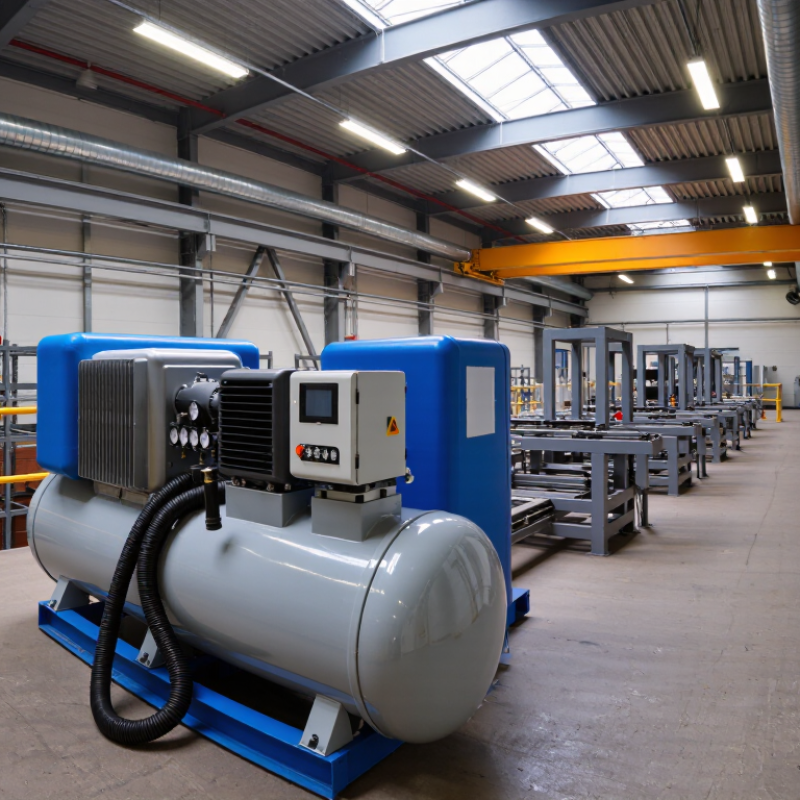
Choosing a Large Screw Air Compressor starts with measuring compressed air demand, not guessing motor size. Record flow in cubic feet per minute, operating pressure, shift patterns, and peak events such as tool starts or valve cycling. The U.S. Department of Energy reports that compressed air may consume about 10% of industrial electricity. It also notes that leakage can waste 20–30% of compressor output. These figures make demand measurement financially important.
Use a data logger for several production days. Compare base load, peak load, and idle periods. A compressor sized only for the highest moment may run inefficiently for most of the day. A unit sized too closely may struggle during expansion. The Compressed Air Challenge recommends reviewing pressure drop, storage capacity, controls, and leaks as a complete system. Air quality matters too. Food, electronics, and machining operations may need different filtration and drying levels. A perfect forecast is impossible. The first estimate is rarely perfect.
Tips: Test leaks after each shift. Measure pressure at the farthest machine. Keep a 10–20% planning margin, but verify it with real production data. Select the Large Screw Air Compressor by delivered free air, not horsepower alone. Recheck demand after six months; production habits often change quietly.
| Requirement Dimension | What to Define | Representative Business Requirement | Planning Guidance |
|---|---|---|---|
| 1. Determine the Required Air Demand | |||
| Application area | Identify every machine, production line, and pneumatic tool that will use compressed air. | Machining, packaging, pneumatic tools, cleaning, and instrument air. | List each air consumer separately instead of sizing the compressor from the largest single machine only. |
| Estimated air demand by application | Measure or obtain the normal and peak flow for each application. |
Machining: 25–40 Nm³/min Packaging: 8–15 Nm³/min Pneumatic tools: 10–20 Nm³/min Cleaning and blow-off: 5–12 Nm³/min Instrument air: 2–5 Nm³/min |
These are representative planning ranges. Replace them with measured demand or equipment data before final selection. |
| Total connected demand | Add the maximum flow of all connected consumers. | Approximate connected range: 50–92 Nm³/min | Use the same reference conditions for every flow value, such as normal cubic metres per minute or standard cubic feet per minute. |
| Diversity or utilisation factor | Estimate how many air-consuming devices operate simultaneously. | Typical planning factor: 70–85% of connected peak demand. | For a 50–92 Nm³/min connected load, the diversified demand is approximately 35–78 Nm³/min. |
| Future expansion allowance | Include planned production increases, additional equipment, or longer operating hours. | Recommended allowance: 15–25% above the calculated current demand. | Avoid using future capacity to compensate for inaccurate demand estimates or system leaks. |
| Illustrative design flow | Combine diversified demand with the expansion allowance. | Approximately 40–95 Nm³/min, depending on the actual operating profile. | Final compressor capacity should be based on measured peak demand, required pressure, and the control strategy. |
| 2. Define Pressure Requirements | |||
| Required point-of-use pressure | Determine the minimum pressure required by the most demanding application. | Common factory pneumatic equipment: 6–7 bar(g). | Check the minimum pressure stated by each machine manufacturer. Do not increase pressure without a documented need. |
| Distribution pressure loss | Allow for pressure loss through piping, filters, dryers, valves, and hose connections. | Typical design allowance: 0.3–0.7 bar. | Long pipe runs, undersized piping, clogged filters, and excessive fittings can increase pressure loss. |
| Compressor discharge pressure | Set the compressor pressure high enough to deliver the required pressure at the point of use. | For a 6–7 bar(g) application, a discharge setting around 7.5–8.0 bar(g) may be suitable after system verification. | Every additional 1 bar of operating pressure can increase compressor energy consumption by roughly 6–8%, depending on the compressor and operating conditions. |
| 3. Define Air Quality Requirements | |||
| Oil and particle control | Identify whether the air contacts products, packaging, instruments, or people. | General manufacturing: filtered compressed air. Sensitive processes: lower oil, particle, and moisture levels. | Use filtration, separation, and monitoring appropriate to the process risk and applicable air-quality specification. |
| Moisture requirement | Specify the required pressure dew point. |
General plant air: approximately +3°C pressure dew point with a refrigerated dryer. Low-temperature or critical processes: approximately −20°C to −40°C with an adsorption dryer. |
The correct dew point depends on ambient temperature, outdoor piping, process sensitivity, and the risk of condensation. |
| Air-quality classification | Define limits for particles, water, and oil. | Use the applicable ISO 8573-1 class for each application rather than applying one unnecessarily strict class to the entire plant. | Different production areas may require different treatment levels and dedicated filtration stages. |
| 4. Match the Compressor to the Operating Profile | |||
| Operating hours | Record daily, weekly, and seasonal operating schedules. | Example: 2 shifts per day, 16 hours per day, 6 days per week. | High annual operating hours make energy efficiency, maintenance access, and part-load performance especially important. |
| Load profile | Determine whether demand is constant, variable, or dominated by short peaks. | Example: 45 Nm³/min base load with peaks up to 75 Nm³/min during simultaneous machine startup. | Use variable-speed control or multiple compressors when demand changes significantly during the day. |
| Compressor arrangement | Choose the number of operating and standby units. | For a large installation, multiple units such as 2 operating plus 1 standby can improve flexibility and availability. | Multiple smaller units can provide better turndown and maintenance continuity than one oversized compressor. |
| Duty cycle | Confirm whether the compressor will operate continuously or intermittently. | Continuous industrial production generally requires a compressor designed for continuous-duty operation. | Check the rated duty cycle, cooling requirements, ambient limits, and service intervals. |
| 5. Size Storage and System Infrastructure | |||
| Air receiver capacity | Use storage to handle short peaks, stabilise pressure, and reduce unnecessary compressor cycling. | Preliminary plant-air storage range: approximately 5–10 litres per Nm³/min of compressor capacity. | For a 60 Nm³/min system, a preliminary receiver range may be 300–600 litres, subject to control method and peak duration. |
| Pipework capacity | Size the main header and branches to limit velocity and pressure drop. | Design the ring main and branches for future flow, not only the present compressor output. | Large systems commonly benefit from a closed-loop distribution header and correctly sized drops. |
| Condensate management | Provide automatic drains, separators, and compliant condensate treatment. | Install drains at receivers, filters, dryers, and low points in the distribution system. | Drain discharge must comply with local environmental and wastewater requirements. |
| 6. Check Practical Selection Criteria | |||
| Electrical supply | Confirm available voltage, frequency, phase, starting current, and transformer capacity. | Large compressors commonly require a three-phase industrial electrical supply. | Verify motor starting method, maximum demand, power-factor requirements, and compatibility with backup generation. |
| Installation environment | Assess ambient temperature, dust, humidity, ventilation, and available floor space. | Provide adequate ventilation and maintain clear service access around the equipment. | High ambient temperatures and contaminated intake air can reduce performance and shorten component life. |
| Energy-efficiency target | Compare specific power, part-load performance, heat recovery potential, and total cost of ownership. | Evaluate energy use in kW per Nm³/min across the expected operating range. | Purchase price alone does not represent the lifetime cost of a large compressor system. |
| Noise and workplace requirements | Determine acceptable sound levels and whether the compressor room is adjacent to occupied areas. | Use enclosure, acoustic treatment, and remote installation where necessary. | Follow local occupational noise regulations and provide appropriate hearing protection when required. |
| Reliability and maintenance | Define acceptable downtime, service access, spare-parts availability, and response time. | Critical production may require standby capacity and remote monitoring. | Document preventive maintenance intervals and provide isolation points for safe servicing. |
Start with measured airflow, pressure, and operating hours. Do not choose by motor size alone. Real demand matters.
Rotary screw compressors usually provide steady airflow for long operating hours. Reciprocating units suit intermittent, high-pressure work. Centrifugal units need stable, high-volume demand.
List every tool, actuator, and process. Record each device’s air consumption in SCFM. Add usage factors, leakage, and future expansion.
Eight tools using 35 SCFM each at 50% simultaneity require 140 SCFM. Add 20% for leaks and 10% for expansion. The result is about 185 SCFM.
Match pressure at the point of use. Include losses from filters, dryers, pipes, and elevation. A process needing 100 psig may require 115 psig at the outlet.
Usually, no. Higher pressure can increase energy use. Improve piping and reduce pressure drops first. More pressure is not always better.
Leaks may waste 20–30% of compressor output. Inspect fittings, hoses, drains, and connections during a quiet shift. A small hiss can become an expensive problem.
Duty cycle shows how long the compressor runs. A machine operating 45 minutes each hour has a 75% duty cycle. Peak demand still needs separate checking.
Consider a refrigerated dryer, coalescing filters, automatic drains, regulators, flexible hoses, and vibration pads. Select them according to air quality and moisture needs.
Request safety certificates, test records, electrical protection details, and pressure-vessel documents. Keep guards over moving parts. Leave clear space for cooling and maintenance.
Ask about commissioning, maintenance intervals, spare parts, training, and technician response times. Confirm filter replacement and drain inspection procedures. Support matters during downtime.
Do not trust forecasts blindly. A clean spreadsheet can still be wrong. Test the busiest production shift before approving major equipment.
Choosing the right Large Air Compressor starts with a clear understanding of your business’s compressed air requirements, including the tools, machinery, operating pressure, airflow volume, and expected duty cycle. Compare compressor types and operating principles to determine which design best suits your workload, production environment, and future expansion plans. Accurate calculations of required airflow and pressure will help prevent poor performance, unnecessary energy use, and premature equipment wear.
You should also consider the available power source, installation space, ventilation, noise levels, and accessibility for maintenance. Evaluate energy efficiency, service requirements, replacement parts, and total ownership cost rather than focusing only on the initial purchase price. Finally, confirm that the equipment meets applicable safety standards and select suitable accessories, controls, air treatment, and storage capacity. Reliable supplier support, technical guidance, installation assistance, and after-sales service can further improve system performance and long-term operating value.